Chapter 99. Doctor Who – The Krotons (1985)

Synopsis: Educated by computers, the Gonds submit their best students to join the Krotons as their favoured companions inside their machine. The students are never seen again. When the Doctor, Jamie and Zoe witness the death of a student and rescue another from a similar fate, they try to convince the Gonds that their loyalty to the Krotons is based on a terrible lie. Then Zoe takes a test on the Krotons’ teaching computer and records their highest ever score. ‘Zoegond’ is duly summoned to join the Krotons. As Jamie tries to prevent the young students from rioting, the Doctor must take the same test to accompany Zoe as a companion of the Krotons.

Chapter Titles

  • 1 A Candidate for Death
  • 2 The Rescue
  • 3 The Rebels
  • 4 The Genius
  • 5 The Companions
  • 6 The Krotons Awake
  • 7 The Militants
  • 8 The Attack
  • 9 The Second Attack
  • 10 Battle Plans
  • 11 Eelek’s Bargain
  • 12 Acid

Background: Terrance Dicks adapts Robert Holmes’s scripts for the 1968 serial. This is the first time we’ve had two second Doctor stories released in succession (and, technically, the next book makes it three!) – and it’s the only time we’ll get two Second Doctor stories published in broadcast order (not that they follow on from one another in any way).

Notes: A new description for this Doctor, who is ‘on the small side, with a thatch of untidy black hair and a gentle, rather humorous face’. When the Doctor tells Zoe that he’s not a ‘doctor of medicine’, we’re reminded by Dicks that this is a little unfair ‘since he was in fact a doctor of almost everything’. Zoe’s surname is spelled ‘Herriot’ here.

The creatures were enormous, almost twice the size of a man. They had huge barrel shaped torsos, high ridged shoulders and a solid base on which they seemed to slide like hovercraft. The massive arms ended in giant clamps. The most terrifying of all were the heads, blank, many faceted and rising to a point in a shape like that of a giant crystal.

I’m not sure anyone ever felt that the Krotons were ‘terrifying’, but it’s lovely that Terrance tries to convince us. Dicks labels the aliens ‘Commander’ and ‘Kroton two’. When Beta orders Vana to escape to the hills, she reminds Beta that she’s ‘a scientist too’, though it’s still the threat of her fainting that persuades Vana to let her stay. When Eelek confronts a Kroton in the Learning Hall, he has to fight back ‘an impulse to fall down and worship’. 

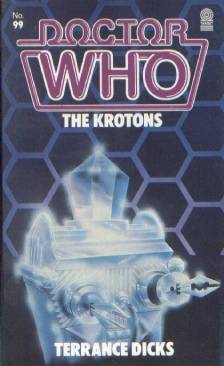
Cover: Andrew Skilleter paints a gleaming Kroton against a simple honeycomb-patterned background. The 1991 edition uses Alister Pearson’s VHS cover art, showing Jamie, Zoe and the Doctor behind a Kroton wielding its cumbersome gun.

Final Analysis: Apparently, Vana’s ‘outstanding beauty made it hard to believe that she was among the most gifted of her generation of students’. Really, Terrance? Or is this a sly dig at actress Madeleine Mills? This is an adaptation of Robert Holmes’ first script for the series and it was a bit of a rush after other scripts fell through. It lacks much of Holmes’ wit and it’s a bit of a generic SF trope really, but many fans have a lot of fondness for it as it was the first chance they got to see a Second Doctor story, thanks to the Five Faces of Doctor Who repeats. It’s worth remembering all this, as Terrance Dicks does his usual workmanlike job of pulling everything together, but he doesn’t take the opportunity to give us anything more.

Further Listening

I was a guest on the Dr Who Literature Podcast to discuss this book, which you can hear in the link below, on YouTube, or via the podcast provider of your choice.

https://podcasters.spotify.com/pod/show/doctorwholit/episodes/Episode-99—The-Krotons-with-Jim-Sangster-CORRECTED-e2e3r35/a-aaql8vq

Update March 2026: An animated comedy sketch for the Doctor Who Literature Podcast.
Chapter 98. Doctor Who – The Invasion (1985)

Synopsis: International Electromatix is a world leader in developing popular electrical devices. The head of the company is the charming and persuasive Tobias Vaughn. But Vaughn’s company is merely a front for a much grander scheme. The Doctor, Jamie and Zoe accidentally find themselves party to an investigation into Vaughn by an organisation called UNIT. Soon, friends old and new help the Doctor uncover the secret behind Vaughn and his partners, who also know the Doctor of old…

Chapter Titles

  • Prologue
  • 1. Home Sweet Home?
  • 2. Old Friends
  • 3. Cat and Mouse
  • 4. Hitching Lifts
  • 5. Skeletons and Cupboards
  • 6. Secret Weapons
  • 7. Underground Operations
  • 8. Invasion
  • 9. Counter Measures
  • 10. The Nick of Time

Background: Ian Marter adapts scripts from the 1968 serial by Kit Pedler and Derrick Sherwin.

Notes: The TARDIS pulls itself together and the Doctor’s companions reappear after the ‘disintegration of the TARDIS in their previous adventure [which] had been a horrifying experience’ [we might assume this follows on from The Mind Robber, but it could also be from some unseen adventure]. Jamie is ‘a robust young Highlander clad in faded kilt and sporran, tattered sleeveless sheepskin waistcoat and sturdy boots’, while Zoe is ‘a bright-eyed teenager with a large face, wide mouth and short black hair and she was wearing a tomboyish trouser-suit’ (not the sparkly catsuit seen on screen or the gaudy mini-skirt and stockings she picks up at Isobel’s apartment). The Doctor has ‘small hands’ apparently, and he looks like ‘an old-fashioned fairground showman’. Later, he’s said to chew the ‘frayed edge of his cravat’.

International ‘Electromatics’ becomes ‘Electromatix’ and its logo is a ‘zig-zag of lightning in the grip of a clenched glove’ rather than the letters ‘IE’ on screen. The introduction of Tobias Vaughn is extraordinarily precise:

The combination of swept-back silver hair and thick black eyebrows gave the older man a disturbing appearance. His right eye was permanently half closed, but his left gazed wide open with chilling pale blue iris and huge black pupil. His clothes were coldly elegant: a plain suit with collarless jacket, round-necked shirt and gleaming black shoes with chrome buckles.

(The detail of his half-closed eye is that of the actor, Kevin Stoney, not the character!)

When Vaughn asks ‘whom I have had the pleasure..?’ the Doctor replies, ‘Not Whom… Who…’ – the closest reminder we’ve had in a while of his proper, official, no-arguments surname. Vaughn  opens the hidden panel in his office with a control disguised as a pen. The machine behind the panel – referred to as the Cyber Unit or Cyber Module – claims to recognise the Doctor and Jamie from ‘Planet Sigma Gamma 14’. The Module is about two metres high, resembling ‘a gigantic radio valve’. 

Bristling electrodes sprouted from a revolving central crystal suspended within a delicate cage of sparking, fizzing filaments. Cathode tubes were arranged like a belt of glass ammunition around the base of the cage and the whole sparkling mechanism was supported in a lattice of shimmering wires and tubes. The planes of the crystal flickered with millions of tiny points of intense blue light and the apparatus possessed a sinister beauty as it hovered in the darkness.

The Brigadier is introduced as a ‘tall officer’ with a ‘strong square-jawed face and neatly clipped moustache suggesting calm and confident authority.’ The communications device he gives to the Doctor is a ‘Polyvox’ with a range of 100km – slightly more powerful than the onscreen ‘TM-45’, which could cover 50 miles (about 80km). He becomes increasingly irritated by the Doctor’s insistence of signing off a radio transmission with a cheery ‘Under and off” and later ‘Down and out’! Jamie writes ‘Kilroy was here’ in the dust on the top of a lift; it’s a nice reference to a bit of graffiti that Frazer Hines wrote on the lift shaft wall on TV, but it’s odd that Jamie even knows the phrase, while the Doctor doesn’t recognise it. Two of the workmen in the IE complex are named ‘Sangster and Graves’ (as far as I know, this is the only time my surname appears in a Target book, but I suspect it’s more a reference to the Hammer horror writer-director than a teenage me). Major-General Rutlidge becomes ‘Routledge’; he addresses the Brigadier as ‘Alistair’ (the Brig’s first name wasn’t revealed on screen until Planet of the Spiders).

Marter’s description of an emerging Cyberman matches that of the ones he saw as an actor in Revenge of the Cybermen:

It stood about two metres high, with a square head from which right-angled loops of hydraulic tubing protruded on either side. Its rudimentary face comprised two blank viewing lenses for eyes and a rectangular slit for a mouth. The broad chest contained a grilled ventilator unit which hissed nightmarishly. Thick flexible tubing ran along the arms and down each leg and was connected into a flattened humplike unit on the creature’s back. Faint gasping and whirring noises inside the silvery body accompanied every movement.

It’s a ‘young constable’ who follows the crazy kids down into the sewers to his death (he’s a little older on TV). Gregory is shot dead during the rescue of Professor Watkins, rather than by a rogue Cyberman in the sewers. When Vaughn dies, his screams sound like a Cyberman. There are a few name changes along the way: Watkins’ machine is called the ‘Cerebration Mentor’ (not ‘Cerebraton’); ‘Henlow Downs’ becomes ‘Henlow Flats’ (echoes of Quatermass II there); Major Branwell and Sergeant Peters become ‘Squadron Leader Branwell’ and flight lieutenant Peters; and, famously, the Russian missile base is called ‘Nykortny’ after Ian Marter’s good friend Nicholas Courtney (and I suspect the final chapter title is a tribute to him as well). The missiles target a single Cyber-mothership, rather than an entire fleet. Jamie spends two days in hospital before the time travellers depart – and the Brigadier joins Isobel and Captain Turner in waving them off.

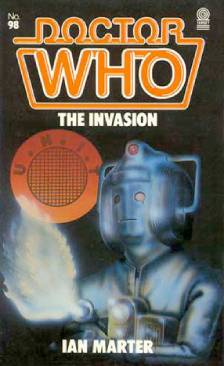
Cover: Andrew Skilleter’s original cover has a Cyberman holding a flaming gun in front of a red UNIT emblem. For the 1993 reprint, Alister Pearson paints the Doctor musing in front of two symmetrically positioned Cybermen.

Final Analysis: We reach peak Marter here, as the author goes all out with his own brand of sticky, smelly violence: Having been compelled to shoot himself, Routledge ‘vomited a stream of blood and pitched forward onto his face at Vaughn’s feet’ while the Cybermen are destroyed by the Cerebration Mentor ‘with smoke and black fluid-like pus oozing from their joints and grilles’. There’s also the return of a singular swearword, as Packer vows ‘We’ll kill the bastard this time’. On publication, this more adult approach was received with some concern, but it does at least make the stakes feel really high. Weirdly, it also makes the Cybermen feel more of a threat, even though they’re possibly even less of a physical presence here than on TV. As in Marter’s Earthshock, the horror of the Cybermen is a sensual experience, from the electric fizzing of the Module to the ‘nightmarish mechanical rasp’ of their breath, ‘rubbery’ with ‘sickly, oily exhalations’. When one of them is struck in the chest unit by an exploding grenade, ‘thick black fluid pump[s] copiously out of the severed tubes’. And, having made Packer even more violent and sadistic than his TV counterpart, it’s satisfying that he gets a particularly gruesome exit:

The Cyberman’s laser unit emitted a series of blinding flashes and Packer’s body seemed to alternate from positive to negative in the blistering discharge. His uniform erupted into flames and his exposed skin crinkled and fused like melted toffee papers. 

Chapter 97. Doctor Who – The Myth Makers (1985)

Synopsis: The beauty of a woman is the spark that fires up a bloody and lengthy war between Greece and Troy. Though many of the figures in the battle have entered into legend, a version of the story as recounted by the great poet Homer reveals the involvement of three travellers who emerged from a blue box and changed the course of the war. 

Chapter Titles

  • 1. Homer Remembers
  • 2. Zeus Ex Machina
  • 3. Hector Forgets
  • 4. Enter Odysseus
  • 5. Exit the Doctor
  • 6. A Rather High Tea
  • 7. Agamemnon Arbitrates
  • 8. An Execution is Arranged
  • 9. Temple Fugit
  • 10. The Doctor Draws a Graph
  • 11. Paris Draws the Line
  • 12. Small Prophet, Quick Return
  • 13. War Games Compulsory
  • 14. Single Combat
  • 15. Speech! Speech!
  • 16. The Trojans at Home
  • 17. Cassandra Claims a Kill
  • 18. The Ultimate Weapon
  • 19. A Council of War
  • 20. Paris Stands on Ceremony
  • 21. Dungeon Party
  • 22. Hull Low, Young Lovers
  • 23. A Victory Celebration
  • 24. Doctor in the Horse
  • 25. A Little Touch of Hubris
  • 26. Abandon Ship!
  • 27. Armageddon and After
  • Epilogue

This now nabs the record held so briefly by Marco Polo for the most number of chapters in a novelisaton, with 27 chapters and an epilogue.

Background: Donald Cotton adapts his own scripts for the 1965 serial. The book carries the dedication: ‘To Humphrey Searle, who wrote the music’ (Searle was indeed the composer of the original serial).

Notes: Yep, the story is narrated in the first person by the great author Homer, who apparently was just out of shot in every scene.

The Doctor had promised his young companions a trip to London in the 1960s. Homer claims that he has met the Doctor on many occasions (and that he is now younger than he was the first time they met), knows that the TARDIS is a time machine – and that the Doctor is specifically a ‘Time Lord’! Vicki has a very loose grasp of Earth history, much to Steven’s despair, but knows enough to recognise the importance of the Trojan Horse. Steven is concerned about his absence from the ‘Space-Research Project’, where he had been an amateur athlete during his training and it’s suggested he might have played football (he compares the prospect of fighting Odysseus with ‘the second eleven on a Saturday knock-about’, so that’s definitely football and not the completely different ‘American Football’). We discover how ‘Cyclops’ lost his eye and gained his name [but see Final Analysis below]. There’s no explanation for how Steven is wounded by the start of the next story. Instead, we learn that Vicki – as Cressida – remained with Troilus and the pair took care of their blind friend Homer. The epilogue reveals that the elderly poet has been telling his story to the Doctor, who, it turns out, has popped back to look in on Homer on many occasions throughout his eventful life.

Cover: The TARDIS materialises in front of the wooden horse, painted by Andrew Skilleter.

Final Analysis: Donald Cotton tore up the rule book for his TV stories and he revolutionises the Doctor Who novel here. Cotton’s habit of using witty episode titles continues with the novel’s chapter titles ‘Zeus Ex Machina’ ‘Temple Fugit’ and of course ‘Doctor in the Horse’, which was his original title of episode 4. He really strains with chapter 22’s ‘Hull Low, Young Lovers’; I wonder how many eager readers would know the song ‘Hello, Young Lovers’ from the 1951 musical (or 1956 film) The King and I, so might this be a reference pitched at a prospective parent reading this for a young fan a chapter a night at bedtime?

Casting Homer as the narrator gives us insight into the politics of the time, while also contriving increasingly outlandish reasons for him to be party to private conversations, ‘concealed in a clump of cactus I wasn’t too fond of’, accompanying the TARDIS into Troy and, after being jabbed in the eye and being dubbed ‘Cyclops’, he passed out and wakes up ‘covered in fish-scales and crabs’ legs’. Homer is aware that the Doctor is a time traveller too, making much merriment with details he shouldn’t know anything about:

… how do you describe a time-machine to a man who has never even heard of Euclid, never mind Einstein? Of course, up till then, I’d never heard of them myself, but I must say I found the whole concept fascinating. 

Cotton – through Homer – has a delightfully waspish style. We’re told that Cassandra is a fearsome woman who looks like ‘her brother Hector in drag’, while Achilles ‘had that look of Narcissistic petulance one so often sees on the faces of health fanatics, or on male models who pose for morally suspect sculptors’, adding ‘I believe the Greeks have a word for it nowadays’. It’s when he comes to explain the causes of the siege of Troy that we might feel certain attitudes from the mid-1980s are guiding his hand. His description of Paris appears to be a commentary on more modern Royal events that resonate just as much in 2021 as 1985:

… the second sons of Royal Houses – especially if they are handsome as the devil – have a lot of temptation to cope with. And then, the unlikelihood of their ever achieving the throne does seem to induce irresponsibility which – combined, of course, with an inflated income – how shall I put it? – well, it aggravates any amorous propensities they may have…. Well, we all know about princes and their libidinous ways: their little frolics below stairs – their engaging stagedoor haunting jaunting? 

Trigger warning here: Among many anachronistic terms Homer uses, the phrase ‘a coon’s age’, which dates from the early 19th-century and referred to racoons, but for many readers this may still have racial connotations.

As one of the missing TV historicals, it’s not a story I know that well, having only heard the soundtrack and watched a telesnap reconstruction. Cotton pulls out all the stops to bring the period alive and make it like a gossip between old friends, a tale told with tongue firmly in cheek and a knowing wink at the reader (this is especially evident in the audiobook with a delicious reading by Stephen Thorne). Even in providing us with what must be the first celebrity historical featuring an author (something modern fans might be more likely to expect), he’s smart enough to leave himself plenty of escape routes. Homer himself tells us the effect of adopting many guises to avoid being trapped into supporting one side or the other. Like the Doctor, his name lives on in legend:

I’ve always found it a very good rule to be a bit cautious about handing out the label unless unavoidable – which is why, I’m told, to this day, nobody is entirely convinced that Homer ever existed […]

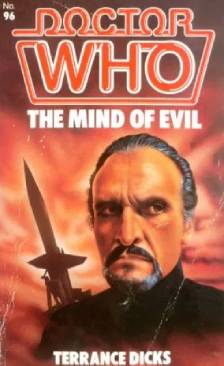
Chapter 96. Doctor Who – The Mind of Evil (1985)

Synopsis: The Doctor and Jo attend a presentation at Stangmoor Prison, where a pioneering new machine for treating violent criminals is being tested. UNIT is providing security at an international conference while also overseeing the transportation of a missile. A series of seemingly unconnected deaths at the prison and among the peace conference are further complicated by a riot breaking out at the prison. The chaos is another scheme by the Master and the Doctor has it in his power to bring it all to an end – but is the price too high even for him?

Chapter Titles

  • 1. The Sentence
  • 2. The Terror
  • 3. The Inferno
  • 4. The Listener
  • 5. The Pistol
  • 6. The Dragon
  • 7. The Hostage
  • 8. The Mutiny
  • 9. The Test
  • 10. The Mind Parasite
  • 11. Hijack
  • 12. The Escape
  • 13. The Attack
  • 14. The Reunion
  • 15. The Mind of Evil
  • 16. The Farewell

Background: Terrance Dicks adapts scripts by Don Houghton for the 1971 serial, completing Target’s run of stories from Season 8.

Notes: A few characters gain additional back-stories. The governor of Stangmore is named ‘Victor Camford’; he’s ‘a massive, heavy-featured man with dark hair and bushy eyebrows’. Professor Kettering is revealed to be completely out of his depth, adept at politics but completely ignorant of the workings of the Keller machine. He was hired personally by Emil Keller and it’s clear the eminent scientist (who is the Master of course) was exploiting Kettering’s personality flaws. Barnham ‘choked the life out of a security guard’ who disturbed him during a robbery. Harry Mailer has ‘a weathered, corrugated look, as if made of leather rather than normal skin’. A gang leader who organised a ‘highly successful’ protection racket in London, Mailer was arrested and convicted after killing someone within sight of witnesses. It’s suggested that he might have been responsible for many other murders, bodies that have never been found as they’re ’embedded in the foundations of bridges and motorways all over England’ (see also Meglos for another example of hiding bodies in motorway constructions). 

Captain Yates is ‘a thin, sensitive-looking young man, a good deal tougher than he looked’. Benton relishes the opportunity for some plain-clothes work and imagines himself as ‘James Bond’. We’re treated to the best description of him so far:

The Sergeant had many excellent qualities. He was a burly, handsome young man, a fine figure in his military uniform. He was completely fearless and utterly loyal. But he wouldn’t have been the Brigadier’s first choice for an undercover assignment. For one thing, he was just too big. Benton lurking in a doorway with his raincoat collar turned up, was about as inconspicuous as an elephant at a tea party. 

The Brigadier nods off at his desk and he dreams he is a young subaltern again, with a young lady called Doris [see Planet of the Spiders and Battlefield]. The Doctor eventually recalls that the parasite inside the machine comes from a planet from which ‘no expedition had ever returned’. As it begins an attack on the Master, the Keller Machine is said to be ‘fully aroused’.

Cover: Andrew Skilleter paints a portrait of the Master with the missile.

Final Analysis: Considering how those mid-to-late Tom Baker books saw a surfeit of Dicks, it really is a treat to find one of his books is next on the list. Terrance dominated the first 100 releases, but there are few of them left by this point. We can rejoice in this one being the second and last of Don Houghton’s scripts to be novelised, from an era where, along with producer Barry Letts, Terrance was king of Doctor Who. There’s a sense that the story is made up largely of three ‘episode two’s sandwiched between an opening and closing episode; Terrance does little to change this, but it’s enjoyable to see a few additional bits of detail that sketch in the lives of our supporting characters.

On TV, Professor Kettering reacts against the Doctor at his most obnoxious, whereas here, we find out he is completely winging it and the Doctor is (unconsciously) correct to pick apart his claims. Barnham and Mailer are both revealed to be extremely violent thugs, so the contrast between them after Barnham has been processed is even more stark – and Mailer is immediately as threatening a presence as he is on screen. A surprise and disappointment comes with the arrival of the Chinese dragon, which kills the delegate. While it provides an appropriate point to conclude a chapter, Dicks doesn’t make much of it or make any attempt to make it more dramatic than the ‘Puff the Magic Dragon’ that so failed to impress the production team as it waddled onto set. For once, he chooses just to say ‘it happened’ and move on. Whether this was down to word-count or he was just trying not to resurrect painful memories of the costume, we’ll never know.

Further Listening

I was a guest on the Dr Who Literature Podcast to discuss this book, which you can hear in the link below, on YouTube, or via the podcast provider of your choice.

Chapter 95. Doctor Who – The Awakening (1985)

Synopsis: In an English village, a historical re-enactment of the civil war begins to take a threatening tone. Some of the players are taking things far too seriously, in particular Sir George, who seems particularly driven towards making the event as accurate as possible. When Tegan Jovanka comes looking for her grandfather, she learns that he has disappeared, while the Doctor joins forces with a local schoolteacher and a time-displaced boy to uncover something terrifying in the church crypt…

Chapter Titles

  • 1. An Unexpected Aura
  • 2. The Devil in the Church
  • 3. The Body in the Barn
  • 4. Of Psychic Things
  • 5. ‘A Particularly Nasty Game’
  • 6. The Awakening
  • 7. Tegan the Queen
  • 8. Stone Monkey
  • 9. Servant of the Malus
  • 10. Fulfillment

Background: Eric Pringle adapts his own scripts from the serial broadcast in 1984, the first novel based on a two-part story since The Sontaran Experiment.

Notes: Little Hodcombe is in Dorset (everyone on TV affects that ‘just outside of London’ accent that covers anywhere from Norfolk to Cornwall). Sir George’s ancestors have governed over the region since before the civil war; Will Chandler was in service to one of them and it’s that ancestor that he sees when he pushes Sir George into the Malus. The conclusion suggests that, as he promised to Tegan, the Doctor does indeed stay in the village for a holiday.

Cover: Andrew Skilleter’s original cover is a handsome portrait of the Malus, free of its crumbling wall frame. Alister Pearson’s 1992 cover adds the Doctor and Tegan to a walled-up Malus.

Final Analysis: This is a fun one: Back when this was first published, I wrote a review for a local fanzine in which I moaned about the padding that was evident in the fact that it took ten pages just to get past the first scene. Impatient youth! So, 35 years later, Eric Pringle’s sole contribution to the range is indeed a slow build as he takes his time to describe every detail that we might have seen on screen… and that’s the issue really. Although made as a two-part story, it was commissioned as four episodes and one might have hoped for an expanded novel that featured loads of extra scenes. As it was, the reason the story was reduced in size was because there wasn’t enough to sustain 90 minutes of drama, so apparently very little incident was actually cut. There was one short scene with Kamelion in the TARDIS that was recorded but subsequently removed, but that doesn’t make it into the novel either. 

Of course, I didn’t know there was material missing in 1985 and what we have is a very thorough and accurate adaptation of the story as broadcast. Far from being padded, this novel makes good use of the increased page-count that’s been the standard since Frontios. The characterisation is strong, particularly for Will Chandler. 

Will had given up being surprised. When he had been bobbing and swinging about in the cart and feeling sure that his bones were splintering inside him, he had made up his mind that if he survived he would take everything in his stride from now on. He had discovered that when absolutely everything is extraordinary, nothing is astonishing any more. Running into a blue box, therefore, was simply another wonder to be accepted without demur, and he shrugged as he ran in through its door, as though this sort of thing happened to him every day. 

Oh why wasn’t he a companion?! There’s one thread that gives us an extra hint of Will’s backstory, as he explores the Little Hodcombe of 1984 and is appalled that the events that he remembers from 1643 – which must be just a day or so ago in his own timeline – are happening again. He even notes that this current time has a Squire Hutchinson, just as his own did. The Squire who pressed him into service and whose actions led Will to hide in the church. Come on, Big Finish, surely there’s a gap you could fill with a mini-series? The Will and Jane Adventures!

Further Listening

I was a guest on the Doctor Who Book Club Podcast to discuss this book, which you can hear in the link below, or via the podcast provider of your choice.

Chapter 94. Doctor Who – Marco Polo (1985)

Synopsis: The Venetian explorer Marco Polo meets four travellers stranded with their strange blue caravan – a box that that he immediately realises will make a splendid gift for the great Kublai Khan. On their long journey, the strangers become friends as they share stories of many cultures, but their journey is fraught with danger, not only from a hostile environment but also from within the party as a traitor schemes against them.

Chapter Titles

  • 1. Roof of the World
  • 2. Emissary of Peace
  • 3. Down to Earth
  • 4. Singing Sands
  • 5. Desert of Death
  • 6. A Tale of Hashashins
  • 7. Five Hundred Eyes
  • 8. Wall of Lies
  • 9. Too Many Kan-Chow Cooks
  • 10. Bamboozled
  • 11. Rider from Shang-Tu
  • 12. Runaway
  • 13. Road to Karakorum
  • 14. Mighty Kublai Khan
  • 15. Gambler
  • 16. Best-Laid Schemes
  • 17. Key to the World

Background: John Lucarotti adapts his own scripts for the series broadcast in 1964, so stealing the record from himself and The Aztecs for the biggest gap between broadcast and novelisation at 20 years, eight months and a week.

Notes: A new opening scene sees Susan give a temperature in centigrade and Ian calculates the fahrenheit equivalent. Ian opens the TARDIS door, then shuts it quickly (suggesting that the doors are the same as those on the exterior of the ship) and jokes that they can’t be in the Alps because there’s no yodelling. The Doctor also gives a clearer reason for staying outside of the ship (it will act like a ‘cold storage room’ and kill them). He introduces his granddaughter as ‘Susan Foreman’ (!) and both she and Ping-Cho are 15 years old (not 16 like on TV). Once again, the Doctor uses a pen torch [see The Aztecs]. Susan mentions the TARDIS ‘water producer’. Surprisingly, the device of Marco’s journal is not used; instead, some of the events he describes are expanded upon. 

Ping-Cho learns of the death of her husband-to-be as soon as she arrives at the Imperial Palace. The Empress notices exchanged glances between Ping-Cho and the Captain, Ling-Tau; she urges Kublai Khan to promote the captain so he might be of sufficient rank to be a husband to Ping-Cho. Tegana doesn’t get to commit suicide; he’s shot dead by Ling-Tau with an arrow that kills him instantly. There’s no swift escape to the TARDIS at the end either. Kublai Khan invites the Doctor to stay as his personal secretary, but he declines and says a relaxed goodbye to him, Marco and Ping-Cho before leaving in the TARDIS. Kublai Khan dubs the key to the TARDIS the ‘Key to the World’ and has it placed on a gold chain (unaware that it’s the Doctor’s spare). The Key is said to lie in a museum that was once the imperial palace.

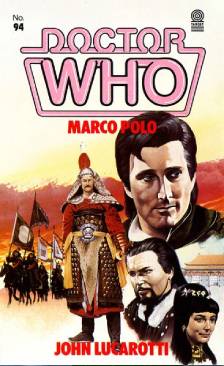
Cover: David McAllister returns with a painted composition of Marco Polo, Tegana, Pingo Cho and Kublai Khan, along with some other elements that apparently come from an entirely different production called Marco Polo from the 1980s. It’s nice to see accurate resemblences to actors Mark Eden, Zienia Merton and Derren Nesbitt here.

Final Analysis: John Lucarroti’s second novel and it’s as much of a jolly history lesson as the first, with additional highly detailed descriptions of various menus. Obviously, each of the locations is grander than the sets in Lime Grove could have allowed and also we get a real sense of the time passing, as each chapter adds days onto the journey, which lasts around 40 days in all. It might lack the fun and melodrama of monsters of robots, but it’s a rare story that truly allows us to step into a culture and enjoy various aspects of it.

Chapter 93. Doctor Who – The Caves of Androzani (1985)

Synopsis: Troops from Androzani Major are losing in a war against the android soldiers of Sharaz Jek, an arms trader who controls his operations from deep within the catacombs of the twin planet Androzani Minor. Driven by revenge, Jek has a stranglehold over the supply of spectrox, a substance that, when refined, is a much-valued elixir. In its raw state, however, it can be a deadly poison. And both the Doctor and Peri are already suffering from the effects of spectrox toxaemia. Can the Doctor hold off an impending regeneration long enough to rescue Peri and get them both to safety? 

Chapter Titles

  • 1. Androzani Minor Revisited
  • 2. Spectrox War
  • 3. The Execution
  • 4. Sharaz Jek
  • 5. The Escape
  • 6. The Magma Beast
  • 7. Spy!
  • 8. The Boss
  • 9. Crash Down
  • 10. Mud Burst
  • 11. Takeover
  • 12. Change

Background: Terrance Dicks adapts scripts by Robert Holmes for a serial broadcast eight months earlier. This followed Planet of Fire on TV, so that’s another pair of stories to be released consecutively.

Notes: Androzani Major and Minor are two of the five planets that make up the Sirius system. Peri gets her very own Terrance Dicks summary, she’s ‘an attractive American girl, her piquant features framed in short dark hair.’ She considers the Doctor’s interest in everything to be one of his ‘endearing and aggravating characteristics’, which might indicate that they’ve been together for some time, even though soon after she says that the mud of Androzani Major would make ‘a change from lava’, which would suggest this is her first trip since Sarn – or they’ve visited a lot of volcanic locations. We’re shown what happened to Trooper Boze (a scene only recounted on TV in reported speech by the android Salateen) and the reference to ‘Chacaws’ is explained; they’re a ‘fiercely-spiked fruit grown on the penal plantations of Androzani Major’, which leave the chacaw pickers covered in scars.

The Magma Beast is the recipient of this volume’s ‘let’s beef up the monster’ award:

The body resembled that of a giant tortoise, or perhaps an armadillo, though the creature stalked upright on two powerful back legs, like a Tyrannosaurus Rex. The massive fanged head was like that of a tyrannosaurus too, though it also bore two ferocious-looking horns. The powerful arms were short and stubby, ending in two enormous claws. As the monster stalked forwards, the massive carapace, at once protection and camouflage, covered the back of its body like an armoured cloak.

When the Doctor finds the beast dead, he surmises that it was caught in a mud burst and ‘either choked or boiled to death’. Sharaz Jek removes his mask to reveal ‘two mad eyes blazing from a face that was no more than a formless blob, a lump of peeling corrugated skin, devoid of all features’. He strangles Morgus until he’s dead (rather than shoving his head into the laser of one of his machines). 

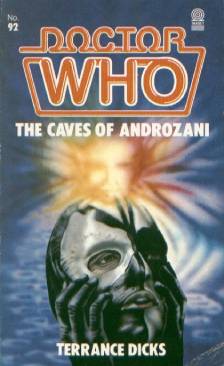
Cover: Andrew Skilleter’s cover shows Sharaz Jex clutching his mask forlornly while an explosion overhead has a blurred and very subtle approximation of the sixth Doctor’s face. A 1992 reprint uses the VHS cover, again by Skilleter, which shows the fifth Doctor, Sharaz Jek (inset), some androids and the twin Androzani planets.

Final Analysis: Terrance Dicks is back, working on his friend Robert Holmes’s most popular story – and doesn’t put a foot wrong. He adds little details to help build upon the societies Holmes created, puts in a few extra bits to bridge gaps – and unlike the omissions by Bidmead in Logopolis, he describes the onscreen visions of the Doctor’s past companions and the Master’s taunting. It’s the idea that the Master might literally get the last laugh that propels him towards choosing to survive. And so, once again, Terrance gets to describe the first moments of a new Doctor:

He had a broad, high forehead and a mop of curly light-brown hair. There was something cat-like about the eyes, a touch of arrogance in the mouth.

Chapter 92. Doctor Who – Planet of Fire (1985)

Synopsis: Peri Brown, a young American student, is rescued from drowning by Turlough. Among her belongings is a metallic object that the boy recognises as coming from his own world. The shape-changing robot Kamelion interferes with the TARDIS to take them all to a volcanic planet where a religious order revolves around a teenage boy who might be the key to Turlough’s secret past. A bewildered Peri discovers that Kamelion is being controlled by someone who knows the Doctor well, someone who calls himself ‘The Master’…

Chapter Titles

  • 1. Mayday
  • 2. Message Received
  • 3. Destination Unknown
  • 4. Crisis on Sarn
  • 5. A Very Uncivil Servant
  • 6. Outsiders
  • 7. The Misos Triangle
  • 8. An Enemy in Disguise
  • 9. In the Heart of the Volcano
  • 10. The Blue Flame
  • 11. The Time of Fire

Background: Peter Grimwade adapts his own scripts for the serial broadcast seven months earlier.

Notes: The book begins aboard the ship of Captain Antigonas struggling in a storm. The vessel is weighed down by the treasures of Dimitrios, a fat merchant from Rhodes who is more concerned with the welfare of a marble statue of a boy than for his own life (or those of the crew). He’s last seen clinging to the statue  ‘as if it were a lover’, plummeting to the depths of the ocean. The ancient ways of the doomed mariners are contrasted with the similar fate of the crew of a Trion vessel caught in the gravitational pull of Sarn. Another captain, Grulen, eagerly awaits landing on the planet as several generations of his family once lived there before the volcanoes became overactive. A sudden surge of volcanic activity causes a magnetic storm. Realising they won’t be able to guarantee a safe landing, Grulen opens the security quarters of the ship so that his prisoners might have equal chance of survival as the rest of the crew. Having faced the threat of execution daily, two of the prisoners are resigned to their deaths and as the couple cradle their sleeping child, the father’s thoughts turn to Turlough.

There’s a shuffling of scenes at the start, with all of the scenes on Sarn delayed to chapter 4, which makes a lot more sense. We join the TARDIS in the immediate aftermath of Tegan’s departure. Turlough considered the Australian ‘argumentative, tactless, interfering, brainless and with a voice that could strip paint’; he also misses her terribly and so does the Doctor. Turlough suggests a holiday, and while the Doctor isn’t enthused with the idea, remembering the chaos that ensued after a trip to Brighton, Turlough recalls a holiday with his school chum Ibbotson and his family to Weston-super-Mare – and so is determined that they should find a ‘paradise island’ instead. Kamelion’s screams force the Doctor to realise he’d forgotten all about the robot shapeshifter and notes that he had ‘none of the cheerful loyalty of K9’. His voice is like a speak-your-weight machine. Turlough suspects Kamelion of working with the Custodians on Trion and when the robot advises him to take care under the hot sun (‘with your fair skin you will easily burn’) it sounds to Turlough more like a threat than advice.

Howard Foster speculates that the mysterious metal object might be debris from a Russian satellite. His assistant is Karl, not Curt. Peri mentions a ‘Doc Corfield’ and notes that she would ‘never trust a man with a toupee!!’ Howard is 41 next birthday. He says that Peri has travelled all her life but Peri moans that it’s mainly been a succession of Hilton hotels. She has a trust fund, left to her by her (presumably deceased) father, which will be released to her when she turns 21. The English guys she hopes to go travelling with are called ‘Trevor’ and ‘Kevin’. Peri acknowledges that she’s not a strong swimmer but it’s leg cramp that causes her to come into difficulty as she heads to the shore. Incidentally, Lanzarote is not mentioned at any point in the story; the story begins with the shipwreck off the coast of North Africa (‘the headland’) so Howard’s archeological excavation might take place in Gibraltar, which has easier access to Athens. But it’s probably still Lanzarote in anything but name.

Turlough has a more physical altercation with Kamelion before disabling the robot with a bombardment of waves and dumping him in a spare room. Sarn is a city, not the name of the planet, believed to be the last surviving community after the last earthquakes and firestorms a generation ago. Turlough appears to tell the Doctor the name of his home planet, Trion, for the first time, despite having asked to go there in previous stories. The Doctor quotes Paradise Lost and admonishes Turlough for not studying Milton at school. Misunderstanding Turlough’s intentions, the Doctor calls him a ‘little racialist’: ‘As Tegan had never been slow to point out, Turlough could be a rather nasty piece of work.’ There’s a summary of the Master’s exploits that led to his predicament, during which it’s confirmed that this is his fourteenth incarnation. Turlough and Malkon find a poorly tended grave near the wreck of the Trion ship, which confirms Turlough’s suspicions that Malkon is the only survivor of the crash. The Master’s final teasing line asking the Doctor to ‘show mercy to your own-‘ is cut, as is the final scene on TV where Peri received her proper invitation to join the Doctor.

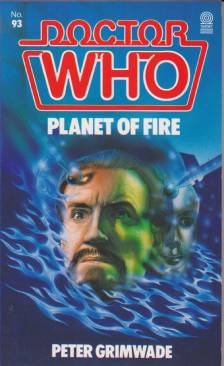
Cover: Andrew Skilleter’s illustration depicts the Master and Kamelion in waves of blue flame.

Final Analysis: An elegant adaptation here. I particularly like the way Grimwade makes sure we know when we’re with the Kamelion version of any character as he undermines the illusion in every line: ‘the duplicate professor’; ‘the man in the dark suit who everyone believed to be Professor Foster’; ‘Kamelion in the guise of the American archaeologist’; ‘The robotic Master’. He also has a nice line in similes: The Doctor’s device squeaks ‘like an old lady who has turned her hearing aid up too high’; the volcano grumbled ‘like a sleeping giant with a touch of indigestion’; the Master announces himself to Peri ‘as if he were the Tsar of all Abe Russias’; the Doctor’s party works its way through the streets of Sarn ‘like rodents navigating the secret byways of the skirting board’; the Doctor arrives at the portico ‘like a royal bride’; Kamelion glitters ‘like a Maltese tinfoil Saint at Festa Time,’ and later the robot appears ‘blustered like an actor unsure of his lines’. It’s so much fun seeing which ridiculous comparison he’ll submit next. Though what we’re supposed to make of Peri delivering ‘a sharp kick at the Master’s shins that would have repulsed a Globetrotter’, I’m not so sure.

Chapter 91. Doctor Who – Frontios (1984)

Synopsis: In the far future, the TARDIS suffers a forced landing on the planet Frontios, where the Doctor, Tegan and Turlough find a colony of humans struggling to survive against the elements and the continual bombardments from an unknown aggressor. Then there are the strange unaccountable deaths and the threat of insurrection from citizens tired of rations and restrictions. But Turlough knows the truth. A distant memory from his own people that reveals the attacks are not coming from above, but below.

Chapter Titles

  • 1. Refugees of Mankind
  • 2. The Unknown Invaders
  • 3. The Deadly Hail
  • 4. The Power of the Hat-Stand
  • 5. Downwardness
  • 6. Beneath the Rocks
  • 7. The Force Takes Hold
  • 8. Eaten by the Earth
  • 9. The Excavating Machine
  • 10. Prisoners of the Gravis
  • 11. The Price of Rescue
  • 12. Greed Sets the Trap

Background: Christopher H. Bidmead adapts his own scripts for a serial broadcast seven months earlier.

Notes: While Tegan tries in vain to read an unhelpful handbook, Turlough expresses his boredom by tying viciously tight knots into one of the Doctor’s scarves, which the Doctor later fails to unravel. There’s no follow-on from the previous story, so we’re just told that the Doctor has become ‘mysteriously reclusive’ since whatever time and place they last visited. Turlough sees a large portrait on a wall in the medical shelter and Mr Range tells him it’s of their recently deceased leader, Captain Revere (information that I’m sure will come in use later!).

When Norna describes the circumstances of the colony ship’s crash on Frontios, we’re told her grandparents died among many other casualties, but this was many years before she herself was born. Plantagenet is about the same age as Turlough with a ‘thin physique’ and a ‘head of thick, white hair’. There’s a useful paragraph that explains the scale of the crashed ship:

The propulsion chamber led them through into Causeway 8 that ran the length of the ship – a half hour’s brisk walk in the days Brazen was a boy and the ship was whole. Now most of the structure except the stern end was buckled and filled with silt, and only the part of the ship they walked in now was usable for the business of state and the storage of the precious resource reserves.

The Tractators are ‘silver creatures, each larger than a man. Their insect-like bodies were scaled like fish, and from their underbellies a pale luminescence emanated’. They have ‘two bulbous eyes on either side of the shrimp-like head’ with ‘glossy black mouths’. Their leader, the Gravis, rises up on ‘innumerable rear legs’ and he’s said to be larger than the other Tractators. As the creatures notice Norna, she experiences the sensation of them ‘threatening to drag her flesh from her bones’. Later, we’re told ‘her hair stood up on her head in spikes’… well, it was the 80s…

Norna and her father find a plaque, not a map, which tells them that Revere found no valuable minerals as of the year ‘Alpha 14404’. Brazen’s Deputy is introduced early on, accompanying him as he discovers the blue Police Box in the colony. It’s only when Mr Range faces the inquiry that we learn the Deputy is a woman. The Gravis has a translation machine and an excavation machine that utilise human body parts in very grizzly ways; the excavator is also vaguely the same shape as a Tractator. There are two colonists called ‘Kernighan’ and ‘Ritchie’, named after Brian Kernighan and Dennis Ritchie, computer scientists who literally wrote the book on the subject of the programming language ‘C’.

The Gravis claims that they know of the Doctor ‘by reputation’ and explicitly states his belief that the Doctor has been sent by the Time Lords of Gallifrey to prevent their plans (and of course, he also knows what a TARDIS is, though not what it looks like). Much more is made of the Doctor’s ruse that Tegan is an android and as she recalls how she accidentally stumbled aboard the TARDIS and how she cared for the Doctor after his regeneration, she is outraged and not quite realising what the Doctor is doing until he gives her ‘a swift, barely perceptible wink’. He later claims to need his spectacles just to buy him enough time to explain his deception to Tegan. He uses the half-frame spectacles ‘when the print was very small, or the book unusually dull’, though he tells the Gravis that they have ‘poly-directrix lenses with circular polarising filters [to] reduce spectral reflection as much as seventy-five percent, without any perceptible deterioration of resolution’, which is ‘Gallifreyan technology – like the TARDIS’. Observing the wrecked excavation machine, the Doctor utters ‘a Gallifreyan word that is said in these circumstances’.

Cockerill appears to assume the post left vacant by Brazen as Plantagenet’s second in command, taking on an official uniform, giving tasks to the survivors and tempting the Retrogrades back into the community. The final scene where the TARDIS is caught in a plot device from the next story is omitted, though it’s hinted at by the closing line: ‘More serious trouble was on the way for the Doctor, nevertheless. But that was only to be expected.’

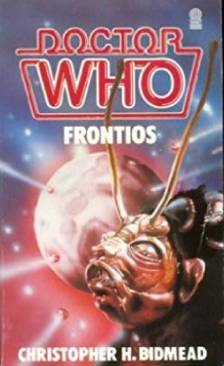
Cover: Andrew Skilleter’s illustration shows a rather dignified profile of the Gravis, with Frontios in the background during a bombardment.

Final Analysis: I’ve been gently critical of Christopher Bidmead’s arrogance leaking into his previous novels, so it’s a relief to see that aspect missing here. Instead, we get a slow-burning horror story that gives Ian Marter a serious challenge with some genuinely unsettling body horror. The Gravis’s translation device consists of ‘a tall narrow trolley that floated a foot or so above the ground… mounted on it was the head and one arm of a dead Colonist, connected by improvised metalwork to a swinging pendulum’. As it speaks, ‘its dead mouth moving to the click of the pendulum’. Then there’s ‘the machine’ – the excavator – which ‘needs a captive human mind to drive it’ and uses human hands to smooth the walls of their tunnels:

White bones tipped with metal cutters scraped against the rock, while rotting hands polished the surface smooth. Through illuminated windows in the body Tegan glimpsed more mechanically gesticulating human arms and legs in an advanced state of decay. It was a machine built from the dead.

While Marter likes his violence wet and gooey, this is more mechanical, playing on castration anxiety and the ‘vagina dentata’ folklore as much as Jaws, where the ground devours people and then the Tractators’ machines chew them up and reconstitute the parts as required. Just look at Bidmead’s description of the Doctor’s reaction here:

The Doctor was not very fond of tunnels at the best of times. They were frequently damp, dark, deep and dangerous, and as a method of transport ranked only a little higher than sitting absolutely still under water waiting for the right current. The best place to be in a tunnel was outside, and if you had to be inside, the less inside you were the better.

We don’t even need Dr Freud to explain this one, do we boys? No wonder 80s producer John Nathan-Turner kept reassuring his audience of quivering adolescents that there’d be ‘no hanky panky aboard the TARDIS’…

Chapter 90. Doctor Who – The Highlanders (1984)

Synopsis: In the aftermath of the battle of Culloden in 1745, a group of Jacobite rebels try to evade capture by the English army. The Doctor, Ben and Polly help a wounded laird but are then captured by an incompetent English officer. The Doctor adopts a fun disguise as Polly uses guile to free her new friends and escape. One young Scot in particular impresses the time-travelling trio – a piper by the name of Jamie McCrimmon.

Chapter Titles

  • 1. Where are We?
  • 2. The Cottage
  • 3. The Captives
  • 4. The Handsome Lieutenant
  • 5. Polly and Kirsty
  • 6. Polly’s Prisoner
  • 7. The Water Dungeon
  • 8. Blackmail!
  • 9. The Doctor’s New Clothes
  • 10. Aboard the Annabelle
  • 11. At the Sea Eagle
  • 12. The Little Auld Lady
  • 13. A Ducking for Ben
  • 14. Where is the Prince?
  • 15. The Fight for the Brig
  • 16. Algernon Again
  • 17. A Return to the Cottage

Background: Gerry Davis adapts the scripts he co-wrote with Elwyn Jones for the 1967 serial.

Notes: The bonhomie of TV’s Ben and Polly is replaced by something closer to the bickering of 1980s companions; Ben insists on calling Polly ‘Princess’ (not ‘Duchess’) and thinks she is ‘uppity and toffee-nosed’. He also thinks the sounds of battle drifting over the moor are just celebrations from ‘the Spurs Supporters Club’ (ahem, a reference to the er, London-based football team Tottenham Hotspurs) or a historical society. Polly resents Ben’s ‘big brother’ protectiveness, especially as she is ‘about a head taller than he was’; later, it’s confirmed she’s an ‘independent girl from the sixties’ – so her ‘seventies’ origins have been properly reset from previous Gerry Davis novels. The Doctor admits to Polly that the discovery of a cannon ball makes him afraid. There’s a dump of history at the start too, as we’re told of the battle for the British monarchy between the Scottish Stuarts and the ‘Hanoverian German Georges’. The Scots had been booted out 40 years ago and we join the story in the aftermath of the battle of Culloden Moor. As this wasn’t taught in English schools in my day, this is especially welcome and helpful.

As the Doctor inspects a tam-o’-shanter, we’re told it’s a ‘standing joke in the TARDIS that he could never resist trying on any new hat he came across’; as this is the first TV story where his hat fetish became a regular thing, this suggests the trio have had a fair few offscreen adventures since the Doctor’s regeneration. He adopts the pseudonym ‘Doctor von Verner’ (not the more obvious meta-joke ‘von Wer’ on telly). Algernon Ffinch stammers ‘in a way approved by the London dandies of the time’, which could mean it’s an affectation for fashionable purposes. The Sergeant’s name is spelled ‘Klegg’, not ‘Clegg’. While in the prison, Jamie plays a mournful tune on his bagpipes before the Doctor creates a disruption in the gaol by playing the Jacobite ‘Lillibulero’ on his recorder. The name of the pub where Solicitor Grey has installed himself is called the Sea Eagle Inn. As Jamie boots Trask overboard during the final battle, Ben tries to regain some composure as he claims he was about to use karate to save himself. There’s a more pressing reason for Jamie to join the travellers; having escorted them to the TARDIS, Jamie boasts that he’ll be fine on his own as they hear the sound of muskets being fired nearby. We then join Jamie as he sees the inside of the TARDIS for the first time (see below).

Cover: A smashing portrait by Nick Spender of Jamie, accompanied by Alexander, a Saltire flag and the TARDIS. Unusually for this period, there are likenesses of recognisable actors here!

Final Analysis: Gerry Davis returns to adapt a script that he originally oversaw to production. It was the last of the pure historicals on TV, yet it’s the second one we’ve had in novel form in the space of a year. The Highlanders is often overlooked in favour of the more monster-focused stories of the era and, perhaps it won’t come as a surprise to learn that this is the first time I’ve read this particular book. Davis keeps things light, even with the threat of violence and a very sudden and shocking death early on. The stakes are high, but so’s the sense of adventure and Polly in particular has a rare old time running rings around every man she encounters. Effectively, she gets her own companion in the form of Kirsty and it’s easy to forget that this is the debut of Jamie, even though his future role as a companion isn’t foreshadowed at all, he’s just one of a number of likeable characters that we meet. Poor Ben’s experience in Scotland isn’t quite so jolly. Despite having spent very little time with Jamie, Polly takes an immediate shine to him and the final scene sees him adopted as a fully-fledged TARDIS member at last:

As he hesitated, Polly turned back and grasped his hand. ‘Don’t be afraid,’ she said, ‘it’s much nicer inside than it is out. There’s so many wonderful surprises waiting for you, you’ll see.’

Jamie allowed himself to be drawn through into the small police box. The door closed behind him and he saw to his astonishment the large, hexagonal, brightly-lighted interior of the time-machine.