Synopsis: The Venetian explorer Marco Polo meets four travellers stranded with their strange blue caravan – a box that that he immediately realises will make a splendid gift for the great Kublai Khan. On their long journey, the strangers become friends as they share stories of many cultures, but their journey is fraught with danger, not only from a hostile environment but also from within the party as a traitor schemes against them.
Chapter Titles
1. Roof of the World
2. Emissary of Peace
3. Down to Earth
4. Singing Sands
5. Desert of Death
6. A Tale of Hashashins
7. Five Hundred Eyes
8. Wall of Lies
9. Too Many Kan-Chow Cooks
10. Bamboozled
11. Rider from Shang-Tu
12. Runaway
13. Road to Karakorum
14. Mighty Kublai Khan
15. Gambler
16. Best-Laid Schemes
17. Key to the World
Background: John Lucarotti adapts his own scripts for the series broadcast in 1964, so stealing the record from himself and The Aztecs for the biggest gap between broadcast and novelisation at 20 years, eight months and a week.
Notes: A new opening scene sees Susan give a temperature in centigrade and Ian calculates the fahrenheit equivalent. Ian opens the TARDIS door, then shuts it quickly (suggesting that the doors are the same as those on the exterior of the ship) and jokes that they can’t be in the Alps because there’s no yodelling. The Doctor also gives a clearer reason for staying outside of the ship (it will act like a ‘cold storage room’ and kill them). He introduces his granddaughter as ‘Susan Foreman’ (!) and both she and Ping-Cho are 15 years old (not 16 like on TV). Once again, the Doctor uses a pen torch [see The Aztecs]. Susan mentions the TARDIS ‘water producer’. Surprisingly, the device of Marco’s journal is not used; instead, some of the events he describes are expanded upon.
Ping-Cho learns of the death of her husband-to-be as soon as she arrives at the Imperial Palace. The Empress notices exchanged glances between Ping-Cho and the Captain, Ling-Tau; she urges Kublai Khan to promote the captain so he might be of sufficient rank to be a husband to Ping-Cho. Tegana doesn’t get to commit suicide; he’s shot dead by Ling-Tau with an arrow that kills him instantly. There’s no swift escape to the TARDIS at the end either. Kublai Khan invites the Doctor to stay as his personal secretary, but he declines and says a relaxed goodbye to him, Marco and Ping-Cho before leaving in the TARDIS. Kublai Khan dubs the key to the TARDIS the ‘Key to the World’ and has it placed on a gold chain (unaware that it’s the Doctor’s spare). The Key is said to lie in a museum that was once the imperial palace.
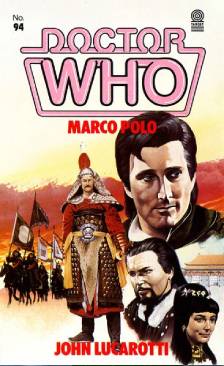
Cover: David McAllister returns with a painted composition of Marco Polo, Tegana, Pingo Cho and Kublai Khan, along with some other elements that apparently come from an entirely different production called Marco Polo from the 1980s. It’s nice to see accurate resemblences to actors Mark Eden, Zienia Merton and Derren Nesbitt here.
Final Analysis: John Lucarroti’s second novel and it’s as much of a jolly history lesson as the first, with additional highly detailed descriptions of various menus. Obviously, each of the locations is grander than the sets in Lime Grove could have allowed and also we get a real sense of the time passing, as each chapter adds days onto the journey, which lasts around 40 days in all. It might lack the fun and melodrama of monsters of robots, but it’s a rare story that truly allows us to step into a culture and enjoy various aspects of it.
Synopsis: Troops from Androzani Major are losing in a war against the android soldiers of Sharaz Jek, an arms trader who controls his operations from deep within the catacombs of the twin planet Androzani Minor. Driven by revenge, Jek has a stranglehold over the supply of spectrox, a substance that, when refined, is a much-valued elixir. In its raw state, however, it can be a deadly poison. And both the Doctor and Peri are already suffering from the effects of spectrox toxaemia. Can the Doctor hold off an impending regeneration long enough to rescue Peri and get them both to safety?
Chapter Titles
1. Androzani Minor Revisited
2. Spectrox War
3. The Execution
4. Sharaz Jek
5. The Escape
6. The Magma Beast
7. Spy!
8. The Boss
9. Crash Down
10. Mud Burst
11. Takeover
12. Change
Background: Terrance Dicks adapts scripts by Robert Holmes for a serial broadcast eight months earlier. This followed Planet of Fire on TV, so that’s another pair of stories to be released consecutively.
Notes: Androzani Major and Minor are two of the five planets that make up the Sirius system. Peri gets her very own Terrance Dicks summary, she’s ‘an attractive American girl, her piquant features framed in short dark hair.’ She considers the Doctor’s interest in everything to be one of his ‘endearing and aggravating characteristics’, which might indicate that they’ve been together for some time, even though soon after she says that the mud of Androzani Major would make ‘a change from lava’, which would suggest this is her first trip since Sarn – or they’ve visited a lot of volcanic locations. We’re shown what happened to Trooper Boze (a scene only recounted on TV in reported speech by the android Salateen) and the reference to ‘Chacaws’ is explained; they’re a ‘fiercely-spiked fruit grown on the penal plantations of Androzani Major’, which leave the chacaw pickers covered in scars.
The Magma Beast is the recipient of this volume’s ‘let’s beef up the monster’ award:
The body resembled that of a giant tortoise, or perhaps an armadillo, though the creature stalked upright on two powerful back legs, like a Tyrannosaurus Rex. The massive fanged head was like that of a tyrannosaurus too, though it also bore two ferocious-looking horns. The powerful arms were short and stubby, ending in two enormous claws. As the monster stalked forwards, the massive carapace, at once protection and camouflage, covered the back of its body like an armoured cloak.
When the Doctor finds the beast dead, he surmises that it was caught in a mud burst and ‘either choked or boiled to death’. Sharaz Jek removes his mask to reveal ‘two mad eyes blazing from a face that was no more than a formless blob, a lump of peeling corrugated skin, devoid of all features’. He strangles Morgus until he’s dead (rather than shoving his head into the laser of one of his machines).
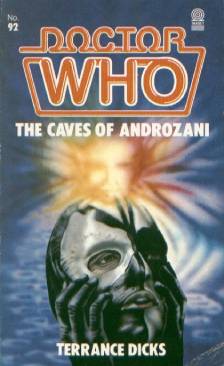
Cover: Andrew Skilleter’s cover shows Sharaz Jex clutching his mask forlornly while an explosion overhead has a blurred and very subtle approximation of the sixth Doctor’s face. A 1992 reprint uses the VHS cover, again by Skilleter, which shows the fifth Doctor, Sharaz Jek (inset), some androids and the twin Androzani planets.
Final Analysis: Terrance Dicks is back, working on his friend Robert Holmes’s most popular story – and doesn’t put a foot wrong. He adds little details to help build upon the societies Holmes created, puts in a few extra bits to bridge gaps – and unlike the omissions by Bidmead in Logopolis, he describes the onscreen visions of the Doctor’s past companions and the Master’s taunting. It’s the idea that the Master might literally get the last laugh that propels him towards choosing to survive. And so, once again, Terrance gets to describe the first moments of a new Doctor:
He had a broad, high forehead and a mop of curly light-brown hair. There was something cat-like about the eyes, a touch of arrogance in the mouth.
Synopsis: Peri Brown, a young American student, is rescued from drowning by Turlough. Among her belongings is a metallic object that the boy recognises as coming from his own world. The shape-changing robot Kamelion interferes with the TARDIS to take them all to a volcanic planet where a religious order revolves around a teenage boy who might be the key to Turlough’s secret past. A bewildered Peri discovers that Kamelion is being controlled by someone who knows the Doctor well, someone who calls himself ‘The Master’…
Chapter Titles
1. Mayday
2. Message Received
3. Destination Unknown
4. Crisis on Sarn
5. A Very Uncivil Servant
6. Outsiders
7. The Misos Triangle
8. An Enemy in Disguise
9. In the Heart of the Volcano
10. The Blue Flame
11. The Time of Fire
Background: Peter Grimwade adapts his own scripts for the serial broadcast seven months earlier.
Notes: The book begins aboard the ship of Captain Antigonas struggling in a storm. The vessel is weighed down by the treasures of Dimitrios, a fat merchant from Rhodes who is more concerned with the welfare of a marble statue of a boy than for his own life (or those of the crew). He’s last seen clinging to the statue ‘as if it were a lover’, plummeting to the depths of the ocean. The ancient ways of the doomed mariners are contrasted with the similar fate of the crew of a Trion vessel caught in the gravitational pull of Sarn. Another captain, Grulen, eagerly awaits landing on the planet as several generations of his family once lived there before the volcanoes became overactive. A sudden surge of volcanic activity causes a magnetic storm. Realising they won’t be able to guarantee a safe landing, Grulen opens the security quarters of the ship so that his prisoners might have equal chance of survival as the rest of the crew. Having faced the threat of execution daily, two of the prisoners are resigned to their deaths and as the couple cradle their sleeping child, the father’s thoughts turn to Turlough.
There’s a shuffling of scenes at the start, with all of the scenes on Sarn delayed to chapter 4, which makes a lot more sense. We join the TARDIS in the immediate aftermath of Tegan’s departure. Turlough considered the Australian ‘argumentative, tactless, interfering, brainless and with a voice that could strip paint’; he also misses her terribly and so does the Doctor. Turlough suggests a holiday, and while the Doctor isn’t enthused with the idea, remembering the chaos that ensued after a trip to Brighton, Turlough recalls a holiday with his school chum Ibbotson and his family to Weston-super-Mare – and so is determined that they should find a ‘paradise island’ instead. Kamelion’s screams force the Doctor to realise he’d forgotten all about the robot shapeshifter and notes that he had ‘none of the cheerful loyalty of K9’. His voice is like a speak-your-weight machine. Turlough suspects Kamelion of working with the Custodians on Trion and when the robot advises him to take care under the hot sun (‘with your fair skin you will easily burn’) it sounds to Turlough more like a threat than advice.
Howard Foster speculates that the mysterious metal object might be debris from a Russian satellite. His assistant is Karl, not Curt. Peri mentions a ‘Doc Corfield’ and notes that she would ‘never trust a man with a toupee!!’ Howard is 41 next birthday. He says that Peri has travelled all her life but Peri moans that it’s mainly been a succession of Hilton hotels. She has a trust fund, left to her by her (presumably deceased) father, which will be released to her when she turns 21. The English guys she hopes to go travelling with are called ‘Trevor’ and ‘Kevin’. Peri acknowledges that she’s not a strong swimmer but it’s leg cramp that causes her to come into difficulty as she heads to the shore. Incidentally, Lanzarote is not mentioned at any point in the story; the story begins with the shipwreck off the coast of North Africa (‘the headland’) so Howard’s archeological excavation might take place in Gibraltar, which has easier access to Athens. But it’s probably still Lanzarote in anything but name.
Turlough has a more physical altercation with Kamelion before disabling the robot with a bombardment of waves and dumping him in a spare room. Sarn is a city, not the name of the planet, believed to be the last surviving community after the last earthquakes and firestorms a generation ago. Turlough appears to tell the Doctor the name of his home planet, Trion, for the first time, despite having asked to go there in previous stories. The Doctor quotes Paradise Lost and admonishes Turlough for not studying Milton at school. Misunderstanding Turlough’s intentions, the Doctor calls him a ‘little racialist’: ‘As Tegan had never been slow to point out, Turlough could be a rather nasty piece of work.’ There’s a summary of the Master’s exploits that led to his predicament, during which it’s confirmed that this is his fourteenth incarnation. Turlough and Malkon find a poorly tended grave near the wreck of the Trion ship, which confirms Turlough’s suspicions that Malkon is the only survivor of the crash. The Master’s final teasing line asking the Doctor to ‘show mercy to your own-‘ is cut, as is the final scene on TV where Peri received her proper invitation to join the Doctor.
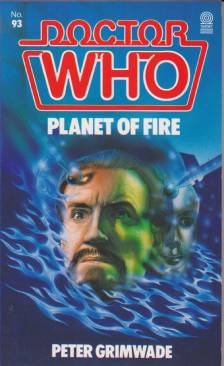
Cover: Andrew Skilleter’s illustration depicts the Master and Kamelion in waves of blue flame.
Final Analysis: An elegant adaptation here. I particularly like the way Grimwade makes sure we know when we’re with the Kamelion version of any character as he undermines the illusion in every line: ‘the duplicate professor’; ‘the man in the dark suit who everyone believed to be Professor Foster’; ‘Kamelion in the guise of the American archaeologist’; ‘The robotic Master’. He also has a nice line in similes: The Doctor’s device squeaks ‘like an old lady who has turned her hearing aid up too high’; the volcano grumbled ‘like a sleeping giant with a touch of indigestion’; the Master announces himself to Peri ‘as if he were the Tsar of all Abe Russias’; the Doctor’s party works its way through the streets of Sarn ‘like rodents navigating the secret byways of the skirting board’; the Doctor arrives at the portico ‘like a royal bride’; Kamelion glitters ‘like a Maltese tinfoil Saint at Festa Time,’ and later the robot appears ‘blustered like an actor unsure of his lines’. It’s so much fun seeing which ridiculous comparison he’ll submit next. Though what we’re supposed to make of Peri delivering ‘a sharp kick at the Master’s shins that would have repulsed a Globetrotter’, I’m not so sure.
Synopsis: In the far future, the TARDIS suffers a forced landing on the planet Frontios, where the Doctor, Tegan and Turlough find a colony of humans struggling to survive against the elements and the continual bombardments from an unknown aggressor. Then there are the strange unaccountable deaths and the threat of insurrection from citizens tired of rations and restrictions. But Turlough knows the truth. A distant memory from his own people that reveals the attacks are not coming from above, but below.
Chapter Titles
1. Refugees of Mankind
2. The Unknown Invaders
3. The Deadly Hail
4. The Power of the Hat-Stand
5. Downwardness
6. Beneath the Rocks
7. The Force Takes Hold
8. Eaten by the Earth
9. The Excavating Machine
10. Prisoners of the Gravis
11. The Price of Rescue
12. Greed Sets the Trap
Background: Christopher H. Bidmead adapts his own scripts for a serial broadcast seven months earlier.
Notes: While Tegan tries in vain to read an unhelpful handbook, Turlough expresses his boredom by tying viciously tight knots into one of the Doctor’s scarves, which the Doctor later fails to unravel. There’s no follow-on from the previous story, so we’re just told that the Doctor has become ‘mysteriously reclusive’ since whatever time and place they last visited. Turlough sees a large portrait on a wall in the medical shelter and Mr Range tells him it’s of their recently deceased leader, Captain Revere (information that I’m sure will come in use later!).
When Norna describes the circumstances of the colony ship’s crash on Frontios, we’re told her grandparents died among many other casualties, but this was many years before she herself was born. Plantagenet is about the same age as Turlough with a ‘thin physique’ and a ‘head of thick, white hair’. There’s a useful paragraph that explains the scale of the crashed ship:
The propulsion chamber led them through into Causeway 8 that ran the length of the ship – a half hour’s brisk walk in the days Brazen was a boy and the ship was whole. Now most of the structure except the stern end was buckled and filled with silt, and only the part of the ship they walked in now was usable for the business of state and the storage of the precious resource reserves.
The Tractators are ‘silver creatures, each larger than a man. Their insect-like bodies were scaled like fish, and from their underbellies a pale luminescence emanated’. They have ‘two bulbous eyes on either side of the shrimp-like head’ with ‘glossy black mouths’. Their leader, the Gravis, rises up on ‘innumerable rear legs’ and he’s said to be larger than the other Tractators. As the creatures notice Norna, she experiences the sensation of them ‘threatening to drag her flesh from her bones’. Later, we’re told ‘her hair stood up on her head in spikes’… well, it was the 80s…
Norna and her father find a plaque, not a map, which tells them that Revere found no valuable minerals as of the year ‘Alpha 14404’. Brazen’s Deputy is introduced early on, accompanying him as he discovers the blue Police Box in the colony. It’s only when Mr Range faces the inquiry that we learn the Deputy is a woman. The Gravis has a translation machine and an excavation machine that utilise human body parts in very grizzly ways; the excavator is also vaguely the same shape as a Tractator. There are two colonists called ‘Kernighan’ and ‘Ritchie’, named after Brian Kernighan and Dennis Ritchie, computer scientists who literally wrote the book on the subject of the programming language ‘C’.
The Gravis claims that they know of the Doctor ‘by reputation’ and explicitly states his belief that the Doctor has been sent by the Time Lords of Gallifrey to prevent their plans (and of course, he also knows what a TARDIS is, though not what it looks like). Much more is made of the Doctor’s ruse that Tegan is an android and as she recalls how she accidentally stumbled aboard the TARDIS and how she cared for the Doctor after his regeneration, she is outraged and not quite realising what the Doctor is doing until he gives her ‘a swift, barely perceptible wink’. He later claims to need his spectacles just to buy him enough time to explain his deception to Tegan. He uses the half-frame spectacles ‘when the print was very small, or the book unusually dull’, though he tells the Gravis that they have ‘poly-directrix lenses with circular polarising filters [to] reduce spectral reflection as much as seventy-five percent, without any perceptible deterioration of resolution’, which is ‘Gallifreyan technology – like the TARDIS’. Observing the wrecked excavation machine, the Doctor utters ‘a Gallifreyan word that is said in these circumstances’.
Cockerill appears to assume the post left vacant by Brazen as Plantagenet’s second in command, taking on an official uniform, giving tasks to the survivors and tempting the Retrogrades back into the community. The final scene where the TARDIS is caught in a plot device from the next story is omitted, though it’s hinted at by the closing line: ‘More serious trouble was on the way for the Doctor, nevertheless. But that was only to be expected.’
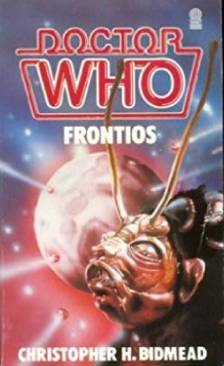
Cover: Andrew Skilleter’s illustration shows a rather dignified profile of the Gravis, with Frontios in the background during a bombardment.
Final Analysis: I’ve been gently critical of Christopher Bidmead’s arrogance leaking into his previous novels, so it’s a relief to see that aspect missing here. Instead, we get a slow-burning horror story that gives Ian Marter a serious challenge with some genuinely unsettling body horror. The Gravis’s translation device consists of ‘a tall narrow trolley that floated a foot or so above the ground… mounted on it was the head and one arm of a dead Colonist, connected by improvised metalwork to a swinging pendulum’. As it speaks, ‘its dead mouth moving to the click of the pendulum’. Then there’s ‘the machine’ – the excavator – which ‘needs a captive human mind to drive it’ and uses human hands to smooth the walls of their tunnels:
White bones tipped with metal cutters scraped against the rock, while rotting hands polished the surface smooth. Through illuminated windows in the body Tegan glimpsed more mechanically gesticulating human arms and legs in an advanced state of decay. It was a machine built from the dead.
While Marter likes his violence wet and gooey, this is more mechanical, playing on castration anxiety and the ‘vagina dentata’ folklore as much as Jaws, where the ground devours people and then the Tractators’ machines chew them up and reconstitute the parts as required. Just look at Bidmead’s description of the Doctor’s reaction here:
The Doctor was not very fond of tunnels at the best of times. They were frequently damp, dark, deep and dangerous, and as a method of transport ranked only a little higher than sitting absolutely still under water waiting for the right current. The best place to be in a tunnel was outside, and if you had to be inside, the less inside you were the better.
We don’t even need Dr Freud to explain this one, do we boys? No wonder 80s producer John Nathan-Turner kept reassuring his audience of quivering adolescents that there’d be ‘no hanky panky aboard the TARDIS’…
Synopsis: In the aftermath of the battle of Culloden in 1745, a group of Jacobite rebels try to evade capture by the English army. The Doctor, Ben and Polly help a wounded laird but are then captured by an incompetent English officer. The Doctor adopts a fun disguise as Polly uses guile to free her new friends and escape. One young Scot in particular impresses the time-travelling trio – a piper by the name of Jamie McCrimmon.
Chapter Titles
1. Where are We?
2. The Cottage
3. The Captives
4. The Handsome Lieutenant
5. Polly and Kirsty
6. Polly’s Prisoner
7. The Water Dungeon
8. Blackmail!
9. The Doctor’s New Clothes
10. Aboard the Annabelle
11. At the Sea Eagle
12. The Little Auld Lady
13. A Ducking for Ben
14. Where is the Prince?
15. The Fight for the Brig
16. Algernon Again
17. A Return to the Cottage
Background: Gerry Davis adapts the scripts he co-wrote with Elwyn Jones for the 1967 serial.
Notes: The bonhomie of TV’s Ben and Polly is replaced by something closer to the bickering of 1980s companions; Ben insists on calling Polly ‘Princess’ (not ‘Duchess’) and thinks she is ‘uppity and toffee-nosed’. He also thinks the sounds of battle drifting over the moor are just celebrations from ‘the Spurs Supporters Club’ (ahem, a reference to the er, London-based football team Tottenham Hotspurs) or a historical society. Polly resents Ben’s ‘big brother’ protectiveness, especially as she is ‘about a head taller than he was’; later, it’s confirmed she’s an ‘independent girl from the sixties’ – so her ‘seventies’ origins have been properly reset from previous Gerry Davis novels. The Doctor admits to Polly that the discovery of a cannon ball makes him afraid. There’s a dump of history at the start too, as we’re told of the battle for the British monarchy between the Scottish Stuarts and the ‘Hanoverian German Georges’. The Scots had been booted out 40 years ago and we join the story in the aftermath of the battle of Culloden Moor. As this wasn’t taught in English schools in my day, this is especially welcome and helpful.
As the Doctor inspects a tam-o’-shanter, we’re told it’s a ‘standing joke in the TARDIS that he could never resist trying on any new hat he came across’; as this is the first TV story where his hat fetish became a regular thing, this suggests the trio have had a fair few offscreen adventures since the Doctor’s regeneration. He adopts the pseudonym ‘Doctor von Verner’ (not the more obvious meta-joke ‘von Wer’ on telly). Algernon Ffinch stammers ‘in a way approved by the London dandies of the time’, which could mean it’s an affectation for fashionable purposes. The Sergeant’s name is spelled ‘Klegg’, not ‘Clegg’. While in the prison, Jamie plays a mournful tune on his bagpipes before the Doctor creates a disruption in the gaol by playing the Jacobite ‘Lillibulero’ on his recorder. The name of the pub where Solicitor Grey has installed himself is called the Sea Eagle Inn. As Jamie boots Trask overboard during the final battle, Ben tries to regain some composure as he claims he was about to use karate to save himself. There’s a more pressing reason for Jamie to join the travellers; having escorted them to the TARDIS, Jamie boasts that he’ll be fine on his own as they hear the sound of muskets being fired nearby. We then join Jamie as he sees the inside of the TARDIS for the first time (see below).
Cover: A smashing portrait by Nick Spender of Jamie, accompanied by Alexander, a Saltire flag and the TARDIS. Unusually for this period, there are likenesses of recognisable actors here!
Final Analysis: Gerry Davis returns to adapt a script that he originally oversaw to production. It was the last of the pure historicals on TV, yet it’s the second one we’ve had in novel form in the space of a year. The Highlanders is often overlooked in favour of the more monster-focused stories of the era and, perhaps it won’t come as a surprise to learn that this is the first time I’ve read this particular book. Davis keeps things light, even with the threat of violence and a very sudden and shocking death early on. The stakes are high, but so’s the sense of adventure and Polly in particular has a rare old time running rings around every man she encounters. Effectively, she gets her own companion in the form of Kirsty and it’s easy to forget that this is the debut of Jamie, even though his future role as a companion isn’t foreshadowed at all, he’s just one of a number of likeable characters that we meet. Poor Ben’s experience in Scotland isn’t quite so jolly. Despite having spent very little time with Jamie, Polly takes an immediate shine to him and the final scene sees him adopted as a fully-fledged TARDIS member at last:
As he hesitated, Polly turned back and grasped his hand. ‘Don’t be afraid,’ she said, ‘it’s much nicer inside than it is out. There’s so many wonderful surprises waiting for you, you’ll see.’
Jamie allowed himself to be drawn through into the small police box. The door closed behind him and he saw to his astonishment the large, hexagonal, brightly-lighted interior of the time-machine.
Synopsis: UNIT has been invited to provide security for a top secret drilling project in search of a new energy source from the Earth’s core. Hoping that the facility might help with his repairs to the TARDIS, the Doctor immediately becomes an irritation for the project’s director and instigator, Professor Stahlman, who is determined to lead the project to undoubted victory, whatever the risk. Afreak accident sees the Doctor transported to a parallel world where Stahlman’s project is much further advanced – and the dangers more apparent. Can the Doctor save this world and make it back to his own in time?
Chapter Titles
1 Project Inferno
2. The Beast
3. Mutant
4. The Slime
5. Dimension of Terror
6. The Nightmare
7. Death Sentence
8. Countdown to Doom
9. Penetration-Zero
10. The Monsters
11. Escape Plan
12. Doomsday
13. Return to Danger
14. The Last Mutation
15. The Doctor Takes a Trip
Background: Terrance Dicks adapts scripts for the 1970 serial by Don Houghton.
Notes: The Stahlman Project is ‘the greatest scientific project that England had ever known’; it’s predicted to be ‘more technologically advanced than nuclear power’ and, more importantly, ‘far more lucrative than North Sea Oil’, promising ‘limitless free energy for everyone’. We’re reminded that these are still the early days of the Doctor’s exile by the Time Lords to Earth. The complex that houses the project is in ‘a messy, unattractive-looking area’ – and this will be relevant later.
Professor Stahlman’s first name is Eric and he grew up ‘in the ruins of post-war Germany’ (which means he’s either only in his late twenties or he grew up in post-First-World-War Germany – unless Terrance Dicks is maintaining the idea of UNIT stories being set in a ‘near future’). Sir Keith Gold observes Professor Stahlman’s ‘bulky broad-shouldered body and massive close-cropped head’, with a neat beard; in his mind, Sir Keith compares him to a gorilla in a lab coat – and immediately feels guilty for being so uncharitable. It’s an interesting choice to make Stahlman physically strong, ‘powerfully built man’, as this accentuates his early encounter with the Doctor, who restrains him with just two fingers and freezes him to the spot.
Liz Shaw is a ‘serious-looking girl with reddish-brown hair’ dressed in ‘a rather incongruously frivolous-looking mini-skirt’ – details which help to provide contrast with the parallel-world version. We’re reminded that Liz is ‘a scientist of some distinction in her own right’ and that she had been brought into UNIT from Cambridge ‘some time ago’. Petra Williams is ‘an attractive white-coated young woman, with a pleasant open face’ – yes, just like the Fifth Doctor – ‘framed by long fair hair’. Greg Sutton is said to be ‘a burly, broad-shouldered man’ and he has ‘a pleasantly ugly face’ (a bit unfair on Derek Newark there, Terrance!) and ‘a sun-baked, wind-weathered complexion’.
The Doctor witnesses Stahlman stealing the microcircuit and exclaims ‘Jumping Jehosophat’, as he does when he sees the Master in The Five Doctors. When he finally escapes limbo and lands in the parallel world, the Doctor is aware that he’s not where he’d previously been because the hut is tidy (the Doctor likes ‘a bit of clutter’). The neatness extends to the rest of the surrounding area, which has also been ‘tidied up’. Without the moustache of the Brigadier, the Brigade Leader’s mouth looks ‘thin-lipped and cruel’. The Doctor begins to speculate as to the cause of the parallel world and guesses that it might be down to a different outcome for the Second World War. The savage beasts are simply mutants (they’re called ‘Primords’ on the end titles of the TV episodes, but the word isn’t used in dialogue or in the novel). The novel retains the radio broadcasts that were cut from the original transmission (but retained for overseas broadcast). The Doctor checks his pulse and it’s ‘normal’ at 70 (it’s 170 on TV). The Doctor realises that he was so ‘haunted by that nightmarish vision of an exploding Earth’ that his violent outburst at Stahlman will have damaged his credibility.
Cover: Nick Spender’s fiery illustration shows a likeness of Ian Fairbairn as technician Bromley beginning to transform into an atavistic beast on the roof of a cooling tower beneath a burning sky. It’s quite the scariest cover since Alun Hood’s 1979 piece for the Terror of the Autons reprint.
Final Analysis: The first of two Don Houghton stories adapted by Terrance Dicks and it’s a real treat. It benefits from the increased page-count that’s gradually crept in since Terrance’s middle-period, plus it’s the sort of story that really plays to Terrance’s strengths as his economic thumbnail-sketch descriptions help us remember who’s who and what’s different about them in the other world. We also get an insight into the Doctor’s thought process, initially fascinated by the opportunity to explore a parallel world until he begins to treat the people he encounters as real, and not just disposable alternatives of the ones he knew on the other Earth. His horror at realising he has to give up on the alt-world to gain the chance to save his own Earth stays with him, even down to him accepting his desperation has alienated the very people he’s trying to save. And as we’ll discover, it’s a devastating decision that will haunt him for… well, at least as long as Don Houghton’s other story.
Synopsis: Emerging from a hidden doorway in a temple, Barbara is mistaken for the Aztec God Yetaxa and finds it difficult to refuse the role. As the Doctor tries to regain access to the temple and return to the TARDIS, Barbara learns the difficult lesson that she cannot change history. Not one line of it!
Chapter Titles
1. Coiled Serpent
2. Yetaxa the God
3. Chosen Warriors
4. Sacrifice to Tlaloc
5. Perfect Victim
6. Thorn of Doom
7. No Holds Barred
8. Cups of Cocoa
9. Bride of Sacrifice
10. Offence and Retribution
11. Crawl, Swim, Climb
12. Wall of Deception
13. False God
14. Day of Darkness
15. Eclipse
Background: John Lucarotti adapts his own scripts for the series broadcast in 1964. Published a week after its 20th anniversary, The Aztecs now holds the crown for the biggest gap between first transmission and novelisation. It’s also the first pure historical story to be adapted since The Crusaders, some 19 years earlier.
Notes: We begin with a new scene inside the TARDIS with little explanation of who the characters are or what the TARDIS is. Susan is said to be still 15 years old, while Ian is 28 and a ‘scientist’ (not a science teacher’). When the Doctor asks for a screwdriver (a normal screwdriver!) to fix a panel on the TARDIS ‘control desk’, Ian jokes that they might land on Earth in the 1980s and get help form an aerospace factory; it’s a curiously specific reference for a man from 1963. Barbara specialised in Aztec history at university and her brief summary for Susan of Mexican civilisation is a lot more heavy-handed than it is on screen. She guesses that they’re at some point in history between 1430 and 1519, and the Doctor is able to confirm it’s 17 May, 1507. We might pause to ponder how the TARDIS can produce a date so accurate when it’s 75 years before the introduction of the Gregorian calendar, but this story’s already threatening us with a huge history lesson, so let’s just ignore the issue and move on.
Cameca is ‘a grey-haired, pleasant-faced, plumpish woman in her mid fifties’. The architect of the temple, Topau, is renamed ‘Chapal’. On the night that he meets the Doctor in the garden, Ian wears ‘only a warrior’s loin-cloth and sandals’. Ixta is startled by the Doctor’s electronic torch when he sees Ian use it, wondering if it’s ‘magic’. It was Ixta’s ‘father’s father’ who originally built the secret tunnel that is used to irrigate the garden (it’s his father on TV – and see later). Ian has a much more arduous trek through the secret tunnel, including a climb up a vertical shaft using crumbling footholds. He finds the remains of a body – which he correctly assumes is that of Ixta’s father – in the tunnel and soon discovers that the man must have fallen to his death when a foothold in the shaft gave way beneath his foot; Ian also correctly deduces that he himself was at risk of drowning because of Ixta deliberately opening the sluice. The Doctor tells Barbara of his suspicion that Ian has drowned, shortly before Ian finds them both (on telly, Barbara already knows Ian is safe by the time the Doctor reaches her).
It’s a lot clearer that the Doctor feels utterly wretched for exploiting Cameca’s affection purely to gain access to the temple. As Cameca offers to help restore Autloc’s faith in Barbara, the Doctor is moved by her devotion and muses ‘in another world, in another time’ – but it’s definitely not the romantic relationships some fans imagine. Barbara has a long discussion with Autloc about the ‘schizophrenic’ nature of the Aztecs and her words remind him of a legend he has heard of a man from a foreign land who spoke of a ‘gentleness and love’ who was crucified, as the Aztecs do with their criminals. The climactic fight scene between Ixta and Ian is replaced by something wittier but also just as brutal, as Ian reflects light into his opponent’s eyes, which makes Ixta topple backwards and fall to his death. The scene leading into The Sensorites is, unsurprisingly, cut.
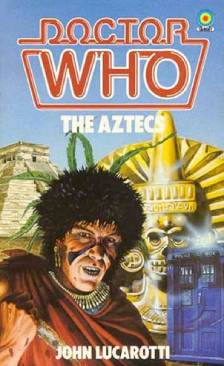
Cover: Featuring the last appearance of the coloured Target logo, Nick Spender’s first cover depicts a man with a dagger (Tlotoxl possibly?), a temple and a giant golden mask, as the TARDIS materialises. A 1992 reprint cover uses Andrew Skilleter’s VHS cover art, showing Tlotoxyl and the Doctor amid some Aztec pyramids.
Final Analysis: John Lucarotti provides a fairly loose adaptation of his own story, clearly written from the original scripts but with a relaxed approach to sticking rigidly to the text. He’s also done a lot of research and is happy to let us know it, but unlike some of the authors from the early 80s, there’s no showboating here; we’re just exposed to the history of an ancient and brutal culture – even the cuisine – of a time in Earth’s history that’s as alien to the modern reader as that of Peladon or Skaro. The descriptions of torture are particularly graphic; at one point, Tlotoxyl tells Barbara that Susan will have her eyes gouged out. I might lament that the original TV version didn’t give us the chance to hear how William Hartnell might have approached a name like ‘Huitzilipochtli’ but Lucarotti’s undiluted approach makes the story all the richer. I read this novel for the first time here and we’re now entering a period where I suspect there are more books I’ve not previously read than I have.
Synopsis: The Earth was once home to a race of intelligent reptiles who dominated the land and the sea. Having spent millions of years in hibernation, they are now preparing to awake and reclaim their planet. As the personnel of a nearby underwater military base run tests in preparation for a potential war, their paranoia and stress is being exploited from within by agents secretly working for a foreign power. The Doctor has failed to broker peace with the reptiles before, but now the Sea Devils and Silurians are working together to trigger a war that could eradicate humanity entirely.
Chapter Titles
1. The Intruder
2. The Traitors
3. Hunted
4. The Sea Devils Awake
5. The Attack
6. The Myrka
7. The Breakthrough
8. Sabotage
9. The Hostage
10. Captured
11. Counterattack
12. Sacrifice
Background: Terrance Dicks adapts scripts by Johnny Byrne for the serial broadcast just four months earlier.
Notes: By 2084, Earth is divided into two power blocs, East and West (suggested on screen but not spelled out) and after space stations proved vulnerable to ‘spy-satellites and the searing blast of laser beams’, many of Earth’s defence systems are now housed under the sea. Commander Vorshak has ‘the rugged good looks of a recruiting-poster hero, much to his own embarrassment’. The hull of the Silurian vessel has an irregular surface, as if it were ‘grown rather than manufactured’. The Silurians are ‘immensely tall, robed figures’…:
… brown-skinned with great crested heads and huge bulging eyes. Their slow, almost stately movements, their coldly measured speech-tones gave evidence of their reptilian origin.
Icthar is confirmed as the sole survivor of the ‘Silurian Triad’ and it’s made clear that the Doctor specifically remembers him as one of three Silurians from their origin story [see The Cave Monsters for Okdel, K’to and Morka – thought he could be one of the other bystanders who survives the end of the story only to be entombed]. He led the return to hibernation and awoke over a hundred years later. The Sea Devil warriors are in suspended animation in a chamber in the bowels of the Silurian ship (not in their own base as on TV), which is where Icthar found them, frozen under a polar ice cap (so Sea Devils and Silurians presumably had an alliance at some earlier point, considering the Sea Devils are piloting a craft that the Doctor recognises as specifically Silurian). There’s a handy addition to the backstory of the Earth Reptiles, summarising their two previous appearances. Apparently, many of them had developed’ almost mystic powers, the Silurian ‘third eye’ being ‘the source of psychic energy that enabled some Silurians to dominate lesser races by sheer mental force’.
Terrance Dicks still considers Tegan to be an ‘air-hostess’; she hasn’t been one for some time now, after she was sacked, and hadn’t actually started work prior to Time Flight, so it might be time to accept that she’s ex-flight crew now and let her move on, eh?
Doctor Solow was recruited by Nilson to the cause of the Eastern Bloc. She was ‘disappointed in her career, left alone by the death of her husband and her parents’ so she fell ‘an easy prey to Nilson’s arguments’. Icthar found the Myrka along with Sauvix’s ship and revived it. The beast is ‘like a kind of pocket dinosaur’ with a ‘hideous dragon-like head’ and ‘a long tail’ that is agile enough to use as a weapon against its attackers.
The Doctor climbs out of his stolen Sea-Base uniform as soon as he hands the gun over to Vorshak. The charred bulkhead door reminds Turlough of toast, which triggers a memory of ‘study teas’ at his public school, ‘with a terrified fag to make the toast’; for non-English readers, this isn’t quite as offensive as it sounds, referring to the public-school practice of forcing the younger boys to work as servants (or fags) for older boys. The fact that he finds himself running towards the sound of battle with a gun in his hand strikes Turlough as odd. Later, he and Preston shoot down two Sea Devils to rescue the Doctor and Tegan; Turlough reminds Preston to ‘Aim for the head’. Tegan is surprised by Turlough’s change of heart but decides to give him the benefit of the doubt. As the Doctor laments that there ‘should have been another way’, he also recognises that Bulic won’t be the sole survivor and maybe he can lead the others and get the base running again.
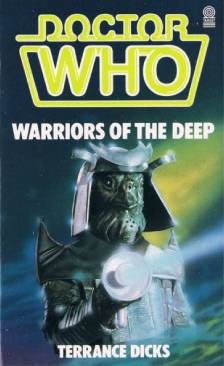
Cover: The first release boasts a straightforward portrait of a Sea Devil warrior by Andrew Skilleter. Alister Pearson’s 1992 cover is really classy, with the sea base and the Doctor between a Silurian and a Sea Devil. There’s also a new brand logo, the colourful target is dropped in favour of a hollow, white line drawing.
Final Analysis: Terrance Dicks has form for improving on the limitations of what could be achieved in a studio: Adapting a story that was famously overlit because of external pressures, he tells us here that the whiteness of the sea base is intentional, a design choice to counter the blackness of the deep sea; while the Silurians walk and speak slowly not because of restrictive costumes but because it’s dignified to do so; the heavy bulkhead door lands on Tegan, whose foot is ‘only trapped, not mangled’; and the Myrka is a horrific beast with a lithe and deadly tail! In truth, I’ve always loved this story, so it’s gratifying to see Terrance do it justice, even if some of the enhancements are tongue in cheek, it at least allows him to pay tribute to his friend Malcolm Hulke in reminding new readers of the origins of the Sea Devils and Silurians.
We should remember also that this novel, like the story it retells, was released in 1984, the year that Ultravox released Dancing with Tears in My Eyes and Frankie Goes to Hollywood topped the charts with Two Tribes. While the TV episodes and the novel both predate the harrowing drama Threads this was the peak year for anxiety of mutual annihilation from a nuclear attack, the most ‘1984’ story we could have got, short of a celebrity historical where the Doctor meets George Orwell.
Further Listening
I was a guest on the Doctor Who Book Club Podcast to discuss this book, which you can hear in the link below, or via the podcast provider of your choice.
Update March 2026: An animated musical parody for the Doctor Who Literature Podcast.
Synopsis: An island in an ocean on the planet Dulkis. Survivors of war, the Dulcians are now complete pacifists. They have no concept of aggression, no understanding of what it takes to defend themselves. They are ill equipped to deal with the Dominators. Accompanied by their murderous robot servants the Quarks, the invaders see Dulkis merely as a resource to be exploited. And the Doctor, Jamie and Zoe must stop them.
Chapter Titles
1. Island of Death
2. The Radiation Mystery
3. The Assessment
4. Heads in the Sand
5. Slavery
6. Fighting Back
7. Buried Alive
8. Clues
9. Last Chances
10. Desperate Remedies
Background: Ian Marter adapts the 1968 scripts credited to Norman Ashby (a pseudonym for Mervyn Haisman and Henry Lincoln).
Notes: Dulkis is immediately diminished in importance; it’s ‘pale, ochre-coloured’, and ‘an insignificant little planet which orbited an isolated minor star’. In contrast, everything about the Dominators is heightened to make them appear impressive:
They were human in form but towered more than two and a half metres in height. Their leathery features were starkly chiselled, with thin bloodless lips and deeply set red-rimmed eyes which burned with a cold green light beneath heavy brows. Their short hair was black and sleeked back, like a skullcap, from their shallow foreheads.The creatures were clad in protective suits consisting of black quilted material like rubber, armoured with small overlapping plates and built up around the shoulders so that they appeared to have no necks.
The Quarks too are much taller than the schoolboy-sized ones we see on telly, about two metres tall. The surface of their ball-shaped heads is covered with ‘a network of eyes and sensors’, while their arms have hand-like endings ‘bristling with sensors, sockets and implements’. They’re also a little bit more talkative.
Inside the War Museum, Jamie inspects a laser gun and it accidentally discharges, punching a hole into a door . There are four figures sat around a circular table (not two at a desk as on screen):
… their bodies frozen into grotesquely contorted positions. Their clothing was charred and rotten, here and there fused into a glassy lump with their roasted and flayed flesh. The eyeless faces were burned beyond recognition.
The Dulcians measure years in ‘annos’ and months in ‘lunars’. ‘Cully’ becomes ‘Kully’; at one point, he attempts to impersonate Jamie’s accent.
Cover: Andrew Skilleter gives us a Dominator and a Quark operating drilling equipment, while a huge oversized Quark fills the skyline. The 1991 reprint cover reuses Alister Pearson’s VHS artwork, with the Doctor flanked by pairs of Dominators and Quarks.
Final Analysis: It’s surprising that one of the most unsettling visual effects of its time – the fiery bubbling of Tolata’s skin as she’s blasted by a Quark – is reduced to an energy burst and a bloodless murder. I’d have expected Ian Marter to go all out on this, considering the gruesome description he gives to the dummies in the war room in a later scene. But this is a subtle work: Marter’s introduction places the impressive Dominator battleships soaring across space in formation near to quite the most boring-looking planet ever. In Chapter 4, we finally reach the Dulcian Capitol, where its citizens enjoy warmth from the planet’s ‘modest yellow sun’, there are galleries filled with ‘lush green vegetation’, small fountains that cast ‘fine shimmering sprays of purified water in myriad colours’. The Council Chambers are pastel shades, the elderly Councillors lounge in ‘padded reclining chairs’ with cushions, everything is soft, soothing and entirely non-threatening. In the space of a couple of paragraphs, we’re shown that Dukis has absolutely no defence against the trigger-happy invaders. It’s so much better than the story deserves, being a little one-note and thin on TV.
Synopsis: As the Black Guardian tightens his grasp on the terrified Turlough, the time travellers find themselves taking part in a race across the solar system. The players are a race of Eternals and the prize is ‘enlightenment’, though nobody seems too sure what that means. As one of the eternals tries to cheat their way to victory, the finish line offers a surprising choice for Turlough.
Chapter Titles
1. Winner Takes All
2. The Race
3. Here She Blows!
4. Marker Buoy
5. One Down!
6. The Officers
7. Man Overboard!
8. The Buccaneer
9. The Grid Room
10. Spy!
11. Focus Point
12. The Prize
Background: Barbara Clegg adapts her scripts from the 1983 serial. She’s the first woman to write for Target’s Doctor Who range.
Notes: As on TV, Turlough and Tegan play chess as a foreshadowing of the battle between the Guardians; significantly, on TV, Turlough chooses to play as white, but here he’s black. The Black Guardian doesn’t appear after the White Guardian at the beginning. The Doctor reviews a newspaper to discern that it’s 1901 (the newspaper on TV is from a year later). In her quarters aboard Striker’s ship, Tegan is startled to see the dress that Lady Cranleigh gave her among her things [see Black Orchid]. Striker’s ship is unnamed (although it’s only named on screen on a lifebelt). Turlough’s communication crystal for the Black Guardian is, once again, a cube.
Quick trigger warning: Aboard the Buccaneer, Turlough sees ‘Persian rugs and a negro statue holding a great candelabra’. Mansell is a much bigger man than on telly:
… his brocaded coat flashed with gold thread, but it appeared to have belonged once to someone else, for it fitted him poorly. His broad shoulders were nearly bursting the seams. He walked with the lithe power of a black athlete…
The Doctor speculates that Eternals don’t have a human form, but simulate it based on the minds of their ‘ephemeral’ crews. Wrack’s deadly jewels include crystals and sapphires as well as the ruby gems seen on TV; they’re all described as ‘capuchon’, so they’re polished, not cut like more modern gems.When activated by Wrack, the gem in Tegan’s tiara turns black and as the Doctor tries to destroy it, they can all hear the voice of the Black Guardian saying ‘Focus… focus…’ (this happens on TV, but it’s not clear if it’s diegetic sound or just a theatrical device). As the ‘Enlighteners’ (the two Guardians) reveal the prize of the race, the Doctor tells Turlough that he wasn’t sure who the boy would push overboard on the Buccaneer; Turlough confesses, neither did he.
Cover: That daft cutout of the Doctor is still blocking the logo, but Andrew Skilleter captures that beautiful image of the sailing ships floating through space towards the glowing Enlightenment.
Final Analysis: Again, the original scriptwriter novelises the story and it’s a cracker. Barbara Clegg brings a level of nuance that I’m not sure we’d have got with Terrance Dicks. While other writers have highlighted Tegan’s brashness, Clegg delves a little deeper: When Marriner corners Tegan and appears ‘inexperienced’ in his pursuit, Tegan feels she can cope with the situation:
There had been other young men boringly concerned about her in the past. She was on home ground…. She did hate emotional scenes, particularly when she could not return the emotion.
Clegg also chooses to hide the Black Guardian’s involvement until very late on, so for any reader who’s missed Turlough’s previous adventures so far, his involvement with the Doctor’s enemy will come as quite a shock.





 Escape to Danger