Chapter 42. Doctor Who and the Time Warrior (1978)

Synopsis: Scientists have disappeared from across the country. In an attempt to keep them safe, the remaining experts have been brought to a research centre under the guard of UNIT – but still they continue to vanish. The Doctor identifies the cause must be someone with access to time travel. Following the trail in the TARDIS back to the Middle Ages, the Doctor discovers the time-hopping kidnapper is a Sontaran warrior – unaware that the TARDIS has brought alomg a 20th-Century stowaway aboard in the form of intrepid journalist Sarah Jane Smith. 

Chapter Titles

  • Prologue
  • 1.  Irongron’s Star
  • 2. Linx’s Bargain
  • 3. Sarah’s Bluff
  • 4. Irongron’s Captive
  • 5. The Doctor Disappears
  • 6. A Shock for Sarah
  • 7. Prisoner in the Past
  • 8. The Robot Knight
  • 9. Linx’s Slaves
  • 10. Irongron’s Wizard
  • 11. The Rescue
  • 12. The Doctor’s Magic
  • 13. Counter Attack
  • 14. The Robot’s Return
  • 15. Shooting Gallery
  • 16. Return to Danger
  • 17. Linx’s Departure

Background: Terrance Dicks adapts Robert Holmes’ scripts for the 1973-4 serial, except from the prologue, which Holmes wrote himself before handing the task over to Dicks.

Notes: Three years after the word ‘Sontaran’ first appeared in a Target book [see Terror of the Autons], we finally meet one – in the most exciting prologue ever, written by an uncredited Robert Holmes! We join Sontaran Commander Jingo Linx as his ship faces certain obliteration after an unsuccessful battle against the Rutans in their third galactic war. We learn that the Sontarans come from the planet Sontara and he listens to the ‘sweet strains of the Sontaran Anthem’ (presumably the same one that accompanies Linx’s flag when he erects it in front of Bloodaxe) as his ship makes a last desperate escape from the black, dart-shaped Rutan pursuit ships. Sontarans are cyborgs, thanks to implants in the back of their neck that allow them to draw energy through a ‘probic vent’. The procedure that allows this is undergone on entry to the Space Corps and although it gives him a rush of energy, Linx always dreads taking a ‘power burn’.

The flood of power through his tissues was like a roaring madness, a chaotic maelstrom of colour and sound depriving him of all sentient knowledge of the outside world. He felt himself clinging like a limpet within some solitary crevice of consciousness, aware only that he still existed… still existed… still… 

His cruiser is destroyed, driven into a sun as a diversion to allow him to escape the Rutans in a small scout ship. As the ship heads towards a little blue planet orbiting the sun, Linx allows himself a smile usually reserved for the ‘ the death throes of an enemy’. Most of the details here have been forgotten by subsequent authors, even Holmes himself [see The Two Doctors], but it should be mandatory reading for any hopeful Sontaran scribes. 

Irongron and his band of men had once ‘roamed the forest like wolves’ before stumbling upon a castle abandoned by a lord away ‘at the wars’. His group attacked the castle at night, its inhabitants massacred, and the castle became his. His nearest neighbour, Sir Edward Fitzroy, is sickly, having returned from the Crusades with a fever. Sir Edward’s son and most of his soldiers are still fighting the king’s crusades overseas, leaving him with a depleted defence. His young squire, Eric, is given a splendid introduction, riding through the forest, wary of being too close to Irongron’s castle and falling victim to a simple trap laid by Bloodaxe.

When he first addresses Irongron, Linx speaks with ‘a booming metallic voice… strangely accented but clearly understandable English’ and the suggestion is that this is due to a translation device, not his natural voice.

The Brigadier brings the Doctor in to investigate the missing scientists and equipment to distract him as he’s missing Jo since she had got married and has refused a new assistant ever since. The Doctor is described as ‘a tall man with a lined young-old face and a shock of white hair’ (we’ll be seeing this description regularly from now on). He insists on having the TARDIS brought to the research centre in case there’s an alien influence he needs to trace. Sarah Jane Smith is introduced, ‘an attractive dark-haired girl’ who is a freelance journalist (the ‘freelance’ bit is new to the book) who has been ‘making her own way in a man’s world for some years now, and she strongly resented any suggestion that her sex doomed her to an inferior role’. The Doctor tells Rubeish that ‘Lavinia Smith’ is a woman in her ‘late sixties’ as well as being in America. The Brigadier reminds the Doctor about his failed attempts to reach Metabelis III (‘I got there eventually’, says the Doctor defensively). We get Sarah’s first reaction to the inside of the TARDIS and she hides inside a wardrobe when the Doctor enters. Realising that the wardrobe is bigger than the police box she entered – and the central control room even bigger again – she quickly forms a theory that the Doctor is an alien responsible for kidnapping the scientists. She also watches the switch the Doctor uses to open the door and uses the same switch to escape.

We might want to note that Hal makes his first attempt to assassinate Irongron by taking up position on a ‘grassy knoll’.

Linx rides on horseback for the attack on Sir Edward’s castle. The attack on Linx, the destruction of Irongron’s castle and the Doctor’s departure with Sarah all happen at night. Although Hal’s arrow kills Linx, the hand of the dead warrior hits the launch button and his ship escapes the burning castle to be returned with Linx’s corpse to the war in the stars. And hurrah for Hal as he rescues Squire Eric from the dungeon!

Oh and there’s a chapter title called ‘Return to Danger’ – so close!!

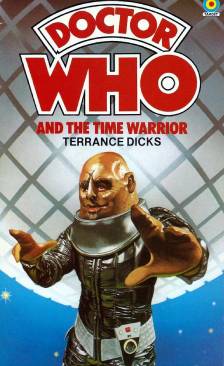
Cover: Linx the Sontaran strikes a dramatic pose before his globe-shaped craft, a superb photorealistic portrait by Roy Knipe. The cover for the 1993 reprint by Alister Pearson places the Doctor, Sarah and Irongron in square tiles behind Linx, who’s side on and holding his helmet by his side.

Final Analysis: It might be heresy but I’m not a fan of this story on TV and reading this story I can put it down to Alan Bromly’s static, leaden direction. But look at all the notes in this chapter and join me in wondering if Terrance Dicks was spurred on by his friend Holmes’ wonderful opening prologue – top three in the series so far (See also Doctor Who and the Crusaders and Doctor Who and the Day of the Daleks.). Compare the two descriptions of Linx’s face – the first is by Holmes, the second by Dicks, picking up the baton:

… the heavy bones, the flat powerful muscles, the leathery, hairless epidermis, the calculating brain.… little, red eyes that were like fire-lit caves under the great green-brown dome of a skull…

The face beneath was something out of a nightmare. The head was huge and round, emerging directly from the massive shoulders. The hairless skull was greenish-brown in colour, the eyes small and red. The little nose was a pig-like snout, the mouth long and lipless. It was a face from one of Earth’s dark legends, the face of a goblin or a troll. 

This extends to the major and minor characters – how Sir Edward waits for his wife to ‘run out of words’, (and on the very next line ‘It was a considerable wait’) and how Lady Eleanor’s eyes ‘gleamed’ at the prospect of the Doctor poisoning Irongron’s dog’. It’s clear Dicks enjoyed this. I know I did. 
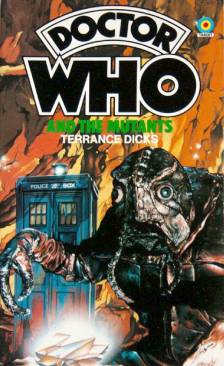
Chapter 35. Doctor Who and the Mutants (1977)

Synopsis: When the Doctor receives a mysterious object, it leads him and Jo to the planet Solos, a colony in Earth’s future empire ruled by a cruel and sadistic Marshal. The native Solonians are fighting for their rights to independence while also battling something far more puzzling – some of them are transforming into hideous insect-like creatures…

Chapter Titles

  • 1. The Hunters
  • 2. Mutant on the Loose!
  • 3. Assassination!
  • 4. Hunted on Solos
  • 5. The Experiment
  • 6. Escape
  • 7. The Attack
  • 8. The Trap
  • 9. The Fugitive
  • 10. The Crystal
  • 11. Condemned
  • 12. The Message
  • 13. The Investigator
  • 14. The Witness
  • 15. The Change

Background: Terrance Dicks adapts scripts from a 1972 story by Bob Baker and Dave Martin.

Notes: Solos is a ‘planet of jungles’, but still looks grey from orbit due to the mists. Varan’s son is called ‘Vorn’. Dicks writes that the Doctor was exiled by the Time Lords ‘for some unknown offence’; obviously Dicks himself knows why – he co-wrote the story that saw the Doctor exiled (and so do we), but Jo actually doesn’t – the closest she gets is in The Doomsday Weapon, where the Doctor explained that he used to roam the universe before the Time Lords caught him and trapped him on Earth – but he never explains to her precisely why!

Professor Jaeger is ‘a vain and unprincipled man, desperate for scientific recognition, but without the talent to attain it on his own’; he’s disgraced back on Earth after some scandal involving results stolen from a junior colleague. The Marshal, meanwhile, came to Solos as a security guard and slowly climbed his way up the ranks to his current position; he sees himself as the supreme power over Solos, which is why he is so desperate not to lose his position. Standing at the mouth of the caves, the Marshal uses a device with a ‘directional microphone’ to overhear Stubbs and Cotton talking to the Doctor to uncover their treachery. The Marshal has a secret exit behind the desk in his office, which Cotton knows about.

Cover: Jeff Cummins makes his first appearance with a splendid photorealistic cover. A mutant leers into frame just as the TARDIS materialises in a red-lit cavern. As with Doctor Who and the Space War, the title page in early editions of this book claimed that the front cover showed ‘the third DOCTOR WHO, whose physical appearance was altered by the Time Lords when they banished him to the planet Earth in the Twentieth Century’. Er…

Final Analysis: Despite being a huge fan of the Third Doctor, this has always been my least favourite of his stories, largely because the Marshal is such a relentless bully. He’s still that here, but it’s at least useful to get the perspective of every character working around him. Even Jaeger, who is enabling his ‘scorched Solos’ policy, is doing so for scientific glory, not for anything that might benefit the marshal politically. Dicks manages to edit down the six episodes in a tidy fashion, so even though some speeches are summarised or cut back, all the beats are there in the right order.

Chapter 31. Doctor Who and the Claws of Axos (1977)

Synopsis: A strange object from space lands on Earth near a nuclear power station. Inside are Axons, a family of golden beings who offer unlimited power in return for help with their damaged spacecraft. While the Doctor tries to keep an open mind, an ambitious politician rushes to seize the Axon’s power for his own interests. Deep inside the alien craft, the Master is being held captive – and as Jo Grant discovers, that’s not the only secret the Axons are keeping…

Chapter Titles

  • 1. Invader from Space
  • 2. The Landing
  • 3. The Voice of Axos
  • 4. Enter the Master
  • 5. The Doctor Makes a Plan
  • 6. Escape from Axos
  • 7. The Axons Attack
  • 8. The Power Robbers
  • 9. The Sacrifice
  • 10. Brainstorm
  • 11. The Feast of Axos
  • 12. Trapped in Time

Background: Terrance Dicks adapts scripts by Bob Baker and Dave Martin from the 1971 production.

Notes: As we first saw in Revenge of the Cybermen, Terrance alludes to the ‘blackness of deep space’ (and see The Ambassadors of Death for more on this). As it soars towards Earth, the Axos ship has a ‘constantly changing’ shape and glows with a ‘myriad of colours’ – its intention is to be noticed. The first scene with the two radio operators is expanded here; they’re not UNIT operators here, but personnel at the tracking station – Ransome and his assistant, Harry – who work down the list of people they need to contact and find ‘something called UNIT’. The first interaction between the Brigadier and Chinn also provides background information – the minister in overall charge of Chinn’s department cannot stand him, and as the Brigadier is also a problem, he decides to set the two men against each other in the hope that the winner will eliminate one or the other. Although UNIT is governed from Geneva, the Brigadier’s operations are part-funded by the British Government. Corporal Bell is not part of this story, her role is given to a nameless male technician.

We get an introductory scene (cut from the TV version but included as an extra on DVD) where Bill Filer is on the hunt for a man called ‘Joe Grant’ – and Jo corrects him. Bill is described as having ‘closely trimmed brown hair and a pleasantly ugly face’ – wow, that’s a pretty mean swipe at the reasonably handsome Paul Grist who played him.

The Doctor and Jo drive to the landing site in Bessie (yay!). The Axon who first frightens Jo subsequently appears as a male identical to the Axon leader. The Axon leader does not assume that the toad is livestock, but spells out the potential, had it been a ‘food animal’. The process transforms the toad into a huge form that overwhelms Chinn and makes him scream. Later, as Axos reacts to the Doctor’s experiment, the Eye of Axos is said to be ‘lashing wildly to and fro on its stalk’, which is much more fluid a movement than the TV prop could manage.

Jo overhears the Doctor speculating about Axonite’s potential for time travel and suspects he has selfish intentions early on. The Doctor spots straight away that the Axon-Filer is a fake thanks to his experience of the Autons replicating humans. He also baffles a sentry to gain access to the arrested Brigadier: ‘Good heavens, man, I know the Brigadier’s incommunicado. I’m incommunicado myself. There’s no reason why we can’t talk to each other.’ Delightful!

The Master enters the Nuton complex disguised as a visitings scientist and recalls the time he broke into UNIT HQ dressed as a ‘humble telephone engineer’. The Master’s TARDIS is a white dome, not a filing cabinet.

To the Eye of Axos’s surprise, the Doctor reveals that he’s deduced that Axos already has some limited ability for time travel; he realised that Axos reached Earth before the missiles were fired and Axos confesses that they can ‘move only moments in Time.’ Hardiman’s assistant (credited on screen as ‘Technician’) is named ‘Ericson’.

Cover: Achilleos gives us an eerie female Axon with rays of light coming from her eyes while an Axon monster looms behind her and the Doctor (taken from a photo from Frontier in Space) is pictured inset looking concerned. A 1979 edition had a cover by John Geary showing the adult male Axon and two very green Axon monsters.

Final Analysis: I’m hugely fond of The Claws of Axos TV episodes, one of those comfort stories I can bung on while I decide what I’d sooner be watching and then settle down and enjoy it. Terrance Dicks captures all of the conflicted loyalties that the Axons draw out of our heroes – are they victims in need, or should they have been blasted into bits from the start? –  but he enhances the suspicion that the Doctor is solely interested in using Axos to escape Earth and relishes in making Chinn hated by absolutely everyone he encounters. The Master once again enjoys the thrill of the adventure, deciding on a whim to jump from a bridge onto a UNIT truck and then exploiting his good fortune when it turns out to be going where he wants to be. The ending is also less rushed than on TV, as Bill Filer says his goodbyes and jokes that he’d thought England would be ‘dull’, Chinn scampers back to the Minister to try framing the success as his own, while the operation to rescue the TARDIS and get it onto the back of a UNIT truck turns into a huge argument, which Jo welcomes as things getting ‘back to normal’. 

Chapter 28. Doctor Who and the Carnival of Monsters (1977)

Synopsis: Aiming for the planet Metabelis III, the Doctor and Jo arrive on board a ship in the Indian Ocean. Something strange is going on as the crew and inhabitants of the vessel appear to be trapped in a time loop, repeating the same actions and conversations in a cycle. And then the ship is attacked by a prehistoric monster that has been extinct for millions of years. Meanwhile, the planet Inter Minor welcomes its first ever off-world visitors, including a travelling showman and his assistant who possess a rather unusual device that contains wonders from around the universe. Purely for entertainment, strictly non-political – and highly illegal.

Chapter Titles

  • 1. Dangerous Arrivals
  • 2. The Monster from the Sea
  • 3. The Giant Hand
  • 4. Trapped!
  • 5. Inside the Machine
  • 6. The Monster in the Swamp
  • 7. ‘Nothing Escapes the Drashigs’
  • 8. The Battle on the Ship
  • 9. Kalik Plans Rebellion
  • 10. The Doctor Takes Over
  • 11. Return to Peril
  • 12. The End of the Scope

Background: Terrance Dicks adapts the 1973 scripts by Robert Holmes, which also makes season 10 the first complete season available in Target form.

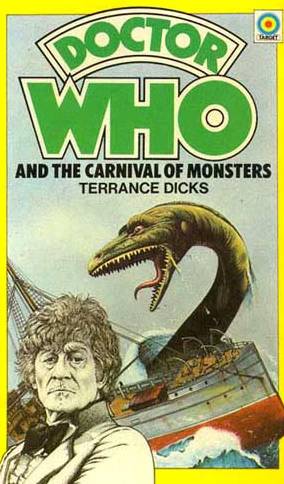
Notes: The story follows on immediately from The Three Doctors, published by Target two years before. The Scope draws in its audience, creating ‘a mild hypnotic effect, making the viewer feel part of the scene he was witnessing’. As well as environments containing humans, drashigs, Cybermen and Ogrons, we’re told that the Scope also has a collection of Ice Warriors. The Doctor uses a flare gun that he pocketed from the SS Bernice to ignite the marsh gas on the drashig’s planet (he uses his sonic screwdriver on TV). The drashig differs significantly from the beast seen onscreen; lacking the six eyes and gaining limbs, it’s less worm-like and a lot closer to the plesiosaur on the original front cover:

… something between a dinosaur and a dragon with squat body, powerful clawed legs, a sinuous neck and a mouth that seemed to contain not two but at least a dozen rows of enormous razor-edged teeth. The eyes were small and blinking, the nostrils huge and flared. 

Describing his part in vanquishing the drashigs, Vorg claims he is an ‘old soldier’. After the death of Kalik, Orum confesses to his part in the conspiracy, but Plectrac assures Jo that an inquiry must still take place for the sake of procedure – and it’s this that prompts the Doctor and Jo to depart..

Cover: Within a bright yellow frame, Chris Achilleos shows a plesiosaurus as it curves around a ship in the ocean and a monochrome Doctor looks sternly at the reader. The 1993 reprint cover art by Alister Pearson is a lot busier (in a good way!), incorporating a dramatic portrait of Jon Pertwee, two face-pics of Shirna and Vorg in a moody blue, while an Inter Minor administrator inspects the mini-scope and two drashigs loom up from the bottom of the page.

Final Analysis: Adapting Robert Holmes’ satire on bureaucracy, Dicks seems to tap into some of Malcolm Hulke’s influence. His description of the splitting of the ruling and functionary castes into two different species seems vaguely more political than usual. By the story’s conclusion, Officials and Functionaries alike congregate to congratulate Vorg and there’s no sign of the lower caste being ushered away. Maybe that’s wishful thinking but the suggestion is there. As mentioned in the introduction, this was one of four books I received as a Christmas present in 1980, the first Target books I owned, rather than loaning from the library. This was a year before I saw the story repeated as part of the ‘Five Faces of Doctor Who’ season, so it was a favourite even before I saw what a Drashig looked like, which for once was much more creative and fearsome on TV than the book had led me to believe.

Chapter 26. Doctor Who and the Planet of the Daleks (1976)

Synopsis: The TARDIS lands on the planet Spiridon, populated by killer plants, monstrous beasts and hostile invisible natives. The Doctor and Jo encounter a small group of space travellers, Thals from the planet Skaro. The Thals are tracking a small Dalek unit, hoping to destroy them. Then a second group of Thals arrives with grave news – deep beneath the planet’s surface awaits an army of thousands of Daleks.

Chapter Titles

  • 1. Jo Alone
  • 2. The Invisible Menace
  • 3. The Deadly Trap
  • 4. In the Power of the Daleks
  • 5. The Escape
  • 6. Danger on Level Zero
  • 7. Ascent to Peril
  • 8. The Enemy Within
  • 9. Vaber’s Sacrifice
  • 10. Return to the City
  • 11. An Army Awakes
  • 12. The Last Gamble

Background: Terrance Dicks adapts scripts by Terry Nation for the 1973 serial. Conveniently, this followed Frontier in Space on TV, so that’s another pair of stories to be released consecutively.

Notes: Despite being published a month after The Space War, the beginning doesn’t match up with how that ended, but with how the TV episodes played out – the Doctor has been wounded after being ambushed by the Daleks. Which means there’s a potential unseen adventure in the Target universe between the two stories in which the Doctor is injured in a battle with Daleks. 

The tentacle that snakes towards Vaber belongs to a huge carnivorous bell-plant 20 feet across and the eye plants open their ‘eye’ only when something comes near. We’re offered a little more detail about the Spiridons, a once-great race who developed invisibility as a survival technique against the hostile environment, but all that remains of their civilisation are the ruins. The Daleks ‘saturated the jungles with killer rays’ to guarantee the Spiridons’ subjugation.

The Dalek hierarchy includes an expedition commander, patrol leaders, technicians and a chief scientist as well as the Dalek Supreme. The Supreme is head of the Supreme Council (not just a member of the council) and ‘second only to the Emperor himself’ – and it is described as ‘not the usual silver’ (so the Dalek troopers might match those in Death to the Daleks?). 

Rebec operates the decoy Dalek because she can tell Jo was too afraid. Wester destroys the Dalek immunisation device before releasing the virus. Taron gives the Doctor and Jo anti-jungle coverings and spray to get them safely back to the TARDIS.

Cover: Utterly perfect pulp excellence from Chris Achilleos as the Doctor and the Thal Taron wrestle with a Dalek, which blasts away the side of the frame, all against a crazy lurid background of meteors soaring past a green planet. The 1992 reprint art from Alister Pearson is much more low-key, the Doctor shows off his Spiridon cloak and a patrol of Daleks, like, totally snub him as they glide by.

Final Analysis: How lovely to have this follow on from The Space War, just as it followed Frontier in Space on telly, even if the two books don’t really match up. It remains an epic adventure, every bit the remake of the very first Dalek adventure, but improved on the page by Dicks’s subtle additions to make the alien world feel much more expansive and more terrifying than BBC Television Centre could realise (and indeed more than a few fans felt disappointed by the ‘real’ version when they saw it on home video as it lacked the scale of the novel). The Daleks themselves have a little more personality than their TV counterparts too and at the climax to the story, there’s a gorgeous summation of the Dalek expedition, just before the Supreme delivers that curt motivation speech:

The Dalek Supreme turned arrogantly to his aides. It had been a day of total catastrophe, the army buried, the Spiridon expedition wiped out, the city destroyed. Any other life-form would have been crushed by despair. But Daleks do not recognise defeat. They ignore it and carry on their chosen path of conquest and destruction.

Chapter 19. Doctor Who and the Dinosaur Invasion (1976)

aka Doctor Who – Invasion of the Dinosaurs (1993)

Synopsis: The Doctor and Sarah return to Earth to discover that London has been evacuated due to a spate of dinosaurs appearing and disappearing across the city. While the Doctor goes on the hunt for monsters, Sarah uncovers a conspiracy that implicates some very surprising people.

Chapter Titles

  • Prologue
  • 1. London Alert!
  • 2. ‘Shoot to Kill!’
  • 3. The Time Eddy
  • 4. The Timescoop
  • 5. Monster in Chains
  • 6. The Spaceship
  • 7. The Reminder Room
  • 8. Escape!
  • 9. Operation Golden Age
  • 10. The Final Countdown

Background: Malcolm Hulke adapts his 1974 scripts for Invasion of the Dinosaurs.

Notes: An opening scene is added, introducing Shughie McPherson, a football fan from Glasgow who wakes up in an evacuated London and is killed by a dinosaur. The Doctor and Sarah find a cafe and discover the food’s rotten, while the Doctor is aghast that he’s taken Sarah around time and space but she gets really excited by the sight of a Woolworths (and later he points out a Wimpy’s too); this hints that they’ve had adventures since The Time Warrior but this is their first time together back on modern-day Earth. 

Infamously, Butler has a ‘livid scar’ on his face, so that Hulke can make him easy to identify without spelling out who he is – very inventive (he could hardly say ‘a man who looked just like Martin Jarvis’, although that would have added a little extra fun to the audiobook). It also serves to humanise him when Sarah cruelly attacks him for choosing to be ‘ugly’ only to learn that he got the scar while serving as a fire officer saving the life of a child (and Sarah quickly apologises for being so callous). There’s no weird new car for the Doctor; instead, he borrows a motorcycle as the best way to get around London (which all feels much more logical and in keeping for this Doctor).

As he watches the Doctor on a TV monitor, Professor Whitaker comments that the intruder is ‘terribly handsome’, which seems to be an addition perhaps inspired by the casting of the Professor onscreen, but it does add an extra dimension to him (on paper, he’s also extra-arrogant and driven by the glory of proving wrong a load of people who might not ever exist if he succeeds!). The story has a new conclusion where the Doctor shows Sarah a passage in Ezekiel that describes where Professor Whitaker and Grover might have ended up.

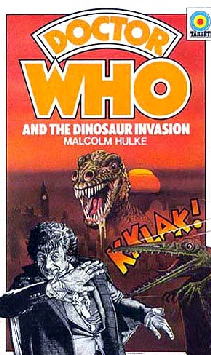
Cover: Best cover artwork ever. It’s just so lurid and melodramatic and sums up the vast differences between the TV version and the imagination of a child who’s read the book (and I do love both). The cheeky “KKLAK!” really makes it. Having stood in the living room of the person who owns the original art, I marvelled at the beauty of it and had criminal thoughts. The first edition I read was the 1978 reprint with a cover by Jeff Cummins showing a dinosaur standing on the lower steps at St Pauls (those ones we remember the Cybermen descending in The Invasion). Alister Pearson’s cover for the 1993 rerelease (as Invasion of the Dinosaurs) shows the Doctor with his weird device and a tyrannosaurus rex, with a very subtle incorporation of the London Underground logo in a manner that might be familiar to fans of Jurassic Park. It also solidifies Pearson’s record as the only artist to provide cover art for all of the novelisations in three entire seasons of stories.

Final Analysis: This has long been one of my favourites, ever since I picked up on a character having ‘badly bitten fingernails’, while Professor Whitaker’s are ‘well-polished’. That kind of subtle detail really jumped out at me at aged eight and it still does many years later. Hulke’s eagerness to give a balanced view of his worlds extends to showing us how a stegosaurus reacts to being shot at on Hampstead Heath and I’m not even going to make a joke about that or point out that dinosaurs and mammals didn’t really hang out together in the past.

Just a few additional lines to Mark and Adam on the ‘spaceship’ also help to flesh them out a bit and make them more rounded. Adam concludes that Grover is ‘a raving lunatic’ but Sarah counters that the politician knows exactly what he’s doing. Mark rounds on Ruth because, confronted with the evidence against Grover, she still supports him because she ‘can’t stand being made a fool of! You must never be wrong!’

It all helps to sell the underlying message: As with The Cave Monsters, the title has a double meaning as there’s more than one kind of dinosaur in Westminster; there’s also the type who can’t let go of ancient history and wants to drag us all back with them to a time that never really existed. Thanks in part to the actual dinosaurs being much more realistic and thrilling on the page than on screen, plus some deeper characterisation that helps us understand who these people are, this really might be the best Target novel so far. Trust me.

Chapter 17. Doctor Who – The Three Doctors (1975)

Synopsis: A strange blob of jelly invades UNIT HQ while the Time Lords are being drained of energy. The answer to the mystery lies on the other side of a black hole, where a Time Lord legend waits to enact his revenge. As the Time Lords break one of their strictest rules to allow three of the Doctor’s incarnations to work together, Jo Grant worries they might only end up bickering…

Chapter Titles

  • 1. Lightning from Space
  • 2. Attack from the Unknown
  • 3. The Menace of the Black Hole
  • 4. Beyond the Unknown
  • 5. A Shock for the Brigadier
  • 6. In the Hands of the Enemy
  • 7. Door to Freedom
  • 8. Escape from Omega
  • 9 .’All things shall be destroyed’
  • 10. Return through the Flame
  • 11. Three Doctors Minus Two

Background: Terrance Dicks adapts the 1973 scripts by Bob Baker and Dave Martin.

Notes: The Second Doctor has ‘dark brown eyes’ (which doesn’t match Patrick Troughton) that are ‘at once humorous and sad’. Omega’s servants are only called ‘Jelly creatures’ and ‘blob-men’ – not ‘Gellguards’ as we’ve come to know them. The First Doctor asks ‘what’s a bridge for?’ and it’s Jo who suggests ‘crossing?’, prompting the old Doctor to note ‘Gel’s got more sense than the two of you put together!’ (it’s the Third Doctor who grabs the glory on TV). The battle with Omega’s monster takes place in an open-air arena and the beast itself is still humanoid but eight feet tall and muscular (rather than a short avante-garde dance performer). There’s a hilarious pitch battle in chapter 10 where Jo is ‘staggering under the weight of an anti-tank rifle’ before she fires at the blob men and falls backwards, deciding instead to be an ‘observer’.

Cover: A Chris Achilleos classic, using references from the familiar Three Doctors photoshoot and merging them with a classic Jack Kirby Fantastic Four cover (depicting Galactus where Omega would be). It’s a vision in orange and gold. The first edition also has a rear illustration by Achilleos showing the second Doctor being led away by two blob-men. My first copy was the 1978 reprint with a cover by Jeff Cummins showing the three Doctors in front of a black hole in space (it’s the one a reader of Doctor Who Magazine criticised for making the Doctors look too old, too evil and ‘too Welsh’!). The Pertwee is from Invasion of the Dinosaurs, the Hartnell from An Unearthly Child and the Troughton isn’t the Doctor, but Salamander – hence why he’s ‘too evil’. A 1991 edition with a cover by Alister Pearson is a little more stylised, with a photorealistic Omega ranting before a backdrop of burnt-out Doctors as banners in front of a black circle.

Final Analysis: Dicks makes Jo our point-of-view character, so to her, the other Doctor that Benton knows is her ‘Doctor Two’, while the one on the scanner screen is ‘the old man’ and ‘the old Doctor’, which works so well. Dicks also has Doctor Two correctly identify his instrument as a recorder – then refer to it as a ‘flute’ for the rest of the book!

Chapter 16. Doctor Who and the Planet of the Spiders (1975)

Synopsis: The Doctor’s adventures come back to haunt him as a stolen gem from Metebelis Three triggers ‘the most dangerous adventure of his life’. The Doctor’s greed for adventure and knowledge is matched by the greed for power of the Eight-Legs and their leader, the Great One. And none of them will survive this one… 

Chapter Titles

  • Prologue: The Mystery of the Crystal
  • 1. The Menace at the Monastery
  • 2. The Deadly Experiment
  • 3. The Coming of the Spider
  • 4. The Chase for the Crystal
  • 5. The Council of the Spiders
  • 6. Arrival on Metebelis Three
  • 7. Prisoner of the Spiders
  • 8. The Doctor Hits Back
  • 9. In the Lair of the Great One
  • 10. Return to Earth
  • 11. The Battle with the Spiders
  • 12. The Last Enemy
  • Epilogue: An End and a Beginning

Background: Terrance Dicks adapts scripts by Robert Sloman (and Barry Letts, uncredited) from 1974.

Notes: Another lovely prologue that I wish we’d seen on TV as Professor Jones and his new bride encounter resistance in their trek across the Amazon forests. Jo Jones, formerly Jo Grant of UNIT, has to ditch a huge blue crystal that the Doctor gave her as a wedding present. There’s a Dr Sweetman working as UNIT’s medical officer today [but see The Giant Robot]. The soldier on guard at UNIT HQ gets a name (Corporal Hodges). We also find out that four of Lupton’s gang were hospitalised with nervous breakdowns, while the Brigadier helps Sarah to get Tommy into university.

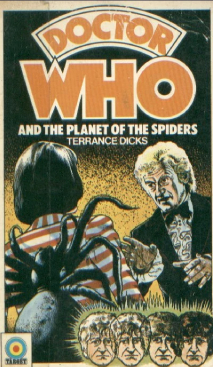
Cover: ‘Read the last exciting adventure of DR WHO’s 3rd Incarnation!’ screams the back cover. On the front, Peter Brookes gives us the Doctor reacting to Sarah with the Queen Spider on her back, along with a montage of the Doctor changing face that’s much more dramatic than we get on telly. There are no illustrations inside but there’s one on the back cover of a spider crawling across a mandala. I had the 1978 reprint with an Alun Hood cover depicting a blue crystal and a red-backed tarantula clambering over some rocks. The 1991 reprint with art by Alister Pearson shows a haunted portrait of Pertwee reflected in the blue crystal and another tarantula-like arachnid reared to attack.

The epilogue is called ‘An End and a Beginning’; we’ll be seeing variations on this a lot over the next few years.

Final Analysis: My earliest memory is of Planet of the Spiders, where a spider appearing on a carpet after some men chant ‘Um Andy Pandy Um’ (I know what they chant now, of course!), so this holds a special relevance for me. This is a decent adaptation with some lovely additions to the thought processes of the characters. Dicks captures Sarah’s voice particularly well (although once again, he has her fainting!) and he adds greatly to our understanding of Lupton and his bitterness. We also benefit from a much more thrilling – and logical – version of the very padded chase sequence.

Chapter 11. Doctor Who and the Curse of Peladon (1975)

Synopsis: Alien delegates assemble on the eve of the planet Peladon’s acceptance into a galactic federation. King Peladon balances the superstition of his people and the promises of advancement, but his High Priest, Hepesh, wishes to preserve the Old Ways. The old priest plots to sabotage the King’s ambitions with help from an alien with selfish plans of their own. As the Doctor becomes entwined in the political future of this primitive planet, King Peladon of Peladon makes a proposal to Jo – an allegiance bonded in marriage…

Chapter Titles

  • 1. The Deadly Guardian
  • 2. Into the Chasm
  • 3. An Enemy from the Past
  • 4. The Doctor Must Die
  • 5. The Attack on Arcturus
  • 6. The Temple of Aggedor
  • 7. Escape to Danger
  • 8. Trial by Combat
  • 9. A Conspiracy of Terror
  • 10. The Battle for the Palace
  • 11. The King’s Avenger

Background: Bryan Hayles adapts his own 1972 scripts. 

Notes: King Peladon’s mother is named (Ellua) and she may have had a passing resemblance to Jo. Alpha Centauri changes colour, like a cuttlefish, to reflect moods. There are a few extra scenes, such as a chat between the Doctor and Ssorg, and another between Jo and Grun, just before the duel. Peladon saves Jo’s life by making sure Jo is not overheard by Hepesh when she criticises him about the Doctor’s trial (Hepesh would certainly call for Jo’s death too) and later, before a statue of Aggedor, Peladon vows to rid his land of all iconography of the beast if the Doctor is killed in the duel.The Doctor is specific about his encounters with the Ice Warriors, telling Jo he’s ‘met them twice so far’.

Cover & Illustrations: The first cover was again by Chris Achileos, a nice montage of the Doctor, Alpha, Aggedor (with smoking nostrils) and Ssorg. An illustration by Bill Donohoe solely for a 1981 hardback edition uses photo references from The Monster of Peladon for another Ice Warrior, Alpha and Aggedor group shot. Alister Pearson’s 1992 reprint cover shows the Doctor in weirdly beautiful blue-red lighting, the citadel, Arcturus, Ssorg and Aggedor. Alan Willow provides internal illustration again and it’s taken me way too long to realise that he wouldn’t have had access to the tapes, only of selected publicity photos, which is why the likenesses of the guest cast in these books are often so unlike their TV counterparts (here, King Peladon looks suspiciously like Christopher Lee!). Willow’s Aggedor is more monstrous and huge than on screen and the arena for the duel between the Doctor and Grun looks like a traditional medieval pageant.

Final Analysis: Bryan Hayles’ first novelisation and the ‘Escape to Danger’ chapter title makes its first appearance in a Target original (though we’ve been close a few times). This is largely a straightforward summary of the TV episode with just a few deviations and elaborations (noted above), but what he does change is for the benefit of the characters, in particular the Martians and Alpha Centauri.

Chapter 8. Doctor Who and the Daemons (1974)

Synopsis: The Master’s up to no good in an English village, posing as both a vicar and the leader of a satanic cult. The Doctor and Jo appear on TV and they take on the Master, a gargoyle and an ancient god – with the help of UNIT and a self-proclaimed white witch.

Chapter Titles

  • Prologue
  • 1. The White Witch
  • 2. The New Vicar
  • 3. The Opening of the Barrow
  • 4. The Appearance of the Beast
  • 5. The Heat Barrier
  • 6. Meetings
  • 7. Explanations
  • 8. The Second Appearance
  • 9. Into Danger
  • 10. The Third Appearance
  • 11. The Rescue
  • 12. Into the Cavern
  • 13. The Sacrifice
  • Epilogue

Background: Barry Letts adapts the 1971 scripts he co-wrote with Robert Sloman as ‘Guy Leopold’.

Notes: An early manifestation of Azal is much more dramatic, involving the death of the verger. Benton recalls earlier adventures with the cybermen, Axons and the daffodil-touting autons, none of which have been novelised by this point, while Jo recalls her first meeting with the Master as seen on TV but which flatly contradicts the books so far. We also get the first revelation that the Doctor and the Master were schoolfriends – and that the Doctor wasn’t a particularly keen student. Azal reveals that his race were responsible for the dispassionate destruction of all life on the planets Talkur and Yind. The character of Stan Wilkins is new to the book, on TV he’s just a nameless acolyte in the coven who recognises that the Master is evil and tries to save Jo and the Doctor. His courage serves to make Jo’s attempted self-sacrifice all the braver. Stan also gets to review events with ‘mixed feelings’ in the epilogue; while he acknowledges the number of people who’ve died, he also realises that he’ll inherit his uncle’s garage and be able to care for his ‘Mam’.

Cover & Illustrations:  The original cover was by Chris Achilleos following the now-familiar formula of the Doctor’s face with a head-shot of Azal and a teeny Bok. Internal illustrations are by Alan Willow. There’s a lovely drawing of Jo back against an ivy-covered wall (that’s based on a photo from The Sea Devils), but Azal and Bok are both faithfully reproduced. My first cover was the 1980 reprint with a portrait by Andrew Skilleter of Azal in the cavern, while the 1993 reprint used Alister Pearson’s VHS cover, with an almost-Celtic cross that shows the Doctor and Master both in half-portrait, Azal at the top and Bok at the bottom against a sunburn-pink background.

Final Analysis: Barry Letts adapts the scripts well, so it’s surprising this is his only novelisation of a TV story (though it’s not his only entry in this blog – as you’ll find out in about 146 chapters). It enhances what was possible on telly but doesn’t elaborate vastly; the prologue is just everything that happens on TV before the Doctor appears, where Mac Hulke might have given us an insight into Azal’s arrival on Earth. Azal gets a better motivation to implode though – being both confused by Jo’s illogical actions and on the verge of death anyway. We do gain some lovely insight into the Squire (a minor character on TV), who is perplexed by his regular headaches that always arrive the morning after a night in the pub. And the lead character is referred to as ‘Doctor Who’, right at the start of the first chapter.