Chapter 17. Doctor Who – The Three Doctors (1975)

Synopsis: A strange blob of jelly invades UNIT HQ while the Time Lords are being drained of energy. The answer to the mystery lies on the other side of a black hole, where a Time Lord legend waits to enact his revenge. As the Time Lords break one of their strictest rules to allow three of the Doctor’s incarnations to work together, Jo Grant worries they might only end up bickering…

Chapter Titles

  • 1. Lightning from Space
  • 2. Attack from the Unknown
  • 3. The Menace of the Black Hole
  • 4. Beyond the Unknown
  • 5. A Shock for the Brigadier
  • 6. In the Hands of the Enemy
  • 7. Door to Freedom
  • 8. Escape from Omega
  • 9 .’All things shall be destroyed’
  • 10. Return through the Flame
  • 11. Three Doctors Minus Two

Background: Terrance Dicks adapts the 1973 scripts by Bob Baker and Dave Martin.

Notes: The Second Doctor has ‘dark brown eyes’ (which doesn’t match Patrick Troughton) that are ‘at once humorous and sad’. Omega’s servants are only called ‘Jelly creatures’ and ‘blob-men’ – not ‘Gellguards’ as we’ve come to know them. The First Doctor asks ‘what’s a bridge for?’ and it’s Jo who suggests ‘crossing?’, prompting the old Doctor to note ‘Gel’s got more sense than the two of you put together!’ (it’s the Third Doctor who grabs the glory on TV). The battle with Omega’s monster takes place in an open-air arena and the beast itself is still humanoid but eight feet tall and muscular (rather than a short avante-garde dance performer). There’s a hilarious pitch battle in chapter 10 where Jo is ‘staggering under the weight of an anti-tank rifle’ before she fires at the blob men and falls backwards, deciding instead to be an ‘observer’.

Cover: A Chris Achilleos classic, using references from the familiar Three Doctors photoshoot and merging them with a classic Jack Kirby Fantastic Four cover (depicting Galactus where Omega would be). It’s a vision in orange and gold. The first edition also has a rear illustration by Achilleos showing the second Doctor being led away by two blob-men. My first copy was the 1978 reprint with a cover by Jeff Cummins showing the three Doctors in front of a black hole in space (it’s the one a reader of Doctor Who Magazine criticised for making the Doctors look too old, too evil and ‘too Welsh’!). The Pertwee is from Invasion of the Dinosaurs, the Hartnell from An Unearthly Child and the Troughton isn’t the Doctor, but Salamander – hence why he’s ‘too evil’. A 1991 edition with a cover by Alister Pearson is a little more stylised, with a photorealistic Omega ranting before a backdrop of burnt-out Doctors as banners in front of a black circle.

Final Analysis: Dicks makes Jo our point-of-view character, so to her, the other Doctor that Benton knows is her ‘Doctor Two’, while the one on the scanner screen is ‘the old man’ and ‘the old Doctor’, which works so well. Dicks also has Doctor Two correctly identify his instrument as a recorder – then refer to it as a ‘flute’ for the rest of the book!
Chapter 16. Doctor Who and the Planet of the Spiders (1975)

Synopsis: The Doctor’s adventures come back to haunt him as a stolen gem from Metebelis Three triggers ‘the most dangerous adventure of his life’. The Doctor’s greed for adventure and knowledge is matched by the greed for power of the Eight-Legs and their leader, the Great One. And none of them will survive this one… 

Chapter Titles

  • Prologue: The Mystery of the Crystal
  • 1. The Menace at the Monastery
  • 2. The Deadly Experiment
  • 3. The Coming of the Spider
  • 4. The Chase for the Crystal
  • 5. The Council of the Spiders
  • 6. Arrival on Metebelis Three
  • 7. Prisoner of the Spiders
  • 8. The Doctor Hits Back
  • 9. In the Lair of the Great One
  • 10. Return to Earth
  • 11. The Battle with the Spiders
  • 12. The Last Enemy
  • Epilogue: An End and a Beginning

Background: Terrance Dicks adapts scripts by Robert Sloman (and Barry Letts, uncredited) from 1974.

Notes: Another lovely prologue that I wish we’d seen on TV as Professor Jones and his new bride encounter resistance in their trek across the Amazon forests. Jo Jones, formerly Jo Grant of UNIT, has to ditch a huge blue crystal that the Doctor gave her as a wedding present. There’s a Dr Sweetman working as UNIT’s medical officer today [but see The Giant Robot]. The soldier on guard at UNIT HQ gets a name (Corporal Hodges). We also find out that four of Lupton’s gang were hospitalised with nervous breakdowns, while the Brigadier helps Sarah to get Tommy into university.

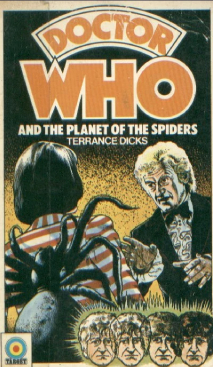
Cover: ‘Read the last exciting adventure of DR WHO’s 3rd Incarnation!’ screams the back cover. On the front, Peter Brookes gives us the Doctor reacting to Sarah with the Queen Spider on her back, along with a montage of the Doctor changing face that’s much more dramatic than we get on telly. There are no illustrations inside but there’s one on the back cover of a spider crawling across a mandala. I had the 1978 reprint with an Alun Hood cover depicting a blue crystal and a red-backed tarantula clambering over some rocks. The 1991 reprint with art by Alister Pearson shows a haunted portrait of Pertwee reflected in the blue crystal and another tarantula-like arachnid reared to attack.

The epilogue is called ‘An End and a Beginning’; we’ll be seeing variations on this a lot over the next few years.

Final Analysis: My earliest memory is of Planet of the Spiders, where a spider appearing on a carpet after some men chant ‘Um Andy Pandy Um’ (I know what they chant now, of course!), so this holds a special relevance for me. This is a decent adaptation with some lovely additions to the thought processes of the characters. Dicks captures Sarah’s voice particularly well (although once again, he has her fainting!) and he adds greatly to our understanding of Lupton and his bitterness. We also benefit from a much more thrilling – and logical – version of the very padded chase sequence.

Chapter 15. Doctor Who and the Green Death (1975)

Synopsis: Deep beneath the hills of a Welsh town, pollutants from a chemical factory have caused the deaths of local miners. Worse, the chemicals have transformed maggots into deadly monsters. Fighting the chemical company is an idealistic young professor, who’s unimpressed by a clumsy fool of a girl from UNIT who wants to join his cause. Meanwhile, the Doctor finally lands the TARDIS on Metebelis Three…

Chapter Titles

  • 1. ‘Wealth in our time!’
  • 2. The Doctor Plans a Holiday
  • 3. Land of My Fathers
  • 4. Into the Mine
  • 5. Escape!
  • 6. The Sluice Pipe
  • 7. The Egg
  • 8. The Maggots
  • 9. The Swarm
  • 10. The Green Death
  • 11. The Chrysalis
  • 12. One World, One People, One BOSS!

Background: Malcolm Hulke adapts scripts from the 1974 serial by Robert Sloman and (uncredited) Barry Letts. 

Notes: The Global Chemicals of the TV show is now Panorama Chemicals. Elgin gets a first name (Mark) and a job title (public relations), and he doesn’t disappear as in the TV version, so his TV replacement, Mr James, doesn’t appear. Hulke has a lot of fun with Metebelis Three, constructing a bit of a legend around it involving a lone Time Lord and then giving us an insane escapade involving unicorns and giant eagles. The Doctor keeps the Professor’s gang amused with stories of his journey to Metebelis Three, rather than that wonderfully incomprehensible nonsense about the perigosto stick from the telly. Jo speculates why the Doctor never married, or even if there are Lady Time Lords, while stating on the very last page that the Doctor is 725 years old. In the TV story, the actual term ‘Green Death’ is never mentioned; in the book it appears in descriptions and dialogue eleven times.

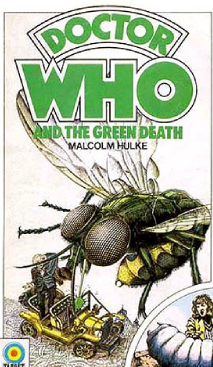
Cover & Illustrations: The first edition cover, by Peter Brookes, shows a giant green fly raining acid down onto the Doctor and Bessie while in inset, Jo recoils from a huge maggot. On the back cover, there’s another two-panel illustration, depicting Ted Hughes discovering the deadly green goo in the mine. There’s a similar illustration of that scene inside, one of six by Alan Willow, the best of which shows the Doctor and Jo in a mine-cart surrounded by maggots. I had Alun Hood’s 1979 reprint cover, which has a beautiful dragonfly stretching its wings across the bleak murky landscape of the mine, surrounded by maggots. This is the final Target book to have illustrations.

Final Analysis: The opening chapter explains why the coal mines are being closed (and how the miners feel about this), how Elgin views the locals (being university educated, he considers himself superior to them) and what Stevens thinks of everyone else. And Professor Jones and Dai Evans discuss the forces of production in relation to the mining industry and the people of Llanfairfach – before they’re interrupted by the first tragic event. Even in the climax, the Doctor worries about whether any of BOSS’s ‘slaves or semi-slaves died’ in the aftermath. It’s not too heavy-handed, but it leaves us no uncertainty as to where Hulke’s politics might lean.

How strange that Jo Grant’s final story follows her first in publication order. And is followed by the Third Doctor’s last.

Chapter 14. Doctor Who and the Terror of the Autons (1975)

Synopsis: A renegade Time Lord calling himself ‘The Master’ has followed the Doctor to Earth and as an introductory calling card he’s brought the Autons with him. The Doctor has even more trouble on his hands with a new assistant forced upon him by the Brigadier, the very keen and very newly qualified agent Jo Grant.

Chapter Titles

  • 1. The Terror Begins
  • 2. Sabotage at the Space Probe
  • 3. The Master Takes Over
  • 4..Death at the Plastics Factory
  • 5. The Killer Doll
  • 6. In the Hands of the Autons
  • 7. The Battle of the Forest
  • 8. The Killer Doll Attacks
  • 9. The Deadly Daffodils
  • 10. Prisoners of the Master
  • 11. The Final Assault
  • 12. The End of Round One

Background: Terrance Dicks adapts Robert Holmes’ 1971 scripts.

Notes: Our introduction to Luigi Rossini (real name here is ‘Lew Ross’) presents a much more consciously obnoxious figure, employing labour of a mainly criminal type as they’re cheap and won’t risk complaining. This includes Tony the Strongman, who’s wanted by the police. Rossini manages to persuade his crew that the Doctor and Jo blew up Phillips as they were trying to steal the mob’s wages. The Auton meteorite device glows green as in The Auton Invasion, while the Master says that the plastic chair that kills McDermott is made of ‘polynestine’. The Doctor recognises the visiting Time Lord as being a member of the High Council who exiled the Doctor to Earth.

The Doctor recognises the device that the Master leaves in the cabin of the radio telescope is a ‘Volataliser’, a product of ‘The Xanthoids [who] use them for mining operations’, while the one that Jo tries to detonate in the UNIT lab is ‘a Saturnian Solar Bomb’. One of the best / nastiest additions is the revelation that the Master uses Professor Phillips to help him operate controls within his Tardis, but when he’s not on duty, he is both disguised as – and forced to work as – an actual clown, because it amuses the Master to ‘degrade a brilliant scientist into a mindless buffoon’. There’s a gap of a few days between Mr Farrel’s death and the Doctor’s visit to his wife, and the distribution of the daffodils spans a few more days too. Brownrose from the Ministry is completely removed and I didn’t even notice until just now. And of course, as the cover reveals, the description of the Nestene’s arrival is much more impressive than on TV.

Considering the Master’s crimes, the Doctor provides an insight into their race:

Once captured by the Time Lords, the Master’s life-stream would be thrown into reverse. Not only would he no longer exist, he would never have existed. It was the severest punishment in the Time Lords’ power.

The text refers to the ‘chameleon mechanism’ and ‘chameleon circuits’ for the first time in print (and ‘chameleon circuit’ won’t be said on screen until Logopolis!). There’s also a reference to a ‘Sontaran fragmentation grenade’ (the story came before their first appearance, but the novelisation was published a year after The Time Warrior aired). The Doctor makes good use of his sonic screwdriver, dismantling a bomb, opening the Auton-containing safe and trying to break into the Master’s Tardis. We’re party to the Master’s thought processes as he weighs up his options in turning against the Nestene, swayed by the Doctor’s persuasive argument – and the Brigadier’s pistol.

Cover & Illustrations: Peter Brookes’ original cover depicts a scene that doesn’t actually happen on TV as the one-eyed crabtopus Nestene creature envelops the radio telescope and, inset, the Doctor makes a surprise entrance as the Master plays with a lever. The back cover again features an illustration, Captain Yates inspects a fallen auton carnival dummy while another soldier in silhouette takes on a horde of autons. The 1979 reprint boasts a cover by Alun Hood, again depicting the imagined Nestene but in a more photorealistic style more akin to a Pan horror book; this was the edition I first owned and I was convinced this was a photo of the prop they used (what a disappointment the TV version turned out to be!). Alan Willow provides six illustrations, all of which expand upon what we saw on TV. It’s hard to pick a favourite although I love the one of the radiotelescope technician working away as ‘A dark shape peered down at him’ – the Master, snooping through a skylight, is much more dramatic than him just stepping through a door. 

Final Analysis: Another good job by Dicks here, covering a lot of ground and adding nuance where appropriate. Jo’s previous ‘debut’ in The Doomsday Weapon is glossed over, but there’s some decent continuity between this and The Auton Invasion, including the Brigadier asking why they can’t just do what they did last time and the Doctor points out all the flaws in his previous attack plan.

Chapter 13. Doctor Who and the Giant Robot (1975)

aka Doctor Who – Robot (1992)

Synopsis: As everyone comes to terms with the appearance and behaviour of a brand new Doctor, a robot with conflicting orders is stealing parts for a super-weapon. Sarah Jane Smith investigates an elite scientific research group while new arrival Harry Sullivan tries his hand at playing James Bond.

Chapter Titles

  • 1. Killer in the Night
  • 2. Something More than Human
  • 3. Trouble at Thinktank
  • 4. Robot!
  • 5. The Killer Strikes Again
  • 6. Trapped by the Robot
  • 7. The World in Danger
  • 8. In the Hands of the Enemy
  • 9. The Battle at the Bunker
  • 10. The Countdown Begins
  • 11. The Kidnapping of Sarah
  • 12. The Giant Terror

Background: Terrance Dicks adapts his own scripts for the 1974-5 story Robot (snatching the record from The Sea Devils for the shortest gap between broadcast and novelisation publication, at one month and three weeks).

Notes: The regeneration is a lot more involved and emotional than the simple cross-fade seen on telly. It’s told in flashback from the Brigadier’s point of view and it enables Dicks to give us a very brief history of the Brigadier’s relationships with his two previous Doctors.

Suddenly it had been all over. A new man with a new face was lying on the laboratory floor. Like, and yet unlike. Still tall and thin, still with the same rather beaky nose. But a younger man, the face far less lined, a tangle of curly brown hair replacing the flowing white locks.

The Doctor’s recovery takes much longer than on screen. The Doctor’s car, Bessie, is described as ‘an old Edwardian roadster’ (and we’ll see variations of this again over the years). On first seeing the robot, Sarah faints (no, she doesn’t, Terrance! No!). There’s a new scene where UNIT raids Thinktank only to discover they’ve already abandoned their base, while the K1 robot is attacked by RAF jets (as shown on the first cover). And at last, we experience Harry’s first reaction to being inside the Tardis!

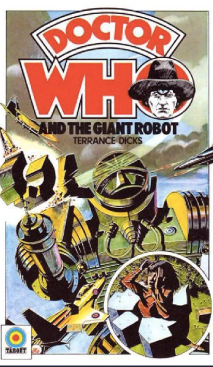
Cover & Illustrations: Peter Brookes ushers in a more comic-book style for this cover, which shows the K1 robot attacked by fighter planes on three sides while an inset shows the robot’s giant hand clasped around a screaming Sarah Jane – it’s very reminiscent of King Kong, of course. The logo on the cover now reflects the logo used on screen for the first time, using a version of Bernard Lodge’s design, and for this cover only, the Doctor’s face peers from the ‘O’. No internal illustrations this time, but there’s a two-panel illustration on the rear of the cover depicting the giant robot booting a UNIT jeep into the air. My first edition was the 1979 reprint with the portrait of K1 by Jeff Cummins, which dropped the rear illustration. The 1992 version used Alister Pearson’s painting for the VHS cover, with the K1 robot changing size against a lovely portrait of the Doctor.

Final Analysis: Is this the beginning of the more simplified novelisations? Not much is changed from screen to page but it all flows along nicely without expanding the story to any great degree.

Chapter 10. Doctor Who and the Abominable Snowmen (1974)

Synopsis: Landing the TARDIS in Tibet near the Det-sen monastery, the Doctor decides to return a holy relic, which he took receipt of three hundred years before. He’s quickly accused of murder by a zealous explorer called Travers, who’s hunting the legendary Yeti. But the Yeti that are roaming these hills are the real killers – and they’re robots controlled by someone within the monastery. 

Chapter Titles

  • 1. The Secret of the Snows
  • 2. The Creature in the Cave
  • 3. Live Bait to Catch a Monster
  • 4. Jamie Traps a Yeti
  • 5. The Secret of the Inner Sanctum
  • 6. A Yeti Comes to Life!
  • 7. A Plan to Conquer Earth
  • 8. Revolt in the Monastery
  • 9. Attack of the Yeti
  • 10. Peril on the Mountain
  • 11. The Final Battle
  • 12. The Abominable Snowman

Background: Terrance Dicks adapts the first Second Doctor novelisation based on the scripts by Mervyn Haisman & Henry Lincoln.

Notes: Terrance Dicks gets his first go at the Second Doctor, who has ‘a gentle, rather comical face, and a shock of untidy black hair’, while Jamie is ‘a brawny youth in highland dress, complete with kilt’ and Victoria is ‘a small, dark girl dressed in the style of Earth’s Victorian age’. There’s also harkbacks to the origin stories for the companions. He tweaks the Yeti here to make them more like the ferocious ones seen in The Web of Fear, with glowing red eyes and a terrifying roar. He also adjusts a few of the character names, in deference to his Buddhist producer on the TV show, Barry Letts, to avoid using the names of real historical figures, and he expands the backstory of Travers: His nemesis is a Professor Walters; and Travers’ fated companion who’s killed early on (called simply ‘John’ onscreen) is here identified as his best / only friend, known as ‘Mackay’.

Cover & Illustrations: Chris Achilleos’s original cover showed a lovely Second Doctor head-shot (taken for The Three Doctors) with a small Jamie and Victoria cowering from a roaring Yeti and the Earth creating a lovely circular frame in the background. I had the 1983 edition with a shaggy Yeti in the moonlight up a mountain and both covers used the same photo reference. The illustrations are again by Allan Willow and the standout one is where Jamie and Thomni smash the glowing spheres in the control room; there’s a lovely depth to it with the Doctor and Victoria just visible through the doorway. And that’s the only (tiny) illustration of the Doctor in the entire book.

Final Analysis: This is much more fun than the TV series. It’s largely helped by Dicks choosing to make the Yeti more like they were in the sequel, so they roar and claw and attack, rather than amble about and wiggle a bit. Padmasambvha is a less terrifying creation than on TV, we never forget that he is still a human struggling against the possession of the Great Intelligence, described here as having been ‘exiled’ from ‘another dimension’ (so who kicked him out?!). His final end is rather heartbreaking.

Chapter 9. Doctor Who and the Sea-Devils (1974)

Synopsis: The Master has been tried and imprisoned with a ‘life-long’ sentence (commuted from a death sentence by the Doctor’s plea for mercy). When the Doctor and Jo visit him in his high-security home, they are only briefly reassured that he’s secure before he escapes and sets into motion a plan to resurrect more of the homo reptilia race – this time from beneath the sea.

Chapter Titles

  • 1. ‘Abandon Ship!’
  • 2. Visitors for the Master
  • 3. The Vanished Ships
  • 4. Stranded!
  • 5. Air-Sea Rescue
  • 6. ‘This Man Came to Kill Me!’
  • 7. Captain Hart Becomes Suspicious
  • 8. The Submarine
  • 9. Visitors for Governor Trenchard
  • 10. The Diving Bell
  • 11. ‘Depth Charges Away!’
  • 12. Attack in Force
  • 13. Escape

Background: Malcolm Hulke adapts his scripts from the 1972 serial (the smallest gap so far between story transmission and novelisation, at two years, six months and two weeks).

Notes: It’s a little less even-handed this time as Hulke plays the Sea-Devils (not ‘Sea Devils’) as the aggressors from the start (and what a great opening scene as the crew of the ss Pevensey Castle abandon ship and are pulled under water one by one). Hulke also doesn’t give names to any of the Sea-Devils. There’s some background from the Master’s trial, where the Doctor begged for his best enemy’s life; although the death penalty was repealed for murder in the UK (except Northern Ireland) in 1965, it was still available for treason until 1998.

Governor George Trenchard’s backstory is elaborated upon to be both comical and rather tragic. The Doctor and Jo’s walk up to the chateau is given extra detail with the engraved wall-tap and the mysterious poem that reveals ancient local legends and somehow inspires the Doctor to deduce a pun on ‘the scales of justice’. The Master reveals that he’s worked with the Ogrons before (not in the TV version, but this was written soon after Frontier in Space, so would be fresh in the mind of the author and his audience). And the lead character is referred to as ‘Doctor Who’ twice.

Cover & Illustrations: The first cover by Chris Achilleos (a yellow maelstrom with the Doctor, Jo, two Sea Devils and a submarine). The first cover I owned was the 1979 John Geary reprint with the green and yellow Sea Devils and a bluey-pink background. The illustrations are once again by Alan Willow and my favourite is either the Doctor ducking as a Sea-Devil fires a heat ray or a Sea-Devil watching the submarine on TV.

Final Analysis: Another corker from Hulke. Even though the Sea-Devils are more overtly villainous than their cave cousins, they repeat their claim on the planet and at least appear to waver before going on the assault (stirred up by the Master). There’s the oft-quoted business about Trenchard wanting to be brave but being killed by Sea-Devils because he left the catch on his gun, and the Doctor switching it off before Captain Hart notices, but this is only one of many moments of charm for the characters – in fact if anything, it’s Jo who comes across worst, brash and impatient and occasionally compelled to back down when she gets too hot-headed.

Chapter 8. Doctor Who and the Daemons (1974)

Synopsis: The Master’s up to no good in an English village, posing as both a vicar and the leader of a satanic cult. The Doctor and Jo appear on TV and they take on the Master, a gargoyle and an ancient god – with the help of UNIT and a self-proclaimed white witch.

Chapter Titles

  • Prologue
  • 1. The White Witch
  • 2. The New Vicar
  • 3. The Opening of the Barrow
  • 4. The Appearance of the Beast
  • 5. The Heat Barrier
  • 6. Meetings
  • 7. Explanations
  • 8. The Second Appearance
  • 9. Into Danger
  • 10. The Third Appearance
  • 11. The Rescue
  • 12. Into the Cavern
  • 13. The Sacrifice
  • Epilogue

Background: Barry Letts adapts the 1971 scripts he co-wrote with Robert Sloman as ‘Guy Leopold’.

Notes: An early manifestation of Azal is much more dramatic, involving the death of the verger. Benton recalls earlier adventures with the cybermen, Axons and the daffodil-touting autons, none of which have been novelised by this point, while Jo recalls her first meeting with the Master as seen on TV but which flatly contradicts the books so far. We also get the first revelation that the Doctor and the Master were schoolfriends – and that the Doctor wasn’t a particularly keen student. Azal reveals that his race were responsible for the dispassionate destruction of all life on the planets Talkur and Yind. The character of Stan Wilkins is new to the book, on TV he’s just a nameless acolyte in the coven who recognises that the Master is evil and tries to save Jo and the Doctor. His courage serves to make Jo’s attempted self-sacrifice all the braver. Stan also gets to review events with ‘mixed feelings’ in the epilogue; while he acknowledges the number of people who’ve died, he also realises that he’ll inherit his uncle’s garage and be able to care for his ‘Mam’.

Cover & Illustrations:  The original cover was by Chris Achilleos following the now-familiar formula of the Doctor’s face with a head-shot of Azal and a teeny Bok. Internal illustrations are by Alan Willow. There’s a lovely drawing of Jo back against an ivy-covered wall (that’s based on a photo from The Sea Devils), but Azal and Bok are both faithfully reproduced. My first cover was the 1980 reprint with a portrait by Andrew Skilleter of Azal in the cavern, while the 1993 reprint used Alister Pearson’s VHS cover, with an almost-Celtic cross that shows the Doctor and Master both in half-portrait, Azal at the top and Bok at the bottom against a sunburn-pink background.

Final Analysis: Barry Letts adapts the scripts well, so it’s surprising this is his only novelisation of a TV story (though it’s not his only entry in this blog – as you’ll find out in about 146 chapters). It enhances what was possible on telly but doesn’t elaborate vastly; the prologue is just everything that happens on TV before the Doctor appears, where Mac Hulke might have given us an insight into Azal’s arrival on Earth. Azal gets a better motivation to implode though – being both confused by Jo’s illogical actions and on the verge of death anyway. We do gain some lovely insight into the Squire (a minor character on TV), who is perplexed by his regular headaches that always arrive the morning after a night in the pub. And the lead character is referred to as ‘Doctor Who’, right at the start of the first chapter.

Chapter 7. Doctor Who and the Day of the Daleks (1974)

Synopsis: A British diplomat is the target of a group of fanatical time-travelling assassins trying to change the course of their own history. An accident sees Jo catapulted into the fututre and when the Doctor follows her, he finds an Earth under the control of the Daleks.

Chapter Titles

  • 1. Terror in the Twenty-Second Century
  • 2. The Man Who Saw a Ghost
  • 3. The Vanishing Guerilla
  • 4. The Ghost Hunters
  • 5. Condemned to Death!
  • 6. Prisoner of the Daleks
  • 7. Attack of the Ogrons
  • 8. A Fugitive in the Future
  • 9. Escape from the Ogrons
  • 10. Interrogation by the Daleks
  • 11. The Raid on Dalek Headquarters
  • 12. Return to Danger
  • 13. The Day of the Daleks
  • 14. All Kinds of Futures

Background: Terrance Dicks adapts Louis Marx’s scripts from the 1972 serial. It’s the first novelisation to have a title the same as used on TV (although ‘The Crusaders’ comes close, the story title wasn’t used on screen). 

Notes: One of the best prologues in the range introduces the brutalised humans attempting to form a resistance. We encounter the Ogrons in a description that draws closer comparison to the gorillas from Planet of the Apes, then meet the Controller of Earth and the Black Dalek (the more senior-ranking gold leader seen on screen is introduced later). We have a solid idea of the Earth of the 22nd Century before the first frame of the televised story hits the page. When the Doctor emerges from underground in the 22nd Century, this future Earth matches how Malcolm Hulke had described it in The Doomsday Weapon: ‘Every inch of the countryside, as far as he could see, seemed to have been built up till not an inch was left…’

It’s possibly a conscious decision to only allude to those adventures of Jo that have been novelised, so we get a reference to the Doomsday Weapon and Jo’s trip to an alien world in the far future, but Jo’s relationship with the Doctor and the three main UNIT characters is much more familiar, as if she’s been with them for some time by this point. The Daleks also reference the first two Doctors, including the original visit to Skaro, even though at this point none of the second Doctor’s stories have been novelised (and his Dalek adventures wouldn’t see print for another 20 years). There are some other minor tweaks (Monia becomes Moni, Auderly House is now Austerly House and some of the minor resistance characters are given names), but the other main addition comes with the reprise of the double Doctor and Jo scene at the end, told from the vantage point of the doorway this time, which ties up the earlier scene neatly but also reminds us that the defeated Daleks were but a small unit of a much larger force, which reduces the scale of the ending somewhat.

Cover & Illustrations: The original and best cover, once again, is by Chris Achilleos – one of his all-time most dramatic, even with those weird Daleks inspired by the Sixties comics again. Neither of the reprints come close; the 80s one by Andrew Skilleter makes much of the Ogrons, while Alister Pearson’s 1991 version is fairly bland and the photo references combine the Pertwee one from the first cover and the Dalek from the second. The illustrations are some of my very favourites and include a map showing the ‘grounds and environs of Austerly House’. One of them is captioned ‘A shimmering effect filled the air around Jo’s body’ but it looks just like everyone’s impression of the Tales of the Unexpected title sequence.

Final Analysis: Terrance Dicks’ second novel and it continues the approach of tweaking and enhancing where possible, but that opening prologue aside, it’s otherwise a basic retelling of the TV story. Which still means it’s brilliant. In fact, even as a fan of the televised original, I have to admit I prefer the book.

… even if it’s slightly spoiled by someone pointing out to me that there’s a typo on the last page that I’ve failed to notice for over 30 years!

Chapter 5. Doctor Who and the Cave Monsters (1974)

aka Doctor Who – The Silurians (1992)

Synopsis: Long before mankind evolved to take over the Earth, it was inhabited by a race of technologically advanced reptiles. An oncoming catastrophe drove them into hibernation for millions of years. Now they’ve awakened and they want the planet back.

Chapter Titles

  • 1. Prologue: The Little Planet
  • 2. The Doctor Gets a Message
  • 3. The Traitor
  • 4. Power Loss
  • 5. The Fighting Monster
  • 6. Into the Caves
  • 7. Quinn Visits His Friends
  • 8. Into an Alien World
  • 9. The Search
  • 10. Man Trap
  • 11. The Doctor Makes a Visit
  • 12. Goodbye, Dr Quinn
  • 13. The Prisoner
  • 14. Man from the Ministry
  • 15. Attack and Counter-Attack
  • 16. The Itch
  • 17. Epidemic
  • 18.  A Hot World
  • 19. The Lie

Background: Malcolm Hulke adapts his scripts from the 1970 serial Doctor Who and the Silurians. As this followed Spearhead from Space on TV, this is our first pair of stories to be adapted as consecutive releases.

Notes: The prologue introduces us to Okdel, a reptile, who sees the rest of his race entering the shelters in preparation for catastrophe. He wonders if there’s life on this new object in the sky and K’to, a scientist, tells him it’s unlikely as it’s been travelling across space. It’s such a kind, considerate question – is this going to be a cataclysm for them too? The prologue explains the basic idea behind the reptile hibernation and shows us division among their ranks as Okdel keeps mammals as pets but his colleague Morka considers them ‘vermin’ and K’to is concerned by the mammal raids on reptile-grown crops. Okdel also notes how scientists often get things wrong – a handy excuse for some of the scientific liberties Hulke will be taking in his story. While it robs the reader of the surprise of who the ‘cave monsters’ are, it prepares us for a tale that tries to see things from multiple perspectives.

Once we join the Doctor and Liz, it’s clearly been some time since the Auton Invasion as Liz recognises a Corporal, who in turn knows the Doctor well enough to know the name of his new car, and Liz has also formed an opinion of the Doctor as ‘the most thoughtful and considerate scientist I have ever worked with’ (though this might be sarcasm as he’s being unconsciously patronising to her). The opening scenes of the potholers have been cut, condensed into a reported summary from Dr Quinn, and in fact, we meet almost all the core human cast in the space of a few pages and learn much more about their background and motivations than we do across seven episodes of TV: Dr Quinn and Miss Dawson gain first names (Matthew and Phyllis); Quinn’s wife was killed in a car crash and he wants to gain fame for discovering the reptile men (they’re not called Silurians, but the word is used as the password to gain entry to the base); Phyllis Dawson is excited by the prospect of doing actual research now that she’s free from being held back by her recently deceased mother; Major Baker is now ‘Barker’ and is shown to be insensitive (calling one patient ‘looney’) and generally paranoid and bigoted against ‘communists… fascists… Americans’, basically anyone who isn’t English.

The outbreak of the reptile virus is depicted differently: Instead of Masters arriving at St Pancras Station and collapsing , we see him aboard the train (infecting a ticket inspector who later dies) and then he leaves the train, catches a taxi and dies before reaching London. Dr Lawrence’s given a different exit too, killed by a reptile heat ray as a warning to the other humans, rather than falling victim to the virus.

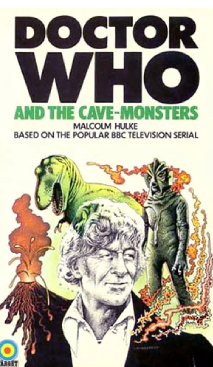
Cover & Illustrations:  The first release had a cover by Chris Achilleos. The cover showed the Doctor from Day of the Daleks with a green Silurian (without a third eye!), a T-rex-like dinosaur and a volcano. I’m very fond of the 1992 Alister Pearson reprint cover (when the book was retitled) with the ‘windows’ over the Earth and photorealistic versions of the T-rex and Silurian, but the Achilleos one is truly epic. The illustrations, also by Achilleos, include a horizontal section showing the cave system beneath Wenley Moor. My favourite shows Dr Quinn chatting with a Silurian that looks like he’s a guest on a chat show.

Final Analysis: I always assumed this was renamed ‘The Cave Monsters’ to simplify the idea of ‘Silurians’ make the title easier for younger readers to understand, but reading this again, I suspect it might also have been Hulke making a point; as Whitaker did in The Crusaders, Hulke works hard to show balance, there are progressive reptile men (though no women) as shown with Oktel, as well as the paranoid and bigotted Morka, plus the pragmatic K’po – and their emotions are mirrored by the Doctor, Barker and Quinn (and later Lawrence) – and the various actions of the humans make then as equally monstrous cave dwellers as the members of the much older race. Aside from that cheeky password the Doctor uses to gain entry to the base, the word ‘Silurian’ doesn’t appear in the book – and as it was written a couple of years after the sequel to this story, Hulke manages to fix his original geological errors and establish the race as simply ‘Reptiles’.

And just one little namecheck for ‘Doctor Who’ in the text as well.