Bonus chapter #5. The Companions of Doctor Who: Harry Sullivan’s War (1986)

Synopsis: It’s been ten years since Harry Sullivan left UNIT. Reluctantly awaiting a new posting to a weapons division in the outer Hebrides, Harry decides to use some leave and visit friends. Within days, he survives numerous violent attacks – someone is trying to kill him. But why? A chance meeting with Brigadier Lethbridge-Stewart leaves Harry wondering if their reunion is just a coincidence or if he’s accidentally stumbled into something very worrying indeed…

Chapter Titles

  • 1. A Brush With Death
  • 2. Happy Birthday!
  • 3. The Castle 
  • 4. Persuasion 
  • 5. An Odd Weekend 
  • 6. Unexplained Mysteries
  • 7. The Amateur Investigator 
  • 8. A Human Guinea Pig 
  • 9. More Clues 
  • 10. The Chase 
  • 11. Trapped 
  • 12. The Prisoner 
  • 13. Double Bluff 
  • 14. Secrets of the Burial Mound
  • 15. Ambush
  • 16. Out On A Limb 
  • Epilogue 

Background: Ian Marter writes an original novel inspired by the character he played in the series in 1975.

Notes: Chapter 2 takes place on Harry’s 41st birthday (which, based on later information, is in May). Since leaving UNIT ten years ago, he’s been employed by the Biological Defence Establishment at Tooth Tor on Dartmoor, developing antidotes to nerve toxins. He’s unhappy that he’s being transferred to work on weapons development – by order of General Schlitzburger in Geneva (with a mind to Marter’s fondness for sneaking innuendo into his novels, it might be best to consider a more colloquial version than the literal translation of ‘Slot-burger’ here). Harry decides to spend his birthday at the National Gallery, where he sees a self portrait by Van Gogh (this becomes a recurring image, for plot reasons). Introducing himself to Samantha, Harry adopts the pseudonym ‘Laury L Varnish’ – an anagram of his real name. Samantha has a ‘husky voice’, pale blue eyes, a ‘strong but pretty oval face’ and ‘curly straw-coloured hair’. She claims that her father is American and a doctor, and that she’s a member of ACHES, the ‘Anti-Chemical Hazard Environment Society’. 

Harry is six feet tall. He has a ‘spacious flat’ on the fifth floor of a 1930s apartment block in St John’s Wood (which we’re told is at the Regent’s Park end). He displays his many rugby and rowing trophies and we’re told later that he was a ‘stroke oar in the Dartmouth College Ace Eight’; this would be from the Britannia Royal Naval College – aka ‘Dartmouth’ – and not the New Hampshire, USA, college of the same name. He receives a birthday card from an old friend, Teddy Bland, who has a sister, Esther, who Harry was once very close to; he nearly proposed, but a secondment to UNIT put paid to that. Esther is ‘buxom’ and ‘red-headed’ and during his trip to Yarra, Harry learns that Esther has only ever loved him. Harry drives a red MG sportscar (mid-life crisis?). Harry’s new position sees him promoted to Surgeon-Commander. Esther notes that he no longer has the sideburns he had while with UNIT. In his early naval career, Harry was stationed on the Ark Royal. 

Brigadier ‘Alistair Gordon Lethbridge-Stewart’ is said to have a ‘deep and resonant […]  precise military voice’. The Brigadier is still teaching (Senior Mathematics Master at ‘a private school in Sussex’), but his business card mentions his ‘DSO’ (Distinguished Service Order) and ‘MC’ (Military Cross). The Brigadier shares old stories with Harry of his own experiences in UNIT, not just of Sarah Jane Smith, but of ‘Jo and Sergeant Benton, about Jamie and Zoe and about the Daleks and the Cybermen and all manner of old friends and enemies’. On his flight through Scotland, Harry meets a small child who offers him a jelly baby. The sweet makes him wish the Doctor would appear to put everything right.

Harry is arrested in Trafalgar Square by an Inspector Spode (possibly a reference to the fictional publisher Erwin Spode in the Gervase Fen detective novels by Edmund Crispin). Placed in a cell in Wormwood Scrubs, his window affords him a view of the playing fields and, beyond, the church in Harrow-on-the-Hill where he was christened as a baby (not that this is mentioned at any point, but had his cell faced the opposite direction, he’d have had a lovely view of BBC Television Centre). Harry asks if ‘Sir Algernon’ might take up his case and is told he is holidaying in Bermuda; it’s a short sentence but it might bear unpacking. Sir Algernon Usborne Willis KCB DSO (17 May 1889 – 12 April 1976) was a former Admiral of the Fleet, while Bermuda was where Sir William Stephenson retired to – long believed to have been the real-life inspiration for 007. Except we later discover that this Sir Algernon has the surname ‘Flowers’, so his name is surely a nod to the Daniel Keys science fiction story Flowers for Algernon, about a laboratory mouse.

When Sarah Jane Smith visits Harry in prison, she’s said to be:

… a young woman of about thirty […] wearing a fashionable pink boiler-suit outfit with green boots, and a rainbow-coloured plastic shoulder bag [….] Her hair was brown and wavy, held back by a pair of sunglasses perched on her forehead. Her figure looked petite under her billowy clothes.

Harry and Sarah haven’t seen each other since the Zygon business (though a short story I later wrote for a Big Finish Short Trips anthology proudly contradicts this). He affectionately calls Sarah ‘old thing’; and quickly realises his mistake. Sarah is no longer living with her aunt in Croydon, having moved to Camberwell, South London. Harry confesses that he’s told many stories about Sarah to his elderly neighbour.

When Harry drops the name ‘Davros’, both Major Sawyer and George Fawcett-Smith of the Home office react with surprise that Harry knows the name. Conrad Gold’s money envelope consists of bundles of £100-notes – which means he was paying Harry with notes issues by the Royal Bank of Scotland (the highest denomination issued by the Bank of England is £50, though Fawcett-Smith asks Spode to ‘find out where these were printed’. The story concludes in September, which makes this possibly the story with the longest timespan since Marco Polo! 

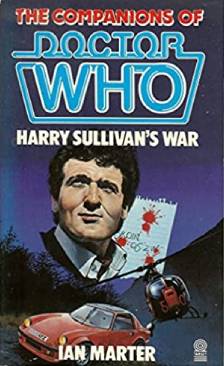
Cover: David McAllister goes full Bond with an appropriately dramatic illustration of a car being chased by a helicopter while Harry Sullivan looks every bit the heroic action-movie star. It’s only the second cover to feature blood and the first to depict the author in the illustration!

Final Analysis: Let’s pretend that Turlough and the Earthlink Dilemma never happened, eh? This is a stunning novel that wears its influences shamelessly (Terrance Dicks always said that greatness always steals from the best). The opening chapter lifts cheekily from the James Bond film Thunderball (and its more recent remake, Never Say Never Again), though 007 fends off the attack more successfully; a later sequence is reminiscent of John Buchan’s The Thirty-Nine Steps and the three different movie adaptations (particularly the Hitchcock one); and as Gary Russell noted in his review for Doctor Who Magazine, the final chapter owes a lot to the film version of A View to a Kill – even down to Harry wearing a tuxedo – which was released the year before this was published. It’s by no means a criticism; Harry Sullivan always wanted to play at James Bond and Marter throws his hero into an espionage story without allowing him any of the innate skills of the most celebrated spies. Right from the start, he suffers a savage attack that leaves him vulnerable and confused – and his discomfort barely lets up as he careers from one escapade to another, only just escaping alive on each occasion.

Just while we’re here – Vincent Van Goch’s art is referenced repeatedly here. There are many possible ways to pronounce his name, such as ‘van Goff’, ‘van Gock’ – and most Dutch people would say ‘Vun Goch’ – to rhyme with the Scottish ‘loch’. However, it does not rhyme with ‘Toe’ (‘Van Goe’). Ever.

Ian Marter had originally intended to kill Harry off, but was persuaded to let him survive, so instead he plays a cruel trick on us in the finale. He claimed in interviews prior to the book’s release that he hoped to write a sequel. Harry Sullivan’s War was published on 11 September 1986; Ian Marter died on 28 October the same year, on his 42nd birthday. Your humble blogger was due to interview him at a convention four days later and was stunned to hear his close friend Nicholas Courtney announce his passing at the event. I was sat on the front row of the main hall, dressed (for charity reasons) in a Sea Devil costume at the time; It hid the tears.

There were still a few of Ian’s books yet to be published, so we’ve not quite said a final goodbye to him yet, but I thought it’d be appropriate to pay tribute here. There are plenty of Target novels I’ve not read prior to this project, but this is one I return to regularly. It’s not an official one, so ‘doesn’t count’, but it’s by far and away my favourite novel by one of my absolute favourite Target authors.

Further Listening

I was a guest on the Dr Who Literature Podcast to discuss this book, which you can hear in the link below, on YouTube, or on the podcast provider of your choice.
Chapter 107. Doctor Who – The King’s Demons (1986)

Synopsis: King John is an honoured guest at the home of Ranulph and his wife Isabella. When the Doctor, Tegan and Turlough unexpectedly drop in, the King welcomes them and dubs him his ‘Demons’. The King’s champion Sir Gilles views the intrusion with irritation – unsurprisingly, as he is the Master in disguise. But the Master is not the only one pretending to be something he’s not.

Chapter Titles

  • 1. The Challenge
  • 2. The Demons
  • 3. The King Takes A Hostage
  • 4. The Iron Maiden
  • 5. Command Performance
  • 6. An Old Enemy
  • 7. Doctor Captures King’s Knight
  • 8. ‘Find These Demons!’
  • 9. Kamelion
  • 10. A Battle of Wills

Background: Terence Dudley adapts his own scripts from the 1983 serial, completing the run of stories from Season 20.

Notes: Ranulf Fitzwilliam has been a loyal servant and friend of King John for twelve years [since the French Wars that saw the King lose his hold on the Duchy of Normandy]. He is immediately suspicious of the ‘King’ who sits next to him now, identical to the one he knows, but his manner is vastly different – the way he consumes food ‘like a starving Flemish mercenary’. The King’s eyes are – metaphorically – described as ‘metallic’ and ‘ferrous’. 

Turlough is aware of the Doctor’s ability to regenerate, or as he calls it cheekily, ‘a refit’, and later tells the incredulous Hugh that the Doctor has two hearts and is ‘getting on for eight hundred years old’. He manages to escape from Hugh in the dungeon and is about to flee the cell when Sir Gilles returns with his prisoner, Isabella. Sir Gilles questions Turlough about the Doctor’s ‘blue engine’ and Turlough accidentally reveals that it can only be opened by a key in the Doctor’s possession. The Doctor tells Tegan that Shakespeare did not write history, so cannot be trusted as a factual source. He also shows off knowledge of the King’s mother, Eleanor of Aquitane, and claims that she had told her son, the future King, about the legends of Melusine, the alleged daughter of Satan, which might explain King John’s insistence that the travellers are demons. Tegan recalls her aunt’s murder at the hands of the Master [see Logopolis].

The Doctor and Tegan both recognise the Tissue Compression Eliminator weapon and realise too late that Sir Gilles is the Master; he doesn’t remove his disguise here. He accuses the Doctor of being ‘obtuse’, not naive’, as on telly. Tegan tries to disarm him with a cricket ball, not a knife. Despite never having met him, Turlough recognises the Master by the Doctor’s description from some previous point (‘Listen here, Turlough, I know we’ve just had that unpleasant business with the Black Guardian, but the one you really have to watch out for is another black-garbed chap with a pointy beard – calls himself the Master. He’s a Time Lord like me and…’). Tegan is 22 years old (and would very much like to celebrate her 23rd birthday). At one point, the Doctor recalls that he once spent time with the real King John’s brother Richard and helped him in negotiations with Saladin [see The Crusade].

Taking up the role of King’s Champion, the Doctor is dressed in full chain-mail armour and he persuades Sir Geoffrey to head to the dungeon by pretending that his demonic powers can be used to torture Lady Isabella. The gaoler is called ‘Cedric’. The castle is said to be located at Wallingford, near Oxford, which Sir Geoffrey says is five hours away from London by horse. When Sir Geoffrey is shot by the Master, Turlough helps the merely-wounded knight to safety. Ranulf manages to enter the TARDIS and is so disturbed by the confusion of what lies within that he is convinced the Doctor and his friends are demons. Tegan is aware that to set the TARDIS in motion requires the use of one of two switches, ‘the metastasis switch or the transit switch’. After a frustrating first attempt, she uses the transit switch, followed by the input bar. Kamelion’s lute is apparently part of his illusion, as it transforms into a cricket bat when he takes the form of the Doctor. Once back in control of his ship, the Doctor makes an additional hop to both assure Lady Isabella that only the Master is their enemy and to give her some medicine to help Sir Geoffrey recover from his wounds. The Master manages to evade being shrunk by the trap with the TCE left by the Doctor, but it has somehow sent his TARDIS out of control.

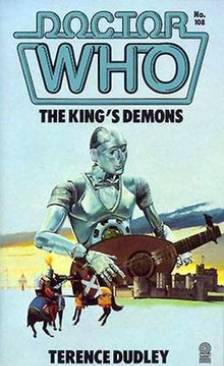
Cover: David McAllister paints a jousting competition outside Ranulph Castle as a lute-playing Kameleon dominates the skyline.

Final Analysis: I’ve always felt rather dismissive of Terence Dudley, largely because of Four to Doomsday (where his rather dreary story was adapted without frills / thrills by Terrance Dicks), but his approach to his own novelisation is surprisingly entertaining. As Sir Gilles, the Master outlines his plan to discredit the King through the means of a lengthy tour around some of the King’s most loyal supporters. Once his true identity is revealed and he faces execution inside the Iron Maiden, he orchestrates a display of fear and pleading so over the top that it makes the Doctor think he’s finally succumbed to madness. So overplayed is the performance that even Tegan is distressed at the prospect of his grisly death – until the villain escapes in his torture cabinet-disguised TARDIS. 

Turlough is particularly well described, even though he spends most of the story in a prison, as on TV; his various attempts to escape and his increasing indignation at being left chained up is hilarious. When he’s finally rescued, Turlough lets out a huge rant that builds to a revelation:

‘Just a minute! Just a minute!’ interrupted Turlough indignantly. ‘Get on with what? What about my trust? What about my enemies? Who’s doing what to whom and why? I’m dragged down into this hole by that young ruffian whose life you saved this morning. Then he’s going to put me into that thing.’ He flicked a hand at the Iron Maiden. ‘Then I’m hung up on the wall by that hairy Frenchman … Estram. Then the other two get rescued by the Master but I’m left there… hanging… and not a sign on my …’ He stopped short, overcome by the suddenness of thought and his mouth and eyes wide in realisation. ‘It’s an anagram! Estram! It’s an anagram!’

The whole anagram thing works so much better in print, but the fact that the Doctor had only just made the same realisation a few pages earlier makes the scene all the funnier.

It’s not all cause for celebration though. As great as he is at capturing Turlough, Dudley’s depiction of Tegan is pretty patronising: The Doctor is profoundly irritated by Tegan’s ‘feminine superficiality’ and her general habit of moaning, which he’d hoped she’d have grown out of, while there’s a lengthy passage mocking her for her ‘practical feminine mind’ prompting her to ask the castle has ‘a back way’. The Doctor also grows exasperated by Tegan’s inability to grasp that the Master didn’t need to drag the TARDIS through narrow doorways when he could dematerialise it; on TV the exchange is swift, but here it takes two pages before Tegan finally understands and calls herself ‘stupid’. It might have been a funnier scene if the author hadn’t spent the entire book having Tegan constantly and repeatedly moan about being cold. And then, to add insult to injury, he has Tegan sink into ‘a swoon’ when she’s surprised by Hugh. Dudley also has the Doctor refer to ‘a marooned stewardess from an Antipodean airline’, while the book ends with the Doctor expecting Tegan to say that he knows she wants him to take her to London airport, which of course was her main goal in the previous season [Terrance Dicks made the same mistake in The Five Doctors]. Considering she spent her first year aboard the TARDIS trying to get back to a job she was swiftly sacked from, it must be particularly jarring for her to still be thought of as flight crew when she can’t have actually done the job since the events of Logopolis.

Further Listening

I was a guest on the Dr Who Literature Podcast to discuss this book, which you can hear in the link below, on YouTube, or via the podcast provider of your choice.

Chapter 102. Doctor Who – The Time Monster (1986)

Synopsis: Experiments in a Cambridge laboratory have created instability in the web of time. The Master is using a trident-shaped crystal to summon Kronos, a creature from legend that ‘eats’ time itself. Recognising the origin of the crystal, the Doctor and Jo travel back to the time of Atlantis with the hope of stopping the Master but instead find themselves caught in his trap. When Kronos finally arrives, however, it is the Master who has to plead for his life…

Chapter Titles

  • 1. The Nightmare
  • 2. The Test
  • 3. The Summoning
  • 4. The Ageing
  • 5. The Legend
  • 6. The Ambush
  • 7. The High Priest
  • 8. The Secret
  • 9. Time Attack
  • 10. Take-Off
  • 11. The Time-Eater
  • 12. Atlantis
  • 13. The Guardian
  • 14. The Captives
  • 15. The Return of Kronos

Background: Terrance Dicks adapts Robert Sloman’s scripts for the 1972 serial, completing the run of stories from Season 9 in Target’s library.

Notes: Professor Thascalos (not ‘Thascales’) is…:

… a medium-sized, compactly but powerfully built man, this Professor Thascalos, with sallow skin and a neatly-trimmed pointed beard. His dark burning eyes radiated energy and power.

A familiar description, but it’s not until he hypnotises Doctor Charles Perceval (not ‘Percival’) that Thascalos is revealed to be the Master. Percival’s predecessor was ‘over-fond of the bottle’ and so ‘an easy man [for the Master] to impress and to deceive’. The Master’s TOMTIT apparatus recreates ‘the powers of the legendary Timescoop of the Time Lords, forbidden by Rassilon in the Dark Time’, something only revealed eleven years later (or three years ago in book terms) in The Five Doctors.

The Doctor’s TARDIS sniffer-outer’ is ‘rather like a table tennis bat’ (it looks a lot ruder on telly!). Young Atlantean councillor Miseus is renamed ‘Myseus’. Perceval is accidentally confused with Humphrey Cook when he’s called ‘Humphrey Perceval’ seconds before his final moments. Weirdly, Dicks references the new TARDIS control room design and why we don’t see it again, as Jo notes that ‘from time to time, the Doctor altered some detail of the TARDIS interior. More often than not he decided he didn’t like what he’d done and reverted to the original.’ After the Master has captured Jo and disappeared in his TARDIS, Queen Galleia frees the Doctor and admits that she was wrong to trust the Master, just as she accepts that the people of Atlantis cannot be saved.

Cover: Andrew Skilleter paints a multilayered piece depicting the female eyes of Kronos, the winged Kronos creature and the trident crystal. It might be my favourite Skilleter cover.

Final Analysis: In the 1990s, when the Pertwee backlash was in full swing in some fanzines, The Time Monster came in for a particularly hard time. Compared to the Master’s previous exploits, it feels a little lightweight and it suffers from wading in the same pool as The Daemons, which concluded the previous season. There are ancient myths, the Master posing as a member of a community and resurrecting a godlike being. Sadly, we also get a load of nonsense with the Doctor balancing house-hold rubbish on a wine bottle before playing matador with a real, live minotaur, while the whole narrative purpose of UNIT seems a long way from its origins as an organisation investigating serious alien threats to Earth. The Brigadier is particularly dim while Benton’s reward for being the only member of UNIT with any brains is to be left standing before his peers in a nappy.

I’m not here to review the TV stories of course, but it’s difficult to avoid doing so when the book sticks so closely to the transmitted version. All of these excesses are present and correct in this book and, for once, Terrance Dicks’ methodical approach doesn’t work quite so well. It can be summed up by this underwhelming description of the final destruction of the TOMTIT machine:

… the result was nothing more serious than a loud bang, a shower of sparks and a lot of smoke.

Just one other observation: In the descriptions, the Brigadier’s number two is ‘Captain Yates’ or ‘Mike Yates’, but never ‘Mike’. Always the full name.

Chapter 101. Doctor Who – The Gunfighters (1986)

Synopsis: In the old town of Tombstone, the Doc’s name’s in doubt / He wanted a dentist but his luck ran out / Now the Clantons are coming – they’ll all be here soon / There’ll be blood on the piano at the Last Chance Saloon…

Chapter Titles

  • Prologue
  • 1. Landfall in Tombstone
  • 2. The Last Chance
  • 3. The Brief Career of Dead-shot Steve
  • 4. A Funeral is Arranged
  • 5. Notice to Quit
  • 6. Identity Parade
  • 7. Open Mouth Surgery
  • 8. An Offer Refused
  • 9. A Pardonable Error
  • 10. A Little Night Music
  • 11. And Some Durn Tootin’
  • 12. Arrest Is As Good As A Change
  • 13. The Red Hand of Tradition
  • 14. The Law and Doc Holliday
  • 15. A Very Nasty Little Incident
  • 16. Wyatt Plays It By The Book
  • 17. Pa Clanton Keeps a Welcome
  • 18. Ringo in the Morning
  • 19. Post Mortem
  • 20. Thought For Feud
  • 21. Dodo Draws a Bead
  • 22. The Entry of the Gladiators
  • 23. Come Sun-Up…
  • Epilogue

Background: Donald Cotton loosely adapts his own scripts from 1966. The book is dedicated: ‘For TAMSIN, with coloured moon clouds’. As discovered by Lucas Testro, Tamsin Hickling was a young actress who Cotton befriended in the 1980s; her middle name was a Chinese word that meant ‘moon clouds’.

Notes: You know I love a prologue! We open with a journalist called Ned Buntline, who made his name writing biographies of notable Wild West legends (the real-life Buntline was a celebrated author who died five years after the events at the OK Corral – and a year before Doc Holliday!). Having previously spoken to Wyatt Earp, who refused to be drawn on certain inconsistencies in the myths surrounding the OK Corral, Buntine now comes to a sanatorium at Glenwood Springs, Colorado, to meet an elderly Doc Holliday, who is in his last days with tuberculosis. Holliday speaks freely about the TARDIS, ‘a kind of four-wheel buggy designed for ridin’ every sort of direction through eternity, without much decent respect for the laws of physics’.

Aboard the TARDIS, Steven reminds the Doctor of the time when they encountered ‘great, nebulous jelly-fish things… with poisonous what-nots’. Dodo claims she took a first-aid course, but didn’t do very well. When the TARDIS lands in Tombstone, it’s raining heavily. Behind the bar of the Last Chance Saloon is a, er, well as Buntine tells it, it’s…

…a shot-up oil-painting of a fat blonde in her birthday rig. Sitting on a cloud, she was being molested by a bunch of tear-away cherubs, who looked as if they’d been up several nights round a stud-game, and passing the nectar pretty free, at that.

… and then he gives us two verses of that song (only one of which was heard on TV). 

Dodo is wearing ‘a little number made up of scarlet furbelows and flounces trimmed with black lace’ with an oversized hat (or as Buntine claims, like ‘the proprietress of a broken-down cat-house in one of the less select quarters of New Orleans’). Steven has, according to the Doctor, ‘disguise[d] himself as Billy the Kid’. He took his advanced astronaut course at Cape Canaveral, where he learned to play ‘America the Brave’ on the piano. Dodo sees a poster for real-life star of the stage Eddie Foy – who makes a brief cameo towards the end of the story (and whose son, Eddie Foy, was a Hollywood movie star who Dodo might conceivably have seen). Kate’s surname is ‘Elder’, not ‘Fisher’ as on TV (and in the 1957 movie); the real-life Kate was formally ‘Mary Katherine Horony-Cummings’, but she was also known by the deeply unflattering ‘Big Nose Kate’. 

Doc Holliday’s new dentist’s chair had previously seen service at ‘the Death House in San Quentin’. Pa Clanton is standing for mayoral election and hopes taking up said office will result in free drinks for life at the Last Chance Saloon. Johnny Ringo is a keen student of the Classics and is, at the time of the gunfight, partway through the ten-volume edition of Caesar’s Gallic Wars. The Doctor’s discomfort with a gun results in him accidentally shooting two bystanders, though eventually he is said to have begun to ‘enjoy himself’. The Doctor and his friends leave in the TARDIS, its dematerialisation witnessed by Doc Holliday, Wyatt Earp and a few others. In the epilogue, Holliday concludes telling his story to Buntine, necks a bottle of whisky … and dies.

Doc Holliday did indeed die in 1887, staying at Glenwood Hotel, Glenwood Springs, Colorado. He was 36 years old (Anthony Jacobs, who played him on TV, was 48 at the time of broadcast).

Cover: Andrew Skilleter paints the Doctor with a stetson while Wyatt Earp walks down the street of Tombstone with smoking guns. 

Final Analysis: There are people who’ll still tell you that The Gunfighters is a ‘bad story’ or that it was the lowest-rated story ever (it really wasn’t). There’s even a sly dig at the production in the text of this book, where a passage begins ‘Meanwhile, at the Last Chance Saloon, the stage was already set – as if by an incompetent director.’ Fan elders have shaped opinion to the point where many people who haven’t even seen it know what they think of it. And they’re wrong. Utterly. They’re very quick to remind us that Doctor Who can tell ‘any kind of story’, but seem to bristle when the genre isn’t one they personally like or – worst of all – if the story veers into the realm of comedy!

While the historical adventures did tend to be outperformed on original transmission by the often less ambitious efforts featuring silver sets on alien worlds, as we’ve seen with these novelisations, the writers tried much harder to engage the brain with their characters, perhaps mindful that they’d be representing figures who’s actually lived, or possibly just because they preferred history to SF. In the best Reithian tradition, Donald Cotton clearly realised that the best way to ‘educate and inform’ was to entertain. In this adaptation, he once again relies upon a narrator who casts doubt upon the factual accuracy of other versions of the legend; in other words, he’s excusing and exploiting any historical mistakes in both the TV serial and all other conflicting adaptations. We’re presented with a further myth rather than a text-book account of the real events, yet Cotton’s characters feel like they might have actually lived and breathed. More importantly though, Cotton’s retelling of the tale is very, very funny. My favourite joke in the whole thing is where he describes the drunk Ike Clanton as speaking ‘blotto voce’. There’s also a lovely description of the Doctor operating the TARDIS controls: 

… clutching at an apparently haphazard selection of levers with the air of a demented xylophonist, who finds he’s brought along the wine list instead of the score.

There are some instances of swearing – two uses of ‘bastard’, eight ‘goddam(ned)’ and sixteen uses of ‘damn’. As the notes above illustrate, there’s also a degree of bawdiness to this not seen before (mainly involving Kate’s profession). 

Finally, it’s become a popular game in modern stories (including The Shakespeare Code and The Unicorn and the Wasp) to crowbar in as many metatextual references as possible, but we can trace this back directly to Donald Cotton. While some of these might have reasonable claims to be accurate contemporary phrases, the modern reader can play ‘Spot the Film Title’ throughout the text. To start you off, here are just a few: For a Few Dollars More (1965); The Wild Bunch (1969); Calamity Jane and Sam Bass (1949); Terror of the Plains (1934); Death Valley (1946); The Golden West, (1932); … and The Right Stuff (1983). 

Further Listening

I was a guest on the Dr Who Literature Podcast to discuss this book, which you can hear in the link below, on YouTube, or via the podcast provider of your choice.
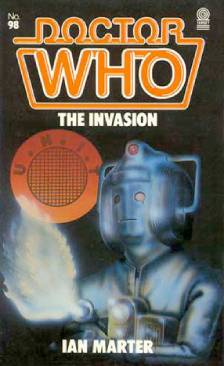
Chapter 98. Doctor Who – The Invasion (1985)

Synopsis: International Electromatix is a world leader in developing popular electrical devices. The head of the company is the charming and persuasive Tobias Vaughn. But Vaughn’s company is merely a front for a much grander scheme. The Doctor, Jamie and Zoe accidentally find themselves party to an investigation into Vaughn by an organisation called UNIT. Soon, friends old and new help the Doctor uncover the secret behind Vaughn and his partners, who also know the Doctor of old…

Chapter Titles

  • Prologue
  • 1. Home Sweet Home?
  • 2. Old Friends
  • 3. Cat and Mouse
  • 4. Hitching Lifts
  • 5. Skeletons and Cupboards
  • 6. Secret Weapons
  • 7. Underground Operations
  • 8. Invasion
  • 9. Counter Measures
  • 10. The Nick of Time

Background: Ian Marter adapts scripts from the 1968 serial by Kit Pedler and Derrick Sherwin.

Notes: The TARDIS pulls itself together and the Doctor’s companions reappear after the ‘disintegration of the TARDIS in their previous adventure [which] had been a horrifying experience’ [we might assume this follows on from The Mind Robber, but it could also be from some unseen adventure]. Jamie is ‘a robust young Highlander clad in faded kilt and sporran, tattered sleeveless sheepskin waistcoat and sturdy boots’, while Zoe is ‘a bright-eyed teenager with a large face, wide mouth and short black hair and she was wearing a tomboyish trouser-suit’ (not the sparkly catsuit seen on screen or the gaudy mini-skirt and stockings she picks up at Isobel’s apartment). The Doctor has ‘small hands’ apparently, and he looks like ‘an old-fashioned fairground showman’. Later, he’s said to chew the ‘frayed edge of his cravat’.

International ‘Electromatics’ becomes ‘Electromatix’ and its logo is a ‘zig-zag of lightning in the grip of a clenched glove’ rather than the letters ‘IE’ on screen. The introduction of Tobias Vaughn is extraordinarily precise:

The combination of swept-back silver hair and thick black eyebrows gave the older man a disturbing appearance. His right eye was permanently half closed, but his left gazed wide open with chilling pale blue iris and huge black pupil. His clothes were coldly elegant: a plain suit with collarless jacket, round-necked shirt and gleaming black shoes with chrome buckles.

(The detail of his half-closed eye is that of the actor, Kevin Stoney, not the character!)

When Vaughn asks ‘whom I have had the pleasure..?’ the Doctor replies, ‘Not Whom… Who…’ – the closest reminder we’ve had in a while of his proper, official, no-arguments surname. Vaughn  opens the hidden panel in his office with a control disguised as a pen. The machine behind the panel – referred to as the Cyber Unit or Cyber Module – claims to recognise the Doctor and Jamie from ‘Planet Sigma Gamma 14’. The Module is about two metres high, resembling ‘a gigantic radio valve’. 

Bristling electrodes sprouted from a revolving central crystal suspended within a delicate cage of sparking, fizzing filaments. Cathode tubes were arranged like a belt of glass ammunition around the base of the cage and the whole sparkling mechanism was supported in a lattice of shimmering wires and tubes. The planes of the crystal flickered with millions of tiny points of intense blue light and the apparatus possessed a sinister beauty as it hovered in the darkness.

The Brigadier is introduced as a ‘tall officer’ with a ‘strong square-jawed face and neatly clipped moustache suggesting calm and confident authority.’ The communications device he gives to the Doctor is a ‘Polyvox’ with a range of 100km – slightly more powerful than the onscreen ‘TM-45’, which could cover 50 miles (about 80km). He becomes increasingly irritated by the Doctor’s insistence of signing off a radio transmission with a cheery ‘Under and off” and later ‘Down and out’! Jamie writes ‘Kilroy was here’ in the dust on the top of a lift; it’s a nice reference to a bit of graffiti that Frazer Hines wrote on the lift shaft wall on TV, but it’s odd that Jamie even knows the phrase, while the Doctor doesn’t recognise it. Two of the workmen in the IE complex are named ‘Sangster and Graves’ (as far as I know, this is the only time my surname appears in a Target book, but I suspect it’s more a reference to the Hammer horror writer-director than a teenage me). Major-General Rutlidge becomes ‘Routledge’; he addresses the Brigadier as ‘Alistair’ (the Brig’s first name wasn’t revealed on screen until Planet of the Spiders).

Marter’s description of an emerging Cyberman matches that of the ones he saw as an actor in Revenge of the Cybermen:

It stood about two metres high, with a square head from which right-angled loops of hydraulic tubing protruded on either side. Its rudimentary face comprised two blank viewing lenses for eyes and a rectangular slit for a mouth. The broad chest contained a grilled ventilator unit which hissed nightmarishly. Thick flexible tubing ran along the arms and down each leg and was connected into a flattened humplike unit on the creature’s back. Faint gasping and whirring noises inside the silvery body accompanied every movement.

It’s a ‘young constable’ who follows the crazy kids down into the sewers to his death (he’s a little older on TV). Gregory is shot dead during the rescue of Professor Watkins, rather than by a rogue Cyberman in the sewers. When Vaughn dies, his screams sound like a Cyberman. There are a few name changes along the way: Watkins’ machine is called the ‘Cerebration Mentor’ (not ‘Cerebraton’); ‘Henlow Downs’ becomes ‘Henlow Flats’ (echoes of Quatermass II there); Major Branwell and Sergeant Peters become ‘Squadron Leader Branwell’ and flight lieutenant Peters; and, famously, the Russian missile base is called ‘Nykortny’ after Ian Marter’s good friend Nicholas Courtney (and I suspect the final chapter title is a tribute to him as well). The missiles target a single Cyber-mothership, rather than an entire fleet. Jamie spends two days in hospital before the time travellers depart – and the Brigadier joins Isobel and Captain Turner in waving them off.

Cover: Andrew Skilleter’s original cover has a Cyberman holding a flaming gun in front of a red UNIT emblem. For the 1993 reprint, Alister Pearson paints the Doctor musing in front of two symmetrically positioned Cybermen.

Final Analysis: We reach peak Marter here, as the author goes all out with his own brand of sticky, smelly violence: Having been compelled to shoot himself, Routledge ‘vomited a stream of blood and pitched forward onto his face at Vaughn’s feet’ while the Cybermen are destroyed by the Cerebration Mentor ‘with smoke and black fluid-like pus oozing from their joints and grilles’. There’s also the return of a singular swearword, as Packer vows ‘We’ll kill the bastard this time’. On publication, this more adult approach was received with some concern, but it does at least make the stakes feel really high. Weirdly, it also makes the Cybermen feel more of a threat, even though they’re possibly even less of a physical presence here than on TV. As in Marter’s Earthshock, the horror of the Cybermen is a sensual experience, from the electric fizzing of the Module to the ‘nightmarish mechanical rasp’ of their breath, ‘rubbery’ with ‘sickly, oily exhalations’. When one of them is struck in the chest unit by an exploding grenade, ‘thick black fluid pump[s] copiously out of the severed tubes’. And, having made Packer even more violent and sadistic than his TV counterpart, it’s satisfying that he gets a particularly gruesome exit:

The Cyberman’s laser unit emitted a series of blinding flashes and Packer’s body seemed to alternate from positive to negative in the blistering discharge. His uniform erupted into flames and his exposed skin crinkled and fused like melted toffee papers. 

Chapter 96. Doctor Who – The Mind of Evil (1985)

Synopsis: The Doctor and Jo attend a presentation at Stangmoor Prison, where a pioneering new machine for treating violent criminals is being tested. UNIT is providing security at an international conference while also overseeing the transportation of a missile. A series of seemingly unconnected deaths at the prison and among the peace conference are further complicated by a riot breaking out at the prison. The chaos is another scheme by the Master and the Doctor has it in his power to bring it all to an end – but is the price too high even for him?

Chapter Titles

  • 1. The Sentence
  • 2. The Terror
  • 3. The Inferno
  • 4. The Listener
  • 5. The Pistol
  • 6. The Dragon
  • 7. The Hostage
  • 8. The Mutiny
  • 9. The Test
  • 10. The Mind Parasite
  • 11. Hijack
  • 12. The Escape
  • 13. The Attack
  • 14. The Reunion
  • 15. The Mind of Evil
  • 16. The Farewell

Background: Terrance Dicks adapts scripts by Don Houghton for the 1971 serial, completing Target’s run of stories from Season 8.

Notes: A few characters gain additional back-stories. The governor of Stangmore is named ‘Victor Camford’; he’s ‘a massive, heavy-featured man with dark hair and bushy eyebrows’. Professor Kettering is revealed to be completely out of his depth, adept at politics but completely ignorant of the workings of the Keller machine. He was hired personally by Emil Keller and it’s clear the eminent scientist (who is the Master of course) was exploiting Kettering’s personality flaws. Barnham ‘choked the life out of a security guard’ who disturbed him during a robbery. Harry Mailer has ‘a weathered, corrugated look, as if made of leather rather than normal skin’. A gang leader who organised a ‘highly successful’ protection racket in London, Mailer was arrested and convicted after killing someone within sight of witnesses. It’s suggested that he might have been responsible for many other murders, bodies that have never been found as they’re ’embedded in the foundations of bridges and motorways all over England’ (see also Meglos for another example of hiding bodies in motorway constructions). 

Captain Yates is ‘a thin, sensitive-looking young man, a good deal tougher than he looked’. Benton relishes the opportunity for some plain-clothes work and imagines himself as ‘James Bond’. We’re treated to the best description of him so far:

The Sergeant had many excellent qualities. He was a burly, handsome young man, a fine figure in his military uniform. He was completely fearless and utterly loyal. But he wouldn’t have been the Brigadier’s first choice for an undercover assignment. For one thing, he was just too big. Benton lurking in a doorway with his raincoat collar turned up, was about as inconspicuous as an elephant at a tea party. 

The Brigadier nods off at his desk and he dreams he is a young subaltern again, with a young lady called Doris [see Planet of the Spiders and Battlefield]. The Doctor eventually recalls that the parasite inside the machine comes from a planet from which ‘no expedition had ever returned’. As it begins an attack on the Master, the Keller Machine is said to be ‘fully aroused’.

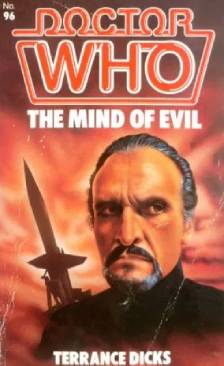
Cover: Andrew Skilleter paints a portrait of the Master with the missile.

Final Analysis: Considering how those mid-to-late Tom Baker books saw a surfeit of Dicks, it really is a treat to find one of his books is next on the list. Terrance dominated the first 100 releases, but there are few of them left by this point. We can rejoice in this one being the second and last of Don Houghton’s scripts to be novelised, from an era where, along with producer Barry Letts, Terrance was king of Doctor Who. There’s a sense that the story is made up largely of three ‘episode two’s sandwiched between an opening and closing episode; Terrance does little to change this, but it’s enjoyable to see a few additional bits of detail that sketch in the lives of our supporting characters.

On TV, Professor Kettering reacts against the Doctor at his most obnoxious, whereas here, we find out he is completely winging it and the Doctor is (unconsciously) correct to pick apart his claims. Barnham and Mailer are both revealed to be extremely violent thugs, so the contrast between them after Barnham has been processed is even more stark – and Mailer is immediately as threatening a presence as he is on screen. A surprise and disappointment comes with the arrival of the Chinese dragon, which kills the delegate. While it provides an appropriate point to conclude a chapter, Dicks doesn’t make much of it or make any attempt to make it more dramatic than the ‘Puff the Magic Dragon’ that so failed to impress the production team as it waddled onto set. For once, he chooses just to say ‘it happened’ and move on. Whether this was down to word-count or he was just trying not to resurrect painful memories of the costume, we’ll never know.

Further Listening

I was a guest on the Dr Who Literature Podcast to discuss this book, which you can hear in the link below, on YouTube, or via the podcast provider of your choice.
Chapter 95. Doctor Who – The Awakening (1985)

Synopsis: In an English village, a historical re-enactment of the civil war begins to take a threatening tone. Some of the players are taking things far too seriously, in particular Sir George, who seems particularly driven towards making the event as accurate as possible. When Tegan Jovanka comes looking for her grandfather, she learns that he has disappeared, while the Doctor joins forces with a local schoolteacher and a time-displaced boy to uncover something terrifying in the church crypt…

Chapter Titles

  • 1. An Unexpected Aura
  • 2. The Devil in the Church
  • 3. The Body in the Barn
  • 4. Of Psychic Things
  • 5. ‘A Particularly Nasty Game’
  • 6. The Awakening
  • 7. Tegan the Queen
  • 8. Stone Monkey
  • 9. Servant of the Malus
  • 10. Fulfillment

Background: Eric Pringle adapts his own scripts from the serial broadcast in 1984, the first novel based on a two-part story since The Sontaran Experiment.

Notes: Little Hodcombe is in Dorset (everyone on TV affects that ‘just outside of London’ accent that covers anywhere from Norfolk to Cornwall). Sir George’s ancestors have governed over the region since before the civil war; Will Chandler was in service to one of them and it’s that ancestor that he sees when he pushes Sir George into the Malus. The conclusion suggests that, as he promised to Tegan, the Doctor does indeed stay in the village for a holiday.

Cover: Andrew Skilleter’s original cover is a handsome portrait of the Malus, free of its crumbling wall frame. Alister Pearson’s 1992 cover adds the Doctor and Tegan to a walled-up Malus.

Final Analysis: This is a fun one: Back when this was first published, I wrote a review for a local fanzine in which I moaned about the padding that was evident in the fact that it took ten pages just to get past the first scene. Impatient youth! So, 35 years later, Eric Pringle’s sole contribution to the range is indeed a slow build as he takes his time to describe every detail that we might have seen on screen… and that’s the issue really. Although made as a two-part story, it was commissioned as four episodes and one might have hoped for an expanded novel that featured loads of extra scenes. As it was, the reason the story was reduced in size was because there wasn’t enough to sustain 90 minutes of drama, so apparently very little incident was actually cut. There was one short scene with Kamelion in the TARDIS that was recorded but subsequently removed, but that doesn’t make it into the novel either. 

Of course, I didn’t know there was material missing in 1985 and what we have is a very thorough and accurate adaptation of the story as broadcast. Far from being padded, this novel makes good use of the increased page-count that’s been the standard since Frontios. The characterisation is strong, particularly for Will Chandler. 

Will had given up being surprised. When he had been bobbing and swinging about in the cart and feeling sure that his bones were splintering inside him, he had made up his mind that if he survived he would take everything in his stride from now on. He had discovered that when absolutely everything is extraordinary, nothing is astonishing any more. Running into a blue box, therefore, was simply another wonder to be accepted without demur, and he shrugged as he ran in through its door, as though this sort of thing happened to him every day. 

Oh why wasn’t he a companion?! There’s one thread that gives us an extra hint of Will’s backstory, as he explores the Little Hodcombe of 1984 and is appalled that the events that he remembers from 1643 – which must be just a day or so ago in his own timeline – are happening again. He even notes that this current time has a Squire Hutchinson, just as his own did. The Squire who pressed him into service and whose actions led Will to hide in the church. Come on, Big Finish, surely there’s a gap you could fill with a mini-series? The Will and Jane Adventures!

Further Listening

I was a guest on the Doctor Who Book Club Podcast to discuss this book, which you can hear in the link below, or via the podcast provider of your choice.

Chapter 94. Doctor Who – Marco Polo (1985)

Synopsis: The Venetian explorer Marco Polo meets four travellers stranded with their strange blue caravan – a box that that he immediately realises will make a splendid gift for the great Kublai Khan. On their long journey, the strangers become friends as they share stories of many cultures, but their journey is fraught with danger, not only from a hostile environment but also from within the party as a traitor schemes against them.

Chapter Titles

  • 1. Roof of the World
  • 2. Emissary of Peace
  • 3. Down to Earth
  • 4. Singing Sands
  • 5. Desert of Death
  • 6. A Tale of Hashashins
  • 7. Five Hundred Eyes
  • 8. Wall of Lies
  • 9. Too Many Kan-Chow Cooks
  • 10. Bamboozled
  • 11. Rider from Shang-Tu
  • 12. Runaway
  • 13. Road to Karakorum
  • 14. Mighty Kublai Khan
  • 15. Gambler
  • 16. Best-Laid Schemes
  • 17. Key to the World

Background: John Lucarotti adapts his own scripts for the series broadcast in 1964, so stealing the record from himself and The Aztecs for the biggest gap between broadcast and novelisation at 20 years, eight months and a week.

Notes: A new opening scene sees Susan give a temperature in centigrade and Ian calculates the fahrenheit equivalent. Ian opens the TARDIS door, then shuts it quickly (suggesting that the doors are the same as those on the exterior of the ship) and jokes that they can’t be in the Alps because there’s no yodelling. The Doctor also gives a clearer reason for staying outside of the ship (it will act like a ‘cold storage room’ and kill them). He introduces his granddaughter as ‘Susan Foreman’ (!) and both she and Ping-Cho are 15 years old (not 16 like on TV). Once again, the Doctor uses a pen torch [see The Aztecs]. Susan mentions the TARDIS ‘water producer’. Surprisingly, the device of Marco’s journal is not used; instead, some of the events he describes are expanded upon. 

Ping-Cho learns of the death of her husband-to-be as soon as she arrives at the Imperial Palace. The Empress notices exchanged glances between Ping-Cho and the Captain, Ling-Tau; she urges Kublai Khan to promote the captain so he might be of sufficient rank to be a husband to Ping-Cho. Tegana doesn’t get to commit suicide; he’s shot dead by Ling-Tau with an arrow that kills him instantly. There’s no swift escape to the TARDIS at the end either. Kublai Khan invites the Doctor to stay as his personal secretary, but he declines and says a relaxed goodbye to him, Marco and Ping-Cho before leaving in the TARDIS. Kublai Khan dubs the key to the TARDIS the ‘Key to the World’ and has it placed on a gold chain (unaware that it’s the Doctor’s spare). The Key is said to lie in a museum that was once the imperial palace.

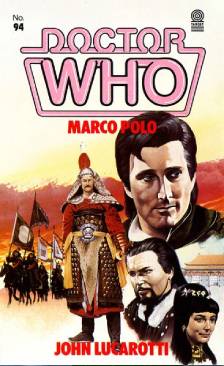
Cover: David McAllister returns with a painted composition of Marco Polo, Tegana, Pingo Cho and Kublai Khan, along with some other elements that apparently come from an entirely different production called Marco Polo from the 1980s. It’s nice to see accurate resemblences to actors Mark Eden, Zienia Merton and Derren Nesbitt here.

Final Analysis: John Lucarroti’s second novel and it’s as much of a jolly history lesson as the first, with additional highly detailed descriptions of various menus. Obviously, each of the locations is grander than the sets in Lime Grove could have allowed and also we get a real sense of the time passing, as each chapter adds days onto the journey, which lasts around 40 days in all. It might lack the fun and melodrama of monsters of robots, but it’s a rare story that truly allows us to step into a culture and enjoy various aspects of it.

Chapter 92. Doctor Who – Planet of Fire (1985)

Synopsis: Peri Brown, a young American student, is rescued from drowning by Turlough. Among her belongings is a metallic object that the boy recognises as coming from his own world. The shape-changing robot Kamelion interferes with the TARDIS to take them all to a volcanic planet where a religious order revolves around a teenage boy who might be the key to Turlough’s secret past. A bewildered Peri discovers that Kamelion is being controlled by someone who knows the Doctor well, someone who calls himself ‘The Master’…

Chapter Titles

  • 1. Mayday
  • 2. Message Received
  • 3. Destination Unknown
  • 4. Crisis on Sarn
  • 5. A Very Uncivil Servant
  • 6. Outsiders
  • 7. The Misos Triangle
  • 8. An Enemy in Disguise
  • 9. In the Heart of the Volcano
  • 10. The Blue Flame
  • 11. The Time of Fire

Background: Peter Grimwade adapts his own scripts for the serial broadcast seven months earlier.

Notes: The book begins aboard the ship of Captain Antigonas struggling in a storm. The vessel is weighed down by the treasures of Dimitrios, a fat merchant from Rhodes who is more concerned with the welfare of a marble statue of a boy than for his own life (or those of the crew). He’s last seen clinging to the statue  ‘as if it were a lover’, plummeting to the depths of the ocean. The ancient ways of the doomed mariners are contrasted with the similar fate of the crew of a Trion vessel caught in the gravitational pull of Sarn. Another captain, Grulen, eagerly awaits landing on the planet as several generations of his family once lived there before the volcanoes became overactive. A sudden surge of volcanic activity causes a magnetic storm. Realising they won’t be able to guarantee a safe landing, Grulen opens the security quarters of the ship so that his prisoners might have equal chance of survival as the rest of the crew. Having faced the threat of execution daily, two of the prisoners are resigned to their deaths and as the couple cradle their sleeping child, the father’s thoughts turn to Turlough.

There’s a shuffling of scenes at the start, with all of the scenes on Sarn delayed to chapter 4, which makes a lot more sense. We join the TARDIS in the immediate aftermath of Tegan’s departure. Turlough considered the Australian ‘argumentative, tactless, interfering, brainless and with a voice that could strip paint’; he also misses her terribly and so does the Doctor. Turlough suggests a holiday, and while the Doctor isn’t enthused with the idea, remembering the chaos that ensued after a trip to Brighton, Turlough recalls a holiday with his school chum Ibbotson and his family to Weston-super-Mare – and so is determined that they should find a ‘paradise island’ instead. Kamelion’s screams force the Doctor to realise he’d forgotten all about the robot shapeshifter and notes that he had ‘none of the cheerful loyalty of K9’. His voice is like a speak-your-weight machine. Turlough suspects Kamelion of working with the Custodians on Trion and when the robot advises him to take care under the hot sun (‘with your fair skin you will easily burn’) it sounds to Turlough more like a threat than advice.

Howard Foster speculates that the mysterious metal object might be debris from a Russian satellite. His assistant is Karl, not Curt. Peri mentions a ‘Doc Corfield’ and notes that she would ‘never trust a man with a toupee!!’ Howard is 41 next birthday. He says that Peri has travelled all her life but Peri moans that it’s mainly been a succession of Hilton hotels. She has a trust fund, left to her by her (presumably deceased) father, which will be released to her when she turns 21. The English guys she hopes to go travelling with are called ‘Trevor’ and ‘Kevin’. Peri acknowledges that she’s not a strong swimmer but it’s leg cramp that causes her to come into difficulty as she heads to the shore. Incidentally, Lanzarote is not mentioned at any point in the story; the story begins with the shipwreck off the coast of North Africa (‘the headland’) so Howard’s archeological excavation might take place in Gibraltar, which has easier access to Athens. But it’s probably still Lanzarote in anything but name.

Turlough has a more physical altercation with Kamelion before disabling the robot with a bombardment of waves and dumping him in a spare room. Sarn is a city, not the name of the planet, believed to be the last surviving community after the last earthquakes and firestorms a generation ago. Turlough appears to tell the Doctor the name of his home planet, Trion, for the first time, despite having asked to go there in previous stories. The Doctor quotes Paradise Lost and admonishes Turlough for not studying Milton at school. Misunderstanding Turlough’s intentions, the Doctor calls him a ‘little racialist’: ‘As Tegan had never been slow to point out, Turlough could be a rather nasty piece of work.’ There’s a summary of the Master’s exploits that led to his predicament, during which it’s confirmed that this is his fourteenth incarnation. Turlough and Malkon find a poorly tended grave near the wreck of the Trion ship, which confirms Turlough’s suspicions that Malkon is the only survivor of the crash. The Master’s final teasing line asking the Doctor to ‘show mercy to your own-‘ is cut, as is the final scene on TV where Peri received her proper invitation to join the Doctor.

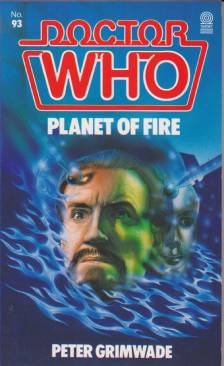
Cover: Andrew Skilleter’s illustration depicts the Master and Kamelion in waves of blue flame.

Final Analysis: An elegant adaptation here. I particularly like the way Grimwade makes sure we know when we’re with the Kamelion version of any character as he undermines the illusion in every line: ‘the duplicate professor’; ‘the man in the dark suit who everyone believed to be Professor Foster’; ‘Kamelion in the guise of the American archaeologist’; ‘The robotic Master’. He also has a nice line in similes: The Doctor’s device squeaks ‘like an old lady who has turned her hearing aid up too high’; the volcano grumbled ‘like a sleeping giant with a touch of indigestion’; the Master announces himself to Peri ‘as if he were the Tsar of all Abe Russias’; the Doctor’s party works its way through the streets of Sarn ‘like rodents navigating the secret byways of the skirting board’; the Doctor arrives at the portico ‘like a royal bride’; Kamelion glitters ‘like a Maltese tinfoil Saint at Festa Time,’ and later the robot appears ‘blustered like an actor unsure of his lines’. It’s so much fun seeing which ridiculous comparison he’ll submit next. Though what we’re supposed to make of Peri delivering ‘a sharp kick at the Master’s shins that would have repulsed a Globetrotter’, I’m not so sure.

Chapter 90. Doctor Who – The Highlanders (1984)

Synopsis: In the aftermath of the battle of Culloden in 1745, a group of Jacobite rebels try to evade capture by the English army. The Doctor, Ben and Polly help a wounded laird but are then captured by an incompetent English officer. The Doctor adopts a fun disguise as Polly uses guile to free her new friends and escape. One young Scot in particular impresses the time-travelling trio – a piper by the name of Jamie McCrimmon.

Chapter Titles

  • 1. Where are We?
  • 2. The Cottage
  • 3. The Captives
  • 4. The Handsome Lieutenant
  • 5. Polly and Kirsty
  • 6. Polly’s Prisoner
  • 7. The Water Dungeon
  • 8. Blackmail!
  • 9. The Doctor’s New Clothes
  • 10. Aboard the Annabelle
  • 11. At the Sea Eagle
  • 12. The Little Auld Lady
  • 13. A Ducking for Ben
  • 14. Where is the Prince?
  • 15. The Fight for the Brig
  • 16. Algernon Again
  • 17. A Return to the Cottage

Background: Gerry Davis adapts the scripts he co-wrote with Elwyn Jones for the 1967 serial.

Notes: The bonhomie of TV’s Ben and Polly is replaced by something closer to the bickering of 1980s companions; Ben insists on calling Polly ‘Princess’ (not ‘Duchess’) and thinks she is ‘uppity and toffee-nosed’. He also thinks the sounds of battle drifting over the moor are just celebrations from ‘the Spurs Supporters Club’ (ahem, a reference to the er, London-based football team Tottenham Hotspurs) or a historical society. Polly resents Ben’s ‘big brother’ protectiveness, especially as she is ‘about a head taller than he was’; later, it’s confirmed she’s an ‘independent girl from the sixties’ – so her ‘seventies’ origins have been properly reset from previous Gerry Davis novels. The Doctor admits to Polly that the discovery of a cannon ball makes him afraid. There’s a dump of history at the start too, as we’re told of the battle for the British monarchy between the Scottish Stuarts and the ‘Hanoverian German Georges’. The Scots had been booted out 40 years ago and we join the story in the aftermath of the battle of Culloden Moor. As this wasn’t taught in English schools in my day, this is especially welcome and helpful.

As the Doctor inspects a tam-o’-shanter, we’re told it’s a ‘standing joke in the TARDIS that he could never resist trying on any new hat he came across’; as this is the first TV story where his hat fetish became a regular thing, this suggests the trio have had a fair few offscreen adventures since the Doctor’s regeneration. He adopts the pseudonym ‘Doctor von Verner’ (not the more obvious meta-joke ‘von Wer’ on telly). Algernon Ffinch stammers ‘in a way approved by the London dandies of the time’, which could mean it’s an affectation for fashionable purposes. The Sergeant’s name is spelled ‘Klegg’, not ‘Clegg’. While in the prison, Jamie plays a mournful tune on his bagpipes before the Doctor creates a disruption in the gaol by playing the Jacobite ‘Lillibulero’ on his recorder. The name of the pub where Solicitor Grey has installed himself is called the Sea Eagle Inn. As Jamie boots Trask overboard during the final battle, Ben tries to regain some composure as he claims he was about to use karate to save himself. There’s a more pressing reason for Jamie to join the travellers; having escorted them to the TARDIS, Jamie boasts that he’ll be fine on his own as they hear the sound of muskets being fired nearby. We then join Jamie as he sees the inside of the TARDIS for the first time (see below).

Cover: A smashing portrait by Nick Spender of Jamie, accompanied by Alexander, a Saltire flag and the TARDIS. Unusually for this period, there are likenesses of recognisable actors here!

Final Analysis: Gerry Davis returns to adapt a script that he originally oversaw to production. It was the last of the pure historicals on TV, yet it’s the second one we’ve had in novel form in the space of a year. The Highlanders is often overlooked in favour of the more monster-focused stories of the era and, perhaps it won’t come as a surprise to learn that this is the first time I’ve read this particular book. Davis keeps things light, even with the threat of violence and a very sudden and shocking death early on. The stakes are high, but so’s the sense of adventure and Polly in particular has a rare old time running rings around every man she encounters. Effectively, she gets her own companion in the form of Kirsty and it’s easy to forget that this is the debut of Jamie, even though his future role as a companion isn’t foreshadowed at all, he’s just one of a number of likeable characters that we meet. Poor Ben’s experience in Scotland isn’t quite so jolly. Despite having spent very little time with Jamie, Polly takes an immediate shine to him and the final scene sees him adopted as a fully-fledged TARDIS member at last:

As he hesitated, Polly turned back and grasped his hand. ‘Don’t be afraid,’ she said, ‘it’s much nicer inside than it is out. There’s so many wonderful surprises waiting for you, you’ll see.’

Jamie allowed himself to be drawn through into the small police box. The door closed behind him and he saw to his astonishment the large, hexagonal, brightly-lighted interior of the time-machine.