Chapter 136. Doctor Who – The War Machines (1989)

Synopsis: The white heat of British technology is evident in the unveiling of an impressive new tower in the heart of London. At the top sits a powerful super-computer – WOTAN – enabling rapid communication across the world. The computer’s inventor, Professor Brett, is in fact a servant of WOTAN, helping the machine to build a fleet of mobile battle-tanks. Soon, the War Machines appear on the streets of London – and the Doctor is required…

Chapter Titles

  • 1 The Home-Coming
  • 2 The Super-Computer
  • 3 A Night Out
  • 4 Servant turned Master
  • 5 Putting the Team Together
  • 6 Working for the Cause
  • 7 A Demonstration of Power
  • 8 The One Who Got Away
  • 9 Attack and Defence
  • 10 Taking to the Streets
  • 11 Setting the Trap
  • 12 The Showdown
  • 13 We Can’t Stay Long

Background: Ian Stuart Black adapts his own scripts for the 1966 story, 22 years and seven months after it aired. On transmission, Kit Pedler was credited as having been responsible for the idea of the story, though it’s still not clear how much of this was just a PR exercise from the production team to highlight their science-based aspirations; if the idea was no more than ‘a computer at the top of the new Post Office Tower’, this wouldn’t be sufficient to lay a claim to a share of the copyright, which might also explain the lack of a credit for Pedler at the front of this book.

Notes: The opening chapter sees Dodo helping the Doctor to steer the TARDIS to its next destination (a task she’s inherited from the recently departed Steven). The Doctor can apparently ‘predict exactly where they would materialise’ [we can look to the start of The Savages for why this might now be the case, as he’s had time to calculate their exact position in the universe for possibly the first time in a while]. Seeing the name ‘Carnaby Street’ on the TARDIS monitor, Dodo reacts as if the street is brand new; it first appeared on documentation in the 1680s and it had been a destination for jazz fans since 1934, slowly transforming into a string of boutiques by about the time Dodo absconded aboard the TARDIS (as a schoolgirl, she was probably a little young for it to have appeared on her radar). 

It’s the Doctor, not Dodo, who realises that the new construction in the centre of London is ‘finished’ and he observes that it’s called the ‘Post Office Tower’, though ‘in all probability they would change that name’; opened to the public in May 1966, just two months before the broadcast of the first episode of The War Machines on TV, the building became the ‘British Telecom Tower’ in the mid-1980s before settling on ‘The BT Tower’ in the 90s. William Hartnell’s fluff of the word ‘sense’ to ‘scent’ becomes the Doctor’s intention all along, prompting Dodo to make a joke about London fog. Curiously, Dodo doesn’t know what a milk bar is (they existed in her time and a girl from London would know, but she’s acting as an agent for the reader here). The Doctor is said to be wearing a ‘velvet jacket’.

The duo head to a nearby cafe, where the Doctor speculates that his former companion Ian Chesterton will have become something of note in the world of science and in all probability had something to do with training the staff at the new Tower – and it turns out he’s entirely correct! The Doctor fakes documents that provide him with an introduction, a minor act of subterfuge that then enables him and Dodo to investigate the operations at the top of the Tower – and his credentials are checked and verified by Major Green. Professor Brett has heard Ian Chesterton speak of the Doctor often.

Polly is ‘an attractive girl with long blonde hair and blue eyes’ and she wears a very short skirt that shows off ‘her long and shapely legs’. Dodo thinks that she and Polly might be ‘about the same age – not that Dodo was too sure what her own age was nowadays’ (Dodo was a schoolgirl of about 15 when she first entered the TARDIS and Polly is at least 18 – she’ll have had to attend secretarial school – so that’s a sizeable age gap of Dodo’s for Big Finish to cover there). Polly offers to take Dodo to a new club, The Inferno, which is in Long Acre (that’s a swift 20-minute walk there – and 20 minutes back – so she apparently wangles an early finish on the Friday before the project’s big launch (miraculous in itself!). WOTAN says that ‘The Doctor is required’, not ‘Doctor Who’ as on telly. Spoilsport.

The War Machines have names, not numbers, and the one captured by the Doctor is called Valk. It has no weapons, so the Doctor installs an automatic rifle. Polly and Ben force their way aboard the TARDIS because they feel he’s trying to get rid of them – and not because they’re returning his key.

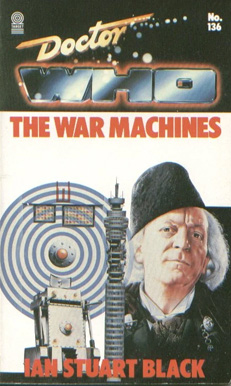
Cover: You really wouldn’t want much more from this cover – a lovely shot of the Doctor, a War Machine and the Post Office Tower, with a close-up of WOTAN’s control panel in the background, broadcasting concentric circles of radio waves. Alister Pearson had help from Graeme Way with the concentric circles.

Final Analysis: Another author delivers his final novel and as with the TV story it’s based on, it’s Ian Stuart Black’s best one. There’s some lovely foreshadowing in Chapter 1 of both the Doctor and Dodo realising this will mark the end of their travels together. That chapter also boasts an introduction to the idea of time travel, and indeed what time itself actually is:

Of course he knew that in one sense Time was a fiction – an attempt by man to measure duration with reference to the sun and stars. But he also knew that although such measurements were based on an impressive formula, all man’s concepts were fraught with error. Time was not as it was supposed to be, for here they were, he and his single crew-member, Dodo, travelling fortuitously across space, splitting Time into fragments – or more exactly, ignoring the passage of time, the rising and setting of the sun, the ebb and flow of tides, the coming and going of the galaxy in which they voyaged. 

While Dodo’s departure is only slightly less abrupt than it was in the original, this very swiftly becomes the story of Ben and Polly, who we first met in Doctor Who and the Cybermen (1975). We’ve long forgotten Gerry Davis’s fudging of their origins in those early Target books and they feel as much a part of ‘Swinging Sixties London’ as a story set in the very heart of the ‘white heat of technology’ can possibly allow.

Chapter 113. Doctor Who – The Ark (1987)

Synopsis: The TARDIS delivers the Doctor and Steven, with their new friend Dodo, aboard a huge space ark carrying the survivors of Earth to a new home. As most of humanity sleeps in miniaturised form, the ark is maintained by a small community of humans with the assistance of the alien Monoids, knowing that their journey will outlast them all. Then the humans and Monoids succumb to a terrible disease – the common cold, brought aboard by Dodo. The Doctor manages to find a cure and the trio leave – only to return to the space vessel almost immediately, but hundreds of years into the future for humanity, which is now enslaved by the Monoids…

Chapter Titles

  • 1. The Steel Sky
  • 2. Capture
  • 3. The Plague
  • 4. The Fight Back
  • 5. The Return
  • 6. Refusis
  • 7. Search
  • 8. The Final Conflict

Background: Adapted by Paul Erickson from the 1966 scripts he officially co-wrote with Lesley Scott.

Notes: We begin with a single word: ‘Jungle’. The opening scene provides us with a description of the Monoid that includes details not visible on telly:

But this creature was different from the snakes and lizards that were normally found in this jungle. In the first place it walked upright on two legs, two arms hanging at its sides. It made no sound, not even the hissing that other reptiles might make. And while its body was covered in scales, the head boasted a mop-like thatch of ginger hair.

Facially, it displayed three shrunken nostrils and a small, thin mouth from which a tongue occasionally flicked out.

But its most prominent feature was a large single eye that constantly swivelled as it looked around.

Later, we’re told that the Monoids have no vocal cords, but that they can ‘lip-read’ and understand sign language – which suggests that they are also deaf (or, more likely, that the author doesn’t understand the difference). 

The Doctor mentions a previous adventure that took place on the planet Venessia – or possibly Enlandia – where there was no landmasses, only water and a ‘peculiar form of crystal ice’. He also mentions events on the planet Sava, which he tells Steven he visited ‘some time ago,’:

Some time ago was right. No sense in telling the young man that it must have been three centuries in his terms, although in the Doctor’s own knowledge such a time span had little meaning. Places were places, creatures were creatures… and time was time. All in the now period. That was the only way he ever experienced it, the only way he knew it.

The Doctor has never been to Refusis, but he did pass by it with previous companions (presumably this is Ian and Barbara with either Susan or Vicki); on that occasion, the TARDIS was attacked by rockets and the Doctor had to steer his ship to make the missiles collide and destroy each other. The Doctor criticises Dodo’s use of the word ‘fab’, calling her English ‘Most… elastic’. The Guardian Commander has a similar reaction when Dodo claims she might have ‘an attack of the willies’ and uses the adjective ‘flipping’. The Doctor name-drops Houdini and tells his friends about the events that led to the escapologist’s death. Later, while teaching Rhos about vaccines, he compares their work to that of Marie and Pierre Curie. ‘a husband and wife team of scientists of the nineteenth century’. Dodo tells her new friends that it’s Friday the 13th, still failing to grasp that they’ve travelled in time.

The prisoner on trial at the beginning is called Niash and he is offered a choice of either death or miniaturisaton (on TV, he’s simply told he’ll be miniaturised). The Guardians measure their ship’s dimensions in leagues – it’s two thousand leagues long – but Mellium doesn’t know if a league is three miles or three kilometres (it’s three nautical miles). The ship has no name – although the Guardians adopt Dodo’s use of the term ‘ark’ – and it contains many different types of environment; in addition to the jungle, there are lakes, deserts and polar regions. 

The trial of the travellers is much more involved and fleshed out (the Doctor is concerned by Steven’s blunt defence, noting that ‘advocacy [is] a special art – one that often calls for delicacy rather than the heavy hammer’. The hunt for a vaccine involves an operation to take blood and saliva samples from all living things aboard the ark, including a goat. Dodo takes Manyak inside the TARDIS to fetch equipment for the Doctor’s experiments; Dodo compares some of the items to the kind used by dentists and Manyak reveals that they don’t have dentistry in their time. The perplexing size of the TARDIS interior to its external shell convinces Manyak of the truth at last. Dodo tells him that ‘Lots of people have been fooled by that’ and that the Doctor told her it’s all ‘an optical illusion’. [On TV, this is her first journey, but this does lend credence to the theory that she’s had a few offscreen adventures prior to this – or that Dodo feels confident in pretending to Manyak that she knows more than she really does, which – considering she takes a long time to accept that they’ve travelled in time – seems more credible].

The Doctor and his friends encounter a very tame tiger, which surprises them by licking Dodo’s hand with affection. They later learn that the humans removed aggression from their character to create their harmonious society – and then extended this gift to the predators among their livestock. Later though, a Guardian is attacked by a boa constrictor (observed by a curious Monoid) and in the polar region, the Doctor sees a polar bear and is told that not all animals were successfully converted away from aggression.

On inspecting a Guardian’s physical scan, the Doctor discovers that humans now have two hearts (though makes no reference to having two himself), two livers and a ‘greatly reduced intestinal system’, but have lost their vermiform appendix and tonsils, all the results of genetic manipulation many generations ago; the humans also have reduced musculature that makes them incapable of heavy lifting; in contrast, the Monoids have no heart, just a series of pulses, but they do have a nervous system. The Doctor applies the vaccine via pads, rather than needles (as on TV) and as he explains that the future humans are a ‘changed species’ from Steven and Dodo, he adds cryptically that he himself has ‘had more experience of adapting’ [this is the ‘first’ Doctor, but see some similarly confusing statements in Galaxy Four]. 

The Doctor’s quest to administer the vaccine takes him, Rhos and a Monoid via conveyor transport into the desert area, where they encounter a caravan of nomads, and to the ‘cultivated zone’ inhabited by farmers. An elderly woman tells the Doctor that not everyone on Earth came aboard the ship; some remained to live out their lives on the doomed Earth. The people of Earth abandoned country names ‘a long time ago’. Burial had been banned, replaced by mandatory cremation. Again, it’s noted that Guardians don’t do manual work, while Monoids accept it.

When the travellers first return to the TARDIS, the Doctor and Dodo grab some sleep while Steven is left ‘on duty’, but Steven falls asleep too and accidentally knocks a switch, which is why they return to the Ark in its future. They emerge aboard the Ark to discover that the previously placid predators have now reverted to type, as they see a tiger hunting gazelle. Monoid One is actually the 17th One, a descendant of the Monoid who assumed power after the war that resulted in the subjugation of the humans. Monoid Four comes from a long line of individuals who question decisions – and he feels that the treatment of the humans is wrong.

Dodo meets a second Refusian, a female who tells her they don’t have individual names, but decides that they should adopt some and chooses ‘Mary’ for herself and ‘Charles’ for her brother. Dodo tells Mary that the Refusis castle reminds her of a similar building she once visited in Wales, then the two new friends play a game of tennis. After the launcher is destroyed, Dodo panics that she might be stranded and suddenly realises that she’s millions of miles and years away from home. She speculates that back home she’d be shopping and preparing for a night out – but is quick to appease Mary when she inadvertently causes offense at being ungrateful for the Refusian hospitality. The time travellers stay to witness the arrival of the Ark’s population and revival of the miniaturised beings on the surface of Refusis, which is ‘a model of efficient organisation’ thanks to the cooperation of Monoids and humans alike. Among the revived people is Niash, the prisoner from the trial at the start of the story. As usual, the tag scene leading into the next story [The Celestial Toymaker] is not included here; instead, the Doctor attempts to give Dodo elocution lessons (‘The rain in Spain falls mainly on the Plain’, made famous by My Fair Lady). The old man promises his young friends a journey – but ‘no guaranteed destination!’

Cover: For the first edition, David McAllister shows the Doctor and a Monoid in a triangular motif as animals break the frame and run into space. For the 1993 reprint, Alister Pearson uses a border that’s reminiscent of the one he used on The Ark in Space and Revenge of the Cybermen, with Dodo and the Doctor either side of an attacking Monoid.

Final Analysis: This is a pretty solid adaptation, telling the story as seen on TV but with the kind of nuances and subtle enhancements that make these books all the more worthwhile. Paul Erickson provides a more rational explanation for how the Monoids managed to overthrow the human rulers (humanity having slowly removed aggression and physical strength from its genetic makeup, making them vulnerable to revolt) and really adds to the scale of the Ark and its many geographical simulations. Something he really excels with is Dodo, perfectly capturing her carefree and cheeky attitude. She’s an absolute hoot, annoying the Doctor with her never-ending supply of 60s slang. The book still contains two of the less credible elements too – the security kitchen (!) and the ‘galactic accident’ that led to the Refusians becoming invisible – which would have been a shame to lose.

Further Listening

I was a guest on the Dr Who Literature Podcast to discuss this book, which you can hear in the link below, on YouTube, or on the podcast provider of your choice.

Chapter 110. The Celestial Toymaker (1986)

Synopsis: The TARDIS has become trapped in the realm of the Celestial Toymaker, a strange and powerful being. He promises to free the Doctor and his friends – but first, they must play his games and if they lose, they will join his collection of dolls. As the Doctor pits his wits against the infamous trilogic game, Steven and Dodo quickly find the TARDIS – but it’s a fake, one of many. It won’t be that easy to defeat the Toymaker, especially when his doll servants cheat!

Chapter Titles

  • Foreword
  • 1. Trapped
  • 2. Bring On The Clowns
  • 3. Snakes and Ladders
  • 4. The Hall of Dolls
  • 5. Siege Perilous
  • 6. The Last Deadly Sister
  • 7. Enter Mrs Wiggs and Sergeant Rugg
  • 8. The Ballroom
  • 9. The Final Test
  • 10. Stalemate

Background: Gerry Davis and Alison Bingeman adapt scripts from the 1965 serial by Brian Hayles, which were heavily rewritten by Davis.

Notes: A foreword by Gerry Davis explains some of the problems that beset the production. The Doctor is explicitly named as ‘the ‘first Doctor’. The story follows on immediately from the events of The Ark and references the invisible Refusians. The Toymaker’s domain is not just a white void – the ‘ceiling’ is exposed to the ‘black immensity of outer space and the twinkling stars of the galaxies’. The Toymaker’s study is filled with ‘every conceivable type of toy’ placed on various antique tables, while the villain himself is an impresive figure.

The Toymaker stood up, a tall imposing figure, dressed as a Chinese mandarin with a circular black hat embossed with heavy gold thread, a large silver red and blue collar and a heavy, stiffly embroidered black robe encrusted with rubies, emeralds, diamonds and pearls set against a background of coiled Chinese dragons.

As the Toymaker tries to take control of the Doctor’s companions, Steven sees visions of himself during ‘the Massacre of Saint Bartholomew’ and on the Ark surrounded by Monoids (on TV, it’s the planet Kemble from The Daleks Master Plan, along with the massacre). The Doctor’s trilogic game score is displayed on a large black robot (which is silver on telly). As Joey the Clown nears the end of the game, he appears to ‘move stiffly like an old man’. Among the female ballerinas seen on screen is a male dancer who Dodo says looks like Rudolph Nureyev (apparently she’s ‘a great ballet fan’). Unlike on TV, when the King of Hearts quotes the counting game, ‘Eeny, meeny, miney, mo’, the racist next line is thankfully omitted. Steven is a military history enthusiast and can recognise the period of Sergeant Rugg’s uniform. Before the final game, Cyril tries on the hats of the joker and the chef, making it clear that he’s been both of those characters before picking up the schoolboy role. He’s dressed in a school uniform for a younger child, with shorts. The Doctor suggests that the Toymaker is just one of many – and they are all immortal. The linking material into The Gunfighters is omitted as usual. Instead, the Doctor suggests that another meeting with the Toymaker is inevitable, adding that ‘There will always be a Celestial Toyroom in the universe.’

Cover: Graham Potts contributed just this one cover to the range but it’s rather beautiful, a photorealistic composition of Joey and Clara flanking the Toymaker, with some playing cards just peeking up from the bottom of the frame. Though we try to forget it, Michael Gough previously appeared on the cover of Arc of Infinity as Hedin. Alister Pearson’s 1992 reprint has a simple composition consistent with the time, showing the Toymaker and the Doctor, inspecting a piece of the trilogic game.

Final Analysis: Rewritten heavily at short notice, The Celestial Toymaker as broadcast was limited by the sets and costumes already commissioned for the original scripts. For the novel, Gerry Davis and Alison Bingeman don’t take the opportunity to give the readers Brian Hayles’ earlier version of the story – thankfully! It follows the TV episodes faithfully, enhancing and creating a degree of scale impossible to achieve in Riverside Studios. In keeping with the decade in which the book was published, Steven and Dodo are a little more adversarial than the friends on TV – Dodo in particular enjoys laughing at Steven’s misfortunes. The best addition though is the suggestion that the Toymaker is not the only one:

‘I really don’t know why you want to leave here, Doctor.’ The Toymaker’s tone was most conciliatory now. ‘There will always be a toymaker in the world ready to make more and more inventive machines. That is, until one is made that will destroy his world. But each time, the world can be recreated and we can have the fun of building better and better toys. Why not join me, Doctor?’

The Doctor stared at him for a moment. ‘I won’t join you,’ he said, ‘because you and your kind are evil. The toys you make have no use except to amuse yourselves and ultimately lead to your own destruction. Toys should be left in the nursery where they belong, not decide the fate of worlds. You have failed.’

Chapter 108. Doctor Who – The Savages (1986)

Synopsis: The Doctor, Steven and Dodo are welcomed by Juno, leader of the elite Elders, who have followed the Doctor’s adventures throughout time. Their community seems to be a paradise, its people happy and relaxed. Outside in the barren wastelands live the savages and, as the Doctor soon discovers, this lower caste of people is more vital to the future of the community than any of them realise. All except Juno…

Chapter Titles

  • 1. ‘Are You Sure You Know Where We Are?’
  • 2. ‘You Have Made Me Look Very Grand’
  • 3. ‘A Remarkable Advance, Gentlemen. I’d Like To Know How’
  • 4. ‘I Don’t Know What’s Going On, But I Don’t Like It’
  • 5. ‘The Old Man Did Not Obey’
  • 6. ‘Not Exactly A Witness’
  • 7. ‘Come On, Soldier Boy. What Are You Frightened Of?’
  • 8. ‘The Trouble With You People On This Planet…’
  • 9. ‘I Don’t Trust Strangers’
  • 10. ‘All We Need Is One Good Friend’
  • 11. ‘Do You Think We Will Ever See Him Again?’

Background: Ian Stuart Black adapts his own scripts from the 1966 serial.

Notes: The Doctor consults some print-outs that presumably show the coordinates for their location. He is particularly fond of his calculating device – his own invention – having ‘always found it accurate, and it was giving him some most satisfactory readings’ (unlike on TV, he doesn’t name the device a ‘reacting vibrator’). Dodo is said to be more patient with the Doctor than Steven, accepting his ‘eccentric ways’ and having confidence in him. Honestly, that’s pretty much it.

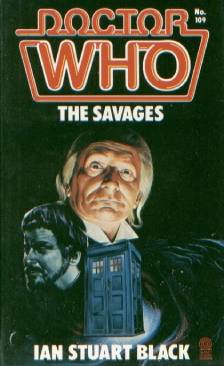
Cover: For the first edition, David McAllister illustrates the Doctor, the TARDIS and Jano. This is the first book cover to illustrate a guest actor  who has previously appeared in a different role on another cover (Frederick Jaegar was also Sorenson / Anti-Man on Planet of Evil, not that he’s all that recognisable on any of the covers for that). For the 1992 reprint, Alister Pearson gives us Chal (as played by Ewen Solon) and the Doctor, with a design motif that evokes the ends of the Doctor’s ribbon tie, forming a cross. 

Final Analysis: It’s a treat to have another 1960s writer taking on his own work even if it’s a fairly straightforward novelisation, largely following the flow of the original scripts. The TV production was one of a number of experiments with trying to replace William Hartnell in 1966 and consequently it’s the third of the 1986 releases to have a noticeably absent Doctor. Yet it doesn’t feel like he’s missing as Jano effectively represents him for a good portion of the book and Ian Stuart Black captures the change in his personality perfectly:

Jano looked at him sharply, and for a moment Senta thought he reminded him of someone else. He had adopted an unusual mannerism, tucking his thumbs into his jacket and peering down his nose, like an old schoolteacher.

Due to the order in which books have been released, it’s strange to have Steven leave when we’ve barely got to know him yet, but we still have a fair few of his adventures to come, which I’m only mentioning because, while it’s a very efficient retelling of the TV episodes, there’s not really much more to report on. Oh – one of the characters mentions it’s a Tuesday, which is an odd thing to note on an alien world. A good debut for Ian Stuart Black though.

Chapter 101. Doctor Who – The Gunfighters (1986)

Synopsis: In the old town of Tombstone, the Doc’s name’s in doubt / He wanted a dentist but his luck ran out / Now the Clantons are coming – they’ll all be here soon / There’ll be blood on the piano at the Last Chance Saloon…

Chapter Titles

  • Prologue
  • 1. Landfall in Tombstone
  • 2. The Last Chance
  • 3. The Brief Career of Dead-shot Steve
  • 4. A Funeral is Arranged
  • 5. Notice to Quit
  • 6. Identity Parade
  • 7. Open Mouth Surgery
  • 8. An Offer Refused
  • 9. A Pardonable Error
  • 10. A Little Night Music
  • 11. And Some Durn Tootin’
  • 12. Arrest Is As Good As A Change
  • 13. The Red Hand of Tradition
  • 14. The Law and Doc Holliday
  • 15. A Very Nasty Little Incident
  • 16. Wyatt Plays It By The Book
  • 17. Pa Clanton Keeps a Welcome
  • 18. Ringo in the Morning
  • 19. Post Mortem
  • 20. Thought For Feud
  • 21. Dodo Draws a Bead
  • 22. The Entry of the Gladiators
  • 23. Come Sun-Up…
  • Epilogue

Background: Donald Cotton loosely adapts his own scripts from 1966. The book is dedicated: ‘For TAMSIN, with coloured moon clouds’. As discovered by Lucas Testro, Tamsin Hickling was a young actress who Cotton befriended in the 1980s; her middle name was a Chinese word that meant ‘moon clouds’.

Notes: You know I love a prologue! We open with a journalist called Ned Buntline, who made his name writing biographies of notable Wild West legends (the real-life Buntline was a celebrated author who died five years after the events at the OK Corral – and a year before Doc Holliday!). Having previously spoken to Wyatt Earp, who refused to be drawn on certain inconsistencies in the myths surrounding the OK Corral, Buntine now comes to a sanatorium at Glenwood Springs, Colorado, to meet an elderly Doc Holliday, who is in his last days with tuberculosis. Holliday speaks freely about the TARDIS, ‘a kind of four-wheel buggy designed for ridin’ every sort of direction through eternity, without much decent respect for the laws of physics’.

Aboard the TARDIS, Steven reminds the Doctor of the time when they encountered ‘great, nebulous jelly-fish things… with poisonous what-nots’. Dodo claims she took a first-aid course, but didn’t do very well. When the TARDIS lands in Tombstone, it’s raining heavily. Behind the bar of the Last Chance Saloon is a, er, well as Buntine tells it, it’s…

…a shot-up oil-painting of a fat blonde in her birthday rig. Sitting on a cloud, she was being molested by a bunch of tear-away cherubs, who looked as if they’d been up several nights round a stud-game, and passing the nectar pretty free, at that.

… and then he gives us two verses of that song (only one of which was heard on TV). 

Dodo is wearing ‘a little number made up of scarlet furbelows and flounces trimmed with black lace’ with an oversized hat (or as Buntine claims, like ‘the proprietress of a broken-down cat-house in one of the less select quarters of New Orleans’). Steven has, according to the Doctor, ‘disguise[d] himself as Billy the Kid’. He took his advanced astronaut course at Cape Canaveral, where he learned to play ‘America the Brave’ on the piano. Dodo sees a poster for real-life star of the stage Eddie Foy – who makes a brief cameo towards the end of the story (and whose son, Eddie Foy, was a Hollywood movie star who Dodo might conceivably have seen). Kate’s surname is ‘Elder’, not ‘Fisher’ as on TV (and in the 1957 movie); the real-life Kate was formally ‘Mary Katherine Horony-Cummings’, but she was also known by the deeply unflattering ‘Big Nose Kate’. 

Doc Holliday’s new dentist’s chair had previously seen service at ‘the Death House in San Quentin’. Pa Clanton is standing for mayoral election and hopes taking up said office will result in free drinks for life at the Last Chance Saloon. Johnny Ringo is a keen student of the Classics and is, at the time of the gunfight, partway through the ten-volume edition of Caesar’s Gallic Wars. The Doctor’s discomfort with a gun results in him accidentally shooting two bystanders, though eventually he is said to have begun to ‘enjoy himself’. The Doctor and his friends leave in the TARDIS, its dematerialisation witnessed by Doc Holliday, Wyatt Earp and a few others. In the epilogue, Holliday concludes telling his story to Buntine, necks a bottle of whisky … and dies.

Doc Holliday did indeed die in 1887, staying at Glenwood Hotel, Glenwood Springs, Colorado. He was 36 years old (Anthony Jacobs, who played him on TV, was 48 at the time of broadcast).

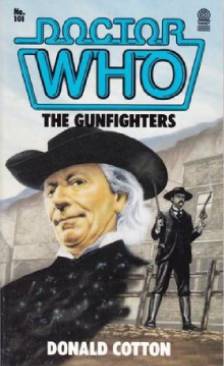
Cover: Andrew Skilleter paints the Doctor with a stetson while Wyatt Earp walks down the street of Tombstone with smoking guns. 

Final Analysis: There are people who’ll still tell you that The Gunfighters is a ‘bad story’ or that it was the lowest-rated story ever (it really wasn’t). There’s even a sly dig at the production in the text of this book, where a passage begins ‘Meanwhile, at the Last Chance Saloon, the stage was already set – as if by an incompetent director.’ Fan elders have shaped opinion to the point where many people who haven’t even seen it know what they think of it. And they’re wrong. Utterly. They’re very quick to remind us that Doctor Who can tell ‘any kind of story’, but seem to bristle when the genre isn’t one they personally like or – worst of all – if the story veers into the realm of comedy!

While the historical adventures did tend to be outperformed on original transmission by the often less ambitious efforts featuring silver sets on alien worlds, as we’ve seen with these novelisations, the writers tried much harder to engage the brain with their characters, perhaps mindful that they’d be representing figures who’s actually lived, or possibly just because they preferred history to SF. In the best Reithian tradition, Donald Cotton clearly realised that the best way to ‘educate and inform’ was to entertain. In this adaptation, he once again relies upon a narrator who casts doubt upon the factual accuracy of other versions of the legend; in other words, he’s excusing and exploiting any historical mistakes in both the TV serial and all other conflicting adaptations. We’re presented with a further myth rather than a text-book account of the real events, yet Cotton’s characters feel like they might have actually lived and breathed. More importantly though, Cotton’s retelling of the tale is very, very funny. My favourite joke in the whole thing is where he describes the drunk Ike Clanton as speaking ‘blotto voce’. There’s also a lovely description of the Doctor operating the TARDIS controls: 

… clutching at an apparently haphazard selection of levers with the air of a demented xylophonist, who finds he’s brought along the wine list instead of the score.

There are some instances of swearing – two uses of ‘bastard’, eight ‘goddam(ned)’ and sixteen uses of ‘damn’. As the notes above illustrate, there’s also a degree of bawdiness to this not seen before (mainly involving Kate’s profession). 

Finally, it’s become a popular game in modern stories (including The Shakespeare Code and The Unicorn and the Wasp) to crowbar in as many metatextual references as possible, but we can trace this back directly to Donald Cotton. While some of these might have reasonable claims to be accurate contemporary phrases, the modern reader can play ‘Spot the Film Title’ throughout the text. To start you off, here are just a few: For a Few Dollars More (1965); The Wild Bunch (1969); Calamity Jane and Sam Bass (1949); Terror of the Plains (1934); Death Valley (1946); The Golden West, (1932); … and The Right Stuff (1983). 

Further Listening

I was a guest on the Dr Who Literature Podcast to discuss this book, which you can hear in the link below, on YouTube, or via the podcast provider of your choice.