Chapter 134. Doctor Who – Paradise Towers (1988)

Synopsis: The residents of Paradise Towers have divided into factions: The caretakers tackle their duties with strict adherence to an insanely restrictive rulebook; the youngsters have formed warring gangs vying for supremacy; the oldsters are supplementing their diets with unspeakable things; … and then there’s Pex, a lonely, frightened boy trapped in the body of a brave hero. But Pex isn’t brave – he’s a cowardly cutlet.

Chapter Titles

  • 1. The Last of the Yellow Kangs
  • 2. No Visitors
  • 3. Tea and Cakes
  • 4. The Chief
  • 5. This Way and That
  • 6. Brainquarters
  • 7. Come into My Parlour
  • 8. The Illustrated Prospectus
  • 9. The Basement
  • 10. The Pool in the Sky
  • 11. Kroagnon
  • 12. Farewells

Background: Stephen Wyatt adapts his own scripts for a story from 1987. This is the first book not to be published as a hardback – the ‘library editions’ were dropped due to falling sales.

Notes: Paradise Towers is, as the back cover first confirms, a man-made planet, accessible via space-faring ships. The Doctor also refers to ‘Mel’s Earth’, and Mel compares Pex’s performance to Karate experts ‘back on Earth’, spelling out that this isn’t her world – although it’s still unclear whether or not the inhabitants originally came from there. The Yellow Kang confirms something that’s fudged on TV, that the Kang wars are not to be taken seriously, they are just games. She’s alone now, after a period of returning to the Yellow Kang Brainquarters to depreciating numbers of her fellow Kangmates. Streets named in the story are Sodium Street, Potassium Street, Nitrate Street, Sunrise Square and Fountain of Happiness Square. 

The young caretaker has only recently taken on his patrol beat, replacing an older caretaker who was (according to the Chief Caretaker) ‘assigned to other duties’ and never seen again. The Kangs are around 15 or 16 years old and they remind Mel of Samurai warriors. The Rezzies are dressed in clothes made up of colourful patchwork (and Mel notes that Tabby has very sharp teeth like a rat). Pex is much more the traditional action hero than we get on screen. He’s not tall, but ‘an imposing figure with a rugged jaw, piercing eyes and a powerful, muscular body’. He has a tattoo on his neck, he wears a ‘commando-style outfit’ and his voice is ‘deep and strong’. Despite all this, Mel still recognises that he’s putting on a show and is an outsider from all of the sub-groups in the Towers.

The Chief is of ‘middle height’ and his uniform was once grand but is now ‘somewhat faded and dusty’. He’s not a vain man and considers his looks to be unimportant. He has a  ‘sallow complexion and drooping black moustache’, and ‘ bloodshot but alert eyes’. The Chief isn’t keen on fresh air or exercise, regarding such activities as ‘futile, even actively harmful’. Pex tries to ward off the Blue Kangs with martial arts poses before they ridicule him. While watching the Paradise Towers prospectus on the videoscreen (or ‘Picturespout’, as the Kangs call it), the Doctor responds to the boasts of the prospectus narrator by thinking he’d rather spend a night locked in a hotel with the Daleks than live here. The Kangs are amazed to learn that there are other worlds without Rezzies or Kangs and are keen to hear about them from the Doctor. The Blue Kang leader is called ‘Drinking Fountain’. Viewed by Kroagnon on the Chief Caretaker’s screen, the Doctor’s face is said to look ‘strange’ and ‘intelligent’, but also ‘impish and insolent’.

Cover: The Doctor looms large as a robot cleaner passes walls strewn with graffiti. It’s a bold composition from Alister Pearson that has a similar basic layout to some of Achilleos’ greats, but with a more photorealistic approach.  For those that are counting, this is the first cover to feature the ‘current’ Doctor prominently in the artwork since Creature from the Pit in 1981 (aside from the photographic covers, the Fifth Doctor appeared within a montage for The Five Doctors and there’s a smudge in the sky representing the regeneration on The Caves of Androzani). This would appear to be down to McCoy himself being impressed by Pearson’s artwork and the way he captured the actor’s likeness. We’ll be seeing a lot of his work from now on…

Final Analysis: This really does the job very well, creating an entire literal world out of the limited sets we saw in the televised episodes. Scenes have been moved around or joined together, avoiding the more frenetic chopping about on telly. It also helps to be able to read the dialogue and make better sense of the sometimes quite convoluted mixed-up phrases of the Kangs. Wyatt also delves a little deeper into the strange relationship between the Chief Caretaker and his pet, making it more explicit that the Chief is being controlled by Kroagnon without his knowledge. He has been ever since he discovered his ‘pet’ in the basement of the Towers. While this explains the ‘how’, it doesn’t seek to justify the ‘why’. The Chief Caretaker was simply a weak man from the start, obsessive and callous, which just made him an easy vassal for the Great Architect to steer and manipulate. Paradise Towers is the perfect proper introduction to this Doctor, toppling an entire society in just a few hours, and Wyatt presents him as almost Holmesian, piecing together clues and improvising effective escapes and solutions from items he finds lying around him.

Update March 2026: An animated musical parody for the Doctor Who Literature Podcast, performed by Antony Owen (who also appears in animated form in the video).
Chapter 133. Doctor Who – The Smugglers (1988)

Synopsis: It was just a police box, but Ben and Polly are amazed to discover the truth when the Doctor’s TARDIS takes them to 17th-century Cornwall. Soon they are drawn into the machinations of a ring of murderous smugglers and a very sinister squire…

Chapter Titles

  • 1. A Shock for Polly and Ben
  • 2. The Frightened Man
  • 3. Longfoot’s Friends
  • 4. Pike
  • 5. Pirate Treasure
  • 6. Kewper’s Trade
  • 7. Captured
  • 8. The Squire’s Plan
  • 9. Pike’s Revenge
  • 10. Treasure Hunt
  • 11. Cherub’s Move
  • 12. The Treasure

Background: Terrance Dicks adapts scripts by Brian Hayles for the 1966 story, 21 years and just over eight months earlier.

Notes: Terrance Dicks explains what a police box is (the target readership is now far too young to have any memory of them). The events of The War Machines are summarised and we’re told that it was Dodo’s decision to remain behind and leave the TARDIS. The Doctor, though old, is ‘still alert and vigorous and the eyes in the heavily lined face blazed with fierce intelligence’. Polly is wearing a ‘fashionable denim trouser suit [with] her long blonde hair tucked beneath a denim cap’ while Ben is in his uniform, ‘bellbottomed trousers, blue raincoat and jersey… and a sailor’s hat with HMS Teazer on the ribbon’. 

 ‘Cherub’ is a nickname bestowed upon him because of his bald head with a little tuft of hair behind the ear.  The sailor who tells Pike that Cherub is no longer aboard the ship is given the name ‘Crow’. The Doctor tells Ben that he feels he has a ‘moral obligation’ to fix the situation as he’s become ‘involved in the affairs of this village’ and fears that ‘my interference may even have brought about the threat of destruction’ (a slight clarification of the words said on screen). The final scene sees the TARDIS materialise in its next destination, but it’s not specified where.

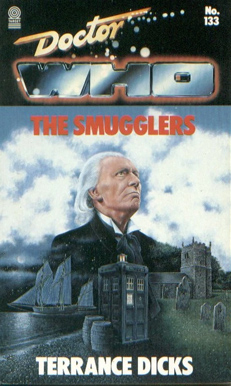
Cover: Beautiful – Alister Pearson paints the Doctor dwarfing two views of a Cornish village, the beach and a ship at night and the church, separated by the TARDIS.

Final Analysis: We’re nearing the end in more ways than one and Terrance Dicks manages to imbue the Doctor with much more vitality than William Hartnell was sadly able to in his final months on the show. We have a Doctor who is alert and analytical at all times, bad tempered with his new young friends but still with a sense of responsibility for their well-being (how far we’ve come since his first stories!). Dicks sticks to the story as usual, so there’s really not much more to report here, but we should still savour every word – there are only two more Dicks novelisations to come!

Chapter 132. Doctor Who – The Edge of Destruction (1988)

Synopsis: Trapped inside the TARDIS, Ian and Barbara are confronted by a disturbed Susan and an increasingly hostile Doctor as paranoia and anxiety swell. What has happened to bring on this switch? Can things return to normal, or are they stuck fast?

Chapter Titles

  • Introduction
  • Prologue
  • 1. Aftershock
  • 2. The Seeds of Suspicion
  • 3. Inside the Machine
  • 4. Trapped
  • 5. ‘Like a Person Possessed’
  • 6. The End of Time
  • 7. The Haunting
  • 8. Accusations
  • 9. The Brink of Disaster
  • 10. A Race Against Time
  • Epilogue
  • Conclusion

Background: Nigel Robinson adapts David Whitaker’s scripts for the 1964 two-part story, 24 years and three months after it was broadcast, making this the new record holder for biggest gap between transmission and publication. This also completes the run of adaptations from the first season.

Notes: The introduction provides Target’s third go at telling the ‘first’ story, bringing new readers up to scratch (and padding the book out a bit too). Miss Johnson, the secretary at Coal Hill School, had grown frustrated by the 15-year-old Susan Foreman’s inability to provide any official documentation for her identification. Barbara had been inclined to believe Susan’s claim that she and her grandfather had been abroad a lot. She also appreciated the girl’s passion for history, which was why she’d offered to provide her with extra tuition at home. The girl was ‘extraordinarily good at science and history’ but very poor at geography and English literature (she could quote huge passages of Shakespeare, but had never heard of Charles Dickens). She was also fluent in French, Latin and ancient Greek. The Doctor is said to be ‘a tall imperious septuagenarian with a flowing mane of white hair and a haughty demeanour’ (William Hartnell was 5’7″, so not exactly tall, and only 54). Later, the Doctor is said to have ‘steel-blue eyes’ (again, not matching the brown eyes of Hartnell). We’re also reminded of the group’s encounter with the Daleks (which also serves as a prompt that this is still very new to Ian and Barbara!) and that the Doctor had considered leaving the planet without Barbara, until Ian intervened.

In the prologue, Barbara wakes up in the darkened TARDIS control room but she thinks she’s back in the staff room of Coal Hill School. In the TARDIS ‘rest room’ is a bookshelf that contains ‘the great classics of Earth literature’:

... the Complete Works of Shakespeare (some of which were personally signed); Le Contrat Social of Rousseau; Plato’s The Republic; and a peculiar work by a French philosopher called Fontenelle on the possibility of life on other planets (that one had always made the Doctor chuckle). Susan’s English teacher at Coal Hill would have been interested to note that there was nothing by Charles Dickens in the Doctor’s library.

Among the Doctor’s accumulated bric-a-brac are a Chippendale chaise longue, a collection of Ming vases from China and a lost portrait by Leonardo da Vinci. The TARDIS ‘power room’ is a series of ‘fifteen interconnected rooms containing all the machinery and power sources which operated the TARDIS’. Susan tells the schoolteachers that the alien world seen on the scanner is called ‘Quinnius’ (it’s ‘Quinnis’ on telly). Barbara recognises the English countryside shown on the scanner as the Malvern Hills Both Ian and Barbara separately explore the long corridors within the TARDIS and Susan admits that there are still rooms within her grandfather’s ship that she is yet to explore. Barbara discovers a laboratory, but an unseen force starts throwing objects at her to drive her away and only when she explains this to Susan does she learn that the laboratory contains radioactive isotopes that could have killed her without a protective suit. 

    Susan tries to placate the schoolteachers, asking them to be patient with her grandfather. 

… you don’t know the terrible sort of life he’s had. He’s never had any reason to trust strangers before when even old friends have turned against him in the past; it’s so difficult for him to start now… But you and Ian are both good people; please, try and forgive him.

Barbara noticed that Susan has started to call them by their first names (something that occurs gradually on screen during the events of The Daleks). The Doctor’s thought processes are revealed as he sits alone in the TARDIS control room, realising that Barbara’s words are the key to the solution.

The TARDIS ‘danger signal’ sounds like the tolling of ‘a huge bronze bell’, which reminds Barbara of the John Donne line, ‘Ask not for whom the bell tolls, it tolls for thee’ [a subtle retconning of the weird noise heard in the TV episodes to bring it in line with the Cloister bell heard for the first time in Logopolis, and many times after]. While on TV, the event that threatens the TARDIS is the birth of a new solar system, here it’s the formation of a galaxy (and not, as Ian suggests, the Big Bang). The Doctor’s big speech is more detailed than on TV (suggesting it might have been edited on the fly by William Hartnell). The conclusion leads neatly into the next adventure (Marco Polo) and specifically states that the schoolteachers’ first meeting with the Doctor took place on a November night.

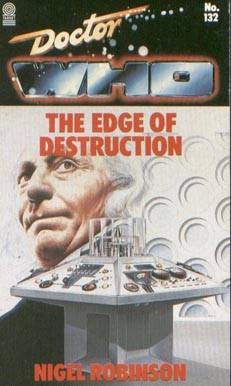
Cover: Deceptively simple-looking, Alister Pearson’s wonderfully stark cover combines the whiteness of the TARDIS control room with the Doctor’s flowing locks. 

Final Analysis: Such a difficult story to dramatise, as it relies so much on general weirdness and vamping for two episodes until the rather flimsy solution is revealed. While adding to the general layout of the TARDIS, Robinson takes the opportunity to create areas to explore that still key into the general idea that the TARDIS is trying to guide them all to safety (if only they’d stop wandering off!). It’s not an easy read – it really does lack a tangible threat – but in his final book for the range, Robinson does the absolute best he can with the material available.

Chapter 131. Doctor Who – The Ultimate Foe (1988)

Synopsis: The Doctor’s defence backfires and the situation looks bleak for his trial by the Time Lords. Unexpected witnesses arrive in the form of Mel and the scheming Glitz, brought to the court by the Master. The Doctor’s oldest enemy has come to his aid for one reason – to expose the Doctor’s prosecutor, the Valeyard. Soon, the Doctor is fighting for his life deep inside the Matrix, trapped by an adversary who knows him better than he knows himself…

Chapter Titles

  • Prologue
  • 1. The Key of Rassilon
  • 2. An Unwelcome Intruder
  • 3. Evil Intent
  • 4. Twelve-and-a-half
  • 5. Treason
  • 6. A World Apart
  • 7. A Lethal Greeting
  • 8. Mr Popplewick
  • 9. A Sticky End
  • 10. To Be Or Not To Be
  • 11. Out of the Frying Pan
  • 12. The Baiter Bitten
  • 13. False Witness
  • 14. Off With His Head
  • 15. Mesmeric Riches
  • 16. Point and Counterpoint
  • 17. About-face
  • 18. Two-faced
  • 19. Double-faced
  • 20. Particles of Death
  • 21. The Price of Vanity
  • 22. The Keeper Vanishes
  • 23. Carrot Juice
  • Epilogue

Background: Pip and Jane Baker adapt one script by Robert Holmes and another by themselves for the concluding episodes of the 1986 serial The Trial of a Time Lord.

Notes: The prologue recaps the trial so far, the events on Ravalox, Sil’s experiments with brain transference and the attack on the Vervoids. The Doctor has been ‘plucked out of time’ and brought to the space station where the trial is being conducted, ‘a baroque cathedral with dozens of thrusting spires and straddled with porticoes’, a ‘gargantuan hulk’ where ‘all the processes of existence hitherto experienced are suspended’. Sabalom Glitz is a ‘thief, liar, and incorrigible rogue. A coward who would sell his grandmother to save his own skin. For whom profit was a god. A wheeler-dealer devoid of conscience.’ Despite her being ‘half his size, a quarter his weight’, Glitz is initially more afraid of Mel than she is of him. She pinches him to prove that he isn’t dead (he’s spooked by the coffin-shaped capsules that have brought them to the trial station). Mel was in the TARDIS – the future Doctor’s TARDIS – writing an ‘experimental programme for one of the TARDIS’s complex computers’ when she was plucked out of time and brought to the courtroom. Glitz is also standing closer to the Doctor than he was on screen – at one point, afraid that the guards might use their guns on him, he shields himself behind the Doctor’s ‘portly form’. As the revelations begin to flow, Mel stands next to the Doctor, close enough to grab his arm in surprise. The Doctor apparently gives his adventures titles, having christened his last encounter with the Master ‘The Mark Of The Rani’.

Though the contents of ‘the secrets’ that were the focus of Glitz’s attention in The Mysterious Planet were not revealed at that time, we discover in chapter 3 that they were stolen from the Matrix. The Inquisitor admonishes the Valeyard for his attempts to silence the Master. The Master claims that the Valeyard is the Doctor’s penultimate incarnation; on TV, this is slightly less clear. Glitz claims to see a resemblance between the Doctor and the Valeyard (‘Same shaped nose. And the mouth. He’s got your mouth’) , though this is challenged robustly by Mel. Having revealed the Valeyard’s true identity, the Master, aided by Glitz, then explains the  mystery behind Ravalox and the theft of the secrets by the Andromedan Sleepers – and only after the Doctor rebukes the Time Lords for their corruption does the Valeyard flee the court. The Master claims to know both the accused and the prosecutor ‘intimately’.

The Inquisitor had been selected from many candidates to oversee the trial; she felt the appointment to be the pinnacle of her career and likely to see her ascend to the High Council. One of the jurors is a two-thousand-year-old Time Lord called Xeroniam. Glitz wears pyjamas made of ‘Attack Repulsor PolyCreman pongee’ (!), fastened with ‘Batayn Radaral buttons’. The authors provide an explanation for how the Master acquired his access to the Matrix that is… wonderfully convoluted. The Time Lords have relegated maintenance of the Matrix to the Elzevirs, inhabitants of the Moon of Leptonica in the constellation of Daedalus and specialists in micro-technology. The Master hypnotised Nilex, an individual who supervised the Matrix repair team. Nilex duplicated the Key of Rassilon and gave the copy to the Master. 

Mel’s spirited defence of the Doctor is revealed to be a ploy to get close enough to the Keeper of the Matrix to be able to steal his key. A crowd of people await the Doctor’s execution within the Matrix. The Doctor is aware of Mr Popplewick’s secret identity before the revelation. There’s a reminder of the Master’s previous exploits, including his final scene in Mark of the Rani, where he and the Rani were trapped in the Rani’s TARDIS with an ever-expanding tyrannosaurus rex, until the creature grew so big that its spine snapped (as previously recounted in the Time and the Rani novelisation). The Inquisitor lightly rebukes the Doctor for his comments about the corruption in Gallifrey society, before she invites him to become president. In the epilogue, the Doctor explains to Mel that she has to return to her own timeline and leave him to travel alone until they meet properly.

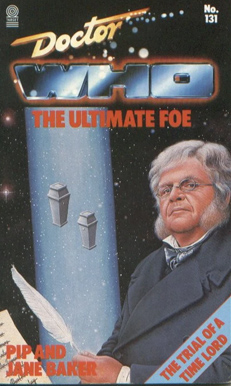
Cover: The Oliver Elms logo settles into place from now on, as Alister Pearson paints two capsules descending down a trial-ship beam of light, with Mr Popplewick standing proudly (a stunning likeness). Pearson had painted a beautiful duo of the Inquisitor and the Valeyard in the courtroom, but the final illustration is a lot more dramatic. Consistent with the two other books published so far, there’s a flash marking this as part of the Trial of a Time Lord season (and the title page lists this as ‘The Trial of a Time Lord: The Ultimate Foe’).

Final Analysis: Pip and Jane Baker deliver their final novelisation and it’s like a distillation of their stories so far. They’re as exuberant with their verbosity as ever, capturing the sesquipedalian nonsense of the original TV story and turning it up a notch (a particularly nice line is the Valeyard saying to Glitz ‘I really cannot countenance such exoteric improbity’). Their intention all along was to ignite a passion for language in the viewer and we might ponder just how invested in this flowery language a young reader might be, but I have to confess… it worked for me! I scampered to the dictionary to look up every new word. They were always the best writers for the Sixth Doctor, matching his pomposity with a kindness that was sadly lacking with other writers. Here, they’re equally successful in bringing Glitz to life, creating a character whose every move is either cowardly or conniving. Even Mel is portrayed as an independent, fiery and determined individual with an unwavering loyalty and admiration for the Doctor.

While the resolution to the trial was a mess, there were extenuating circumstances. The Bakers here resist the temptation to rewrite the story from scratch; they fulfil the remit of adapting what happened on screen admirably. But, as all the greats do, they tweak along the way, adding extra motivations or backstory (some of which is bonkers!). Unlike in Terror of the Vervoids however (where they tended to infodump right before the information was required), they manage to foreshadow their additions and build upon what we saw on telly. Even if their explanation for the Master’s acquisition of the Matrix key is, er… no it’s actually insane, but all the more entertaining for it. They were inconsistent, but I’ll really miss them.

Chapter 130. Doctor Who – The Wheel in Space (1988)

Synopsis: The Doctor and Jamie have little time to come to terms with Victoria’s departure before they’re forced to make an emergency landing aboard a deserted spaceship. Soon, they are brought to ‘The Wheel’, a space station, where Jamie’s lack of basic awareness of life in space draws suspicion, in particular from the very brilliant and very young Zoe. Elsewhere on the Wheel, someone – or something – is wrecking equipment and resources. The Doctor identifies the culprit as a Cybermat, which means its masters the Cybermen must be close by.

Chapter Titles

  • 1. Goodbye to Victoria
  • 2. The Unseen Enemy
  • 3. Hunted
  • 4. Command Decision
  • 5. Under Suspicion
  • 6. Birth of Terror
  • 7. Menace
  • 8. The First Death
  • 9. The Trap
  • 10. Trojan Horse
  • 11. Takeover
  • 12. Into Danger
  • 13. Cybermat Attack
  • 14. Meteor Storm
  • 15. Poison in the Air
  • 16. Perilous Journey
  • 17. The Invasion
  • 18. An End and a Beginning

Background: Terrance Dicks adapts scripts by David Whitaker, based on a story by Kit Pedler, for a production broadcast from 1968. With only 23,000 copies circulated (due, it’s believed, to a warehouse fire), this novel is the rarest of all and tends to be the one book that completists struggle to find without paying huge amounts of money.

Notes: The book begins as on TV with Victoria waving off Jamie and the Doctor from the shore as the TARDIS departs. Jamie is ‘stripped to the waist’ for his medical examination by Gemma Corwyn (on TV, he just unbuttons his shirt). Gemma already suspects Jarvis is becoming paranoid very early on, thinking that he ‘was a man for procedures, routines’ and that ‘the unknown would always be his greatest fear’. Zoe is ‘a very small girl, or rather young woman’ with an ‘appealing rather pixie-like face’ and ‘shortish black hair’.

Here’s how the Cybermen are introduced:

Two massive silver figures now sat at the rocket controls. Approximately man-shaped, they were much bigger than any man, a good seven feet tall, perhaps more. They seemed to be formed of some uniform silvery material, something with the qualities of both metal and plastic. Faces, bodies, arms and legs and the complex apparatus that formed the chest-unit, all seemed to be of a piece, made from the same gleaming silvery material. Their faces were blank, terrifying parodies of the human visage, with small circles for eyes and a thin letter-box slit for a mouth. The heads rose to a sort of crest into which was set what looked like a kind of lamp. Two strange handle-like projections grew out from the head in place of ears. 

The Doctor, had he been there would have recognised them instantly. They were Cybermen. 

The Cyber Planner is ‘a creature of pure thought’ with ‘no physical functions as such, and was, in fact, no more than a vast living brain’. The eyes of the Cybermats glow red [consistent with Gerry Davis’s description in Doctor Who and the Tomb of the Cybermen]. As on TV, the Cybermen are originally from Mondas (so much for the Telos conspiracy theories – Terrance gets the last word!). As the Doctor shows Zoe the kind of adventure they might face and Jamie recognises it as the one they had when they first met Victoria. He wonders how his old friend is doing but struggles to remember her face as he watches Zoe become enthralled by the Doctor’s retelling of a story that we won’t be seeing as a novel for a little while yet.

Chapter 12 is a near miss with ‘Into Danger’ while the final chapter sees another outing for a Dicks’ favourite ‘An End and a Beginning’ – hurrah!

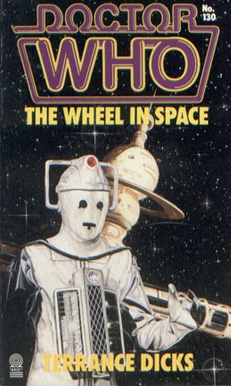
Cover: Back to the Sid Sutton neon logo again, for the final time, as Ian Burgess gives us a Wheel in Space-styled Cyberman with a backdrop of the wheel (an original design by Burgess, not based on the station as seen on telly). It’s so nice to get the proper Cyberman helmet on a cover, even if, on closer inspection of the body, the photo reference is actually from Tomb of the Cybermen! In 2025, Doctor Who Magazine gave away a free gift of The Wheel in Space Target novelisation with a new cover by Dan Liles, depicting the Doctor, Jamie, Zoe, the wheel and two screen-accurate Cybermen.

Final Analysis: I’m running out of ways to say ‘Terrance Dicks is as reliable as ever’. His methodical approach provides decent descriptions for each character as they’re introduced: ‘a big, handsome fair-haired giant of a man, cheerful and confident, sometimes to the point of arrogance’; ‘a slim attractive young woman with a bell of fair hair framing her sensitive face’; ‘a pleasant-looking sensible woman in her mid-thirties’; ‘olive-skinned, brown-eyed and curly-haired’; … and so on. As ever, he provides elegant foreshadowing and explains the motivations and feelings of the characters, covering things that might have been conveyed on screen with a facial expression (though as two-thirds of the telly episodes are missing, it’s hard to know for sure). This even extends to the servo-robot:

The robot abandoned the problem of the TARDIS’s presence on board. Since it was impossible it could not have happened so it was not a problem.

Chapter 129. Doctor Who – The Underwater Menace (1988)

Synopsis: In an undersea base live the last survivors of Atlantis. It’s also home to Zaroff, a scientist believed dead. His experiments on the locals have resulted in strange fish-like people inhabiting the nearby ocean, but that’s not where Zaroff’s ambitions lie. His latest scheme could literally tear the Earth apart.

Chapter Titles

  • Prologue
  • 1. Under the Volcano
  • 2. Sacrifices to Amdo
  • 3. Professor Zaroff
  • 4. Escapees
  • 5. An Audience With the King
  • 6. The Voice Of Amdo
  • 7. Kidnap
  • 8. ‘Nothing In The World Can Stop Me Now!’
  • 9. Desperate Remedies
  • 10. The Prudence of Zaroff
  • 11. The Hidden Assassin
  • Epilogue

Background: Nigel Robinson adapts scripts for a 1967 serial by Geoffrey Orme.

Notes: Jamie’s first sight of the inside of the TARDIS is told in the prologue; the ‘gleaming white walls’ are covered with ‘large circular indentations’ that emit an ‘eerie light, while the walls are lined with strange looking machines’. There’s also a large chest, a ‘splendid Louis XIV chair’, plus a mahogany hatstand upon which a ‘stove-pipe’ rests (though a popular description of the Doctor’s hat for many years, we now understand it to be a ‘Paris Beau’, unless the Target Doctor really does wear a top hat like Abraham Lincoln’s). The Doctor is ‘a little man dressed in baggy check trousers several sizes too big for him and a scruffy frock coat which had obviously seen better days’: he has ‘jade-green eyes’. Ben is, succinctly, a ‘wiry Cockney sailor’, while Polly is ‘a tall, long-legged blonde with long heavily-made-up eyelashes; her clothes – a ‘revealing multi-coloured mini-skirt and a white silk scarf’ – reveal that, like Ben, she comes from London, 1966 [once again contradicting Gerry Davis’s origins for them in the Target universe as shown in Doctor Who and the Cybermen]. The rather nice sequence from the telly episode of interior thoughts for the TARDIS team (‘Prehistoric monsters!’) is cut.

Professor Zaroff’s first name is ‘Hermann’. He disappeared 20 years ago and created the ‘Fish people’ by manipulating the genetic coding of the Atlaneans. His pet octopus is called Neptune. There is a Labour Controller who looks after the slaves (on TV, Damon fulfils this role too). Ara was the daughter of a councillor who spoke out against Zaroff and was killed. She keeps her former high status secret by hiding as a servant. Before he died, her father showed her the speaking grill behind Amdo’s statue. Zaroff and his high priest Lolem are left fighting to the death when they are caught in the flood and drown. The majority of the Atlanteans do survive the disaster (and possibly Zaroff’s pet octopus, Neptune, too). Unusually, the cliffhanger from TV of the TARDIS veering out of control is retained.

Cover: The Oliver Elmes logo is used here. The main artwork is a lovely evocative painting of the fish people, a great effort by artist Alister Pearson, making his debut here. 

Final Analysis: It’s a bit of a kindness on Nigel Robinson’s part that this unloved story gets such a decent treatment here. As the story was missing three of its four episodes at the time of writing, Robinson had to rely on the scripts, so some of the improvisations from the studio are missing; when episode two was discovered and screened at the BFI”s Missing Believed Wiped event, fans in the audience were charmed by such details as the Doctor knocking on his own head while discussing Zaroff’s madness, but that’s understandably absent from the book. What we do get is the now traditional tidying up of motivations and thought processes, such as the Doctor actively searching for Zaroff because he’s been told that he often strolls in the market (it’s much more coincidental on screen) or Zaroff failing to recognise Ben and Jamie because, when he first met them, his attentions were solely focused on the Doctor. The problems with the story are inherent in the original broadcast, but we get the sense that our heroes at least know how ridiculous it all is, which makes them just as determined to put a stop to the mad scientist. Extra points to Robinson for using the story’s most infamous line – ‘Nothing In The World Can Stop Me Now!’ as the title of Chapter 8, building up to it and giving it more context than we had when this was published.

Chapter 128. Doctor Who – Vengeance on Varos (1988)

Synopsis: A former prison planet is now the home to a broken society, where the Governor faces disintegration on the turn of a public vote, where the citizens are tortured for entertainment and where an unscrupulous alien financier can hold the planet to ransom for its minerals. The Doctor could help, but the Doctor is dead – dead as death…

Chapter Titles

  • 1. The Dome of Death
  • 2. The Vital Vote
  • 3. Execution
  • 4. Escape into Danger
  • 5. The Purple Zone
  • 6. Capture
  • 7. Death in the Desert
  • 8. Night and Silence
  • 9. Interrogation
  • 10. Quillam
  • 11. Condemned
  • 12. The Changelings
  • 13. Realm of Chaos
  • 14. The Final Vote
  • 15. Into the End Zone
  • 16. Goodbye to Varos

Background: Philip Martin adapts his own scripts from the 1985 serial. This is the missing book ‘106’, published 23 volumes late.

Notes: Bax wears the orange uniform of the Comm Tech Division. Etta fills in viewer reports about both the content broadcast to her screen and the reactions of her husband Arak, who works in the ‘Zeiton Ore division of Mine Tech’. Peri tells the Doctor she wants to go back home to America to continue her studies (this is probably just a reaction to the Doctor’s new personality, which the Doctor takes at face value and agrees to take her back). Sil is leaf-green in colour with ‘deep-set yellow eyes’ and he sits in a moveable water tank (into which he falls, during his first negotiations with the Governor); he is a mutant native of the planet Thoros Beta and representative of Galatron Consolidated (also known as  the Galatron Mining Corporation, as on screen). The Chief Officer holds more power than the Governor, something Sil tries to exploit with his alliances. The anthem of Varos is a march (not the ‘BBC Video jingle’ we hear on telly).

Chapter 4 is a familiar ‘Escape into Danger’. The Doctor has ‘steel blue eyes’. The Governor travels by private monorail car from the administration dome to his own residence, which he shares with the rest of the officer class. He has a trustee, called ‘Sevrin’ (reinforcing the suggestion that the ‘former prison planet’ still runs along prison lines, if the governor has a trustee). This governor was born into the officer class and while enjoying some blue wine from the vineyards of the planet Emsidium, he simply accepts that he should enjoy a life of luxury that is kept secret from the rest of the population. He recalls how he became the 45th Governor of Varos when the Chief Officer drew lots as a form of election. The Chief Officer and Quillam, the designer of Dome technology, are of equal rank and are apparently old enemies. The Governor is interrupted while bathing by a visit from the Chief Officer, which annoys the Governor as he was hoping to review some recordings from Taza, ‘the entertainment capital’ of his galaxy. 

Peri doesn’t witness the Doctor’s apparent death, but learns about it later when she’s taken by monorail to the Communications Dome, which houses the Governor’s office. The Governor tells Peri that he no longer has a name, now that he’s the Governor. The two mortuary attendants are called Az and Oza. When the Doctor dodges his charge, Az falls into the acid and then pulls his companion in too (there’s no battle where the Doctor might be said to have caused the death of at least one of the attendants). Quillam remains unseen until chapter 10 (though his voice is briefly heard issuing orders), which helps to build anticipation as the Chief and the Governor discuss him in his absence; the technology designer walks with a limp and swiftly replaces the mask the Doctor removes (rather than continuing with an exposed face as he does on TV). Arak watches the exploits of the Doctor and offers a running commentary, claiming Jondar’s torture is ‘fake’ and the Doctor’s acid-bath escape is ‘all fixed’.

Jondar used to maintain the shuttle cars that are reserved for the elite and he once managed to sneak inside the Governor’s dome, where he witnessed the luxury the Governor enjoys; this was the reason he was imprisoned and tortured. The savages who attack the Doctor’s party are ‘Wretches’, relatives of the condemned who are left without any means of support and who scavenge in the outer reaches of the Punishment Dome. The Governor, Maldak and Peri wear protective clothing with breathing equipment to cross the surface of Varos to reach the Punishment Dome.

As his negotiations with the Governor begin to fail, Sil becomes so enraged that he slips into a torrent of Thoros Betan curses which make his translator device explode under the strain. There are a fair few references to elements of Sil’s life that weren’t revealed in TV until Trial of a Time Lord: Sil has two bearers from Thoros Alpha – one of whom is called ‘Ber’ and who refers to Sil with due deference as ‘Mentor’; Sil receives confirmation of his failure aboard his star-ship, where the Governor informs Sil that he has been summoned back to his home world to appear before ‘Lord Kiv’. The news makes Sil’s green skin turn a few shades lighter. Aboard the TARDIS, as the Doctor sets the restored TARDIS on its way, Peri comes to terms with the horrific transformation she endured. The TARDIS leaves Varos, its dematerialisation witnessed by the Governor and his new ministers.

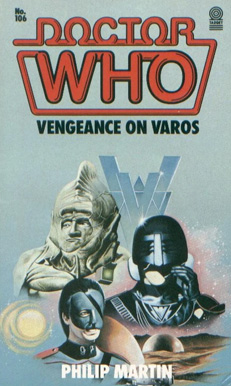
Cover: The Sid Sutton neon logo returns as David McAllister combines Sil, Quillam, a Varosian guard (probably Maldak), the ‘V’ icon of Varos and the planet’s dome-shaped dwellings. Alister Pearson’s 1993 cover is simpler but very effective, showing just Sil, the Doctor and a Varosian ‘V’ logo against a background that evokes the mottled brown walls of the corridors. Chris Achilleos came out of retirement to provide a new illustration for a 2016 BBC Books rerelease, showing Sil, the Governor, a guard and the Doctor, but it’s just not up to the standards of his past glories.

Final Analysis: It was worth the wait. Philip Martin might have delivered his manuscript later than expected, but he makes good use of the wider canvas offered by the printed page. He gives us a Varos that has a sense of scale, with monorails connecting the domes across the planet and patrol cars that soar, rather than trundle. The Governor, a vaguely sympathetic figure on TV, is as much a product of his time as the Controller in Day of the Daleks and we are shown a little of the privileges he enjoys while the rest of the population survives on basic rations. Of course, Martin’s greatest contribution to Doctor Who is his monstrous Sil and here, the author’s descriptions acknowledge the performance of actor Nabil Shaban, who brought the role alive so completely; Sil is every bit as slimy, as wet, as disgusting as he was on telly, gurgling and spitting as he thrashes about ‘like a trapped tuna’.

Chapter 127. Doctor Who – Time and the Rani (1988)

Synopsis: The Doctor has regenerated after an accident in his TARDIS, and his enemy the Rani is exploiting his post-regenerative confusion to gain his assistance with one of her experiments. As Mel explores the planet Lakertya and encounters the bat-like Tetraps, the Doctor seems to have forgotten something… who is he?

Chapter Titles

  • 1. Regeneration
  • 2. The New Doctor
  • 3. Death is Sprung
  • 4. Identity Crisis
  • 5. Collaborators All
  • 6. On With The Fray
  • 7. Haute Couture
  • 8. Visions of Greatness
  • 9. Face To Face
  • 10. A Kangaroo Never Forgets
  • 11. When Strangers Meet
  • 12. ‘You Know, Don’t You!’
  • 13. Rendezvous With a Tetrap
  • 14. The Centre of Leisure
  • 15. Exchange Is A Robbery
  • 16. The Twelfth Genius
  • 17. Selective Retribution
  • 18. Too Many Cooks
  • 19. Star Struck!
  • 20. Holy Grail
  • 21. A Dangerous Break
  • 22. Countdown
  • 23. Goodbye Lakertya

Background: Pip and Jane Baker adapt their own scripts for a story from 1987.

Notes: The opening chapter is a gift – the final scene featuring the sixth Doctor. As Mel is exercising, the Doctor finds he can’t control the TARDIS. There’s mention of the Hostile Action Displacement System [see The Krotons], which the Doctor has forgotten to set. His regeneration seems to be caused when he falls head first against the TARDIS console. Or ‘tumultuous buffering’ as the authors have it.

Lakertyans still have the remnants of tails under their clothes. They have yellow skin and patches of mother-of-pearl-like scales on their arms and face. The Rani is a ‘Time Lady’ who, we’re told, the Doctor considers to be ‘more brilliant than himself’. As well as Einstein, the Rani’s collection of genii includes Charles Darwin, the physicist Niels Bohr and Louis Pasteur as well as figures from other planets such as Za Panato and Ari Centos. While the previous Doctor was six feet tall, the new one has to get used to being five feet six, hence all the falling about. He studied thermodynamics at university while the Rani specialised in chemistry. Unlike the Doctor, the Rani has never regenerated, having led a life of extreme caution. She escaped the predicament of a Tyrannosaurus Rex rapidly growing to full size due to time spillage in her own TARDIS when the creature grew too big and its spine snapped against the ceiling of the TARDIS [see Mark of the Rani].

Mel went to school in Pease Pottage, Sussex (it’s not just where she lived when she met the Doctor, she grew up there) and she once played the third witch in a production of Macbeth. As she confronts the stranger who is the new Doctor, she improvises a weapon with an acetylene torch; the Doctor uses a stool as a shield, until the seat catches fire. Later, the Doctor steps aside as a Tetrap falls into a bubble trap (on TV, he actively pushes it). He uses a penknife to release himself from the Rani’s cabinet. A Tetrap steps on a phial that Mel has dropped, accidentally smashing it and releasing a rapid-action fungus that engulfs the creature and suffocates it. At university, the Doctor and the Rani had enjoyed ‘many an academic battle of wits’ in debates. Instead of dismantling an ornamental decoration, Ikona pulls some cable from a videogame and hands it to Mel to strip for wire. When she’s finally captured by the Tetraps, the Rani is suspended upside down from the ceiling of her TARDIS.

Cover: A final photographic cover and it’s one that actually shows something interesting from the story – namely the Tetraps hanging upside down (a publicity release with an early rejected cover used the neon logo and artwork by Tony Masero of the Tetrap lair, but printed the wrong way up, to show the Tetraps, er, not upside-down). We have the introduction of the Oliver Elms logo. Alister Pearson painted a much more traditional cover for the 1991 reprint, with the Rani, a Tetrap, the new Doctor, the planet Lakertya, the space brain and a lump of strange matter all jostling for space. 

Final Analysis: A huge improvement on Terror of the Vervoids, this novelisation is less giddy and much less overwritten. A good job, as it has one of the most insane plots of any Who adventure (and I have always utterly adored it). While the Bakers used lots of words to create their Vervoids on the page, the description still didn’t successfully build a mental picture of what it was supposed to look like (a difficult task without saying ‘a mash of genitals’!). The summary of the Tetrap follows the slow build to what we saw on TV – multiple points of vision, the odd claw or foot – before the final reveal as Urak jumps out and surprises Mel:

The vulpine, rodent-like face was covered with a gangrenous, oily down. Splayed, moist nostrils and thin sucking lips were dominated by a single luminous eye that glared unblinkingly from beneath a cockscomb of bristle. The veined, bloodshot orb had an enlarged pupil with a green halo.

As if this did not create an ugly enough apparition, above each delicately pointed pink ear, a similar eye bulged.

A fourth eye adorned the back of the Tetrap’s skull. These four eyes were the reason for the three hundred and sixty degree perspective: the quadview.

A predatory grimace exposed razor-sharp cuspids as the repulsive half-ape-half-rat leered at Mel. Then a venomous forked tongue spat at her!

That isn’t to say the authors are not at their verbose best, just that it’s a lot easier to absorb this time. The decision to make the alien language of Tetrapyriarban just… English backwards is hilariously dumb though. Especially when, having come up with this idea, they then explain it. Madness! Similarly, the miraculous substance the Rani seeks is called ‘Loyhargil’, a fact revealed in a chapter called ‘Holy Grail’. Haha – marvellous.

Further Listening

I was a guest on the Dr Who Literature Podcast to discuss this book, which you can hear in the link below, on YouTube, or via the podcast provider of your choice.

https://podcasters.spotify.com/pod/show/doctorwholit/episodes/Episode-127—Time-and-the-Rani-Jim-Sangster-Joe-Ford-e2p0bn7

Update March 2026: An original animated musical number for the Doctor Who Literature Podcast.

Chapter 126. Doctor Who – The Mysterious Planet (1988)

Synopsis: The Doctor is on trial for his life and the prosecutor, the Valeyard, presents to a jury of Time Lords his first evidence, in which the Doctor and his friend Peri explore the planet Ravalox. There they meet the underground dwellers and their ruler, a robot called Drathro, the Tribe of the Free and their ruler, Queen Katryca, and a pair of intergalactic conmen called Glitz and Dibber, who confirm the Doctor’s suspicions, that the planet Ravalox has been moved across the universe from its original location – where it was known as ‘Earth’.

Chapter Titles

  • 1. The Trial Begins
  • 2. Underground
  • 3. Barbarian Queen
  • 4. The Stoning
  • 5. The Reprieve
  • 6. Meeting the Immortal
  • 7. Escape
  • 8. Captives of Queen Katryca
  • 9. The Attack of the Robot
  • 10. Hunt for the Doctor
  • 11. Secrets
  • 12. Tradesman’s Entrance
  • 13. The Big Bang
  • 14. End and Beginning

Background: Terrance Dicks adapts scripts by Robert Holmes for episodes 1-4 of the 1986 serial The Trial of a Time Lord. Holmes had been slated to adapt this himself, prior to his death in 1986.

Notes: The space station that houses the courtroom is hidden within a junkyard floating in space. The Doctor is ‘a tall, strongly built man with a slight tendency towards overweight’ (!) and beneath the ‘mop of curly hair, the face was round, full-lipped and sensual, with a hint of something catlike about the eyes’. The ups and downs of the Doctor’s relationship with the Time Lords are summarised, including his time as a fugitive, his exile to Earth for ‘five years’ (during which he was the scientific adviser to UNIT) and the couple of times he briefly occupied the position of President. Sabalom Glitz is ‘a burly thick-set fellow with a tendency towards fatness’, while his lackey, Dibber, is ‘taller and brawnier with a hard face and coarse bristly black hair’. The final chapter uses a title variation of a Terrance Dicks favourite – ‘End and Beginning’.

Cover: Queen Katryca is dwarfed by the L3 Robot, along with the planet Ravalox and a beam of black light, courtesy of Tony Masero. As before, there’s a flash marking this as part of the Trial of a Time Lord season (and the title page lists this as ‘The Trial of a Time Lord: The Mysterious Planet’.

Final Analysis: Terrance Dicks returns and passes a few milestones’ as he adapts his friend Robert Holmes’ final complete story, tackles the sixth Doctor for his one and only time and it’s also his last novelisation for anything from outside of the 1960s. He matches the impressive opening model shot of the TV version with one of the best single pages of description he’s done for a while. 

Massive, arrogant, invincible, the great complex hovered in space, dwarfing the shattered hulks that drifted around it, dominating its section of space like some enormous baroque cathedral. There was an eerie, almost mystical quality about it. It seemed to be brooding… waiting. 

This enthusiasm to capture everything we might have felt on screen continues with the Doctor’s arrival; the insanity of his costume has never been described so thoroughly but in particular the ‘multi-coloured coat that might have made Joseph himself feel a pang of envy’. I can imagine Terrance chuckling as he wrote about ‘the jutting beak that was his nose [which] seemed to pursue the Doctor through most of his incarnations’. So cheeky!

Some years ago, I was hired as a ‘talking head’ contributor for the Doctor Who DVD range (subsequently released on Blu-Ray). My role there was to represent the views of the contributors who were no longer with us, so my interjections were deliberately on the side of the producer and less supportive of his more vocal critics, who I knew would also be interviewed. My own opinions were put aside, partly so that I didn’t stand in the way of the people I was representing, but also because my feelings towards the overall story – and this segment in particular – are very conflicted. The huge disappointment I felt on first viewing was replaced at first by mockery (a friend used to act out a hilarious ‘Trial in 14 minutes’ routine that had us guffawing for months) and then a desperation to ‘fix’ the story in our minds – a process fans now call ‘head-canon’. I didn’t read this novelisation at the time and it’s rewarding after all these years to find Terrance Dicks trying his best to nudge the narrative a little, hinting at things the reader might discover later or enhancing the mood with a well-chosen description; that thing on the Valeyard’s head might well be a ‘skull-cap’, but coming between the ‘all in black’ ensemble and the ‘gaunt-faced’ description, it just adds to the idea that the Time Lord prosecutor is Death personified. He’s not breaking any new ground here, but Dicks is definitely putting the effort where it’s needed most.

Chapter 125. Doctor Who – The Time Meddler (1988)

Synopsis: New arrival in the TARDIS Steven Taylor cannot accept that he’s travelled in time, even when confronted with a Viking helmet in the year 1066. Landing on a beach, the Doctor and his friends explore the coastline and find themselves in a village near a monastery where the only inhabitant is a very furtive, very secretive monk. The Doctor immediately recognises him as one of his own people, but unlike the Doctor, he has no concerns about changing history, in fact, that’s what the Monk is determined to do.

Chapter Titles

  • Prologue
  • 1 The Watcher
  • 2 The Saxons
  • 3 The Monastery
  • 4 Prisoners of the Saxons
  • 5 The Vikings
  • 6 An Empty Cell
  • 7 Unwelcome Visitors
  • 8 The Secret of the Monastery
  • 9 The Monk’s Master Plan
  • 10 A Threat to the Future
  • 11 A Parting Gift
  • Epilogue

Background: Nigel Robinson adapts scripts by Dennis Spooner for a story from 1965.

Notes: A prologue offers a scene from The Chase not shown on TV as Steven Taylor flees the burning City of the Mechonoids and the ‘strange alien creatures who had come to this planet in search of four mysterious space travellers’. Clutching his stuffed panda and avoiding the Fungoid plants, he runs for hours in pursuit of the four travellers, who had helped him escape. Eventually, he finds a blue box in the jungle and makes his way inside before passing out. And a generation of fans cheer!

The Doctor has ‘sharp blue eyes’ [as we’ve established, the actor who played him had brown eyes]. Vicki is ‘little more than five feet tall’ and she has ‘elfin good looks and a mischievous little-girl smile’. The TARDIS control room contains a Louis Quatorze chair and an ormolu clock, which has stopped. We’re reminded that Vicki came from the 25th Century and that she is an orphan. She had assumed that Steven had died in the flames. 

Edith and Wulnoth have been married for 15 years, though it’s said that she has aged considerably more than her thirty years (a little harsh on actress Alethea Charlton there!). The Monk’s carefully prepared breakfast for the Doctor is a masterpiece in time-trolling: Using a ‘Baby Belling stove’, a non-stick frying pan and a steel spatula, he cooks bacon, sausage and fried eggs; charred toast is delivered from a rusty toaster, served up on a plate with a bottle of tomato ketchup and a mug of instant coffee; and as he approaches the Doctor’s cell, he whistles a tune that won’t be written for nine hundred years (so, around 1965; later, he returns to the monastery whistling a Beatles song, so maybe it’s Ticket to Ride, which had appeared in the previous story, although reading this after 1988, Yesterday would be funnier).

The Doctor spells out for Steven and Vicki the consequences of the Monk’s ‘master plan’ – that as they are both English (new information, by the way!), the chances are that somewhere in their lineage is someone of Norman blood, someone who might die because of the Monk’s interference, thereby wiping out their descendants. It’s a tidy way of making the Doctor’s role much clearer to his young friends and to the reader. After taking the dimensional stabiliser from the Monk’s TARDIS, the Doctor also ensures that the atomic cannon is removed from the clifftop (and Steven has to lug it back to the TARDIS). The Doctor’s line about not being a ‘mountain goat’ (which he so beautifully fluffs on TV) is moved to the end of the book. In the epilogue, we discover the ridiculous effort the Monk puts into messing up time: Fearing some kind of reprisals from his ever-growing list of enemies, the Monk decides to leave his TARDIS in the chapel and cross England on a stolen horse to keep his plan on track; he reaches the infamous battle too late and sees William of Normandy declared the victor; the Monk heads north again to find the Doctor has stranded him in 1066 with a broken TARDIS.

Cover: Jeff Cummins makes his final contribution to the series with a haunting portrait of the Monk lighting beacons on the cliff tops. The image was flipped for the 1992 reprint, for some reason, accompanied by a ‘NOW BACK ON TELEVISION’ exclamation to tie in with the repeats on BBC 2.

Final Analysis: I’m growing rather fond of Nigel Robinson. He’s taken Terrance Dicks’ approach of transferring the script faithfully to the novel format, just adding additional information and tidying as he goes. There’s a charming significance to the way he captures Vicki by pulling in a detail of Maureen O’Brien’s performance, in that she pacifies the Doctor the same way the actress had quelled the fractious temper of her co-star. That he’s also choosing to cover the less favoured stories himself really underlines the mission to create a complete library of adaptations.