
aka Doctor Who – The Silurians (1992)
Synopsis: Long before mankind evolved to take over the Earth, it was inhabited by a race of technologically advanced reptiles. An oncoming catastrophe drove them into hibernation for millions of years. Now they’ve awakened and they want the planet back.
Chapter Titles
- 1. Prologue: The Little Planet
- 2. The Doctor Gets a Message
- 3. The Traitor
- 4. Power Loss
- 5. The Fighting Monster
- 6. Into the Caves
- 7. Quinn Visits His Friends
- 8. Into an Alien World
- 9. The Search
- 10. Man Trap
- 11. The Doctor Makes a Visit
- 12. Goodbye, Dr Quinn
- 13. The Prisoner
- 14. Man from the Ministry
- 15. Attack and Counter-Attack
- 16. The Itch
- 17. Epidemic
- 18. A Hot World
- 19. The Lie
Background: Malcolm Hulke adapts his scripts from the 1970 serial Doctor Who and the Silurians. As this followed Spearhead from Space on TV, this is our first pair of stories to be adapted as consecutive releases.
Notes: The prologue introduces us to Okdel, a reptile, who sees the rest of his race entering the shelters in preparation for catastrophe. He wonders if there’s life on this new object in the sky and K’to, a scientist, tells him it’s unlikely as it’s been travelling across space. It’s such a kind, considerate question – is this going to be a cataclysm for them too? The prologue explains the basic idea behind the reptile hibernation and shows us division among their ranks as Okdel keeps mammals as pets but his colleague Morka considers them ‘vermin’ and K’to is concerned by the mammal raids on reptile-grown crops. Okdel also notes how scientists often get things wrong – a handy excuse for some of the scientific liberties Hulke will be taking in his story. While it robs the reader of the surprise of who the ‘cave monsters’ are, it prepares us for a tale that tries to see things from multiple perspectives.
Once we join the Doctor and Liz, it’s clearly been some time since the Auton Invasion as Liz recognises a Corporal, who in turn knows the Doctor well enough to know the name of his new car, and Liz has also formed an opinion of the Doctor as ‘the most thoughtful and considerate scientist I have ever worked with’ (though this might be sarcasm as he’s being unconsciously patronising to her). The opening scenes of the potholers have been cut, condensed into a reported summary from Dr Quinn, and in fact, we meet almost all the core human cast in the space of a few pages and learn much more about their background and motivations than we do across seven episodes of TV: Dr Quinn and Miss Dawson gain first names (Matthew and Phyllis); Quinn’s wife was killed in a car crash and he wants to gain fame for discovering the reptile men (they’re not called Silurians, but the word is used as the password to gain entry to the base); Phyllis Dawson is excited by the prospect of doing actual research now that she’s free from being held back by her recently deceased mother; Major Baker is now ‘Barker’ and is shown to be insensitive (calling one patient ‘looney’) and generally paranoid and bigoted against ‘communists… fascists… Americans’, basically anyone who isn’t English.
The outbreak of the reptile virus is depicted differently: Instead of Masters arriving at St Pancras Station and collapsing , we see him aboard the train (infecting a ticket inspector who later dies) and then he leaves the train, catches a taxi and dies before reaching London. Dr Lawrence’s given a different exit too, killed by a reptile heat ray as a warning to the other humans, rather than falling victim to the virus.
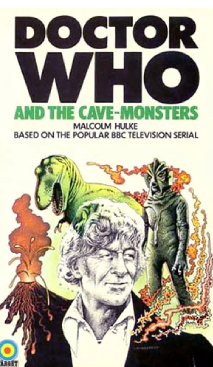
Cover & Illustrations: The first release had a cover by Chris Achilleos. The cover showed the Doctor from Day of the Daleks with a green Silurian (without a third eye!), a T-rex-like dinosaur and a volcano. I’m very fond of the 1992 Alister Pearson reprint cover (when the book was retitled) with the ‘windows’ over the Earth and photorealistic versions of the T-rex and Silurian, but the Achilleos one is truly epic. The illustrations, also by Achilleos, include a horizontal section showing the cave system beneath Wenley Moor. My favourite shows Dr Quinn chatting with a Silurian that looks like he’s a guest on a chat show.
Final Analysis: I always assumed this was renamed ‘The Cave Monsters’ to simplify the idea of ‘Silurians’ make the title easier for younger readers to understand, but reading this again, I suspect it might also have been Hulke making a point; as Whitaker did in The Crusaders, Hulke works hard to show balance, there are progressive reptile men (though no women) as shown with Oktel, as well as the paranoid and bigotted Morka, plus the pragmatic K’po – and their emotions are mirrored by the Doctor, Barker and Quinn (and later Lawrence) – and the various actions of the humans make then as equally monstrous cave dwellers as the members of the much older race. Aside from that cheeky password the Doctor uses to gain entry to the base, the word ‘Silurian’ doesn’t appear in the book – and as it was written a couple of years after the sequel to this story, Hulke manages to fix his original geological errors and establish the race as simply ‘Reptiles’.
And just one little namecheck for ‘Doctor Who’ in the text as well.

 Escape to Danger