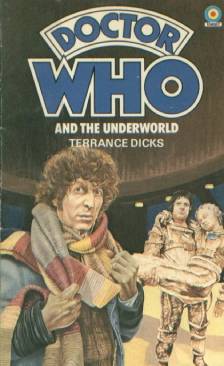
Synopsis: A stone circle in southern England, known locally as ‘The Nine Travellers’. Which is strange, as clearly there are more than nine stones. This is just one of many legends from the region. Another speaks of a woman who lives for centuries, who might have been a Celt goddess called ‘The Cailleach’. And then there’s the tale of two time travellers who expose a galactic criminal and discover a spaceship hidden in another dimension…
Chapter Titles
1. The Awakening of the Ogri
2. The Circle of Power
3. De Vries
4. The Sacrifice
5. The Ogri Attack
6. The Cailleach
7. The Vanished
8. The Prison Ship
9. The Victims
10. The Trial
11. Surprise Witness
12. Verdict
Background: Terrance Dicks adapts scripts by David Fisher for a story from 1978.
Notes: As The Pirate Planet wasn’t scheduled to be novelised at this point (or indeed, at any point in the foreseeable future), the first chapter explains that the second segment of the Key to Time was found on the planet Calufrax, which is almost right. As on TV, Romana learns that she wasn’t assigned to the Doctor by the President of Gallifrey but by the White Guardian, which amends the alternative continuity established by Ian Marter in The Ribos Operation. The Key to Time pieces are kept in the TARDIS control room inside a ‘wall-locker’ that opens to the Doctor’s palm-print. Professor Amelia Rumford mistakes the Doctor for Doctor Cornish Fougous (rather than an academic who specialised in Cornish fogous). Martha had been a school teacher before she met De Vries and she joined the druid cult to liven up an otherwise dull life. The doomed campers are newly-weds. The Megara are floating silver spheres about the size of a football. The Doctor namedrops Tacitus and Julius Caesar, who he was particularly pally with even though he refused to accept advice and the Doctor had to dress up as a soothsayer to warn him about the ‘ides of March’.
Cover: A composition by Andrew Skilleter featuring the Doctor, the Cailleach and some cult members among the flame-lit stones.
Final Analysis: Possibly Dicks’ most straightforward adaptation of a TV story so far, though he does offer up an delightful description of Professor Rumford:
The woman was quite old, though her back was straight, her eyes clear and alert. Her straggly hair was a snowy white, her face a mass of lines and wrinkles. It was the face of a woman of formidable character.
He’s clearly more interested in her than Vivien Fay, who is ‘a tall, strikingly attractive dark-haired woman in her forties’ but doesn’t really receive much more attention. This is particularly odd when we consider that the last time she’s described at all in the book, she’s dressed as a bird-faced Celtic goddess and on TV she arrives on the space-ship in a silver gown with metallic skin to match.
Synopsis: The Doctor has returned home to claim the Presidency of the Time Lords. As the Gallifreyan elite is driven to panic by this shocking development, this is just the first in a chain of horrific events as the new President banishes senior figures to the barren wastelands of Gallifrey – including his friend Leela. And then the Vardans arrive. This is all part of a trap created by the Doctor to defeat the invaders, but the trap backfires when the Vardans are vanquished and in their place arrive the Sontarans!
Chapter Titles
1. Treaty for Treason
2. The President-Elect
3. Attack from the Matrix
4. The Fugitive
5. The Betrayal
6. The Invasion
7. The Outcasts
8. The Assassin
9. The Vardans
10. False Victory
11. The Sontarans
12. The Key of Rassilon
13. Failsafe
14. The Chase
15. The Wisdom of Rassilon
Background: Terrance Dicks adapts the 1978 scripts attributed to David Agnew (Anthony Read and Graham Williams). This followed Underworld on TV, so that’s another pair of stories to be released consecutively.
Notes: Leela has brown eyes again [see The Horror of Fang Rock]. There are many references back to The Deadly Assassin that provide clarification or other information that wasn’t revealed in the onscreen Invasion of Time. There’s a summary of the events that led to the Doctor assuming the position of President by default, including the Doctor’s previous encounter with the Matrix, as well as an explanation that as there was no other candidate available, and the Doctor was absent, Borusa took on the role of acting President as well as Chancellor, making him extremely powerful. Castellan Spandrel has retired and his very recent replacement, Kelner, quickly established a Bodyguard Squad to protect himself; Kelner took possession of a suite of offices that are… :
… of transparent plastic and gleaming metal, with complex control consoles and brightly flickering vision screens everywhere. It was over-technological even by Time Lord standards, but Kelner, the new Castellan felt it helped to maintain his image.
Kelner is ‘thin-faced, nervous, rather insecure Time Lord’ who gained his position thanks to ‘good birth and political intrigue’. He has a bodyguard who is ‘very big, very brave, and very stupid’. Terrance Dicks maintains the impression given in The Deadly Assassin of the ceremonial chamber at the centre of the Panopticon and the scale of the Time Lord ensemble, which could never be achieved on TV:
The grand hall of the Panopticon is an immense circular chamber used by the Time Lords for all their major ceremonies. It is one of the largest and most impressive chambers in the known universe. The immense marble floor is big enough to hold an army, the domed glass roof seems as high above as the sky itself. Row upon row of viewing galleries run around the walls, and on the far side of the hall an impressive staircase leads down to a raised circular dais. By now the hall was filled with rank upon rank of Time Lords, all wearing the different-coloured robes and insignia of the different Chapters, the complex social family and political organisations that dominated Time Lord Society.
The Great Key of Rassilon is just a lost artefact on TV, but Dicks ties it to the one named in The Deadly Assassin; the one the Master stole was a replica and the real one is kept in the possession of the Chancellor; also unlike on TV, the Doctor deduces which one of Borusa’s keys is the correct one without Borusa first offering a decoy. The buildings on the edge of the Capitol have ‘sheer white walls’ and the gleaming towers can be seen many miles away.
Rodan is described as a ‘Time Lady’. The Outsiders live in log huts. Nesbin was expelled from the Capitol for an unprecedented violent attack upon another Time Lord. Ablif is a ‘burly young man’ and is the Outsiders who first captures Leela and Rodan – and gains a scratch across his face for his troubles. Jasko is also a ‘burly young Outsider’ who isn’t ‘especially bright’ but is ‘brave and strong’ and obedient. While these two Outsiders appeared on TV, a third member of the assault party is called ‘Jablif’ and it’s he who is fatally wounded but manages to kill a Sontaran before he dies.
Dicks’ description of Stor echoes that from Robert Holmes’ prologue for The Time Warrior:
The head was huge and round and it seemed to emerge directly from the massive shoulders. The hairless skull was greeny-brown and small red eyes were set deep in cavernous sockets. The nose was a snubby snout, the wide mouth a lipless slit.
Stor calls our hero ‘Dok-tor’ as if it’s his name, which is lovely.
Cover: Andrew Skilleter paints a much-minicked design of the Doctor and Stor smothered by metal cogs.
Final Analysis: Terrance Dicks guides us through what was actually quite a complicated script and helps it make sense along the way. Even Leela’s sudden departure is given a little assistance (in Leela’s tribe, it turns out, the women choose the men and Andred’s fighting skills and bravery clearly impressed her). He also succeeds in making the Vardans seem impressive:
The space ship was enormous, terrifying, a long, sleek killer-whale of space. Its hull-lines were sharp and predatory and it bristled with the weapon-ports of a variety of death dealing devices. Everything about it suggested devastating, murderous power.
… so that when their human forms are revealed, it’s more dramatic and less underwhelming as they’d already been fairly disappointing before the reveal. We’re still in this dry period where the books largely transcribe what happened on TV, but here, this at least prevents everything from feeling as cheap and improvised as it does on home video.
Synopsis: A group of space travellers seek the lost gene banks of the Minyans, a race of beings with tragic connections to the Time Lords. When their space craft becomes surrounded by a planet, the Minyan travellers discover a subjugated race – the Trogs – who live in underground tunnels as the slaves of the Seers and the god-like Oracle. Could these slaves be the descendants of the lost Minyans? The answers rest with the Oracle – and the quest is the quest…
Chapter Titles
Prologue
1. The Nebula
2. The Minyans
3. The Intruders
4. The Quest
5. Buried Alive
6. The Trogs
7. Skyfall on Nine
8. The Smoke
9. The Mouth of the Dragon
10. The Sword of Sacrifice
11. The Crusher
12. The Battle
13. Doomsday
14. The Legend
Background: Terrance Dicks adapts the 1978 scripts by by Bob Baker and Dave Martin.
Notes: We begin with a prologue (how I love a prologue!) that details the events that led to the loss of Minyos and the isolation policy of the Time Lords. Back in The Invisible Enemy, the Doctor complained that the TARDIS control room is such a boring colour – ‘No aquamarines, no blues. No imagination!’ – and here, he’s trying to paint the control room aquamarine and getting paint everywhere (but in the final scene, he’s painting it white again). On learning of the sword ritual, the Doctor reminds Leela that her own tribe had a similar trial by ordeal. Leela suggests that they return to the TARDIS and leave the Minyans to their fate but the Doctor wants to solve the mystery of the P7E.
Cover: Bill Donohoe combines two photo reference from this story to create something rather like a pulp sex book you’d find in the saucy rack in a 1970s newsagent – the Doctor looks pensive while Herrick carries a near-death Tala – as if we’ve just walked in on a scene we don’t really want to be a part of.
Final Analysis: This would always be a tricky one, a real clunker from Bob Baker and Dave Martin (the kings of overambition) and it’s one that’s always been unpopular for good reason. Devoid of the visibly low budget of the TV version, we’re left with a story with no recognisable human interaction, just mythology that gets a bit repetitive. It’s a relief that Terrance Dicks finds a way to highlight that humanity: The father who grieves for his lost wife and daughter after they’re killed in a landfall is a rare highlight. Something I’ve noticed though is that the Fourth Doctor in this period is brash and often his overconfidence borders on bullying, which makes him hard to like. The real highlight is that Dicks makes great use of K9 for his comedy potential, the wilfully over-literal explanations are hilarious.
Synopsis: The Doctor and Romana explore a dead world, unaware that one of them has been there before. A spaceship arrives containing the beautiful Movellans who inform the Doctor that the planet is Skaro – home of the Daleks – and their mission is to find the Dalek creator, Davros. But Davros is dead… and coincidentally, so is Romana!
Chapter Titles
1. The Dead City
2. Underground Evil
3. The Daleks
4. The Movellans
5. Slaves of the Daleks
6. Escape
7. The Secret of the Daleks
8. The Prisoner
9. The Hostages
10. The Bait
11. Stalemate
12. Suicide Squad
13. Blow-up
14. Departure
Background: Terrance Dicks adapts Terry Nation’s scripts for a story that aired just two months earlier.
Notes: Dicks calls Romana a ‘Time Lady’ and summarises the events from the climax of The Armageddon Factor, which hasn’t been novelised yet. The Doctor surmises that Romana’s higher score at the academy accounts for her greater control over how she regenerates, unlike his own traumatic experiences. They arrive on the strange dead world at night during a storm (it’s a bright, sunny day on TV). The slaves bury their dead under rocks because the foundations of the city ruins are too thick to dig up. The dead body that the Doctor investigates was a ‘Space Major Dal Garrant’ (so close to that familiar ‘Tarrant’ that Nation often used). While pinned under the fallen masonry, the Doctor reads ‘The Origins of the Tenth Galaxy’, written by a ‘particularly pompous Time Lord historian’ who he has never liked. He’s interrupted by the arrival of just two Movellans (Lan and Agella) and they’re wearing ‘simple, military-type space coveralls’, rather than the beautifully distinctive space-dreadlocks and Top of the Pops dance-troop suits. On the Movellan spaceship, Commander Sharrell’s rank is denoted by an insignia on his uniform.
Sharrel does not identify the planet they’re on beyond the serial number. Only later does the Doctor discover that it’s Skaro, when Tyssan tells him. As Davros revives, his eyes open [see The Witch’s Familiar in 2015]. The journey to the surface with Davros involves a long, steep, spiralling ramp. The Daleks cheat and make their way to Davros’s level using ‘eerily silent anti-grav discs’ as seen in Planet of the Daleks. Disappointingly, the Doctor doesn’t tell the Daleks to ‘spack off’. The Dalek mutant that he encounters in the sand dunes is more active than the blob of Slime-with-Worms from TV. It’s a ‘pulsating green blob, a kind of land-jellyfish’ that crawls up his arm. There’s a fair bit of gender-swapping here: Veldan and Jall’s genders are reversed, the Daleks’ sacrificial victims are both male and the Movellan that captures the Doctor and Tyssan is also male. Romana doesn’t dismember Sharrel during their fight, she merely kicks away his power tube.
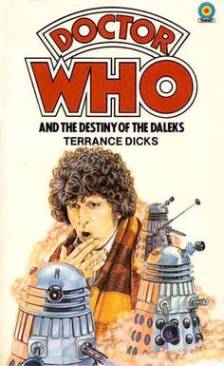
Cover: Welcome Andrew Skilleter, who surrounds an image of the Doctor (based on a pic from The Pirate Planet) with very TV Century 21-style Daleks moving around in fog, as if at a disco. Alister Pearson’s 1990 reprint cover puts the Doctor and Romana alongside a moody Davros in profile, a Dalek and Agella against a salmon background.
Final Analysis: Destiny of the Daleks seems to polarise opinion, but as it was the first Dalek story where I was old enough to follow the plot in full, I didn’t care about how tatty the props looked or that the central point about a robotic impasse shouldn’t have worked because Daleks aren’t robots. I just enjoyed it for being Daleks on my telly. This novelisation is, for me, the first point in this project where Terrance Dicks’ straightforward script-to-page approach feels a little lacking. Racing to get this story novelised meant that Romana v2 is introduced before V1 – we’ve leapt past a season and a half of stories, which is quite confusing – but there’s no real explanation as to who Romana is, only that she’s changed and she’s from Gallifrey. The Movellan costumes are described in such generic terms that they lose some of their onscreen glamour, and it’s all a little… thin. However, there is this lovely harkback to Genesis of the Daleks, which highlights a decision the Doctor has returned to time and time again:
The Doctor sighed. He had hesitated once before, at a time when he could have destroyed the Daleks before their creation, simply by touching the two wires that would complete an explosive circuit. Who knows what horrors he had unleashed upon the Universe? The Daleks were stronger now and more numerous, and with Davros to help them… He must not hesitate again. The Doctor pressed the switch.
Synopsis: Time experiments in an old priory resurrect an ancient evil. The Doctor and Leela arrive just as the manifestations begin – an image of the Fendahl, a legend from the Doctor’s own people that brings with it death – but how can they kill death itself?
Chapter Titles
1 The Skull
2 Dead Man in the Wood
3 Time Scan
4 Horror at the Priory
5 The Fendahleen
6 The Coven
7 Stael’s Mutiny
8 The Missing Planet
9 Ceremony of Evil
10 The Priestess
11 Time Bomb
12 The End of the Fendahl
Background: Terrance Dicks adapts scripts from 1978 by Chris Boucher.
Notes: We start with an introduction to the fated walker, who recalls a rhyme about a ‘frightful fiend’ on a ‘lonely road’. It’s not exactly confirmed onscreen but Colby is a professor, while Professor Fendelman has become ‘Fendleman’. Thea Ransome is described as being ‘strikingly attractive’, while Max Stael has ‘stiff Germanic good looks’ and ‘rather woodenly handsome features’ (which feels like a dig at actor Scott Fredericks).
We’re reminded where K9 came from, although this story doesn’t necessarily follow on immediately from The Invisible Enemy, as K9 has ‘developed some mysterious ailment’. Leela (or maybe just the narrator) wonders if the Doctor’s love of Earth wore off when he was exiled there by the Time Lords (let’s hope it’s the narrator as Leela wouldn’t know this) and Leela recalls her trip to a music hall [See The Talons of Weng Chiang]. Dicks explains the joke behind calling Colby’s dog ‘Leakey’, a tribute to ‘the famous anthropologist’.
Security Team leader Mitchell’s first name is Harry. By the way, in both the TV serial and this book, Stael is ordered to call ‘Hartman’ in London to send a security team to the priory; I’m calling this now with zero evidence – Hartman works for Torchwood.
Cover: John Geary paints the Doctor being menaced by a fendahleen in front of a grandfather clock in a wooden-panelled room.
Final Analysis: I remember reading this accompanied by a fan-made audio recording of the TV episodes and I managed to pretty much keep time with the programme. It’s a slim volume, possibly the slimmest, and it’s by no means as gory as it could have been, but Dicks maintains the horror levels rather nicely for a children’s book: The Doctor considers his first view of an adult fendahleen to be ‘the nastiest looking life-form he had ever seen’.
In shape it was vaguely like an immensely thick snake, though the segmented front gave a suggestion of a caterpillar. It was green, and glistening, and it seemed to move on a trail of slime, like a shell-less snail.
Later, the ‘green slimy skin’ of a dead fendahleen is said to have ‘burst in several places like rotting fruit’ – nice!
Synopsis: Aboard a mining vessel, the crew consists of indolent humans who allow robotic servants to do all the work. When one of the crew is found murdered just as the Doctor and Leela arrive, suspicion naturally falls upon the strangers. But as the murders continue, the crewmembers begin to suspect each other. Leela wonders why the killer couldn’t be the mechanical men, but it’s against their programming – robots cannot kill… can they?
Chapter Titles
1 Sandminer
2 Murder
3 Corpse Marker
4 Death Trap
5 Captives
6 Suspicion
7 The Hunter
8 Sabotage
9 Pressure
10 Robot Detective
11 Killer Robot
12 Robot Rebellion
13 The Face of Taren Capel
14 Brainstorm
Background: Terrance Dicks adapts Chris Boucher’s scripts from 1977, completing Target’s adaptations of Season 14 stories and the first three seasons of the Fourth Doctor.
Notes: The vessel is called ‘The Sandminer’ (it’s ‘Storm Mine 4’ on TV) and Dicks describes it as ‘a massive metal crab on an immense, multi-coloured sea of sand’. Cass is said to be ‘young and muscular, dark-skinned like Zilda’ (he’s also rather difficult to kill as he’s accidentally included in the assembled crew scene in Chapter 6 that takes place after his death. Oops!).
The robots are all silver (not shades of metallic green like the onscreen versions), have ‘high, polished boots’ (not bacofoil moccasins) and their numbers are denoted on a collar around the neck, rather than on the chest-plates. When Uvanov says it’s some consolation that the murders have increased their own share of the takings, it’s Toos, not Zilda who corrects him that it’s ‘no consolation’. ‘Lucanol’ is the rarest mineral of all. Poul clarifies that Chub’s weather balloons contained helium, which sets up the trap that catches Dask at the end.
As the ore threatens to drown him, the Doctor goes full-on Sherlock Holmes to work out a solution to the problem:
In any kind of emergency, the first thing to do is think. Wrong action can be worse than no action at all.
… and dismisses a number of options before settling on breathing through the tube.
There were 20 families who came from Earth to colonise the planet and it’s their descendants who are known as ‘Founding Families’. Poul reveals that many of the crewmembers on this tour were working for Uvanov on the tour that saw the death of Zilda’s brother. Robophobia is known as Grimwold’s syndrome (not ‘Grimwade’ as on TV). Dask’s ‘robot upbringing’ is expanded upon, laying the blame for his madness on the ‘lack of parental love’. The Doctor and Leela stay long enough for the survivors to send a distress satellite and request a rescue ship.
Cover: John Geary joins the family of Target artists with an attractive golden Voc and a lovely illustration of the Doctor holding a Laserson probe. The 1994 reprint was one of the very last Target publications and it had a painting by Alister Pearson showing the Doctor, a Voc face (as well as a full-length Voc) and the Sandmine, with a background inspired by the Sandmine decor.
Final Analysis: Terrance Dicks continues to provide us with a pre-home-video copy of the broadcast story, but he doesn’t get anywhere near enough recognition for the way he paints each scene, not just what we might have seen, but how it should have made us feel, as in this paragraph where the Doctor meets the mine crew for the first time:
He studied the people around him, the elaborate robes and head-dresses, the complex designs of the face paint. It was a form of dress typical of a robot-dependent society, in which no human needed to perform any manual labour.
Efficient, precise and slightly critical. And then he turns his attentions to Uvanov:
There was something pathetic about Uvanov. A middle-aged man pretending to be young, a weak man trying to be strong.
Yet just a few pages later, we’re told:
At times like this, there was something curiously impressive about Uvanov. Whatever his other faults, he was the complete professional when it came to his job.
Chris Boucher’s scripts were already among the best of the series up to this point (and, dare I say it, beyond), but it’s down to Dicks that this opportunity isn’t wasted.
Even if he does accidentally resurrect one of the murder victims…
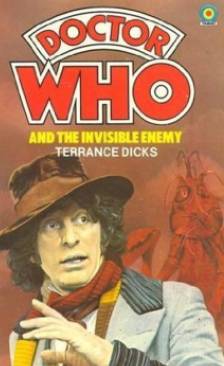
Synopsis: The Doctor is unwell, fighting off an alien virus that is trying to possess him. Heading to a hospital in deep space, the Doctor meets Professor Marius and his robot dog K9, who eagerly assists Leela in fighting off an army of infected people. Realising they need to take the fight to the cause of the infection, the Doctor and Leela are cloned, miniaturized and injected inside the Doctor’s brain to find the nucleus of the virus before it can take hold permanently and use the Doctor to spread its swarm throughout the galaxy.
Chapter Titles
1. Contact
2. The Host
3. Death Sentence
4. Foundation
5. Counter-Attack
6. The Clones
7. Mind Hunt
8. Interface
9. Nucleus
10. The Antidote
11. The Hive
12. Inferno
Background: Terrance Dicks adapts the scripts for a 1977 story by Bob Baker and Dave Martin; that’s three consecutive books to be based on their scripts.
Notes: Terrance Dicks was using the very latest information available, so the reference to Saturn having ten moons is based on the discovery of Janus in 1966. In 1978, it was suspected that Janus shared its orbit with another moon – named Epimetheus – a theory confirmed two years later by the Voyager probe, which also revealed three more moons. It’s now believed that Saturn has over 80 satellites, plus many others embedded within its rings. Considering the definitions of ‘Moon’ and ‘Planet’ have shifted repeatedly in the last 40 years, we can therefore accept that the narrator of this book is using a classification of a significant size of satellite that was common in the year 5000. Or that something terrible happened to Epimetheus or Janus. So there.
The Doctor has high regard for Leela, despite his teasing of her as a savage, and has apparently shown her the basics of TARDIS piloting – and she’s retained the training enough to input coordinates, despite otherwise struggling with general levels of technology. Professor Marius came to the BI-AL foundation from the New Heidelberg University. Growing bored waiting for news of the Doctor, Leela explores the station, bypassing the lifts because she doesn’t trust them and scaling numerous flights of stairs before she finds the Doctor’s ward.
We’re introduced to the legendary K-9, who is a ‘squat metallic creature’ that looks like ‘a kind of squared-off metal dog’, with a ‘computer display screen for eyes, and antennae for ears and tail’.
Dicks manages to work around the visuals of the nucleus of the swarm, which, at micro-scale has ‘waving antennae, glistening wet red flesh, and a bulbous black eye that seemed to swivel to and fro’, while the version in the macro-world is rather unpleasant:
A horrible, incredible shape [which] was filling the booth. It was blood-red in colour and was as big as a man with a bony glistening body and lashing tentacles. The huge black bulbous eyes swivelled malevolently around the ward.
… and definitely not a giant prawn.
The virus tries to reinfect the Doctor through Marius and when it fails, the Doctor is full of glee. Marius gains help from the entire surviving staff at the Foundation in preparing the antidote samples. Back on Titan, the nucleus swells to an enormous size while its hatching brood look like ‘huge, malevolent dragonflies’.
Cover: A rather lovely portrait of the Doctor with the nucleus of the swarm in the background, courtesy of Roy Knipe.
Final Analysis: The opening scene adds a very subtle message that the people of the future are trained for their jobs, but then their environments are controlled so extensively by technology that they’re never required to put any of that training into practice. We also get a decent paragraph that explains the back-history behind Marius’s casual use of the term ‘spaceniks’. Once again though, it’s the little details added to give the monster of the week a greater sense of scale and menace than they could have achieved onscreen.
Synopsis: Trapped under a rockfall after an explosion, Sarah Jane reaches out for help and grabs a hand-shaped object – but it is not the Doctor’s. While Sarah recovers at a nearby hospital, the Doctor discovers that the object Sarah found, though made of stone, appears to have once been ‘alive’. His theory is soon proven correct when Sarah, under a malevolent influence, breaks into a nuclear power station and places the hand inside the reactor – where it regenerates into the alien Eldrad. Free from Eldrad’s control, Sarah accompanies the Doctor as he returns the alien home to Kastria – unaware that this will be Sarah’s final trip…
Chapter Titles
Prologue
1. The Fossil
2. The Ring of Power
3. Power Source
4. The Will of Eldrad
5. Eldrad Must Live
6. Countdown
7. Blow-up
8. Counterstrike
9. The Return of Eldrad
10. Return to Kastria
11. The Caves of Kastria
12. Eldrad Reborn
13. Eldrad’s Destiny
14. Sarah’s Farewell
Background: Terrance Dicks adapts the 1976 scripts by Bob Baker and Dave Martin.
Notes: Although the prologue covers much of the same ground as the TV story’s first scene, it’s actually possible to understand what’s being said by the characters here! There’s a lovely description of the captured Eldrad lying in the capsule, totally still except for a flexing hand with a ring on it. And of course, when the capsule explodes, it’s that hand that survives and gets embedded in primeval mud ‘for one hundred and fifty million years’. The Doctor sees an overhang in the cliff face, which is what protects them from the explosion. He uses his UNIT connections to regain access to the quarry, where the foreman, Tom Abbott, has moved his police box to a safe area.
According to Dr Carter, Sarah is wearing ‘a striped overall dress’, not the ‘Andy Pandy’ suit. Professor Watson’s first name is Owen and he has a handgun in case of terrorist attacks, for which he’s had half-an-hour’s training (reminder to American readers: Someone having access to a gun is extremely unusual in the UK). He decides to patiently listen to his daughter’s story on the phone, in case her last memory of her father might be his shouting at her. The disembodied hand tries repeatedly to leap up and grab the handle to the reactor but eventually gives up to gather its strength. Watson gives Sarah and the Doctor a lift in his Jag away from the complex towards a hill several miles away (so, not in the car park like on telly). When the Doctor drives off in Watson’s car with Sarah and Eldrad, Watson is left behind to explain the situation on the phone to a government minister. The Doctor pretends to be hurt to trick Sarah into crossing the ravine on Kastria – twice!
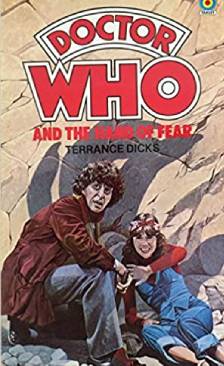
Cover: Roy Knipe rejigs a publicity photo from Planet of Evil to show the Doctor and Sarah cowering under the huge shadow of a clawed hand.
Final Analysis: Aside from a few lines of clarification, this is a simple retelling of the story, but it still manages to draw the reader in. It helps to be a fan of the transmitted version, so we can imagine the actors in position, and perhaps because of familiarity, I still got choked up by the final scene.
Synopsis: The TARDIS brings the Doctor and Sarah to an English village where something is wrong. The locals seem cold and machine-like, while a group of blank-faced astronauts patrol the area and shoot at the new arrivals. The Doctor tries to piece together the clues around him, but it’s Sarah who reveals the truth; the village isn’t a real village, this isn’t really Earth – and Sarah is not the real Sarah! The whole thing is an elaborate copy created by Styggron – chief scientist of the Kraals. And the real invasion is about to begin…
Chapter Titles
1. Strange Arrival
2. Village of Terror
3. The Watcher
4. Hunted
5. Captured
6. The Test
7. The Countdown
8. Braindrain
9. Blastoff
10. Hero’s Return
11. Takeover
12. Death of a Doctor
Background: Terrance Dicks adapts Terry Nation’s 1975 scripts, completing the run of Season 13 stories for Target.
Notes: Sarah wears ‘casual late-twentieth-century clothes, with a brightly coloured scarf at her throat’. The army soldier who throws himself off the cliff isn’t from UNIT and the android Sarah finds inside the capsule by the TARDIS is an old lady. Chased by patrol dogs, the Doctor has a curious thought that anyone who thinks foxes enjoy being hunted should try being chased across country by dogs themselves. Styggron is described thusly:
The face hovering over her was broad and flat with leathery greenish skin. It was heavily jowled with a squashed pig-like snout, underhung jaw, and enormous ears set flat against a massive skull. Huge eyes glowed in cavernous sockets beneath the jutting brows.
The calendar in the Fleur de Lys only shows the month of September (on TV, it’s a day-by-day calendar with solely ‘Friday July 6th’ pages). The entrance to the Kraal bunker is hidden inside an empty barn. When Styggron says ‘There is no time for pleasantries’, the Doctor asks rudely: ‘How about unpleasantries, pig face?’ Haha!
Benton has promised to take his sister to the village dance (not The Palais). It’s not exactly clear on TV, but the android Benton is found leaning over Benton’s body. Here’s the paragraph:
The kneeling man turned and looked up at him and Adams gave a gasp of astonishment. The soldier leaning over Benton, was Benton… He opened his mouth to shout an alarm, and a savage blow struck him down from behind. The android technician caught the falling body and laid it down beside the body of the real Benton. The android Benton got to its feet, and gave a nod of satisfaction. ‘Good. Have them taken away…’
That’s not just ‘the unconscious Benton’, it’s ‘Benton’s body’. Eek!
It’s the Benton android, not the Doctor Android, that points out that there’s ‘much to do’. Once the Doctor has bluffed his way past Android Benton, the scene is not repeated with the android Doctor. We don’t get the final scene of the Doctor and Sarah leaving in the TARDIS; instead, the Doctor plans to collect up all the androids and dismantle them before the scanner beam can be switched off. Marshal Chedaki, meanwhile, waits in vain for Styggron’s signal to begin the invasion. ‘With Styggron dead, his master plan had come to nothing. The android invasion was over.’
Cover: Another brilliant cover by Roy Knipe, it’s just the Doctor being tied to the village memorial by spacemen while Styggron looks off into middle distance, but it’s so effective.
Final Analysis: Often dismissed as lightweight because of the grittier stories that surround it, I’m very fond of The Android Invasion. Here, Dicks adds a little to the playfulness between Sarah and the Doctor where, in the past, that might have been trimmed. Chedaki is more of an antagonist to Styggron, as a disgruntled leader of the military wing, and he’s more threatening a presence than the subservient TV version. Dicks then tidies up all the loose ends in a final section that unfortunately stresses just how rushed the conclusion was on telly.
And just in case we’re in any doubt – it’s Benton’s BODY! Not so lightweight now, eh?
Synopsis: Scientists have disappeared from across the country. In an attempt to keep them safe, the remaining experts have been brought to a research centre under the guard of UNIT – but still they continue to vanish. The Doctor identifies the cause must be someone with access to time travel. Following the trail in the TARDIS back to the Middle Ages, the Doctor discovers the time-hopping kidnapper is a Sontaran warrior – unaware that the TARDIS has brought alomg a 20th-Century stowaway aboard in the form of intrepid journalist Sarah Jane Smith.
Chapter Titles
Prologue
1. Irongron’s Star
2. Linx’s Bargain
3. Sarah’s Bluff
4. Irongron’s Captive
5. The Doctor Disappears
6. A Shock for Sarah
7. Prisoner in the Past
8. The Robot Knight
9. Linx’s Slaves
10. Irongron’s Wizard
11. The Rescue
12. The Doctor’s Magic
13. Counter Attack
14. The Robot’s Return
15. Shooting Gallery
16. Return to Danger
17. Linx’s Departure
Background: Terrance Dicks adapts Robert Holmes’ scripts for the 1973-4 serial, except from the prologue, which Holmes wrote himself before handing the task over to Dicks.
Notes: Three years after the word ‘Sontaran’ first appeared in a Target book [see Terror of the Autons], we finally meet one – in the most exciting prologue ever, written by an uncredited Robert Holmes! We join Sontaran Commander Jingo Linx as his ship faces certain obliteration after an unsuccessful battle against the Rutans in their third galactic war. We learn that the Sontarans come from the planet Sontara and he listens to the ‘sweet strains of the Sontaran Anthem’ (presumably the same one that accompanies Linx’s flag when he erects it in front of Bloodaxe) as his ship makes a last desperate escape from the black, dart-shaped Rutan pursuit ships. Sontarans are cyborgs, thanks to implants in the back of their neck that allow them to draw energy through a ‘probic vent’. The procedure that allows this is undergone on entry to the Space Corps and although it gives him a rush of energy, Linx always dreads taking a ‘power burn’.
The flood of power through his tissues was like a roaring madness, a chaotic maelstrom of colour and sound depriving him of all sentient knowledge of the outside world. He felt himself clinging like a limpet within some solitary crevice of consciousness, aware only that he still existed… still existed… still…
His cruiser is destroyed, driven into a sun as a diversion to allow him to escape the Rutans in a small scout ship. As the ship heads towards a little blue planet orbiting the sun, Linx allows himself a smile usually reserved for the ‘ the death throes of an enemy’. Most of the details here have been forgotten by subsequent authors, even Holmes himself [see The Two Doctors], but it should be mandatory reading for any hopeful Sontaran scribes.
Irongron and his band of men had once ‘roamed the forest like wolves’ before stumbling upon a castle abandoned by a lord away ‘at the wars’. His group attacked the castle at night, its inhabitants massacred, and the castle became his. His nearest neighbour, Sir Edward Fitzroy, is sickly, having returned from the Crusades with a fever. Sir Edward’s son and most of his soldiers are still fighting the king’s crusades overseas, leaving him with a depleted defence. His young squire, Eric, is given a splendid introduction, riding through the forest, wary of being too close to Irongron’s castle and falling victim to a simple trap laid by Bloodaxe.
When he first addresses Irongron, Linx speaks with ‘a booming metallic voice… strangely accented but clearly understandable English’ and the suggestion is that this is due to a translation device, not his natural voice.
The Brigadier brings the Doctor in to investigate the missing scientists and equipment to distract him as he’s missing Jo since she had got married and has refused a new assistant ever since. The Doctor is described as ‘a tall man with a lined young-old face and a shock of white hair’ (we’ll be seeing this description regularly from now on). He insists on having the TARDIS brought to the research centre in case there’s an alien influence he needs to trace. Sarah Jane Smith is introduced, ‘an attractive dark-haired girl’ who is a freelance journalist (the ‘freelance’ bit is new to the book) who has been ‘making her own way in a man’s world for some years now, and she strongly resented any suggestion that her sex doomed her to an inferior role’. The Doctor tells Rubeish that ‘Lavinia Smith’ is a woman in her ‘late sixties’ as well as being in America. The Brigadier reminds the Doctor about his failed attempts to reach Metabelis III (‘I got there eventually’, says the Doctor defensively). We get Sarah’s first reaction to the inside of the TARDIS and she hides inside a wardrobe when the Doctor enters. Realising that the wardrobe is bigger than the police box she entered – and the central control room even bigger again – she quickly forms a theory that the Doctor is an alien responsible for kidnapping the scientists. She also watches the switch the Doctor uses to open the door and uses the same switch to escape.
We might want to note that Hal makes his first attempt to assassinate Irongron by taking up position on a ‘grassy knoll’.
Linx rides on horseback for the attack on Sir Edward’s castle. The attack on Linx, the destruction of Irongron’s castle and the Doctor’s departure with Sarah all happen at night. Although Hal’s arrow kills Linx, the hand of the dead warrior hits the launch button and his ship escapes the burning castle to be returned with Linx’s corpse to the war in the stars. And hurrah for Hal as he rescues Squire Eric from the dungeon!
Oh and there’s a chapter title called ‘Return to Danger’ – so close!!
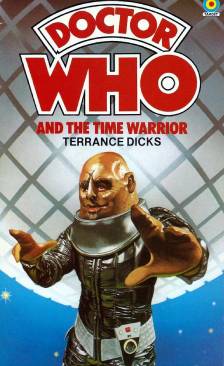
Cover: Linx the Sontaran strikes a dramatic pose before his globe-shaped craft, a superb photorealistic portrait by Roy Knipe. The cover for the 1993 reprint by Alister Pearson places the Doctor, Sarah and Irongron in square tiles behind Linx, who’s side on and holding his helmet by his side.
Final Analysis: It might be heresy but I’m not a fan of this story on TV and reading this story I can put it down to Alan Bromly’s static, leaden direction. But look at all the notes in this chapter and join me in wondering if Terrance Dicks was spurred on by his friend Holmes’ wonderful opening prologue – top three in the series so far (See also Doctor Who and the Crusaders and Doctor Who and the Day of the Daleks.). Compare the two descriptions of Linx’s face – the first is by Holmes, the second by Dicks, picking up the baton:
… the heavy bones, the flat powerful muscles, the leathery, hairless epidermis, the calculating brain.… little, red eyes that were like fire-lit caves under the great green-brown dome of a skull…
The face beneath was something out of a nightmare. The head was huge and round, emerging directly from the massive shoulders. The hairless skull was greenish-brown in colour, the eyes small and red. The little nose was a pig-like snout, the mouth long and lipless. It was a face from one of Earth’s dark legends, the face of a goblin or a troll.
This extends to the major and minor characters – how Sir Edward waits for his wife to ‘run out of words’, (and on the very next line ‘It was a considerable wait’) and how Lady Eleanor’s eyes ‘gleamed’ at the prospect of the Doctor poisoning Irongron’s dog’. It’s clear Dicks enjoyed this. I know I did.






 Escape to Danger