Chapter 144. Doctor Who – The Greatest Show in the Galaxy (1989)

Synopsis: The Psychic Circus has travelled the universe and amassed many fans over the years. Now, it has settled on the planet Segonax, where it has fallen on hard times while under the influence of a malign power. As visitors compete for the approval of the audience, the Doctor has to overcome a major obstacle – Ace’s deep hatred of clowns…

Chapter Titles

  • Overture
  • 1. Beginners
  • 2. Welcome to Segonax
  • 3. Captain Cook
  • 4. The Hippy Bus
  • 5. The Psychic Circus
  • 6. Nord’s Finest Hour
  • 7. The Well
  • 8. The End of Bellboy’s Dream
  • 9. That Old Devil Moon
  • 10. Kingpin
  • 11. The Gods of Ragnarok
  • 12. Positively Last Performance
  • Coda

Background: Stephen Wyatt adapts his own scripts from the 1988 serial. This followed Silver Nemesis on TV, so this was the last time that a pair of stories was released consecutively.

Notes: The approach of the advertising satellite is written in the present tense. Ace is hunting for a new batch of nitro-9 that she recently concocted but is now missing from her rucksack. The Doctor monitors the approaching satellite on the ‘observation screen’ and tells Ace that the TARDIS has a few levels of defence – all of which the satellite bypasses. The satellite lands in the Control Room (hurrah – Wyatt uses the proper name!) and sprouts eight legs to position itself nearer the console. The view of Segonax projected onto the screen shows the circus tent in the middle of a ‘beautiful, lush, green meadow’. The Doctor believes that the founders of the Psychic Circus originally came from Earth. 

‘Nord the Vandal of the Roads’ is a thick-set man, with ‘big muscles, large tattoos, masses of black leather clothing, a brutal unshaven face and a fearsome Viking-style crash-helmet’. When we first meet Captain Cook, he’s delivering a lecture to Mags about the planets Treops and Neogorgon; the latter was where he encountered ‘a whole valley full of electronic dogs’ heads submerged in mud’, which he assumes was a ‘primitive burglar alarm system’. The buried robot begs to be released in a sweet voice, until Ace and Mags get close, when it turns nasty, shouting threats, gnashing its teeth and firing lasers in all directions. Captain Cook, with Mags in tow, drives off and briefly abandons the Doctor and Ace, until they are reunited at the site of the abandoned bus. The bus reminds Ace of when she was a child, when her Aunt Rosemary used to tell her about the Beatles and the Swinging Sixties. 

Nord is given a strongman costume to wear for his act. Whizzkid asks for autographs from the Chief Clown, Morgana and the Ringmaster – which is what propels them into submitting him as a contestant.

By the time Ace first sees Bellboy, his hair is almost white and she suspects he might have received an electric shock. Ace is said to be unable to cope with ‘deep emotion in other people’ and Bellboy’s trauma over Flowerchild makes her feel uncomfortable. She’s ‘never been so close to such naked grief before’. She briefly considers stealing Nord’s bike to help her escape from the circus, but realises it’s useless as Nord didn’t fix the valve properly.

There is a small team of ‘makeup clowns’ who prepare each contestant for the stage – though they allow the Doctor, Mags and the Captain to enter the ring without making them change their costumes. The robot clowns seal Morgana and the Ringmaster into boxes and then when they’re opened, they contain smaller boxes, which contain even smaller boxes until the final two boxes are opened and revealed to be empty. The chief caretaker’s hearse crashes into the Stallholder’s cart, which gets entangled in the limousine’s wheels (on TV, it merely comes to an abrupt halt as she blocks the way). The Doctor has apparently ‘always enjoyed juggling’. His act for the Gods of Ragnarok includes fire eating and a bed of nails. The stallholder claims to have seen the final end of the Psychic Circus, as did everyone else on Segonax as a huge wind scattered leaflets for the circus for miles around.

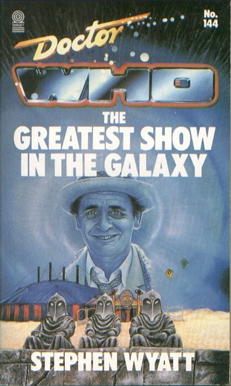
Cover: Alister Pearson paints a smiling Doctor in the blue sky above the Circus marquee as the three Gods of Ragnarok sit in judgement.

Final Analysis: Stephen Wyatt approaches the TV scripts methodically, delivering a straightforward adaptation with a few minor changes to scene order. The value he brings to the text is a deeper insight into the regular characters: it’s quite a brave thing to show Ace as emotionally under-developed, unable to react appropriately to Bellboy’s grief ; and we get a greater sense of the Doctor’s frustration at being tricked twice because he’s focusing all his attention on the mystery that’s at the heart of the Psychic Circus. The highlight of the TV episodes was the transformation of Mags into a feral beast and it’s beautifully realised here:

The moonlight was working its awful transformation. The hands had grown longer and hairier. The nails had turned to claws. The eyes were becoming blood-shot and savage, the face darker and more bestial, the hair like fur. And, worst of all, the mouth. Mags was slavering now. Huge teeth sprouted in her gums. Her tongue lolled hungrily. Then she snarled, baring her terrible fangs. This was no longer Mags: this was a werewolf. And if the Captain had his way, the werewolf would kill the Doctor.

It’s also interesting that, while she’s under the effects of the moonlight, Mags is described as ‘the werewolf’ except where the Doctor tries to connect with Mags to calm her atavism. A solid story well told.

Chapter 134. Doctor Who – Paradise Towers (1988)

Synopsis: The residents of Paradise Towers have divided into factions: The caretakers tackle their duties with strict adherence to an insanely restrictive rulebook; the youngsters have formed warring gangs vying for supremacy; the oldsters are supplementing their diets with unspeakable things; … and then there’s Pex, a lonely, frightened boy trapped in the body of a brave hero. But Pex isn’t brave – he’s a cowardly cutlet.

Chapter Titles

  • 1. The Last of the Yellow Kangs
  • 2. No Visitors
  • 3. Tea and Cakes
  • 4. The Chief
  • 5. This Way and That
  • 6. Brainquarters
  • 7. Come into My Parlour
  • 8. The Illustrated Prospectus
  • 9. The Basement
  • 10. The Pool in the Sky
  • 11. Kroagnon
  • 12. Farewells

Background: Stephen Wyatt adapts his own scripts for a story from 1987. This is the first book not to be published as a hardback – the ‘library editions’ were dropped due to falling sales.

Notes: Paradise Towers is, as the back cover first confirms, a man-made planet, accessible via space-faring ships. The Doctor also refers to ‘Mel’s Earth’, and Mel compares Pex’s performance to Karate experts ‘back on Earth’, spelling out that this isn’t her world – although it’s still unclear whether or not the inhabitants originally came from there. The Yellow Kang confirms something that’s fudged on TV, that the Kang wars are not to be taken seriously, they are just games. She’s alone now, after a period of returning to the Yellow Kang Brainquarters to depreciating numbers of her fellow Kangmates. Streets named in the story are Sodium Street, Potassium Street, Nitrate Street, Sunrise Square and Fountain of Happiness Square. 

The young caretaker has only recently taken on his patrol beat, replacing an older caretaker who was (according to the Chief Caretaker) ‘assigned to other duties’ and never seen again. The Kangs are around 15 or 16 years old and they remind Mel of Samurai warriors. The Rezzies are dressed in clothes made up of colourful patchwork (and Mel notes that Tabby has very sharp teeth like a rat). Pex is much more the traditional action hero than we get on screen. He’s not tall, but ‘an imposing figure with a rugged jaw, piercing eyes and a powerful, muscular body’. He has a tattoo on his neck, he wears a ‘commando-style outfit’ and his voice is ‘deep and strong’. Despite all this, Mel still recognises that he’s putting on a show and is an outsider from all of the sub-groups in the Towers.

The Chief is of ‘middle height’ and his uniform was once grand but is now ‘somewhat faded and dusty’. He’s not a vain man and considers his looks to be unimportant. He has a  ‘sallow complexion and drooping black moustache’, and ‘ bloodshot but alert eyes’. The Chief isn’t keen on fresh air or exercise, regarding such activities as ‘futile, even actively harmful’. Pex tries to ward off the Blue Kangs with martial arts poses before they ridicule him. While watching the Paradise Towers prospectus on the videoscreen (or ‘Picturespout’, as the Kangs call it), the Doctor responds to the boasts of the prospectus narrator by thinking he’d rather spend a night locked in a hotel with the Daleks than live here. The Kangs are amazed to learn that there are other worlds without Rezzies or Kangs and are keen to hear about them from the Doctor. The Blue Kang leader is called ‘Drinking Fountain’. Viewed by Kroagnon on the Chief Caretaker’s screen, the Doctor’s face is said to look ‘strange’ and ‘intelligent’, but also ‘impish and insolent’.

Cover: The Doctor looms large as a robot cleaner passes walls strewn with graffiti. It’s a bold composition from Alister Pearson that has a similar basic layout to some of Achilleos’ greats, but with a more photorealistic approach.  For those that are counting, this is the first cover to feature the ‘current’ Doctor prominently in the artwork since Creature from the Pit in 1981 (aside from the photographic covers, the Fifth Doctor appeared within a montage for The Five Doctors and there’s a smudge in the sky representing the regeneration on The Caves of Androzani). This would appear to be down to McCoy himself being impressed by Pearson’s artwork and the way he captured the actor’s likeness. We’ll be seeing a lot of his work from now on…

Final Analysis: This really does the job very well, creating an entire literal world out of the limited sets we saw in the televised episodes. Scenes have been moved around or joined together, avoiding the more frenetic chopping about on telly. It also helps to be able to read the dialogue and make better sense of the sometimes quite convoluted mixed-up phrases of the Kangs. Wyatt also delves a little deeper into the strange relationship between the Chief Caretaker and his pet, making it more explicit that the Chief is being controlled by Kroagnon without his knowledge. He has been ever since he discovered his ‘pet’ in the basement of the Towers. While this explains the ‘how’, it doesn’t seek to justify the ‘why’. The Chief Caretaker was simply a weak man from the start, obsessive and callous, which just made him an easy vassal for the Great Architect to steer and manipulate. Paradise Towers is the perfect proper introduction to this Doctor, toppling an entire society in just a few hours, and Wyatt presents him as almost Holmesian, piecing together clues and improvising effective escapes and solutions from items he finds lying around him.