News has only just reached me of the passing in January of artist Nick Spender. Nick provided the cover art for four Target books (plus the proposed artwork for the unreleased An Unearthly Child audiobook).
Synopsis: The TARDIS lands on a spaceship orbiting an alien world. The crew of the ship appear to be frozen but suddenly they wake up, dazed and confused. Two visitors from the planet arrive and insist the travellers join them on their world. Leaving Barbara behind on the ship, the Doctor, Susan and Ian meet the Sensorites, a race of beings with telepathic abilities and a sensitivity to bright light. But there is revolution from within as a small faction of Sensorites plot to take control. Meanwhile, Ian falls victim to a mysterious illness…
Chapter Titles
Prologue
1. Strangers in Space
2. War of Nerves
3. The Dreams of Avarice
4. The Unwilling Warriors
5. The Quest for Freedom
6. Hidden Danger
7. A Race Against Death
8. Into the Darkness
9. Surrounded by Enemies
10. A Conspiracy of Lies
11. The Secret or the Caves
12. A Desperate Venture
Epilogue
Background: Nigel Robinson adapts scripts by Peter R. Newman for a 1964 story, breaking the record for biggest gap between broadcast and novelisation (22 years, six months, three weeks).
Notes: A moody prologue establishes the survey ship above the atmosphere of the Sense Sphere – ‘Out in the still and infinite blackness of uncharted space’ (see The Ambassadors of Death for more on this). The ship is nearly a fifth of a mile long and was nearly at the end of its four-year mission when it became caught in that region of space. There’s an elegiac introduction for Susan:
No longer a girl, and not yet quite a woman, her closely cropped hair framed a face of almost Asiatic prettiness, and her dark almond eyes belied an intelligence far beyond her tender years.
Barbara is tall and tidy, in her late-twenties and with a ‘stern purposeful face’ that possesses ‘a melancholy beauty’. She’s also dressed in clothes appropriate to the 1960s, though hers are more conservative than Susan’s, reflecting ‘her maturer years’. Ian is said to be a ‘stocky well-built young man, while the Doctor is ‘an intellectual giant’ and ‘an alien cut off from his home planet by a million light years in space and thousands of years in time’ (finally – someone knows that light years are a unit of distance!). We’re reminded of the travellers’ recent moral dilemma over the culture of the Aztecs as well as their first meeting in the junkyard.
Maitland is provided with an efficient reason for accepting the travellers’ lack of 28th-century knowledge, assuming they’re from an earlier time, pre-hyperspace-travel, when cryogenics were commonplace; it’s apparently a frequent experience for modern travellers to overtake those from previous generations. Ian and Barbara’s rather slow onscreen journey through the corridors of the ship is transcribed as a hideous ordeal where they’re surrounded by evil spirits and bogey-men. The Sensorites are described as possessing an ‘almost Oriental inscrutability’ (a phrase that may trigger some modern readers who may view it as representing outdated imperialism, but is less distressing in the UK where many Chinese-themed takeaways and restaurants still use the word in their name).
The Doctor identifies the humans as being members of a lost Interstellar Navigation, Exploration and Research party (‘INNER’, correcting a contradiction on-screen between what Hartnell says ‘I-N-N-E-R’ – and what the badge reads – ‘INEER’ – which, as Frank points out in the comments below, is likely to have been ‘ENGINEER’ before it was torn). The Sensorites provide Susan and Barbara with a 3D holographic map of the city and the caves. The final argument between the Doctor and Ian is omitted (even though the very next novel to be released follows on directly from this). Instead, Barbara fears for the future of the Sensorites now that first contact with humans has been made:
Maitland, Carol and John were good people and would guard the Sensorites’ secret well. But she remembered other instances in Earth’s history when promises had been made and then broken; when secrets had been kept and later betrayed. She remembered the dreadful consequencesof such actions: the callous exploitation of the Indians of North America, the Aborigines of Australia. In their own naive way the Sensorites were just as helpless as them.
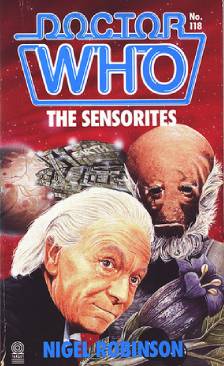
Cover: Nick Spender’s cover shows the Doctor, a Sensorite and a bloom of deadly nightshade. Spoilers, Nick!
Final Analysis: As with The Space Museum, The Sensories is unlikely to be a favourite for many – as pointed out by Tim Worthington ; even if you’re a fan of the first Doctor, it’s slow, small-scale stuff that feels rather dated now. As his time as editor was coming to an end, Nigel Robinson was cautious about commissioning himself to write a novel, so taking on this unloved adventure was a canny idea. And it’s a surprising success. Firstly, Robinson captures the regular characters beautifully. Secondly, he effectively increases the menace without rewriting what is seen onscreen; instead, he provides insight to the mental terror experienced by Ian and Barbara, as well as the attacking beast in the caves, which on TV is obviously just a dishevelled man. He brings a much greater depth to the rather generic and unintentionally comical Sensorites, imbuing them with a sense of culture that helps to explain away some of the more patently ludicrous plot holes; and there’s even compassion for the human survivors of the crashed rocketship:
They weren’t evil – like all men at war they believed totally in the rightness of their mission – but they were mad, and what they were playing at was no more than an elaborate and very deadly game of soldiers.
This is all the most surprising when we remember that though Robinson has edited many works by other authors by this time he left WH Allen, this is his very first self-penned novel. It has all the efficiency of a Terrance Dicks, the empathy of Malcolm Hulke and Ian Marter’s ability to heighten the sense of menace. I’m looking forward to seeing what he can do with a more worthy story.
Synopsis: In the aftermath of the battle of Culloden in 1745, a group of Jacobite rebels try to evade capture by the English army. The Doctor, Ben and Polly help a wounded laird but are then captured by an incompetent English officer. The Doctor adopts a fun disguise as Polly uses guile to free her new friends and escape. One young Scot in particular impresses the time-travelling trio – a piper by the name of Jamie McCrimmon.
Chapter Titles
1. Where are We?
2. The Cottage
3. The Captives
4. The Handsome Lieutenant
5. Polly and Kirsty
6. Polly’s Prisoner
7. The Water Dungeon
8. Blackmail!
9. The Doctor’s New Clothes
10. Aboard the Annabelle
11. At the Sea Eagle
12. The Little Auld Lady
13. A Ducking for Ben
14. Where is the Prince?
15. The Fight for the Brig
16. Algernon Again
17. A Return to the Cottage
Background: Gerry Davis adapts the scripts he co-wrote with Elwyn Jones for the 1967 serial.
Notes: The bonhomie of TV’s Ben and Polly is replaced by something closer to the bickering of 1980s companions; Ben insists on calling Polly ‘Princess’ (not ‘Duchess’) and thinks she is ‘uppity and toffee-nosed’. He also thinks the sounds of battle drifting over the moor are just celebrations from ‘the Spurs Supporters Club’ (ahem, a reference to the er, London-based football team Tottenham Hotspurs) or a historical society. Polly resents Ben’s ‘big brother’ protectiveness, especially as she is ‘about a head taller than he was’; later, it’s confirmed she’s an ‘independent girl from the sixties’ – so her ‘seventies’ origins have been properly reset from previous Gerry Davis novels. The Doctor admits to Polly that the discovery of a cannon ball makes him afraid. There’s a dump of history at the start too, as we’re told of the battle for the British monarchy between the Scottish Stuarts and the ‘Hanoverian German Georges’. The Scots had been booted out 40 years ago and we join the story in the aftermath of the battle of Culloden Moor. As this wasn’t taught in English schools in my day, this is especially welcome and helpful.
As the Doctor inspects a tam-o’-shanter, we’re told it’s a ‘standing joke in the TARDIS that he could never resist trying on any new hat he came across’; as this is the first TV story where his hat fetish became a regular thing, this suggests the trio have had a fair few offscreen adventures since the Doctor’s regeneration. He adopts the pseudonym ‘Doctor von Verner’ (not the more obvious meta-joke ‘von Wer’ on telly). Algernon Ffinch stammers ‘in a way approved by the London dandies of the time’, which could mean it’s an affectation for fashionable purposes. The Sergeant’s name is spelled ‘Klegg’, not ‘Clegg’. While in the prison, Jamie plays a mournful tune on his bagpipes before the Doctor creates a disruption in the gaol by playing the Jacobite ‘Lillibulero’ on his recorder. The name of the pub where Solicitor Grey has installed himself is called the Sea Eagle Inn. As Jamie boots Trask overboard during the final battle, Ben tries to regain some composure as he claims he was about to use karate to save himself. There’s a more pressing reason for Jamie to join the travellers; having escorted them to the TARDIS, Jamie boasts that he’ll be fine on his own as they hear the sound of muskets being fired nearby. We then join Jamie as he sees the inside of the TARDIS for the first time (see below).
Cover: A smashing portrait by Nick Spender of Jamie, accompanied by Alexander, a Saltire flag and the TARDIS. Unusually for this period, there are likenesses of recognisable actors here!
Final Analysis: Gerry Davis returns to adapt a script that he originally oversaw to production. It was the last of the pure historicals on TV, yet it’s the second one we’ve had in novel form in the space of a year. The Highlanders is often overlooked in favour of the more monster-focused stories of the era and, perhaps it won’t come as a surprise to learn that this is the first time I’ve read this particular book. Davis keeps things light, even with the threat of violence and a very sudden and shocking death early on. The stakes are high, but so’s the sense of adventure and Polly in particular has a rare old time running rings around every man she encounters. Effectively, she gets her own companion in the form of Kirsty and it’s easy to forget that this is the debut of Jamie, even though his future role as a companion isn’t foreshadowed at all, he’s just one of a number of likeable characters that we meet. Poor Ben’s experience in Scotland isn’t quite so jolly. Despite having spent very little time with Jamie, Polly takes an immediate shine to him and the final scene sees him adopted as a fully-fledged TARDIS member at last:
As he hesitated, Polly turned back and grasped his hand. ‘Don’t be afraid,’ she said, ‘it’s much nicer inside than it is out. There’s so many wonderful surprises waiting for you, you’ll see.’
Jamie allowed himself to be drawn through into the small police box. The door closed behind him and he saw to his astonishment the large, hexagonal, brightly-lighted interior of the time-machine.
Synopsis: UNIT has been invited to provide security for a top secret drilling project in search of a new energy source from the Earth’s core. Hoping that the facility might help with his repairs to the TARDIS, the Doctor immediately becomes an irritation for the project’s director and instigator, Professor Stahlman, who is determined to lead the project to undoubted victory, whatever the risk. Afreak accident sees the Doctor transported to a parallel world where Stahlman’s project is much further advanced – and the dangers more apparent. Can the Doctor save this world and make it back to his own in time?
Chapter Titles
1 Project Inferno
2. The Beast
3. Mutant
4. The Slime
5. Dimension of Terror
6. The Nightmare
7. Death Sentence
8. Countdown to Doom
9. Penetration-Zero
10. The Monsters
11. Escape Plan
12. Doomsday
13. Return to Danger
14. The Last Mutation
15. The Doctor Takes a Trip
Background: Terrance Dicks adapts scripts for the 1970 serial by Don Houghton.
Notes: The Stahlman Project is ‘the greatest scientific project that England had ever known’; it’s predicted to be ‘more technologically advanced than nuclear power’ and, more importantly, ‘far more lucrative than North Sea Oil’, promising ‘limitless free energy for everyone’. We’re reminded that these are still the early days of the Doctor’s exile by the Time Lords to Earth. The complex that houses the project is in ‘a messy, unattractive-looking area’ – and this will be relevant later.
Professor Stahlman’s first name is Eric and he grew up ‘in the ruins of post-war Germany’ (which means he’s either only in his late twenties or he grew up in post-First-World-War Germany – unless Terrance Dicks is maintaining the idea of UNIT stories being set in a ‘near future’). Sir Keith Gold observes Professor Stahlman’s ‘bulky broad-shouldered body and massive close-cropped head’, with a neat beard; in his mind, Sir Keith compares him to a gorilla in a lab coat – and immediately feels guilty for being so uncharitable. It’s an interesting choice to make Stahlman physically strong, ‘powerfully built man’, as this accentuates his early encounter with the Doctor, who restrains him with just two fingers and freezes him to the spot.
Liz Shaw is a ‘serious-looking girl with reddish-brown hair’ dressed in ‘a rather incongruously frivolous-looking mini-skirt’ – details which help to provide contrast with the parallel-world version. We’re reminded that Liz is ‘a scientist of some distinction in her own right’ and that she had been brought into UNIT from Cambridge ‘some time ago’. Petra Williams is ‘an attractive white-coated young woman, with a pleasant open face’ – yes, just like the Fifth Doctor – ‘framed by long fair hair’. Greg Sutton is said to be ‘a burly, broad-shouldered man’ and he has ‘a pleasantly ugly face’ (a bit unfair on Derek Newark there, Terrance!) and ‘a sun-baked, wind-weathered complexion’.
The Doctor witnesses Stahlman stealing the microcircuit and exclaims ‘Jumping Jehosophat’, as he does when he sees the Master in The Five Doctors. When he finally escapes limbo and lands in the parallel world, the Doctor is aware that he’s not where he’d previously been because the hut is tidy (the Doctor likes ‘a bit of clutter’). The neatness extends to the rest of the surrounding area, which has also been ‘tidied up’. Without the moustache of the Brigadier, the Brigade Leader’s mouth looks ‘thin-lipped and cruel’. The Doctor begins to speculate as to the cause of the parallel world and guesses that it might be down to a different outcome for the Second World War. The savage beasts are simply mutants (they’re called ‘Primords’ on the end titles of the TV episodes, but the word isn’t used in dialogue or in the novel). The novel retains the radio broadcasts that were cut from the original transmission (but retained for overseas broadcast). The Doctor checks his pulse and it’s ‘normal’ at 70 (it’s 170 on TV). The Doctor realises that he was so ‘haunted by that nightmarish vision of an exploding Earth’ that his violent outburst at Stahlman will have damaged his credibility.
Cover: Nick Spender’s fiery illustration shows a likeness of Ian Fairbairn as technician Bromley beginning to transform into an atavistic beast on the roof of a cooling tower beneath a burning sky. It’s quite the scariest cover since Alun Hood’s 1979 piece for the Terror of the Autons reprint.
Final Analysis: The first of two Don Houghton stories adapted by Terrance Dicks and it’s a real treat. It benefits from the increased page-count that’s gradually crept in since Terrance’s middle-period, plus it’s the sort of story that really plays to Terrance’s strengths as his economic thumbnail-sketch descriptions help us remember who’s who and what’s different about them in the other world. We also get an insight into the Doctor’s thought process, initially fascinated by the opportunity to explore a parallel world until he begins to treat the people he encounters as real, and not just disposable alternatives of the ones he knew on the other Earth. His horror at realising he has to give up on the alt-world to gain the chance to save his own Earth stays with him, even down to him accepting his desperation has alienated the very people he’s trying to save. And as we’ll discover, it’s a devastating decision that will haunt him for… well, at least as long as Don Houghton’s other story.
Synopsis: Emerging from a hidden doorway in a temple, Barbara is mistaken for the Aztec God Yetaxa and finds it difficult to refuse the role. As the Doctor tries to regain access to the temple and return to the TARDIS, Barbara learns the difficult lesson that she cannot change history. Not one line of it!
Chapter Titles
1. Coiled Serpent
2. Yetaxa the God
3. Chosen Warriors
4. Sacrifice to Tlaloc
5. Perfect Victim
6. Thorn of Doom
7. No Holds Barred
8. Cups of Cocoa
9. Bride of Sacrifice
10. Offence and Retribution
11. Crawl, Swim, Climb
12. Wall of Deception
13. False God
14. Day of Darkness
15. Eclipse
Background: John Lucarotti adapts his own scripts for the series broadcast in 1964. Published a week after its 20th anniversary, The Aztecs now holds the crown for the biggest gap between first transmission and novelisation. It’s also the first pure historical story to be adapted since The Crusaders, some 19 years earlier.
Notes: We begin with a new scene inside the TARDIS with little explanation of who the characters are or what the TARDIS is. Susan is said to be still 15 years old, while Ian is 28 and a ‘scientist’ (not a science teacher’). When the Doctor asks for a screwdriver (a normal screwdriver!) to fix a panel on the TARDIS ‘control desk’, Ian jokes that they might land on Earth in the 1980s and get help form an aerospace factory; it’s a curiously specific reference for a man from 1963. Barbara specialised in Aztec history at university and her brief summary for Susan of Mexican civilisation is a lot more heavy-handed than it is on screen. She guesses that they’re at some point in history between 1430 and 1519, and the Doctor is able to confirm it’s 17 May, 1507. We might pause to ponder how the TARDIS can produce a date so accurate when it’s 75 years before the introduction of the Gregorian calendar, but this story’s already threatening us with a huge history lesson, so let’s just ignore the issue and move on.
Cameca is ‘a grey-haired, pleasant-faced, plumpish woman in her mid fifties’. The architect of the temple, Topau, is renamed ‘Chapal’. On the night that he meets the Doctor in the garden, Ian wears ‘only a warrior’s loin-cloth and sandals’. Ixta is startled by the Doctor’s electronic torch when he sees Ian use it, wondering if it’s ‘magic’. It was Ixta’s ‘father’s father’ who originally built the secret tunnel that is used to irrigate the garden (it’s his father on TV – and see later). Ian has a much more arduous trek through the secret tunnel, including a climb up a vertical shaft using crumbling footholds. He finds the remains of a body – which he correctly assumes is that of Ixta’s father – in the tunnel and soon discovers that the man must have fallen to his death when a foothold in the shaft gave way beneath his foot; Ian also correctly deduces that he himself was at risk of drowning because of Ixta deliberately opening the sluice. The Doctor tells Barbara of his suspicion that Ian has drowned, shortly before Ian finds them both (on telly, Barbara already knows Ian is safe by the time the Doctor reaches her).
It’s a lot clearer that the Doctor feels utterly wretched for exploiting Cameca’s affection purely to gain access to the temple. As Cameca offers to help restore Autloc’s faith in Barbara, the Doctor is moved by her devotion and muses ‘in another world, in another time’ – but it’s definitely not the romantic relationships some fans imagine. Barbara has a long discussion with Autloc about the ‘schizophrenic’ nature of the Aztecs and her words remind him of a legend he has heard of a man from a foreign land who spoke of a ‘gentleness and love’ who was crucified, as the Aztecs do with their criminals. The climactic fight scene between Ixta and Ian is replaced by something wittier but also just as brutal, as Ian reflects light into his opponent’s eyes, which makes Ixta topple backwards and fall to his death. The scene leading into The Sensorites is, unsurprisingly, cut.
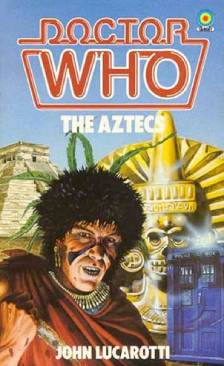
Cover: Featuring the last appearance of the coloured Target logo, Nick Spender’s first cover depicts a man with a dagger (Tlotoxl possibly?), a temple and a giant golden mask, as the TARDIS materialises. A 1992 reprint cover uses Andrew Skilleter’s VHS cover art, showing Tlotoxyl and the Doctor amid some Aztec pyramids.
Final Analysis: John Lucarotti provides a fairly loose adaptation of his own story, clearly written from the original scripts but with a relaxed approach to sticking rigidly to the text. He’s also done a lot of research and is happy to let us know it, but unlike some of the authors from the early 80s, there’s no showboating here; we’re just exposed to the history of an ancient and brutal culture – even the cuisine – of a time in Earth’s history that’s as alien to the modern reader as that of Peladon or Skaro. The descriptions of torture are particularly graphic; at one point, Tlotoxyl tells Barbara that Susan will have her eyes gouged out. I might lament that the original TV version didn’t give us the chance to hear how William Hartnell might have approached a name like ‘Huitzilipochtli’ but Lucarotti’s undiluted approach makes the story all the richer. I read this novel for the first time here and we’re now entering a period where I suspect there are more books I’ve not previously read than I have.



 Escape to Danger