
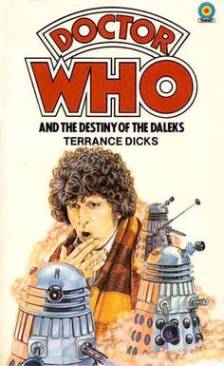
Synopsis: The Doctor and Romana explore a dead world, unaware that one of them has been there before. A spaceship arrives containing the beautiful Movellans who inform the Doctor that the planet is Skaro – home of the Daleks – and their mission is to find the Dalek creator, Davros. But Davros is dead… and coincidentally, so is Romana!
Chapter Titles
- 1. The Dead City
- 2. Underground Evil
- 3. The Daleks
- 4. The Movellans
- 5. Slaves of the Daleks
- 6. Escape
- 7. The Secret of the Daleks
- 8. The Prisoner
- 9. The Hostages
- 10. The Bait
- 11. Stalemate
- 12. Suicide Squad
- 13. Blow-up
- 14. Departure
Background: Terrance Dicks adapts Terry Nation’s scripts for a story that aired just two months earlier.
Notes: Dicks calls Romana a ‘Time Lady’ and summarises the events from the climax of The Armageddon Factor, which hasn’t been novelised yet. The Doctor surmises that Romana’s higher score at the academy accounts for her greater control over how she regenerates, unlike his own traumatic experiences. They arrive on the strange dead world at night during a storm (it’s a bright, sunny day on TV). The slaves bury their dead under rocks because the foundations of the city ruins are too thick to dig up. The dead body that the Doctor investigates was a ‘Space Major Dal Garrant’ (so close to that familiar ‘Tarrant’ that Nation often used). While pinned under the fallen masonry, the Doctor reads ‘The Origins of the Tenth Galaxy’, written by a ‘particularly pompous Time Lord historian’ who he has never liked. He’s interrupted by the arrival of just two Movellans (Lan and Agella) and they’re wearing ‘simple, military-type space coveralls’, rather than the beautifully distinctive space-dreadlocks and Top of the Pops dance-troop suits. On the Movellan spaceship, Commander Sharrell’s rank is denoted by an insignia on his uniform.
Sharrel does not identify the planet they’re on beyond the serial number. Only later does the Doctor discover that it’s Skaro, when Tyssan tells him. As Davros revives, his eyes open [see The Witch’s Familiar in 2015]. The journey to the surface with Davros involves a long, steep, spiralling ramp. The Daleks cheat and make their way to Davros’s level using ‘eerily silent anti-grav discs’ as seen in Planet of the Daleks. Disappointingly, the Doctor doesn’t tell the Daleks to ‘spack off’. The Dalek mutant that he encounters in the sand dunes is more active than the blob of Slime-with-Worms from TV. It’s a ‘pulsating green blob, a kind of land-jellyfish’ that crawls up his arm. There’s a fair bit of gender-swapping here: Veldan and Jall’s genders are reversed, the Daleks’ sacrificial victims are both male and the Movellan that captures the Doctor and Tyssan is also male. Romana doesn’t dismember Sharrel during their fight, she merely kicks away his power tube.
Cover: Welcome Andrew Skilleter, who surrounds an image of the Doctor (based on a pic from The Pirate Planet) with very TV Century 21-style Daleks moving around in fog, as if at a disco. Alister Pearson’s 1990 reprint cover puts the Doctor and Romana alongside a moody Davros in profile, a Dalek and Agella against a salmon background.
Final Analysis: Destiny of the Daleks seems to polarise opinion, but as it was the first Dalek story where I was old enough to follow the plot in full, I didn’t care about how tatty the props looked or that the central point about a robotic impasse shouldn’t have worked because Daleks aren’t robots. I just enjoyed it for being Daleks on my telly. This novelisation is, for me, the first point in this project where Terrance Dicks’ straightforward script-to-page approach feels a little lacking. Racing to get this story novelised meant that Romana v2 is introduced before V1 – we’ve leapt past a season and a half of stories, which is quite confusing – but there’s no real explanation as to who Romana is, only that she’s changed and she’s from Gallifrey. The Movellan costumes are described in such generic terms that they lose some of their onscreen glamour, and it’s all a little… thin. However, there is this lovely harkback to Genesis of the Daleks, which highlights a decision the Doctor has returned to time and time again:
The Doctor sighed. He had hesitated once before, at a time when he could have destroyed the Daleks before their creation, simply by touching the two wires that would complete an explosive circuit. Who knows what horrors he had unleashed upon the Universe? The Daleks were stronger now and more numerous, and with Davros to help them… He must not hesitate again. The Doctor pressed the switch.

 Escape to Danger