Synopsis: Exploring more of E-Space, the Doctor and Romana land on a planet where a small village lies in the shadow of a huge, sinister-looking tower, home to The Three Who Rule. A growing suspicion leads the Doctor to realise that the rulers are vampires, the mortal enemies of the Time Lords. As the pair try to form a plan to defeat them, they are unaware of a complication. A boy called Adric stowed aboard the TARDIS during their last landing and now he is about to become a servant of the Great Vampire…
Chapter Titles
1. The Selection
2. The Strangers
3. The Stowaway
4. The Messengers of Aukon
5. The Tower
6. Tarak’s Plan
7. The Secret Horror
8. The Resting Place
9. Escape
10. The Vampires
11. The Traitor
12. Attack on the Tower
13. The Arising
14. Departure
Background: Terrance Dicks adapts his own scripts from the 1980 serial, which in turn were adapted from scripts he originally wrote for the series in 1977 before they were cancelled. This is a completely separate adaptation to the one he wrote for an audiobook published by Pickwick the previous year.
Notes: Habris introduces us to this world, the village, the tower and the Lords who ‘weren’t quite human’. There’s no trace of any references to the original title, ‘The Wasting’, which had survived to the broadcast version. Adric is introduced as ‘a small, round-faced, dark-haired youth’. The Doctor sticks around ‘well into the next day’ to help with explanations and clearing everything up. Ivo and Kalmar jointly agree to set up a new government, using the old rebel headquarters as its base.
Cover: Andrew Skilleter creates a composition of the Doctor, Aukon, a bat and more bats flying across a moonlit sky.
Final Analysis: This is the fourth complete version of the story that Terrance Dicks wrote – preceded by the abandoned one for Season 15, the broadcast one for Season 18 and that Pickwick audiocassette version from 1981. The Pickwick edit was significantly abridged, so this is a much more faithful adaptation and Terrance even borders on Ian Marter-style violence towards the end. The desiccation of the vampire Lords is particularly effective:
Grouped in front of him in a semi-circle, the three vampires paused for a moment, as if to savour their final triumph. Eyes flaring red, teeth gleaming, hands outstretched like claws, they lunged forwards in unison — and then froze.
Their faces seemed to dry up, to wither and crack, like sun-baked earth.
The dessicated flesh crumbled from their bodies and for one horrible moment, three gorgeously robed skeletons stood leering at the Doctor, bony fingers reaching out, as if to rend him. Then the skeletons, too, crumbled, leaving three huddled heaps of clothes resting on scattered dust piles on the floor of the cave.
Synopsis: The Lady Adrasta is used to being obeyed and her word is law. If you disobey her, if you displease her in any way, you’ll be thrown into a pit that they call… The Pit. If you’re lucky, you’ll break your neck as soon as you reach the bottom. If not, you’ll encounter a terrifying creature they call… The Creature. With the help of a forgotten astrologer, the Doctor uncovers the truth about the creature – and Lady Adrasta.
Chapter Titles
1. The Pit
2. Wolfweeds
3. The Doctor’s Leap to Death
4. The Creature
5. Organon
6. The Web
7. The Meeting
8. The Shield
9. Erato
10. Complications
11. Wrapping Up
Background: David Fisher adapts his own scripts from the 1979 story.
Notes: Madam Karela secretly thinks the whole business with The Pit is a waste of time and would prefer to use her knife to cut the accused’s throat. Romana discovers a multi-dimensional store cupboard that contains a box labelled ‘Toys from Hamleys’, a lone ‘patent-leather dancing pump, signed on the sole “Love from Fred”’; an animal jawbone, an object that might be a musical instrument, a ball of string and a blonde chest-wig! The box containing the transceiver is stamped with the Seal of Gallifrey and the device should have been installed 12 years ago. Romana has clearly been with the Doctor for a long time now, as she reminds herself of her own travels through ‘umpteen galaxies’ and ‘hundreds of thousands of years’, which presumably also included an encounter with the ‘Mudmen of Epsilon Eridani’, which she cites in a moment of exasperation.
The bandits are rubbish because they’re really miners who were forced out of the mines when the creature arrived 15 years ago. Adrasta’s engineer Doran is a ‘not unattractive young man’. When the Doctor lands at the bottom of the pit, Doran’s crushed body breaks his fall. As the creature approaches, the Doctor notices a ‘strange metallic odour, like silver polish or a run-down battery’.
Yes, this is the novel where sex is introduced for the first time as we are treated to a lengthy section on the life cycle of the Tythonians, including steamy, graphic descriptions of their sexual reproduction (no spoilers but at one point it involves two things about six inches long). Tythonians can live for around 40,000 years or more:
… longer, if they avoided any physical activity, like movement or worry, and devoted themselves exclusively to music and poetry.
The story ends with the Doctor’s joke about the lucky number, rather than with the goodbyes with Organon.
Cover: A final submission from Steve Kyte and it’s a cracker as the Doctor looks up fearfully at a sword while Adrasta lurks in the background. I have a strong suspicion that Kyte’s photo reference is the same one used for the cover of The Human League’s track Tom Baker.
Final Analysis: Terrance Dicks repeatedly said that he stopped writing quite so many books when the scriptwriters slowly realised that they could make all of the money if they also did the novelisation, and this is the beginning of that trend (Fisher having already missed out on his first two stories). Season 19’s script editor Douglas Adams, who commissioned the original serial, had just enjoyed a meteoric rise to fame thanks to the novelisation of his Hitch-Hikers radio serial and it’s clear that Fisher has read it (the section on the life cycle of the Tythonian and the asides about various flora and fauna on Chloris are hard to read without hearing Peter Jones’ voice) but Fisher at least has the common sense not to try to blindly copy everything Tom Baker brought to the screen (the sequence where the Doctor hangs onto the edge of the Pit loses the ‘Teach Yourself Tibetan’ jokes and instead involves him recalling the lessons of Sherpa Tensing).
Synopsis: Romana and the Doctor land aboard a stricken ship heading for Skonnos with a group of terrified Anethans. The youngsters are intended as tributes to the fearsome Nimon. As soon as the Doctor has repaired the ship, its captain absconds, leaving the Doctor stranded. By the time the TARDIS gets him to Skonnos, Romana has discovered that the Nimon, a bull-headed alien, is just the first arrival, a spearhead for a race of parasites that intend to lay waste to Skonnos…
Chapter Titles
Prologue
1. Ship of Sacrifice
2. The Skonnons
3. Sardor in Command
4. Asteroid
5. The Nimon
6. The Maze
7. Sardor’s Bluff
8. K9 in Trouble
9. The Journey of the Nimon
10. Journey to Crinoth
11. Time Bomb
12. The Legend
Background: Terrance Dicks adapts Anthony Read’s scripts from 1979. This followed Nightmare of Eden on TV, so that’s another pair of stories to be released consecutively.
Notes: A brilliant prologue sketches the events of the rise and fall of the First Skonnan Empire in which we’re told ‘No enemy had ever defeated the Skonnans. They destroyed themselves.’ In-fighting led to civil war and the collapse of a once-proud race – and then came the Nimon, a god-like being who promised the restoration of the Empire in return for tributes, which the Skonnans, led by Soldeed, acquired on the peaceful neighbouring planet of Aneth. The ship we see in the first proper scene is the last surviving vessel of the former empire.
The Captain is here named Sekkoth and his co-pilot, Sardor, is younger, ‘plump-faced and overweight’. Sardor was too young to have fought in the wars, which accounts for his being ‘even more fiercely militaristic than his superior.’ The Doctor is curious as to why Romana has decided to dress like a fox-hunter. When Romana flees the Nimon’s chamber with Seth and Teka, it’s left to an unnamed Anethan girl to explain the plot so far to the Nimon. After the Complex is destroyed, we’re told what happened next: The Doctor takes Sorak aside and persuades him to enter into a peace treaty with the people of Aneth and lay the blame for previous enmity on the Nimon.
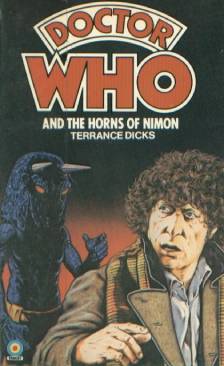
Cover: Steve Kyte’s first of three covers for the range, with the Doctor looking over his shoulder at a blue Nimon.
Final Analysis: Terrance Dicks often said that his favourite novels were the ones where the scripts were already good, so he had little to do, or the ones that were bad, where he got to fix them. Few fans would say Horns of Nimon is their favourite story, but the opening prologue suggests Terrance approached this with determination and a willingness to polish as he progressed. We might lose some of Tom Baker’s onscreen excesses here, but Terrance also takes things much more seriously than anyone in the TV version seems to have done: The opening prologue is as portentous as any other scene-setting chapter we’ve had, as a civilisation rises and falls; the comic trouser-splitting co-pilot is given a zealous determination that makes his ultimate demise a relief; Teka tells Romana that her fellow sacrifices are ‘too frightened even to talk’, which explains why only two of them are given any dialogue (genius!); Soldeed’s rise to power is shown to be a fluke and he clings to power knowing he’s ill-equipped to rule – something that Sorak seems to recognise and hopes to exploit; and of course, it’s the dreaded Nimon who Terrance really beefs up with customary relish – just have a look at this:
It was a fearsome, extraordinary creature, not unlike the great buffalo of Earth. Presumably on the Nimon’s planet some similar creature had developed intelligence and become the dominant life form. The Nimon was like a great black bull that had learned to talk and walk upon its hind legs like a man. The massive head merged directly into the enormous torso, with no suggestion of a neck. Great golden eyes blazed with a fierce intelligence and two amber-coloured horns jutted from the broad flat forehead. The creature wore only a wide jewelled belt and a kind of metallic kilt.
The most terrifying thing about the Nimon was that it was never still. It was as if so much energy was packed into the enormous body that it throbbed with continual power, pacing restlessly to and fro like a great caged beast. Even when it was not speaking it gave off a constant series of low, rumbling growls.
That is how to polish a cow-pat, even making the bizarre choreography something to fear. Right in the middle of his infamous ‘script-to-page’ period, Terrance gives us a surprising little gem.
Synopsis: Two spacecraft collide and are fused together. An investigator suspects that one of the pilots was under the effect of a terrifying drug called Vraxoin. But how did it get aboard? The Doctor and Romana get involved and their attention is drawn to a device that stores snapshots of alien worlds. But these aren’t just photographs, that’s a real jungle from the planet Eden. That’s a real Mandrel from the jungle. Now that’s a real Mandrel leaving the jungle and marauding around the ship, killing real passengers. And more of them. And more…
Chapter Titles
1. Warp Smash
2. The Collector
3. The Attack
4. Monster in the Fog
5. Drugged
6. The Fugitive
7. The Rescuer
8. Man-eater
9. Monster Attack
10. The Plotters
11. The Secret of the Hecate
12. The Smugglers
13. Round-up
14. Electronic Zoo
Background: Terrance Dicks adapts Bob Baker’s scripts for the 1979 story.
Notes: The Doctor and Rigg discuss the history of Vraxoin, which the Doctor says keeps cropping up on various planets but its source has never been found as it was smuggled in from somewhere else. Scientists tried to create it artificially while trying to find a cure for vraxoin addiction, and the drug is ‘a mixture of animal and vegetable elements combined in some unique way’. Secker’s body is too frail after the attack as his system has been weakened by the drug. As ever, the version of the Mandrels from TV is enhanced in Dicks’ description:
The boar-like head had a curiously flattened nose-structure; the huge bulging eyes were a luminous green; and the creature was covered with thick, shaggy fur. Most terrifying of all were the rows of drooling fangs and the massive paws ending in razor-sharp claws.
The Doctor urges Stott to quarantine Eden to enable the Mandrels to live in peace, their secret safe.
Cover: Andrew Skilleter paints the Doctor and a rather drab Mandrel (aside from its glowing green eyes).
Final Analysis: Another no-frills adaptation, a couple of small scenes are missing – the search among the passenger lounge when the Doctor and Romana have leapt through into Eden – and a few scenes are reordered, but otherwise it’s another basic tome.
Synopsis: Two planets locked in war, Atrios and Zeos. A princess tries to help her people while her zealous Marshal fights to win the war. Unseen, a shadowy figure is manipulating events as he awaits the final pawns in his game. The Doctor, Romana and K9 arrive on Atrios in search of the final segment of the Key to Time, and help comes from an unexpected source as the Doctor is reunited with an old friend. Soon, the Key to Time will be assembled – and the hidden enemy will be revealed.
Chapter Titles
1. The Vanishing Planet
2. Missile Strike
3. Kidnapped
4. A Trap for K9
5. The Furnace
6. Behind the Mirror
7. The Shadow
8. Lost on Zeos
9. The Armageddon Factor
10. The Planet of Evil
11. Drax
12. The Bargain
13. Small World
14. The Key to Time
Background: Terrance Dicks adapts the 1978 scripts by Bob Baker and Dave Martin. This is now four stories to be released consecutively in the order they were broadcast on TV.
Notes: The first TARDIS scenes are condensed and moved to the beginning of the first chapter, with an additional explanation of the on-going mission to find the Key to Time. The Marshall’s description is a love-letter to actor John Woodvine:
Tall and broad shouldered, straight-backed with iron-grey hair, he wore a magnificent scarlet tunic with gold epaulettes, the eagle of Atrios emblazoned in silver on the breast. His stern face was rugged and handsome, his voice deep and commanding.
Merak is apparently the son of one of Atrios’ oldest families and has secretly been in love with Astra since they were both children. They are both members of an underground peace party. Drax is from the ‘Class of Ninety-Three’ (not Ninety-Two) and has heard that the Doctor ‘got done by the High Court’ for stealing a TARDIS and ‘served a stretch’ on Earth – Drax himself bought a TARDIS second hand and he agrees to stop calling the Doctor ‘Thete’ (short for Theta Sigma, which we’re told was a ‘Time Lord coding’), though he’s sensitive that, unlike the Doctor, he didn’t get his degree. Once exposed, the Black Guardian contorts into a demonic creature and it’s both his callousness about Princess Astra and his inability to set things right with the Key already assembled that alerts the Doctor to his true identity.
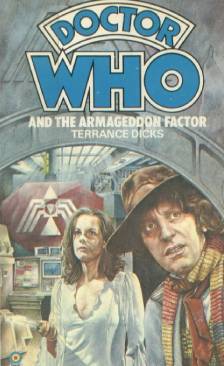
Cover: Bill Donohoe paints the Doctor (using a surprising photo reference from The Seeds of Doom) and Romana with the Key to Time locator core in her hand, with the red bird motif from the War Room on Atrios in the background. Apparently producer John Nathan-Turner didn’t like this cover – he was wrong though.
Final Analysis: Yet another fairly straightforward adaptation, with the only major omissions being those scenes with the Marshall preparing to fire on Zeos that are repeated on TV, which don’t need to be replayed here.
And so ends a long, long journey towards this point. There have been trials, tribulations and many disappointments on this quest, but finally we’re done… we’re out of the worst run of books in the series so far – perhaps ever. A combination of poor original stories and a very lacklustre approach to adapting them makes me so glad we’ve got a treat coming up next.
Synopsis: The Doctor has gone fishing, leaving Romana to hunt down the next segment of the Key to Time. She completes her hunt with surprising ease, but just as quickly she becomes a prisoner of the scheming Count Grendel. Meanwhile, the Doctor’s holiday is interrupted by guards who serve Prince Reynart, a sickly monarch-in-waiting, whose reign is about to be cut short by Grendel. The Prince has an android duplicate of himself, which he hopes to use as a decoy long enough to ascend the throne. The android, however, doesn’t work. Separately, the Doctor and Romana work from opposite sides to fix the state of Tara.
Chapter Titles
1. The Doctor Goes Fishing
2. Count Grendel
3. The Double
4. The Princess
5. The Prisoner of Gracht
6. The Android King
7. Invitation to an Ambush
8. The Android Killer
9. Flag of Truce
10. Count Grendel plans a Wedding
11. Attack by Night
12. Victory
Background: Terrance Dicks adapts scripts by David Fisher for his second story from 1978. This followed The Stones of Blood on TV, so that’s another pair of stories to be released consecutively.
Notes: The statue that transforms into the Key to Time segment depicts ‘a vaguely dragon-like heraldic beast, thrusting time-blunted claws towards the blue summer sky’. The very-much-alive creature that attacks Romana is a very generous evolution of the short, comedic beast seen on telly:
The monster was a good eight feet tall – and it walked upright like a man. It had coarse black fur, slavering jaws filled with yellow, pointed teeth and a stubby horn projecting from the centre of its forehead. A mixture of bear, ape and boar, with the nastiest features of all three.
Count Grendel is said to possess a ‘darkly handsome face’ which is ‘marred only slightly by a fiercely jutting beak of a nose’ – an unflattering description of actor Peter Jeffrey. At the end, the Doctor rescues the adrift K9 – and Romana jokes that he ‘managed to catch a fish on Tara after all’ – before the time travellers depart in the TARDIS.
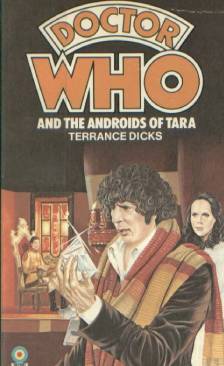
Cover: A scene painted by Andrew Skilleter shows the Doctor inspecting a segment of the Key to Time, watched by Romana (in her Ribos costume), appearing on a cover for the first time. In the background, K9 makes his first appearance on a book cover too, looking up at the Prince on his throne. The back cover announces ‘THE ANDROIDS OF TARA is a novel in the Key To Time Sequence. Read THE RIBOS OPERATION and THE STONES OF BLOOD available now.’ (said books didn’t carry this linking text).
Final Analysis: Around the time that this book was published, Shredded Wheat had an advertisement campaign that boasted that the product had ‘nothing added, nothing taken away’. Aside from the exaggerated details of the beast in the woods, this is all we get here. I still think it’s not fair to dismiss Dicks’ writing simply as just adding ‘he said / she said’ to the script, as he paints a vivid picture of the castles and woodlands of Tara, but this is a great example of Dicks at his most perfunctory. Everything that we might like about this came from David Fisher.
Synopsis: A stone circle in southern England, known locally as ‘The Nine Travellers’. Which is strange, as clearly there are more than nine stones. This is just one of many legends from the region. Another speaks of a woman who lives for centuries, who might have been a Celt goddess called ‘The Cailleach’. And then there’s the tale of two time travellers who expose a galactic criminal and discover a spaceship hidden in another dimension…
Chapter Titles
1. The Awakening of the Ogri
2. The Circle of Power
3. De Vries
4. The Sacrifice
5. The Ogri Attack
6. The Cailleach
7. The Vanished
8. The Prison Ship
9. The Victims
10. The Trial
11. Surprise Witness
12. Verdict
Background: Terrance Dicks adapts scripts by David Fisher for a story from 1978.
Notes: As The Pirate Planet wasn’t scheduled to be novelised at this point (or indeed, at any point in the foreseeable future), the first chapter explains that the second segment of the Key to Time was found on the planet Calufrax, which is almost right. As on TV, Romana learns that she wasn’t assigned to the Doctor by the President of Gallifrey but by the White Guardian, which amends the alternative continuity established by Ian Marter in The Ribos Operation. The Key to Time pieces are kept in the TARDIS control room inside a ‘wall-locker’ that opens to the Doctor’s palm-print. Professor Amelia Rumford mistakes the Doctor for Doctor Cornish Fougous (rather than an academic who specialised in Cornish fogous). Martha had been a school teacher before she met De Vries and she joined the druid cult to liven up an otherwise dull life. The doomed campers are newly-weds. The Megara are floating silver spheres about the size of a football. The Doctor namedrops Tacitus and Julius Caesar, who he was particularly pally with even though he refused to accept advice and the Doctor had to dress up as a soothsayer to warn him about the ‘ides of March’.
Cover: A composition by Andrew Skilleter featuring the Doctor, the Cailleach and some cult members among the flame-lit stones.
Final Analysis: Possibly Dicks’ most straightforward adaptation of a TV story so far, though he does offer up an delightful description of Professor Rumford:
The woman was quite old, though her back was straight, her eyes clear and alert. Her straggly hair was a snowy white, her face a mass of lines and wrinkles. It was the face of a woman of formidable character.
He’s clearly more interested in her than Vivien Fay, who is ‘a tall, strikingly attractive dark-haired woman in her forties’ but doesn’t really receive much more attention. This is particularly odd when we consider that the last time she’s described at all in the book, she’s dressed as a bird-faced Celtic goddess and on TV she arrives on the space-ship in a silver gown with metallic skin to match.
Synopsis: The Doctor has returned home to claim the Presidency of the Time Lords. As the Gallifreyan elite is driven to panic by this shocking development, this is just the first in a chain of horrific events as the new President banishes senior figures to the barren wastelands of Gallifrey – including his friend Leela. And then the Vardans arrive. This is all part of a trap created by the Doctor to defeat the invaders, but the trap backfires when the Vardans are vanquished and in their place arrive the Sontarans!
Chapter Titles
1. Treaty for Treason
2. The President-Elect
3. Attack from the Matrix
4. The Fugitive
5. The Betrayal
6. The Invasion
7. The Outcasts
8. The Assassin
9. The Vardans
10. False Victory
11. The Sontarans
12. The Key of Rassilon
13. Failsafe
14. The Chase
15. The Wisdom of Rassilon
Background: Terrance Dicks adapts the 1978 scripts attributed to David Agnew (Anthony Read and Graham Williams). This followed Underworld on TV, so that’s another pair of stories to be released consecutively.
Notes: Leela has brown eyes again [see The Horror of Fang Rock]. There are many references back to The Deadly Assassin that provide clarification or other information that wasn’t revealed in the onscreen Invasion of Time. There’s a summary of the events that led to the Doctor assuming the position of President by default, including the Doctor’s previous encounter with the Matrix, as well as an explanation that as there was no other candidate available, and the Doctor was absent, Borusa took on the role of acting President as well as Chancellor, making him extremely powerful. Castellan Spandrel has retired and his very recent replacement, Kelner, quickly established a Bodyguard Squad to protect himself; Kelner took possession of a suite of offices that are… :
… of transparent plastic and gleaming metal, with complex control consoles and brightly flickering vision screens everywhere. It was over-technological even by Time Lord standards, but Kelner, the new Castellan felt it helped to maintain his image.
Kelner is ‘thin-faced, nervous, rather insecure Time Lord’ who gained his position thanks to ‘good birth and political intrigue’. He has a bodyguard who is ‘very big, very brave, and very stupid’. Terrance Dicks maintains the impression given in The Deadly Assassin of the ceremonial chamber at the centre of the Panopticon and the scale of the Time Lord ensemble, which could never be achieved on TV:
The grand hall of the Panopticon is an immense circular chamber used by the Time Lords for all their major ceremonies. It is one of the largest and most impressive chambers in the known universe. The immense marble floor is big enough to hold an army, the domed glass roof seems as high above as the sky itself. Row upon row of viewing galleries run around the walls, and on the far side of the hall an impressive staircase leads down to a raised circular dais. By now the hall was filled with rank upon rank of Time Lords, all wearing the different-coloured robes and insignia of the different Chapters, the complex social family and political organisations that dominated Time Lord Society.
The Great Key of Rassilon is just a lost artefact on TV, but Dicks ties it to the one named in The Deadly Assassin; the one the Master stole was a replica and the real one is kept in the possession of the Chancellor; also unlike on TV, the Doctor deduces which one of Borusa’s keys is the correct one without Borusa first offering a decoy. The buildings on the edge of the Capitol have ‘sheer white walls’ and the gleaming towers can be seen many miles away.
Rodan is described as a ‘Time Lady’. The Outsiders live in log huts. Nesbin was expelled from the Capitol for an unprecedented violent attack upon another Time Lord. Ablif is a ‘burly young man’ and is the Outsiders who first captures Leela and Rodan – and gains a scratch across his face for his troubles. Jasko is also a ‘burly young Outsider’ who isn’t ‘especially bright’ but is ‘brave and strong’ and obedient. While these two Outsiders appeared on TV, a third member of the assault party is called ‘Jablif’ and it’s he who is fatally wounded but manages to kill a Sontaran before he dies.
Dicks’ description of Stor echoes that from Robert Holmes’ prologue for The Time Warrior:
The head was huge and round and it seemed to emerge directly from the massive shoulders. The hairless skull was greeny-brown and small red eyes were set deep in cavernous sockets. The nose was a snubby snout, the wide mouth a lipless slit.
Stor calls our hero ‘Dok-tor’ as if it’s his name, which is lovely.
Cover: Andrew Skilleter paints a much-minicked design of the Doctor and Stor smothered by metal cogs.
Final Analysis: Terrance Dicks guides us through what was actually quite a complicated script and helps it make sense along the way. Even Leela’s sudden departure is given a little assistance (in Leela’s tribe, it turns out, the women choose the men and Andred’s fighting skills and bravery clearly impressed her). He also succeeds in making the Vardans seem impressive:
The space ship was enormous, terrifying, a long, sleek killer-whale of space. Its hull-lines were sharp and predatory and it bristled with the weapon-ports of a variety of death dealing devices. Everything about it suggested devastating, murderous power.
… so that when their human forms are revealed, it’s more dramatic and less underwhelming as they’d already been fairly disappointing before the reveal. We’re still in this dry period where the books largely transcribe what happened on TV, but here, this at least prevents everything from feeling as cheap and improvised as it does on home video.
Synopsis: A group of space travellers seek the lost gene banks of the Minyans, a race of beings with tragic connections to the Time Lords. When their space craft becomes surrounded by a planet, the Minyan travellers discover a subjugated race – the Trogs – who live in underground tunnels as the slaves of the Seers and the god-like Oracle. Could these slaves be the descendants of the lost Minyans? The answers rest with the Oracle – and the quest is the quest…
Chapter Titles
Prologue
1. The Nebula
2. The Minyans
3. The Intruders
4. The Quest
5. Buried Alive
6. The Trogs
7. Skyfall on Nine
8. The Smoke
9. The Mouth of the Dragon
10. The Sword of Sacrifice
11. The Crusher
12. The Battle
13. Doomsday
14. The Legend
Background: Terrance Dicks adapts the 1978 scripts by by Bob Baker and Dave Martin.
Notes: We begin with a prologue (how I love a prologue!) that details the events that led to the loss of Minyos and the isolation policy of the Time Lords. Back in The Invisible Enemy, the Doctor complained that the TARDIS control room is such a boring colour – ‘No aquamarines, no blues. No imagination!’ – and here, he’s trying to paint the control room aquamarine and getting paint everywhere (but in the final scene, he’s painting it white again). On learning of the sword ritual, the Doctor reminds Leela that her own tribe had a similar trial by ordeal. Leela suggests that they return to the TARDIS and leave the Minyans to their fate but the Doctor wants to solve the mystery of the P7E.
Cover: Bill Donohoe combines two photo reference from this story to create something rather like a pulp sex book you’d find in the saucy rack in a 1970s newsagent – the Doctor looks pensive while Herrick carries a near-death Tala – as if we’ve just walked in on a scene we don’t really want to be a part of.
Final Analysis: This would always be a tricky one, a real clunker from Bob Baker and Dave Martin (the kings of overambition) and it’s one that’s always been unpopular for good reason. Devoid of the visibly low budget of the TV version, we’re left with a story with no recognisable human interaction, just mythology that gets a bit repetitive. It’s a relief that Terrance Dicks finds a way to highlight that humanity: The father who grieves for his lost wife and daughter after they’re killed in a landfall is a rare highlight. Something I’ve noticed though is that the Fourth Doctor in this period is brash and often his overconfidence borders on bullying, which makes him hard to like. The real highlight is that Dicks makes great use of K9 for his comedy potential, the wilfully over-literal explanations are hilarious.
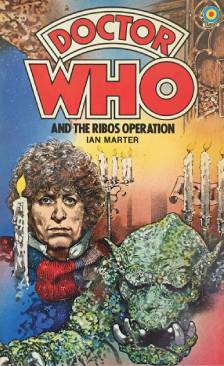
Synopsis: The White Guardian compels the Doctor (on pain of nothing… ever) to undertake a mission to find the six segments of the Key to Time. As part of the mission, the Doctor is given a new companion in the form of Romana. On the planet Ribos, a pair of grifters called Garron and Unstoffe are setting up an elaborate con, assuming the locals are too primitive to see through their scheme. Unfortunately, they have underestimated a visiting despot by the name of the Graff Vynda Ka .
Chapter Titles
1. Unwelcome Strangers
2. The Beast in the Citadel
3. A Shaky Start
4. Double Dealings
5. Arrest and Capture
6. Unlikely Allies
7. Escape Into the Unknown
8. The Doctor Changes Sides
9 .Lost and Found
10. Conjuring Tricks
Background: Ian Marter adapts the 1978 scripts by Robert Holmes.
Notes: The opening scene has the Doctor and K9 being rather snarky with each other. The Doctor suggests ‘Occhinos’ as a holiday destination.The TARDIS doors are opened from the inside by a brass handle. The Guardian sits within an exotic garden that features huge orchids and fountains. The garden disappears along with the Guardian, leaving the Doctor teetering on the edge of space and he has to propel himself backwards into the TARDIS. The Guardian makes no mention of a new companion for the Doctor; it’s left to Romana to introduce herself. Her tracer device is presented as the ‘Locatormutor Core’ and she knows of the existence of the Guardian (on TV, she’s left under the belief that she was selected for the mission by the President of the Time Lords). She graduated from the Academy with a ‘Triple Alpha’ and claims the Doctor achieved a ‘Double Gamma… on [his] third attempt’. The initial destination is Cyrrhenis Minimis (not ‘Minima’).
We learn that, while he was away fighting campaigns alongside his Cyrrhenic allies, the Graff Vynda Ka (‘not ‘K’) was deposed by his half-brother on the Levithian throne; his alliance forgotten, he received no help from his former allies and he now lives in exile (we lose the rest of his back story from the TV episodes). Thanks to its elliptical orbit, Ribos’s summer (the ‘Sun Time’) lasts 11 years. The Doctor refers to Garron and Unstoffe as ‘Laurel and Hardy’ before apologising to Romana for the reference. When the Doctor is searched, Sholakh finds ‘an ear trumpet. a corkscrew, string, marbles, a magnifying glass, a paper bag with a few jelly babies melted into a lump…’ – some of which have been referenced by Marter in his previous books. There are many Shrivenzales living in the catacombs under the city. The Seeker is…:
… a scrawny hag dressed in long strips of crudely dyed remnants. Her frizzled grey hair was parted on the crown of her domed head, and it reached almost to her feet in a thickly tangled cascade.
She survives the knives of the Graff Vynda Ka and crawls off towards the Hall of the Dead, only to be caught in the blast of the Shrieve’s cannon. Despondent after the cave-in, Garron wonders if it would be possible to commit suicide with the Locatormutor Core.
Chapter 7 brings Ian Marter’s take on a popular title, ‘Escape into the Unknown’, almost the same one Terrance Dicks used in Death to the Daleks.
Cover: John Geary created an atmospheric shot of the Doctor, a shrivensale and some moody candles.
Final Analysis: It wasn’t one of Robert Holmes’ greatest scripts and sadly it’s not one of Ian Marter’s best books either. There’s little room for Marter’s violent imagery here and it’s all a bit flat. Without the performances to help sell the characters, Garron and Unstoffe lack any depth beyond their grift, while the Doctor is a horrific bully to Romana (something that was thankfully phased out on screen within a couple of stories, but which comes across as much more savage here). Marter is able to make the lumbering TV shrivenzale into a fearsome beast with claws that make sparks against the catacomb walls and he takes on the death of Sholakh and makes it a little bloodier, but… no, this is largely as dull as I’d expected.
I’ve got to be honest, this is the beginning of a run of books I’ve been dreading.






 Escape to Danger