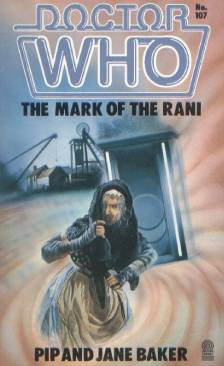
Chapter 106. Doctor Who – Mark of the Rani (1986)

Synopsis: The Doctor and Peri meet the revolutionary engineer George Stephenson, still some years before he achieved fame. Stephenson has organised a meeting of some of the greatest minds of the age, but the event is threatened by a series of attacks from Luddites intent on wrecking any chance of progress. In reality, the attackers are victims of the Rani, an amoral Time Lord. Wanting to be left alone to her experiments, the Rani is instead coerced into joining forces with the Master against the Doctor…

Chapter Titles

  • Prologue
  • 1. House Of Evil
  • 2. The Scarecrow
  • 3. The Old Crone
  • 4. Death Fall
  • 5. Enter The Rani
  • 6. Miasimia Goria
  • 7. A Deadly Signature
  • 8. Face To Face
  • 9. Triumph Of The Master
  • 10. A Change Of Loyalty
  • 11. Fools Rush In
  • 12. An Unpleasant Surprise
  • 13. Taken For A Ride
  • 14. The Bait
  • 15. Metamorphosis
  • 16. Life In The Balance
  • 17. More Macabre Memorials
  • 18. Cave-In
  • 19. Birth Of A Carnivore
  • 20. The Final Question
  • Epilogue

Background: Pip and Jane Baker adapt their own scripts from 1985. Jane Baker becomes only the second woman to have her name on the front of a Target novel. Due to Vengeance on Varos being delayed, the book numbering skips from 105 to 107; it’ll be a couple of years before 106 makes an appearance.

Notes: A prologue full of foreboding and an added TARDIS scene where the Doctor is said to possess an ‘unruly mop of fair curls’ and considers visiting Napoleon while Peri tries to avoid a debate with her travelling companion about English grammar. It’s honestly much funnier than that might sound. It’s Peri who speculates the Daleks might be behind the TARDIS veering off course, despite not having met them at this point (it’s the Doctor on TV). Peri has apparently proven in the past that she’s an expert ‘marksman’. In the Epilogue, we learn that the Doctor finally manages to take Peri to Kew Gardens, but the botany student is distracted, after her experience in Redfern Dell, every flower she looks at appears to have a human face…

Cover: Andrew Skilleter gives us the Rani disguised as an unidentifiable old crone, accompanied by the Rani’s TARDIS flying through the vortex and in the distance a coal mine. Apparently the unused cover, which used a likeness of Kate O’Mara, was also the one Skilleter was paid the most for. This is the last book to feature his original artwork, although his covers for the VHS releases were also on a selection of Target reprints.

Final Analysis: What a way to start a book: ‘Evil cannot be tasted, seen, or touched.’ Glorious hyperbole from the traditionally understated (!) Pip and Jane as they make the bold claim that the small mining community is so saturated in evil that ‘[if] allowed to flourish, the poisonous epidemic could reduce humankind to a harrowing role that would give a dung beetle superior status.’ Right from the off, P&J’s depiction of the Sixth Doctor is the most likeable and charming we’ve seen so far; his relationship with Peri is teasing but affectionate – he wants to make sure they reach Kew Gardens because it’s somewhere Peri really wants to visit. Knowing the writers’ propensity for sesquipedalian language, we might expect an exuberance for prose of a purple hue. Joking aside, this is refreshingly elegant, neither as florid as some of its recent predecessors nor as basic as a traditional Terrance Dicks. We also know that the Bakers, like Malcolm Hulke, were left-wing and they take great pains to disillusion the reader from imagining this historical trip as a jolly fantasy. Facing the prospect of being abandoned by the Doctor, Peri takes a morose turn:

Sooty eight year old urchins, scavenging for coal, tottered past with heavy baskets. Why weren’t they at school, she wondered, then remembered George Stephenson saying he was working down the mine at the age of nine. How romantic the prospect of this visit had been only a short while ago! Now she thought of the mean streets, cramped dwellings and the lack of hygiene. Hygiene? What if she were ill? Medical science didn’t exist. Depression making her morbid, she gazed at her leg. Suppose she had an accident and it had to be amputated? Anaesthetics hadn’t even been dreamt of! She’d just have to – what was the phrase? – bite on the bullet…

Chapter 101. Doctor Who – The Gunfighters (1986)

Synopsis: In the old town of Tombstone, the Doc’s name’s in doubt / He wanted a dentist but his luck ran out / Now the Clantons are coming – they’ll all be here soon / There’ll be blood on the piano at the Last Chance Saloon…

Chapter Titles

  • Prologue
  • 1. Landfall in Tombstone
  • 2. The Last Chance
  • 3. The Brief Career of Dead-shot Steve
  • 4. A Funeral is Arranged
  • 5. Notice to Quit
  • 6. Identity Parade
  • 7. Open Mouth Surgery
  • 8. An Offer Refused
  • 9. A Pardonable Error
  • 10. A Little Night Music
  • 11. And Some Durn Tootin’
  • 12. Arrest Is As Good As A Change
  • 13. The Red Hand of Tradition
  • 14. The Law and Doc Holliday
  • 15. A Very Nasty Little Incident
  • 16. Wyatt Plays It By The Book
  • 17. Pa Clanton Keeps a Welcome
  • 18. Ringo in the Morning
  • 19. Post Mortem
  • 20. Thought For Feud
  • 21. Dodo Draws a Bead
  • 22. The Entry of the Gladiators
  • 23. Come Sun-Up…
  • Epilogue

Background: Donald Cotton loosely adapts his own scripts from 1966. The book is dedicated: ‘For TAMSIN, with coloured moon clouds’. As discovered by Lucas Testro, Tamsin Hickling was a young actress who Cotton befriended in the 1980s; her middle name was a Chinese word that meant ‘moon clouds’.

Notes: You know I love a prologue! We open with a journalist called Ned Buntline, who made his name writing biographies of notable Wild West legends (the real-life Buntline was a celebrated author who died five years after the events at the OK Corral – and a year before Doc Holliday!). Having previously spoken to Wyatt Earp, who refused to be drawn on certain inconsistencies in the myths surrounding the OK Corral, Buntine now comes to a sanatorium at Glenwood Springs, Colorado, to meet an elderly Doc Holliday, who is in his last days with tuberculosis. Holliday speaks freely about the TARDIS, ‘a kind of four-wheel buggy designed for ridin’ every sort of direction through eternity, without much decent respect for the laws of physics’.

Aboard the TARDIS, Steven reminds the Doctor of the time when they encountered ‘great, nebulous jelly-fish things… with poisonous what-nots’. Dodo claims she took a first-aid course, but didn’t do very well. When the TARDIS lands in Tombstone, it’s raining heavily. Behind the bar of the Last Chance Saloon is a, er, well as Buntine tells it, it’s…

…a shot-up oil-painting of a fat blonde in her birthday rig. Sitting on a cloud, she was being molested by a bunch of tear-away cherubs, who looked as if they’d been up several nights round a stud-game, and passing the nectar pretty free, at that.

… and then he gives us two verses of that song (only one of which was heard on TV). 

Dodo is wearing ‘a little number made up of scarlet furbelows and flounces trimmed with black lace’ with an oversized hat (or as Buntine claims, like ‘the proprietress of a broken-down cat-house in one of the less select quarters of New Orleans’). Steven has, according to the Doctor, ‘disguise[d] himself as Billy the Kid’. He took his advanced astronaut course at Cape Canaveral, where he learned to play ‘America the Brave’ on the piano. Dodo sees a poster for real-life star of the stage Eddie Foy – who makes a brief cameo towards the end of the story (and whose son, Eddie Foy, was a Hollywood movie star who Dodo might conceivably have seen). Kate’s surname is ‘Elder’, not ‘Fisher’ as on TV (and in the 1957 movie); the real-life Kate was formally ‘Mary Katherine Horony-Cummings’, but she was also known by the deeply unflattering ‘Big Nose Kate’. 

Doc Holliday’s new dentist’s chair had previously seen service at ‘the Death House in San Quentin’. Pa Clanton is standing for mayoral election and hopes taking up said office will result in free drinks for life at the Last Chance Saloon. Johnny Ringo is a keen student of the Classics and is, at the time of the gunfight, partway through the ten-volume edition of Caesar’s Gallic Wars. The Doctor’s discomfort with a gun results in him accidentally shooting two bystanders, though eventually he is said to have begun to ‘enjoy himself’. The Doctor and his friends leave in the TARDIS, its dematerialisation witnessed by Doc Holliday, Wyatt Earp and a few others. In the epilogue, Holliday concludes telling his story to Buntine, necks a bottle of whisky … and dies.

Doc Holliday did indeed die in 1887, staying at Glenwood Hotel, Glenwood Springs, Colorado. He was 36 years old (Anthony Jacobs, who played him on TV, was 48 at the time of broadcast).

Cover: Andrew Skilleter paints the Doctor with a stetson while Wyatt Earp walks down the street of Tombstone with smoking guns. 

Final Analysis: There are people who’ll still tell you that The Gunfighters is a ‘bad story’ or that it was the lowest-rated story ever (it really wasn’t). There’s even a sly dig at the production in the text of this book, where a passage begins ‘Meanwhile, at the Last Chance Saloon, the stage was already set – as if by an incompetent director.’ Fan elders have shaped opinion to the point where many people who haven’t even seen it know what they think of it. And they’re wrong. Utterly. They’re very quick to remind us that Doctor Who can tell ‘any kind of story’, but seem to bristle when the genre isn’t one they personally like or – worst of all – if the story veers into the realm of comedy!

While the historical adventures did tend to be outperformed on original transmission by the often less ambitious efforts featuring silver sets on alien worlds, as we’ve seen with these novelisations, the writers tried much harder to engage the brain with their characters, perhaps mindful that they’d be representing figures who’s actually lived, or possibly just because they preferred history to SF. In the best Reithian tradition, Donald Cotton clearly realised that the best way to ‘educate and inform’ was to entertain. In this adaptation, he once again relies upon a narrator who casts doubt upon the factual accuracy of other versions of the legend; in other words, he’s excusing and exploiting any historical mistakes in both the TV serial and all other conflicting adaptations. We’re presented with a further myth rather than a text-book account of the real events, yet Cotton’s characters feel like they might have actually lived and breathed. More importantly though, Cotton’s retelling of the tale is very, very funny. My favourite joke in the whole thing is where he describes the drunk Ike Clanton as speaking ‘blotto voce’. There’s also a lovely description of the Doctor operating the TARDIS controls: 

… clutching at an apparently haphazard selection of levers with the air of a demented xylophonist, who finds he’s brought along the wine list instead of the score.

There are some instances of swearing – two uses of ‘bastard’, eight ‘goddam(ned)’ and sixteen uses of ‘damn’. As the notes above illustrate, there’s also a degree of bawdiness to this not seen before (mainly involving Kate’s profession). 

Finally, it’s become a popular game in modern stories (including The Shakespeare Code and The Unicorn and the Wasp) to crowbar in as many metatextual references as possible, but we can trace this back directly to Donald Cotton. While some of these might have reasonable claims to be accurate contemporary phrases, the modern reader can play ‘Spot the Film Title’ throughout the text. To start you off, here are just a few: For a Few Dollars More (1965); The Wild Bunch (1969); Calamity Jane and Sam Bass (1949); Terror of the Plains (1934); Death Valley (1946); The Golden West, (1932); … and The Right Stuff (1983). 

Further Listening

I was a guest on the Dr Who Literature Podcast to discuss this book, which you can hear in the link below, on YouTube, or via the podcast provider of your choice.

Chapter 97. Doctor Who – The Myth Makers (1985)

Synopsis: The beauty of a woman is the spark that fires up a bloody and lengthy war between Greece and Troy. Though many of the figures in the battle have entered into legend, a version of the story as recounted by the great poet Homer reveals the involvement of three travellers who emerged from a blue box and changed the course of the war. 

Chapter Titles

  • 1. Homer Remembers
  • 2. Zeus Ex Machina
  • 3. Hector Forgets
  • 4. Enter Odysseus
  • 5. Exit the Doctor
  • 6. A Rather High Tea
  • 7. Agamemnon Arbitrates
  • 8. An Execution is Arranged
  • 9. Temple Fugit
  • 10. The Doctor Draws a Graph
  • 11. Paris Draws the Line
  • 12. Small Prophet, Quick Return
  • 13. War Games Compulsory
  • 14. Single Combat
  • 15. Speech! Speech!
  • 16. The Trojans at Home
  • 17. Cassandra Claims a Kill
  • 18. The Ultimate Weapon
  • 19. A Council of War
  • 20. Paris Stands on Ceremony
  • 21. Dungeon Party
  • 22. Hull Low, Young Lovers
  • 23. A Victory Celebration
  • 24. Doctor in the Horse
  • 25. A Little Touch of Hubris
  • 26. Abandon Ship!
  • 27. Armageddon and After
  • Epilogue

This now nabs the record held so briefly by Marco Polo for the most number of chapters in a novelisaton, with 27 chapters and an epilogue.

Background: Donald Cotton adapts his own scripts for the 1965 serial. The book carries the dedication: ‘To Humphrey Searle, who wrote the music’ (Searle was indeed the composer of the original serial).

Notes: Yep, the story is narrated in the first person by the great author Homer, who apparently was just out of shot in every scene.

The Doctor had promised his young companions a trip to London in the 1960s. Homer claims that he has met the Doctor on many occasions (and that he is now younger than he was the first time they met), knows that the TARDIS is a time machine – and that the Doctor is specifically a ‘Time Lord’! Vicki has a very loose grasp of Earth history, much to Steven’s despair, but knows enough to recognise the importance of the Trojan Horse. Steven is concerned about his absence from the ‘Space-Research Project’, where he had been an amateur athlete during his training and it’s suggested he might have played football (he compares the prospect of fighting Odysseus with ‘the second eleven on a Saturday knock-about’, so that’s definitely football and not the completely different ‘American Football’). We discover how ‘Cyclops’ lost his eye and gained his name [but see Final Analysis below]. There’s no explanation for how Steven is wounded by the start of the next story. Instead, we learn that Vicki – as Cressida – remained with Troilus and the pair took care of their blind friend Homer. The epilogue reveals that the elderly poet has been telling his story to the Doctor, who, it turns out, has popped back to look in on Homer on many occasions throughout his eventful life.

Cover: The TARDIS materialises in front of the wooden horse, painted by Andrew Skilleter.

Final Analysis: Donald Cotton tore up the rule book for his TV stories and he revolutionises the Doctor Who novel here. Cotton’s habit of using witty episode titles continues with the novel’s chapter titles ‘Zeus Ex Machina’ ‘Temple Fugit’ and of course ‘Doctor in the Horse’, which was his original title of episode 4. He really strains with chapter 22’s ‘Hull Low, Young Lovers’; I wonder how many eager readers would know the song ‘Hello, Young Lovers’ from the 1951 musical (or 1956 film) The King and I, so might this be a reference pitched at a prospective parent reading this for a young fan a chapter a night at bedtime?

Casting Homer as the narrator gives us insight into the politics of the time, while also contriving increasingly outlandish reasons for him to be party to private conversations, ‘concealed in a clump of cactus I wasn’t too fond of’, accompanying the TARDIS into Troy and, after being jabbed in the eye and being dubbed ‘Cyclops’, he passed out and wakes up ‘covered in fish-scales and crabs’ legs’. Homer is aware that the Doctor is a time traveller too, making much merriment with details he shouldn’t know anything about:

… how do you describe a time-machine to a man who has never even heard of Euclid, never mind Einstein? Of course, up till then, I’d never heard of them myself, but I must say I found the whole concept fascinating. 

Cotton – through Homer – has a delightfully waspish style. We’re told that Cassandra is a fearsome woman who looks like ‘her brother Hector in drag’, while Achilles ‘had that look of Narcissistic petulance one so often sees on the faces of health fanatics, or on male models who pose for morally suspect sculptors’, adding ‘I believe the Greeks have a word for it nowadays’. It’s when he comes to explain the causes of the siege of Troy that we might feel certain attitudes from the mid-1980s are guiding his hand. His description of Paris appears to be a commentary on more modern Royal events that resonate just as much in 2021 as 1985:

… the second sons of Royal Houses – especially if they are handsome as the devil – have a lot of temptation to cope with. And then, the unlikelihood of their ever achieving the throne does seem to induce irresponsibility which – combined, of course, with an inflated income – how shall I put it? – well, it aggravates any amorous propensities they may have…. Well, we all know about princes and their libidinous ways: their little frolics below stairs – their engaging stagedoor haunting jaunting? 

Trigger warning here: Among many anachronistic terms Homer uses, the phrase ‘a coon’s age’, which dates from the early 19th-century and referred to racoons, but for many readers this may still have racial connotations.

As one of the missing TV historicals, it’s not a story I know that well, having only heard the soundtrack and watched a telesnap reconstruction. Cotton pulls out all the stops to bring the period alive and make it like a gossip between old friends, a tale told with tongue firmly in cheek and a knowing wink at the reader (this is especially evident in the audiobook with a delicious reading by Stephen Thorne). Even in providing us with what must be the first celebrity historical featuring an author (something modern fans might be more likely to expect), he’s smart enough to leave himself plenty of escape routes. Homer himself tells us the effect of adopting many guises to avoid being trapped into supporting one side or the other. Like the Doctor, his name lives on in legend:

I’ve always found it a very good rule to be a bit cautious about handing out the label unless unavoidable – which is why, I’m told, to this day, nobody is entirely convinced that Homer ever existed […]

Chapter 94. Doctor Who – Marco Polo (1985)

Synopsis: The Venetian explorer Marco Polo meets four travellers stranded with their strange blue caravan – a box that that he immediately realises will make a splendid gift for the great Kublai Khan. On their long journey, the strangers become friends as they share stories of many cultures, but their journey is fraught with danger, not only from a hostile environment but also from within the party as a traitor schemes against them.

Chapter Titles

  • 1. Roof of the World
  • 2. Emissary of Peace
  • 3. Down to Earth
  • 4. Singing Sands
  • 5. Desert of Death
  • 6. A Tale of Hashashins
  • 7. Five Hundred Eyes
  • 8. Wall of Lies
  • 9. Too Many Kan-Chow Cooks
  • 10. Bamboozled
  • 11. Rider from Shang-Tu
  • 12. Runaway
  • 13. Road to Karakorum
  • 14. Mighty Kublai Khan
  • 15. Gambler
  • 16. Best-Laid Schemes
  • 17. Key to the World

Background: John Lucarotti adapts his own scripts for the series broadcast in 1964, so stealing the record from himself and The Aztecs for the biggest gap between broadcast and novelisation at 20 years, eight months and a week.

Notes: A new opening scene sees Susan give a temperature in centigrade and Ian calculates the fahrenheit equivalent. Ian opens the TARDIS door, then shuts it quickly (suggesting that the doors are the same as those on the exterior of the ship) and jokes that they can’t be in the Alps because there’s no yodelling. The Doctor also gives a clearer reason for staying outside of the ship (it will act like a ‘cold storage room’ and kill them). He introduces his granddaughter as ‘Susan Foreman’ (!) and both she and Ping-Cho are 15 years old (not 16 like on TV). Once again, the Doctor uses a pen torch [see The Aztecs]. Susan mentions the TARDIS ‘water producer’. Surprisingly, the device of Marco’s journal is not used; instead, some of the events he describes are expanded upon. 

Ping-Cho learns of the death of her husband-to-be as soon as she arrives at the Imperial Palace. The Empress notices exchanged glances between Ping-Cho and the Captain, Ling-Tau; she urges Kublai Khan to promote the captain so he might be of sufficient rank to be a husband to Ping-Cho. Tegana doesn’t get to commit suicide; he’s shot dead by Ling-Tau with an arrow that kills him instantly. There’s no swift escape to the TARDIS at the end either. Kublai Khan invites the Doctor to stay as his personal secretary, but he declines and says a relaxed goodbye to him, Marco and Ping-Cho before leaving in the TARDIS. Kublai Khan dubs the key to the TARDIS the ‘Key to the World’ and has it placed on a gold chain (unaware that it’s the Doctor’s spare). The Key is said to lie in a museum that was once the imperial palace.

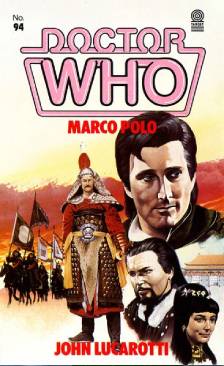
Cover: David McAllister returns with a painted composition of Marco Polo, Tegana, Pingo Cho and Kublai Khan, along with some other elements that apparently come from an entirely different production called Marco Polo from the 1980s. It’s nice to see accurate resemblences to actors Mark Eden, Zienia Merton and Derren Nesbitt here.

Final Analysis: John Lucarroti’s second novel and it’s as much of a jolly history lesson as the first, with additional highly detailed descriptions of various menus. Obviously, each of the locations is grander than the sets in Lime Grove could have allowed and also we get a real sense of the time passing, as each chapter adds days onto the journey, which lasts around 40 days in all. It might lack the fun and melodrama of monsters of robots, but it’s a rare story that truly allows us to step into a culture and enjoy various aspects of it.

Chapter 88. Doctor Who – The Aztecs (1984)

Synopsis: Emerging from a hidden doorway in a temple, Barbara is mistaken for the Aztec God Yetaxa and finds it difficult to refuse the role. As the Doctor tries to regain access to the temple and return to the TARDIS, Barbara learns the difficult lesson that she cannot change history. Not one line of it!

Chapter Titles

  • 1. Coiled Serpent
  • 2. Yetaxa the God
  • 3. Chosen Warriors
  • 4. Sacrifice to Tlaloc
  • 5. Perfect Victim
  • 6. Thorn of Doom
  • 7. No Holds Barred
  • 8. Cups of Cocoa
  • 9. Bride of Sacrifice
  • 10. Offence and Retribution
  • 11. Crawl, Swim, Climb
  • 12. Wall of Deception
  • 13. False God
  • 14. Day of Darkness
  • 15. Eclipse

Background: John Lucarotti adapts his own scripts for the series broadcast in 1964. Published a week after its 20th anniversary, The Aztecs now holds the crown for the biggest gap between first transmission and novelisation. It’s also the first pure historical story to be adapted since The Crusaders, some 19 years earlier.

Notes: We begin with a new scene inside the TARDIS with little explanation of who the characters are or what the TARDIS is. Susan is said to be still 15 years old, while Ian is 28 and a ‘scientist’ (not a science teacher’). When the Doctor asks for a screwdriver (a normal screwdriver!) to fix a panel on the TARDIS ‘control desk’, Ian jokes that they might land on Earth in the 1980s and get help form an aerospace factory; it’s a curiously specific reference for a man from 1963. Barbara specialised in Aztec history at university and her brief summary for Susan of Mexican civilisation is a lot more heavy-handed than it is on screen. She guesses that they’re at some point in history between 1430 and 1519, and the Doctor is able to confirm it’s 17 May, 1507. We might pause to ponder how the TARDIS can produce a date so accurate when it’s 75 years before the introduction of the Gregorian calendar, but this story’s already threatening us with a huge history lesson, so let’s just ignore the issue and move on. 

Cameca is ‘a grey-haired, pleasant-faced, plumpish woman in her mid fifties’. The architect of the temple, Topau, is renamed ‘Chapal’. On the night that he meets the Doctor in the garden, Ian wears ‘only a warrior’s loin-cloth and sandals’. Ixta is startled by the Doctor’s electronic torch when he sees Ian use it, wondering if it’s ‘magic’. It was Ixta’s ‘father’s father’ who originally built the secret tunnel that is used to irrigate the garden (it’s his father on TV – and see later). Ian has a much more arduous trek through the secret tunnel, including a climb up a vertical shaft using crumbling footholds. He finds the remains of a body – which he correctly assumes is that of Ixta’s father – in the tunnel and soon discovers that the man must have fallen to his death when a foothold in the shaft gave way beneath his foot; Ian also correctly deduces that he himself was at risk of drowning because of Ixta deliberately opening the sluice. The Doctor tells Barbara of his suspicion that Ian has drowned, shortly before Ian finds them both (on telly, Barbara already knows Ian is safe by the time the Doctor reaches her). 

It’s a lot clearer that the Doctor feels utterly wretched for exploiting Cameca’s affection purely to gain access to the temple. As Cameca offers to help restore Autloc’s faith in Barbara, the Doctor is moved by her devotion and muses ‘in another world, in another time’ – but it’s definitely not the romantic relationships some fans imagine. Barbara has a long discussion with Autloc about the ‘schizophrenic’ nature of the Aztecs and her words remind him of a legend he has heard of a man from a foreign land who spoke of a ‘gentleness and love’ who was crucified, as the Aztecs do with their criminals. The climactic fight scene between Ixta and Ian is replaced by something wittier but also just as brutal, as Ian reflects light into his opponent’s eyes, which makes Ixta topple backwards and fall to his death. The scene leading into The Sensorites is, unsurprisingly, cut.

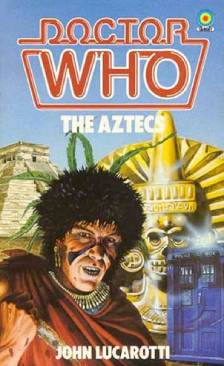
Cover: Featuring the last appearance of the coloured Target logo, Nick Spender’s first cover depicts a man with a dagger (Tlotoxl possibly?), a temple and a giant golden mask, as the TARDIS materialises. A 1992 reprint cover uses Andrew Skilleter’s VHS cover art, showing Tlotoxyl and the Doctor amid some Aztec pyramids.

Final Analysis: John Lucarotti provides a fairly loose adaptation of his own story, clearly written from the original scripts but with a relaxed approach to sticking rigidly to the text. He’s also done a lot of research and is happy to let us know it, but unlike some of the authors from the early 80s, there’s no showboating here; we’re just exposed to the history of an ancient and brutal culture – even the cuisine – of a time in Earth’s history that’s as alien to the modern reader as that of Peladon or Skaro. The descriptions of torture are particularly graphic; at one point, Tlotoxyl tells Barbara that Susan will have her eyes gouged out. I might lament that the original TV version didn’t give us the chance to hear how William Hartnell might have approached a name like ‘Huitzilipochtli’ but Lucarotti’s undiluted approach makes the story all the richer. I read this novel for the first time here and we’re now entering a period where I suspect there are more books I’ve not previously read than I have. 

Chapter 37. Doctor Who and the Talons of Weng Chiang (1977)

Synopsis: A London music hall in the late 19th Century is the setting for murder. Its proprietor, Mr Henry Gordon Jago, has just secured the services of a master magician of Chinese origin while a mortician called Litefoot examines a body fished from the Thames and covered in huge bite marks. The Doctor and Leela follow the clues that lead them into the lair of a Chinese God…

Chapter Titles

  • 1. Terror in the Fog
  • 2. The Horror in the River
  • 3. Death of a Prisoner
  • 4. The Monster in the Tunnel
  • 5. The Quest of Greel
  • 6. The Tong Attacks
  • 7. The Lair of Weng-Chiang
  • 8. The Sacrifice
  • 9. In the Jaws of the Rat
  • 10. A Plan to Kill the Doctor
  • 11. Death on Stage
  • 12. The Hunt for Greel
  • 13. The House of the Dragon
  • 14. The Prisoners of Greel
  • 15. The Firebomb

Background: Terrance Dicks adapts the 1977 scripts by Robert Holmes, just seven months after they were broadcast.

Notes: The ghoulish woman on the dockside who (on telly) discovers the body of the cabby, Alf Buller, becomes an old man who wants his reward – until he sees the state of the mutilated body. The young woman who Leela saves from becoming a victim of Magnus Greel is named Teresa Hart and Dicks explains that she’s up in the small hours of the morning because she’s employed as a waitress in a gambling club across London in Mayfair – just in case there’s any possibility of some other reason why a woman might be walking the streets alone at that time of night.

As he did with the cuddly Yeti in The Abominable Snowmen, Dicks also solves the basic failure of the giant rat on TV, too clean and plodding in its original form, but now ‘huge and savage’ with red eyes’, a ‘trumpeting scream’ and ‘yellow fangs bared in fury’. 

The Doctor taunts Greel by offering him a jelly baby (although North American editions change this for a jelly bean – utter sacrilege!). On TV, the Doctor recalls that Mr Sin – aka ‘the Peking Homunculus’ – was given to the Icelandic Commissioner’s children as a toy, but ‘something went wrong’ and the thing was ‘almost’ the cause of World War Six, but here there’s a little more more detail: the homunculus was really a programmed assassin, which ‘massacred the Commissioner and all his family’, which then ‘set off’ the World War. We later learn that Magnus Greel was the inventor of Mr Sin and that he triggered the war intentionally. As part of a ‘Supreme Alliance’ of dictators, he was defeated at the Battle of Reykjavik and, branded a war criminal, used the time cabinet to flee with Mr Sin to 19th-Century China.

There’s a slight addition to the last scene, as Jago invites Litefoot to a ‘little tavern’ for a ‘celebratory libation’. And it’s the beginning of a beautiful friendship.

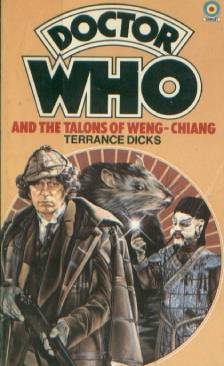
Cover: Jeff Cummins provides a wonderful composition of the Doctor in his Holmesian gear, holding a shotgun, while behind him are Mr Sin, a giant rat and a circular design evoking the sewer. This is his first cover for Target, even though The Mutants was published earlier – and apparently it was later stolen from his portfolio, never to return. The 1994 reprint boasted Alister Pearson’s final reprint cover (as this was also the final release of the original Target books run), featuring the Doctor, Greel, Mr Sin and the head of the ornate dragon-shaped ray gun.

Final Analysis: Recently, this story has come under attack for the unsettling undertones inherent in the very racist genre it takes its inspiration from. While much of the problems are still here – an assumption that all the Chinese population of Limehouse are opium addicts, Irish Casey having ‘a weakness for the bottle’ as well as the general racism of characters from the time – there’s one section that suggests Dicks was at least aware of certain ironies; as Jago appraises the great magician Chang, Dicks makes a dig at the casting in the TV serial:

Perhaps he really was from China as he claimed. After all he really was Chinese, unlike most Oriental magicians who were usually English enough once the makeup was off. 

But Dicks also spells out that Chang’s own stage persona, speaking in pidgin English, is an artifice he employs solely to appease his English audience’s expectations; in this version, it’s the audience who are very much at fault. 

The opening chapter feels like Malcolm Hulke has stepped in to provide some social context by focusing on the different strata within the audience of the Palace Theatre:

The body of the theatre and the Grand Circle above were filled with local people, tradesmen and their wives and families, bank clerks and shop assistants. High above in the top-most balcony, known as the ‘Gods,’ the poorer people were crowded onto hard wooden benches. Labourers, dock workers, soldiers and sailors, even some of the half starved unemployed – they’d all managed to scrape together a few coppers for the big night of the week.

It’s an atypical observation for Dicks, but there’s plenty of social commentary throughout the story. Professor Litefoot is from a ‘wealthy upper-class family’ and his ‘aristocratic relations’ have ceased trying to get him to relinquish his calling to do proper work in the East End, instead of pampering ‘silly women’ in Harley Street. Chang considers the workers of London as ‘peasants’ – but presumably this is a description that places himself on an equal level to them – all subjects to higher powers. It’s a difficult challenge, respecting the original author’s work while also taking opportunities to polish up the stories, so this one’s really down to your own background and exposure to ‘language and attitudes of the time’, I guess.

Chapter 10. Doctor Who and the Abominable Snowmen (1974)

Synopsis: Landing the TARDIS in Tibet near the Det-sen monastery, the Doctor decides to return a holy relic, which he took receipt of three hundred years before. He’s quickly accused of murder by a zealous explorer called Travers, who’s hunting the legendary Yeti. But the Yeti that are roaming these hills are the real killers – and they’re robots controlled by someone within the monastery. 

Chapter Titles

  • 1. The Secret of the Snows
  • 2. The Creature in the Cave
  • 3. Live Bait to Catch a Monster
  • 4. Jamie Traps a Yeti
  • 5. The Secret of the Inner Sanctum
  • 6. A Yeti Comes to Life!
  • 7. A Plan to Conquer Earth
  • 8. Revolt in the Monastery
  • 9. Attack of the Yeti
  • 10. Peril on the Mountain
  • 11. The Final Battle
  • 12. The Abominable Snowman

Background: Terrance Dicks adapts the first Second Doctor novelisation based on the scripts by Mervyn Haisman & Henry Lincoln.

Notes: Terrance Dicks gets his first go at the Second Doctor, who has ‘a gentle, rather comical face, and a shock of untidy black hair’, while Jamie is ‘a brawny youth in highland dress, complete with kilt’ and Victoria is ‘a small, dark girl dressed in the style of Earth’s Victorian age’. There’s also harkbacks to the origin stories for the companions. He tweaks the Yeti here to make them more like the ferocious ones seen in The Web of Fear, with glowing red eyes and a terrifying roar. He also adjusts a few of the character names, in deference to his Buddhist producer on the TV show, Barry Letts, to avoid using the names of real historical figures, and he expands the backstory of Travers: His nemesis is a Professor Walters; and Travers’ fated companion who’s killed early on (called simply ‘John’ onscreen) is here identified as his best / only friend, known as ‘Mackay’.

Cover & Illustrations: Chris Achilleos’s original cover showed a lovely Second Doctor head-shot (taken for The Three Doctors) with a small Jamie and Victoria cowering from a roaring Yeti and the Earth creating a lovely circular frame in the background. I had the 1983 edition with a shaggy Yeti in the moonlight up a mountain and both covers used the same photo reference. The illustrations are again by Allan Willow and the standout one is where Jamie and Thomni smash the glowing spheres in the control room; there’s a lovely depth to it with the Doctor and Victoria just visible through the doorway. And that’s the only (tiny) illustration of the Doctor in the entire book.

Final Analysis: This is much more fun than the TV series. It’s largely helped by Dicks choosing to make the Yeti more like they were in the sequel, so they roar and claw and attack, rather than amble about and wiggle a bit. Padmasambvha is a less terrifying creation than on TV, we never forget that he is still a human struggling against the possession of the Great Intelligence, described here as having been ‘exiled’ from ‘another dimension’ (so who kicked him out?!). His final end is rather heartbreaking.

Chapter 3. Doctor Who and the Crusaders (1965)

Synopsis: The Doctor and his chums meet King Richard the Lionheart, his willful sister, Joanna, and his nemesis, Saladin.

Chapter Titles

  • Prologue
  • 1. Death in the Forest
  • 2. The Knight of Jaffa
  • 3. A New Scheherazade
  • 4. The Wheel of Fortune
  • 5. The Doctor in Disgrace
  • 6. The Triumph of El Akir
  • 7. The Will of Allah
  • 8. Demons and Sorcerers

Background: David Whitaker adapts his own scripts from a serial broadcast in March to April 1965, published by Frederick Muller Ltd in September 1965, first reprinted as a Target book in 1973. t followed The Web Planet on screen, so very early on, we have our first set of consecutive stories to be novelised.

Notes: The prologue gives us a short summary of what’s happened since the first book – and it is incredible. Apparently Susan had left the Tardis to live with David Cameron (!) and her place taken by Vicki, who we met in the previous volume. Ian and especially Barbara are now perfect physical specimens thanks to their travels and Barbara is now apparently ‘the admiration and desire of all who met her’ [see The Keys of Marinus and The Romans], but he’s foreshadowing future events too. Though it’s never explicit on screen, Ian and Barbara’s ‘destinies were bound up in each other’. There’s mention of an unseen adventure involving ‘the talking stones of the tiny planet Tyron in the seventeenth galaxy’ while Barbara and Vicki are playing Martian chess.

… and then Whitaker has the Doctor explain why they can explore all these alien worlds and interfere but they can’t change anything in Earth’s history. The examples he chooses from history – from Pompeii to John F Kennedy – are frank and somewhat surprising. And then, with some additional foreshadowing that really sets out Whitaker’s aims, we have this from the Doctor:

‘The next time we visit Earth,’ he said, ‘I hope we encounter a situation where two men are opposed to each other, each for the best reasons… ‘That is the only way to understand the folly, the stupidity and the horror of war. When both sides, in their own way, are totally right.’

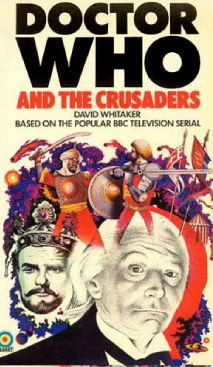
Cover & Illustrations: Henry Fox’s original cover shows a raging crusader and the Tardis with a yellow background, while the Armada hardback by Mary Gernat shows the Doctor fleeing a crusader on a blue background. Chris Achilleos’s Target cover features the Doctor with a strong likeness of Julian Glover as King Richard. The 1975 White Lion hardback again pops Tom Baker in along and the one I first owned was the 1982 Andrew Skilleter cover shows the Tardis (I think it’s from an early Peter Davison photo). Henry Fox’s 15 illustrations are gorgeously melodramatic, in particular the image of Barbara about to be whipped.

Final Analysis: My surprise at the impressive prologue suggests that this is the first time I’ve read this book! As with the previous two volumes, this expands upon the scale of what could be achieved in Riverside Studio 1. In fact it’s hard to visualise a small studio set at all when there is such a sense of distance between each location. Whitaker develops the romance between Ian and Barbara, which gives the pair extra motivation to be reunited, although he also adds to the horror of Barbara’s experience by having El Akir whip her repeatedly, leaving her badly scarred (the death of El Akir is also more violent, strangled before his skull is dashed against a wall, rather than the more theatrically clean stabbing on telly). It’s a mature work, living up to the promise of the prologue by trying to present both sides of the war evenly and with Ian trying to explain how all religions have a basic central idea of a higher being.