Chapter 97. Doctor Who – The Myth Makers (1985)

Synopsis: The beauty of a woman is the spark that fires up a bloody and lengthy war between Greece and Troy. Though many of the figures in the battle have entered into legend, a version of the story as recounted by the great poet Homer reveals the involvement of three travellers who emerged from a blue box and changed the course of the war. 

Chapter Titles

  • 1. Homer Remembers
  • 2. Zeus Ex Machina
  • 3. Hector Forgets
  • 4. Enter Odysseus
  • 5. Exit the Doctor
  • 6. A Rather High Tea
  • 7. Agamemnon Arbitrates
  • 8. An Execution is Arranged
  • 9. Temple Fugit
  • 10. The Doctor Draws a Graph
  • 11. Paris Draws the Line
  • 12. Small Prophet, Quick Return
  • 13. War Games Compulsory
  • 14. Single Combat
  • 15. Speech! Speech!
  • 16. The Trojans at Home
  • 17. Cassandra Claims a Kill
  • 18. The Ultimate Weapon
  • 19. A Council of War
  • 20. Paris Stands on Ceremony
  • 21. Dungeon Party
  • 22. Hull Low, Young Lovers
  • 23. A Victory Celebration
  • 24. Doctor in the Horse
  • 25. A Little Touch of Hubris
  • 26. Abandon Ship!
  • 27. Armageddon and After
  • Epilogue

This now nabs the record held so briefly by Marco Polo for the most number of chapters in a novelisaton, with 27 chapters and an epilogue.

Background: Donald Cotton adapts his own scripts for the 1965 serial. The book carries the dedication: ‘To Humphrey Searle, who wrote the music’ (Searle was indeed the composer of the original serial).

Notes: Yep, the story is narrated in the first person by the great author Homer, who apparently was just out of shot in every scene.

The Doctor had promised his young companions a trip to London in the 1960s. Homer claims that he has met the Doctor on many occasions (and that he is now younger than he was the first time they met), knows that the TARDIS is a time machine – and that the Doctor is specifically a ‘Time Lord’! Vicki has a very loose grasp of Earth history, much to Steven’s despair, but knows enough to recognise the importance of the Trojan Horse. Steven is concerned about his absence from the ‘Space-Research Project’, where he had been an amateur athlete during his training and it’s suggested he might have played football (he compares the prospect of fighting Odysseus with ‘the second eleven on a Saturday knock-about’, so that’s definitely football and not the completely different ‘American Football’). We discover how ‘Cyclops’ lost his eye and gained his name [but see Final Analysis below]. There’s no explanation for how Steven is wounded by the start of the next story. Instead, we learn that Vicki – as Cressida – remained with Troilus and the pair took care of their blind friend Homer. The epilogue reveals that the elderly poet has been telling his story to the Doctor, who, it turns out, has popped back to look in on Homer on many occasions throughout his eventful life.

Cover: The TARDIS materialises in front of the wooden horse, painted by Andrew Skilleter.

Final Analysis: Donald Cotton tore up the rule book for his TV stories and he revolutionises the Doctor Who novel here. Cotton’s habit of using witty episode titles continues with the novel’s chapter titles ‘Zeus Ex Machina’ ‘Temple Fugit’ and of course ‘Doctor in the Horse’, which was his original title of episode 4. He really strains with chapter 22’s ‘Hull Low, Young Lovers’; I wonder how many eager readers would know the song ‘Hello, Young Lovers’ from the 1951 musical (or 1956 film) The King and I, so might this be a reference pitched at a prospective parent reading this for a young fan a chapter a night at bedtime?

Casting Homer as the narrator gives us insight into the politics of the time, while also contriving increasingly outlandish reasons for him to be party to private conversations, ‘concealed in a clump of cactus I wasn’t too fond of’, accompanying the TARDIS into Troy and, after being jabbed in the eye and being dubbed ‘Cyclops’, he passed out and wakes up ‘covered in fish-scales and crabs’ legs’. Homer is aware that the Doctor is a time traveller too, making much merriment with details he shouldn’t know anything about:

… how do you describe a time-machine to a man who has never even heard of Euclid, never mind Einstein? Of course, up till then, I’d never heard of them myself, but I must say I found the whole concept fascinating. 

Cotton – through Homer – has a delightfully waspish style. We’re told that Cassandra is a fearsome woman who looks like ‘her brother Hector in drag’, while Achilles ‘had that look of Narcissistic petulance one so often sees on the faces of health fanatics, or on male models who pose for morally suspect sculptors’, adding ‘I believe the Greeks have a word for it nowadays’. It’s when he comes to explain the causes of the siege of Troy that we might feel certain attitudes from the mid-1980s are guiding his hand. His description of Paris appears to be a commentary on more modern Royal events that resonate just as much in 2021 as 1985:

… the second sons of Royal Houses – especially if they are handsome as the devil – have a lot of temptation to cope with. And then, the unlikelihood of their ever achieving the throne does seem to induce irresponsibility which – combined, of course, with an inflated income – how shall I put it? – well, it aggravates any amorous propensities they may have…. Well, we all know about princes and their libidinous ways: their little frolics below stairs – their engaging stagedoor haunting jaunting? 

Trigger warning here: Among many anachronistic terms Homer uses, the phrase ‘a coon’s age’, which dates from the early 19th-century and referred to racoons, but for many readers this may still have racial connotations.

As one of the missing TV historicals, it’s not a story I know that well, having only heard the soundtrack and watched a telesnap reconstruction. Cotton pulls out all the stops to bring the period alive and make it like a gossip between old friends, a tale told with tongue firmly in cheek and a knowing wink at the reader (this is especially evident in the audiobook with a delicious reading by Stephen Thorne). Even in providing us with what must be the first celebrity historical featuring an author (something modern fans might be more likely to expect), he’s smart enough to leave himself plenty of escape routes. Homer himself tells us the effect of adopting many guises to avoid being trapped into supporting one side or the other. Like the Doctor, his name lives on in legend:

I’ve always found it a very good rule to be a bit cautious about handing out the label unless unavoidable – which is why, I’m told, to this day, nobody is entirely convinced that Homer ever existed […]
Chapter 94. Doctor Who – Marco Polo (1985)

Synopsis: The Venetian explorer Marco Polo meets four travellers stranded with their strange blue caravan – a box that that he immediately realises will make a splendid gift for the great Kublai Khan. On their long journey, the strangers become friends as they share stories of many cultures, but their journey is fraught with danger, not only from a hostile environment but also from within the party as a traitor schemes against them.

Chapter Titles

  • 1. Roof of the World
  • 2. Emissary of Peace
  • 3. Down to Earth
  • 4. Singing Sands
  • 5. Desert of Death
  • 6. A Tale of Hashashins
  • 7. Five Hundred Eyes
  • 8. Wall of Lies
  • 9. Too Many Kan-Chow Cooks
  • 10. Bamboozled
  • 11. Rider from Shang-Tu
  • 12. Runaway
  • 13. Road to Karakorum
  • 14. Mighty Kublai Khan
  • 15. Gambler
  • 16. Best-Laid Schemes
  • 17. Key to the World

Background: John Lucarotti adapts his own scripts for the series broadcast in 1964, so stealing the record from himself and The Aztecs for the biggest gap between broadcast and novelisation at 20 years, eight months and a week.

Notes: A new opening scene sees Susan give a temperature in centigrade and Ian calculates the fahrenheit equivalent. Ian opens the TARDIS door, then shuts it quickly (suggesting that the doors are the same as those on the exterior of the ship) and jokes that they can’t be in the Alps because there’s no yodelling. The Doctor also gives a clearer reason for staying outside of the ship (it will act like a ‘cold storage room’ and kill them). He introduces his granddaughter as ‘Susan Foreman’ (!) and both she and Ping-Cho are 15 years old (not 16 like on TV). Once again, the Doctor uses a pen torch [see The Aztecs]. Susan mentions the TARDIS ‘water producer’. Surprisingly, the device of Marco’s journal is not used; instead, some of the events he describes are expanded upon. 

Ping-Cho learns of the death of her husband-to-be as soon as she arrives at the Imperial Palace. The Empress notices exchanged glances between Ping-Cho and the Captain, Ling-Tau; she urges Kublai Khan to promote the captain so he might be of sufficient rank to be a husband to Ping-Cho. Tegana doesn’t get to commit suicide; he’s shot dead by Ling-Tau with an arrow that kills him instantly. There’s no swift escape to the TARDIS at the end either. Kublai Khan invites the Doctor to stay as his personal secretary, but he declines and says a relaxed goodbye to him, Marco and Ping-Cho before leaving in the TARDIS. Kublai Khan dubs the key to the TARDIS the ‘Key to the World’ and has it placed on a gold chain (unaware that it’s the Doctor’s spare). The Key is said to lie in a museum that was once the imperial palace.

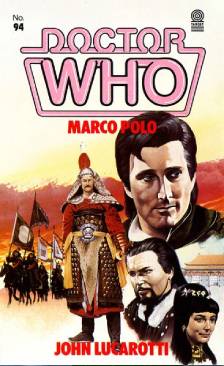
Cover: David McAllister returns with a painted composition of Marco Polo, Tegana, Pingo Cho and Kublai Khan, along with some other elements that apparently come from an entirely different production called Marco Polo from the 1980s. It’s nice to see accurate resemblences to actors Mark Eden, Zienia Merton and Derren Nesbitt here.

Final Analysis: John Lucarroti’s second novel and it’s as much of a jolly history lesson as the first, with additional highly detailed descriptions of various menus. Obviously, each of the locations is grander than the sets in Lime Grove could have allowed and also we get a real sense of the time passing, as each chapter adds days onto the journey, which lasts around 40 days in all. It might lack the fun and melodrama of monsters of robots, but it’s a rare story that truly allows us to step into a culture and enjoy various aspects of it.

Chapter 88. Doctor Who – The Aztecs (1984)

Synopsis: Emerging from a hidden doorway in a temple, Barbara is mistaken for the Aztec God Yetaxa and finds it difficult to refuse the role. As the Doctor tries to regain access to the temple and return to the TARDIS, Barbara learns the difficult lesson that she cannot change history. Not one line of it!

Chapter Titles

  • 1. Coiled Serpent
  • 2. Yetaxa the God
  • 3. Chosen Warriors
  • 4. Sacrifice to Tlaloc
  • 5. Perfect Victim
  • 6. Thorn of Doom
  • 7. No Holds Barred
  • 8. Cups of Cocoa
  • 9. Bride of Sacrifice
  • 10. Offence and Retribution
  • 11. Crawl, Swim, Climb
  • 12. Wall of Deception
  • 13. False God
  • 14. Day of Darkness
  • 15. Eclipse

Background: John Lucarotti adapts his own scripts for the series broadcast in 1964. Published a week after its 20th anniversary, The Aztecs now holds the crown for the biggest gap between first transmission and novelisation. It’s also the first pure historical story to be adapted since The Crusaders, some 19 years earlier.

Notes: We begin with a new scene inside the TARDIS with little explanation of who the characters are or what the TARDIS is. Susan is said to be still 15 years old, while Ian is 28 and a ‘scientist’ (not a science teacher’). When the Doctor asks for a screwdriver (a normal screwdriver!) to fix a panel on the TARDIS ‘control desk’, Ian jokes that they might land on Earth in the 1980s and get help form an aerospace factory; it’s a curiously specific reference for a man from 1963. Barbara specialised in Aztec history at university and her brief summary for Susan of Mexican civilisation is a lot more heavy-handed than it is on screen. She guesses that they’re at some point in history between 1430 and 1519, and the Doctor is able to confirm it’s 17 May, 1507. We might pause to ponder how the TARDIS can produce a date so accurate when it’s 75 years before the introduction of the Gregorian calendar, but this story’s already threatening us with a huge history lesson, so let’s just ignore the issue and move on. 

Cameca is ‘a grey-haired, pleasant-faced, plumpish woman in her mid fifties’. The architect of the temple, Topau, is renamed ‘Chapal’. On the night that he meets the Doctor in the garden, Ian wears ‘only a warrior’s loin-cloth and sandals’. Ixta is startled by the Doctor’s electronic torch when he sees Ian use it, wondering if it’s ‘magic’. It was Ixta’s ‘father’s father’ who originally built the secret tunnel that is used to irrigate the garden (it’s his father on TV – and see later). Ian has a much more arduous trek through the secret tunnel, including a climb up a vertical shaft using crumbling footholds. He finds the remains of a body – which he correctly assumes is that of Ixta’s father – in the tunnel and soon discovers that the man must have fallen to his death when a foothold in the shaft gave way beneath his foot; Ian also correctly deduces that he himself was at risk of drowning because of Ixta deliberately opening the sluice. The Doctor tells Barbara of his suspicion that Ian has drowned, shortly before Ian finds them both (on telly, Barbara already knows Ian is safe by the time the Doctor reaches her). 

It’s a lot clearer that the Doctor feels utterly wretched for exploiting Cameca’s affection purely to gain access to the temple. As Cameca offers to help restore Autloc’s faith in Barbara, the Doctor is moved by her devotion and muses ‘in another world, in another time’ – but it’s definitely not the romantic relationships some fans imagine. Barbara has a long discussion with Autloc about the ‘schizophrenic’ nature of the Aztecs and her words remind him of a legend he has heard of a man from a foreign land who spoke of a ‘gentleness and love’ who was crucified, as the Aztecs do with their criminals. The climactic fight scene between Ixta and Ian is replaced by something wittier but also just as brutal, as Ian reflects light into his opponent’s eyes, which makes Ixta topple backwards and fall to his death. The scene leading into The Sensorites is, unsurprisingly, cut.

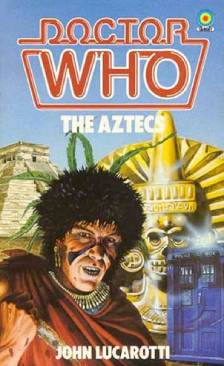
Cover: Featuring the last appearance of the coloured Target logo, Nick Spender’s first cover depicts a man with a dagger (Tlotoxl possibly?), a temple and a giant golden mask, as the TARDIS materialises. A 1992 reprint cover uses Andrew Skilleter’s VHS cover art, showing Tlotoxyl and the Doctor amid some Aztec pyramids.

Final Analysis: John Lucarotti provides a fairly loose adaptation of his own story, clearly written from the original scripts but with a relaxed approach to sticking rigidly to the text. He’s also done a lot of research and is happy to let us know it, but unlike some of the authors from the early 80s, there’s no showboating here; we’re just exposed to the history of an ancient and brutal culture – even the cuisine – of a time in Earth’s history that’s as alien to the modern reader as that of Peladon or Skaro. The descriptions of torture are particularly graphic; at one point, Tlotoxyl tells Barbara that Susan will have her eyes gouged out. I might lament that the original TV version didn’t give us the chance to hear how William Hartnell might have approached a name like ‘Huitzilipochtli’ but Lucarotti’s undiluted approach makes the story all the richer. I read this novel for the first time here and we’re now entering a period where I suspect there are more books I’ve not previously read than I have. 

Chapter 81. Doctor Who – The Five Doctors (1983)

Synopsis: The Death Zone on Gallifrey – once the location of cruel games in the old times of the Time Lords, before it was closed down. A sinister figure has reactivated it and the Doctor has been dragged out of time from different points in his life. Though one of his incarnations is trapped in a time eddy, four others work together, joined by old friends and obstructed by old enemies. Their joint quest points towards an imposing tower that legend says is also the tomb of the Time Lord founder, Rassilon. A deadly new game is afoot, and the prize is not what it seems…

Chapter Titles

  • 1. The Game Begins
  • 2. Pawns in the Game
  • 3. Death Zone
  • 4. Unexpected Meeting
  • 5. Two Doctors
  • 6. Above, Between, Below!
  • 7. The Doctor Disappears
  • 8. Condemned
  • 9. The Dark Tower
  • 10. Deadly Companions
  • 11. Rassilon’s Secret
  • 12. The Game of Rassilon

Background: Terrance Dicks adapts his own TV script in a novel that was published before it was broadcast in the UK – pushing the record for the gap between broadcast and publication into minus figures.

Notes: The book opens in ‘a place of ancient evil’ – the Game Room – where a black-clad Player is preparing for the game to begin. The Doctor has a fresh stalk of celery on his lapel. Tegan is still considered to be ‘an Australian air stewardess’ despite having been sacked by the time of Arc of Infinity. The Doctor has remodelled the TARDIS console room after ‘a recent Cybermen attack’ (is this Earthshock or an unseen adventure?). Turlough is introduced as a ‘thin-faced, sandy-haired young man in the blazer and flannels of his public school.’ He’s also ‘good-looking in a faintly untrustworthy sort of way’.

The First Doctor is said to have ‘blue eyes […] bright with intelligence’ (William Hartnell had brown eyes so this is definitely the Hurndall First Doctor) and a ‘haughty, imperious air’. He’s aware that he’s near the end of his first incarnation and is living in semi-retirement to prepare himself for the impending change. The Brigadier’s replacement is called ‘Charlie Crighton’ [Charles Crighton, as in the film director?]. The Second Doctor has ‘dark brown eyes’ (not blue – or even green as previously) which appear ‘humourous and sad at the same time’. We find the Third Doctor test-driving Bessie on private roads, which is how he can drive so fast without fear of oncoming traffic. On leaving the TARDIS, Sarah-Jane Smith had felt ‘abandoned and more than a little resentful’; at first, she thinks the capture obelisk is a bus rounding a corner – until it’s too late. There’s a new scene depicting life on future Earth for Susan Campbell – formerly Foreman – whose husband David is part of the reconstruction government and they have three children together. 

Strangely, she calls her grandfather ‘Doctor’, which is what alerts the Dalek to the presence of its enemy  (this was fixed for the TV broadcast). The obelisk tries to capture the Fourth Doctor and Romana by lying in wait under a bridge. The Master recognises that the stolen body he inhabits will wear out, so the offer of a full regeneration cycle is especially appealing. The slight incline that Sarah tumbles down on TV becomes a bottomless ravine here. The First Doctor is much more receptive to Tegan’s suggestion that she accompanies him to the Tower. As the Castellan accuses the Doctor of ‘revenge’, we’re reminded of the events in Arc of Infinity, while there’s also a summary of the events with the Yeti in London that led to the Doctor and the Brigadier’s first meeting. The ‘between’ entrance to the tower has a bell on a rope, not an ‘entry coder’ and the First Doctor, realising the chess board has a hundred squares, applies the first hundred places of ‘Pi’ as coordinates (which explains how he translates the measurement of a circle to a square!).

Sarah Jane tries to launch a rock at a Cyberman to keep it away (‘I missed!’) and on meeting the Third Doctor, Tegan tells Sarah ‘My one’s no better’ and they compare notes – scenes that were reinstated for the special edition of the story on VHS and DVD. When the Brigadier helps to disarm the Master, the Doctors pile onto him. The Fourth Doctor and Romana are returned to the exact moment they left, still punting on the river Cam. Though the Second Doctor departs by calling his successor ‘Fancy pants’, the ‘Scarecrow’ response is cut. The Fifth Doctor tells a confused Flavia that Rassion ‘was – is – the greatest Time Lord of all’.

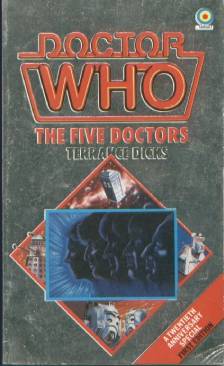
Cover: Andrew Skilleter creates the central image of a diamond containing the five Doctors in profile, surrounded by the TARDIS, Cybermen, a Dalek and K9. All of this on a very swish-looking metallic-silver background with a flash in the bottom right-hand corner proclaiming the book ‘A Twentieth Anniversary First Edition’. Alister Pearson’s art for the 1991 reprint features the story’s five Doctors (Hurndall stepping in for Hartnell and an off-colour Tom Baker) against a backdrop of elements that evoke the interior decor of the Dark Tower with a suggestion of the hexagonal games table.

Final Analysis: Apparently Terrance Dicks completed this in record time, so understandably there are a couple of mistakes (Susan calling her grandfather ‘Doctor’, Zoe and Jamie labelled as companions of the ‘third Doctor’), but otherwise he juggles the elements of his already convoluted tale very well, even resorting to his trick from the previous multi-Doctor story of calling them ‘Doctor One’, ‘Doctor Two’ and ‘Doctor Three’. It’s not just nostalgia working here, Terrance Dicks does such a good job with the shopping list he was given and makes something that both celebrates the past and catapults the series into the future.

Chapter 65. Doctor Who and An Unearthly Child (1981)

Synopsis: A thing that looks like a police box, standing in a junkyard. Home to a secretive old man and his strange granddaughter. Two schoolteachers allow curiosity to lead them into a terrifying journey back to a time where the greatest power is the ability to make fire, and the second greatest is merely to survive.

Chapter Titles

  • 1. The Girl Who Was Different
  • 2. Enter the Doctor
  • 3. The TARDIS
  • 4. The Dawn of Time
  • 5. The Disappearance
  • 6. The Cave of Skulls
  • 7. The Knife
  • 8. The Forest of Fear
  • 9. Ambush
  • 10. Captured
  • 11. The Firemaker
  • 12. Escape into Danger

Background: Terrance Dicks adapts Anthony Coburn’s scripts for the very first TV story. At 17 years, ten months and three or so weeks, this is now the record holder for the longest gap between broadcast of a story and release of the novelisation. Though this record will be broken a few times more in the future, this book can lay claim to another odd record in that the novelisation was released 18 days prior to being repeated in full for the first time.

Notes: We learn from the policeman in the opening scene that the old man who recently became the proprietor of the junkyard in Totter’s Lane has disappeared, along with his granddaughter and two teachers from a local school – so the rest of the story here is told in flashback (and the later flashback to Susan in the classroom is flashing even further back!). We briefly meet Susan in the first Coal Hill School scene as she waits for Miss Wright to fetch the book, and she’s ‘tall for her age, with short dark hair framing a rather elfin face’. Apparently Barbara Wright doesn’t ‘stand for any nonsense’ and Terrance Dicks gives her a rather balanced but critical appraisal: 

Someone had once said, rather unkindly, that Barbara Wright was a typical schoolmistress. She was dark-haired and slim, always neatly dressed, with a face that would have been even prettier without its habitual expression of rather mild disapproval. 

There was undeniably some truth in the unkind remark. Barbara Wright had many good qualities, but she also had a strong conviction that she knew what was best, not only for herself but for everyone else. It suited her temperament to be in charge. 

Ian in contrast is said to be ‘a cheerful, open-faced young man… about as different in temperament from Barbara Wright as could be imagined.’ Ian teaches Science and Mathematics, which explains why he sets his class a problem involving the dimensions ‘a, b and c’. When Barbara tells Ian about Susan’s mistake over decimal currency, she adds that ‘The United States and most European countries have a decimal system’, but Susan then claims ‘You’ll change over in a few years’ time!’ Susan explains that TARDIS stands for ‘Time and Relative Dimension in Space’ (singular) as on TV [see The Daleks, The Time Meddler and others]. As he removes his jacket in the TARDIS control room, the Doctor has the impression of ‘a family solicitor from some nineteenth-century novel’. When Barbara calls him ‘Doctor Foreman’, the Doctor confesses that he stole that name from the gates of the junkyard and suggests ‘It might be best if you were to address me simply as Doctor’. Most helpful of him, even if he then acts as if he’s never heard the name when Ian uses it in the next chapter!

It’s confirmed that Za is the son of Old Mother, who he saved from being cast out by the Tribe (as is their custom) after the death of his father, Gor after (it’s presumed, but not confirmed) a hunting accident. This act of kindness was viewed by the old woman as weakness, hence why she undermines him at every opportunity.

The final chapter is called ‘Escape into Danger’. It ends with a foreshadowing of the next adventure, on a wartorn planet called Skaro – home of the Daleks!

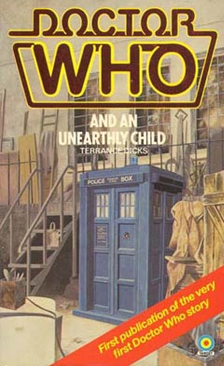
Cover: The first cover to use the Sid Sutton-designed ‘neon’ logo from the TV show, with metallic foil effect on the first edition’s logo, and with a red flash across the corner to tell us this is the ‘First publication of the very first Doctor Who story’. It’s such a simple cover really, as Andrew Skilleter recreates the set of the junkyard from a photo now believed to be lost. It could have done with being set at night, but the details are very satisfying as this cover is now our best view of that very cluttered set. A 1990 reprint used Alister Pearson’s VHS cover and it’s beautifully simplistic. Taking its inspiration from the cover art for Queen’s The Miracle (1989), Pearson merges the Doctor and Susan so they share an eye, positioned above a rocky landscape where the TARDIS is materialising.

Final Analysis: Terrance had just two weeks to complete this, to tie in with the ‘Five Faces of Doctor Who’ repeats, on the suggestion of producer John Nathan-Turner. It was also Target’s first novelisation in six months, due to a writers’ strike that Terrance felt compelled to honour. There’s a Reithian hand at work here, as Terrance guides the young Target reader through some fairly alien concepts: Through the police officer in the opening scene, we learn that police boxes used to be a common sight on British streets and the policeman speculates that they might soon be phased out in favour of individual walkie-talkies; Ian tries to remember what kind of animals might have existed in the time of the cavemen, such as mammoths and sabre-tooth tigers, but making the point that there’d be no dinosaurs as ‘that was a common mistake’; and of course, Anthony Coburn’s original script included a means to make fire that every eager Scout or pyromaniac should know.

One other lovely detail is how Dicks describes Kal as having a ‘short jutting beard’. It’s the kind of description Malcolm Hulke might have used for the same purpose, as later, when the time travellers’ escape route is cut off by tribesmen, their leader is said to have a ‘short jutting beard’ – the viewers would recognise him as Kal, but the travellers wouldn’t, yet – so the reader is given this subtle clue. There’s one small issue with the first edition though – as Za enters the clearing and hears a low growl behind him; it’s such an amazing paragraph that it was repeated a few lines later… oops!

So we now have a novel of the first story, which leads directly into the next – the novel of which is hugely contradictory as we’ve already seen. Heaven help anyone trying this pilgrimage in broadcast order. Much better this way!

Chapter 59. Doctor Who and the Keys of Marinus (1980)

Synopsis: A huge pyramid surrounded by a sea of acid. Inside is Arbitan, sole protector of the Conscience of Marinus, a powerful computer that can control minds. The Doctor and his fellow travellers agree to help Arbitan locate a set of keys for the machine, which have been hidden in different locations across the planet. So begins a deadly quest for the time travellers that will involve mind-controlling brains in jars, killer plants, a frozen tundra and a trial for murder. All the while, they are unaware that Arbitan’s enemy, Yartek, leader of the Voord, has captured the pyramid and now lies in wait for their return with the keys…

Chapter Titles

  • 1. The Sea of Death
  • 2. The Marble City
  • 3. The Velvet Web
  • 4. The Brains of Morphoton
  • 5. The Screaming Jungle
  • 6. The Whispering Darkness
  • 7. The Snows of Terror
  • 8. The Demons
  • 9. Sentenced!
  • 10. The Mystery of the Locked Room
  • 11. The Missing Key
  • 12. Arbitan’s Revenge
  • 13. Final Goodbyes

Background: Philip Hinchcliffe adapts Terry Nation’s 1964 scripts, during a period when the story titles for Hartnell’s stories had not been agreed on by consensus, so the title page states that this is an adaptation of Terry Nation’s ‘The Sea of Death’.  So far, this is the biggest gap between the broadcast of a story and its release as a novel, at 16 years, three months and one week. It’s also been three years and 29 books since the publication of a First Doctor story under the Target banner.

Notes: Time is measured in zeniths in inter-galactic time. The Voord submersible pods are BXV sub-oceanic assault craft. Apparently, Barbara suffers from space-time travel sickness and she believes human bodies are not built for time travel – or at least hers isn’t. Hinchcliffe describes the inside of the TARDIS thus:

They were inside a large hexagonal-shaped control room with white hexagonal-patterned walls. A hexagonal console in the middle of the room supported a transparent cylindrical column which moved slowly up and down when the ship was in flight. 

The Doctor has ‘mischievous blue eyes’ (unlike Harnell’s own, which were brown). Barbara and Ian’s first meeting with the Doctor and Susan is summarised and we’re told that the TARDIS can ‘change its appearance like a chameleon’. Ian is still wearing a ‘Chinese jacket’ that he picked up ‘the court of Kublai Kahn’ [sic], which we’re told ‘undermined his air of schoolmasterly interest’. 

The Voord have webbed hands and feet, they’re the same shape as a man, but stronger and more agile:

Its skin was dark and rubbery, its bulletshaped head smooth and devoid of features except for two frog-like eyes and a snoutish protuberance like corrugated piping. The head was flanked by two flat, pointed lugs. The face as a whole faintly resembled that of Anubis, the jackal-headed god of Egyptian mythology. The creature, however, was far from being any sort of god. It was, in fact, a Class I Voord Assault Trooper, programmed to kill enemy life-forms on sight!

The word ‘programmed’ suggests at least some degree of robotic or artificial intelligence. Yartek developed an immuniser that enabled the Voord to ‘rob and cheat, kill and exploit’; Arbitan’s people were helpless as the Conscience made them incapable of violent resistance. Susan calculates that Arbitan’s temple is a couple of miles all round, while Barbara’s comparison from the TV version of the temple to those of the Egyptians and South Americans is given to Ian for some reason. Vasor is said to be like a ‘Breughel peasant’, which suggests he should have been down an alley, puking. Yartek is said to smile and his face has ‘bulbous eyes’, so he doesn’t quite look like his TV counterpart.

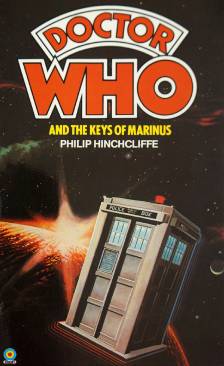
Cover: David McAllister’s first contribution to the range is both beautifully painted and disappointingly bland – the TARDIS hovers in space above a generic planet. Were they too squeamish to attempt one of the Brains of Morphoton for this? As the policy of the time was to avoid having older Doctors on the cover, this might have limited their options, so having the iconic TARDIS might have seemed more marketable, but it’s a shame as we could have had something rivalling Alun Hood’s Terror of the Autons cover for sheer horror.

Final Analysis: This was one of four books I received as a Christmas present in 1980, the first Target books I owned, rather than loaning from the library. Aside from maybe an episode at a convention in the mid-1980s, I’m not sure if I saw the TV story for more than a decade later, so it’s Hinchcliffe’s version that was imprinted on my mind, alongside The Daleks, as what Hartnell’s Doctor was really like. Good going, considering the Doctor himself is missing for half of the story and Ian is, as on TV, very much the lead character. This is Hinchcliffe’s final novel for the range and it’s such a weird choice for him, but it’s every bit the Boy’s Own adventure that was at the heart of his time as producer (including what feels very much like the belittling of Barbara to elevate Ian more), so it’s perhaps not as surprising as it first appears. It faithfully adapts Terry Nation’s scripts, which acted as a template for what the series would quickly become. It has a quest (although after all those Key to Time novels, that’s not necessarily a positive); four alien lands with hostile environments; repulsive monsters; selfish antagonists who are more than a bit rapey; and a trial! At the end, the Big Bad Wolf-style villain is revealed to be rather disappointing, but as this is Hinchcliffe, the description of Yartek’s demise is much, much nastier than the fade-to-white we saw on TV.

Further Listening

I was a guest on the Dr Who Literature Podcast to discuss this book, which you can hear in the link below, on YouTube, or via the podcast provider of your choice.

Chapter 30. Doctor Who and the Dalek Invasion of Earth (1977)

Synopsis: The Doctor finally brings Ian and Barbara back to London but celebrations are short-lived when they realise they are two hundred years in the future and Earth is under the occupation of the Daleks. Separated and befriended by various groups of resistance fighters, the time travellers all come to the same conclusion – they must find out what the Daleks are doing and defeat them. But for one of them, life will never be the same again.

Chapter Titles

  • 1. Return to Terror
  • 2. The Roboman
  • 3. The Freedom Fighters
  • 4. Inside the Saucer
  • 5. Attack the Daleks!
  • 6. The Fugitives
  • 7. Reunion with the Doctor
  • 8. The Mine of the Daleks
  • 9. Dangerous Journey
  • 10. Trapped in the Depths
  • 11. Action Underground
  • 12. Rebellion!
  • 13. Explosion!
  • 14. The Farewell

Background: Terrance Dicks adapts Terry Nation’s 1964 scripts for the second Dalek serial. The title page says it’s adapted from Doctor Who and the World’s End, presumably taking the story title from the Radio Times Tenth Anniversary special, which used the titles of each first episode to represent the serial as a whole.

Notes: The first chapter features a recap of the schoolteachers and their first meeting with the Doctor, Susan and the TARDIS. The Doctor is a lot more tetchy than he was on telly; when Susan describes the TARDIS readings as ‘normal’, the Doctor corrects her with irritation: ‘Normal for where?’ Later, Susan tells David that she left her own planet when she was ‘very young’ – is this comparative for a teenager, or was she a young child?

Tyler’s first name is Jim, not Carl, and Jack Craddock becomes Bill, but David’s name is still Campbell [see The Crusaders for why this is interesting]. The events of the time travellers’ first meeting with the Daleks is put into perspective when the Doctor surmises that the city they attacked was just one on the planet Skaro (in the TV version, he guesses that their first meeting took place a million years in the future). The Black Dalek (also called the Dalek Supreme) is said to be larger than normal Daleks – maybe the standard Daleks don’t have the enlarged bumper in this version? There’s also a ‘second in command’, a ‘commander of the ground forces’ and an engineer without any descriptions – are these based on the movie Daleks?

The Doctor is dazed after escaping the robotisation process, but not unconscious as on TV. David calls the Dalek fire bomb a ‘blockbuster bomb’ – it destroys whole blocks in one go. Dortmun is buried under rubble (like in the movie), rather than just being exterminated, while Larry and his brother Phil don’t kill each other in combat; the rewrite is much more tragic: Roboman-Phil’s helmet comes off in the struggle, killing him and as Larry holds his brother’s body another Roboman guns him down. There are a few dialogue swaps, such as Barbara getting a second go at making the Robomen attack the Daleks – the Doctor merely adds that the slaves should join in. The Doctor’s party is celebrated for their part in overthrowing the Daleks, so there are a lot more people willing to help free the TARDIS (and Tyler says he doesn’t need to know why they want the police box). Ian doesn’t wedge the Dalek bomb to stop it, but diverts it off course (just like Tom does in the movie!). The Doctor’s goodbye to Susan is a little simpler than on TV, but it’s almost more emotional as a consequence. We then join the Doctor inside the TARDIS as he turns from the scanner and sniffs, daring the teachers to comment, before smiling and promising to get them home (and the schoolteachers agreeing he probably won’t).

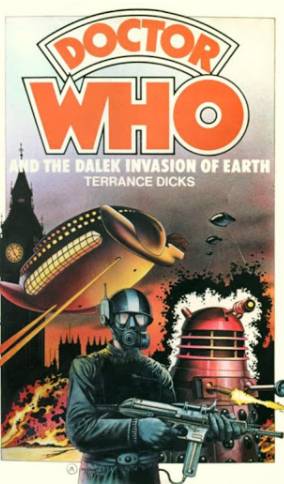
Cover: Chris Achilleos presents one of my favourite covers ever, and it’s so weird. It depicts a scene that’s threatened but not actually delivered on screen – the burning of London to flush out the rebels, with a Dalek and roboman patrolling as Dalek spaceships set fire to the Houses of parliament. But the spaceships are from the second Dalek movie, the roboman is a mashup of a movie version and a Genesis of the Daleks soldier, while the Dalek looks like it’s from the first Dalek movie, but it’s red all over with black spots. Its gun is from one of the original TV props but that and its sucker arm are the wrong way round. Despite all this, it’s utterly stunning. The 1990 reprint cover by Alister Pearson also uses the Houses of Parliament as a backdrop but it’s much more understated, showing portraits of the Doctor and Susan alongside an accurate TV version of a silver and blue Dalek.

Final Analysis: There’s surely no better start to any of these books than the first page of The Dalek Invasion of Earth, particularly that opening line: ‘Through the ruin of a city stalked the ruin of a man.’ It sets up the tone of the book, which is a war story with Daleks, where each character has something to say about the life they’ve led up to this point. Of course, Dicks is working off the back of three other writers – Terry Nation, David Whittaker and Milton Subotsky – but it’s the stuff he adds to meld the work of the others together that makes this so perfect. 

One strange thing is that I recall Terrance Dicks claiming that he’d been sent the wrong photo for the Slyther, and what he described was the Mire Beast from The Chase, yet what he writes is pretty spot on and actually adds to the menace of the creature:

Ian saw a vast lumpy blob of a body, powerful flailing tentacles, two tiny deep-set eyes shining with malice… Moving incredibly fast, the creature lurched towards them.

and:

They heaved and kicked and punched at the Slyther’s flabby bulk, shoving it out of the bucket with maniacal fury, dodging the flailing blows from its enormous tentacles.

That the Slyther survives its fall at the end and crawls off means that even after the Daleks are defeated, there’s the problem of pest control still to deal with – unless the volcano sorted it out. Although, for all the little tweaks Dicks makes to improve on the scripts, he still has the Doctor leaving Susan behind with just one shoe!

Never mind – I might go as far as to say that it’s Dicks’s best adaptation, so I’ll be interested to see if anything can top this.

Chapter 17. Doctor Who – The Three Doctors (1975)

Synopsis: A strange blob of jelly invades UNIT HQ while the Time Lords are being drained of energy. The answer to the mystery lies on the other side of a black hole, where a Time Lord legend waits to enact his revenge. As the Time Lords break one of their strictest rules to allow three of the Doctor’s incarnations to work together, Jo Grant worries they might only end up bickering…

Chapter Titles

  • 1. Lightning from Space
  • 2. Attack from the Unknown
  • 3. The Menace of the Black Hole
  • 4. Beyond the Unknown
  • 5. A Shock for the Brigadier
  • 6. In the Hands of the Enemy
  • 7. Door to Freedom
  • 8. Escape from Omega
  • 9 .’All things shall be destroyed’
  • 10. Return through the Flame
  • 11. Three Doctors Minus Two

Background: Terrance Dicks adapts the 1973 scripts by Bob Baker and Dave Martin.

Notes: The Second Doctor has ‘dark brown eyes’ (which doesn’t match Patrick Troughton) that are ‘at once humorous and sad’. Omega’s servants are only called ‘Jelly creatures’ and ‘blob-men’ – not ‘Gellguards’ as we’ve come to know them. The First Doctor asks ‘what’s a bridge for?’ and it’s Jo who suggests ‘crossing?’, prompting the old Doctor to note ‘Gel’s got more sense than the two of you put together!’ (it’s the Third Doctor who grabs the glory on TV). The battle with Omega’s monster takes place in an open-air arena and the beast itself is still humanoid but eight feet tall and muscular (rather than a short avante-garde dance performer). There’s a hilarious pitch battle in chapter 10 where Jo is ‘staggering under the weight of an anti-tank rifle’ before she fires at the blob men and falls backwards, deciding instead to be an ‘observer’.

Cover: A Chris Achilleos classic, using references from the familiar Three Doctors photoshoot and merging them with a classic Jack Kirby Fantastic Four cover (depicting Galactus where Omega would be). It’s a vision in orange and gold. The first edition also has a rear illustration by Achilleos showing the second Doctor being led away by two blob-men. My first copy was the 1978 reprint with a cover by Jeff Cummins showing the three Doctors in front of a black hole in space (it’s the one a reader of Doctor Who Magazine criticised for making the Doctors look too old, too evil and ‘too Welsh’!). The Pertwee is from Invasion of the Dinosaurs, the Hartnell from An Unearthly Child and the Troughton isn’t the Doctor, but Salamander – hence why he’s ‘too evil’. A 1991 edition with a cover by Alister Pearson is a little more stylised, with a photorealistic Omega ranting before a backdrop of burnt-out Doctors as banners in front of a black circle.

Final Analysis: Dicks makes Jo our point-of-view character, so to her, the other Doctor that Benton knows is her ‘Doctor Two’, while the one on the scanner screen is ‘the old man’ and ‘the old Doctor’, which works so well. Dicks also has Doctor Two correctly identify his instrument as a recorder – then refer to it as a ‘flute’ for the rest of the book!

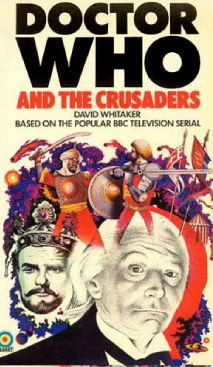
Chapter 3. Doctor Who and the Crusaders (1965)

Synopsis: The Doctor and his chums meet King Richard the Lionheart, his willful sister, Joanna, and his nemesis, Saladin.

Chapter Titles

  • Prologue
  • 1. Death in the Forest
  • 2. The Knight of Jaffa
  • 3. A New Scheherazade
  • 4. The Wheel of Fortune
  • 5. The Doctor in Disgrace
  • 6. The Triumph of El Akir
  • 7. The Will of Allah
  • 8. Demons and Sorcerers

Background: David Whitaker adapts his own scripts from a serial broadcast in March to April 1965, published by Frederick Muller Ltd in September 1965, first reprinted as a Target book in 1973. t followed The Web Planet on screen, so very early on, we have our first set of consecutive stories to be novelised.

Notes: The prologue gives us a short summary of what’s happened since the first book – and it is incredible. Apparently Susan had left the Tardis to live with David Cameron (!) and her place taken by Vicki, who we met in the previous volume. Ian and especially Barbara are now perfect physical specimens thanks to their travels and Barbara is now apparently ‘the admiration and desire of all who met her’ [see The Keys of Marinus and The Romans], but he’s foreshadowing future events too. Though it’s never explicit on screen, Ian and Barbara’s ‘destinies were bound up in each other’. There’s mention of an unseen adventure involving ‘the talking stones of the tiny planet Tyron in the seventeenth galaxy’ while Barbara and Vicki are playing Martian chess.

… and then Whitaker has the Doctor explain why they can explore all these alien worlds and interfere but they can’t change anything in Earth’s history. The examples he chooses from history – from Pompeii to John F Kennedy – are frank and somewhat surprising. And then, with some additional foreshadowing that really sets out Whitaker’s aims, we have this from the Doctor:

‘The next time we visit Earth,’ he said, ‘I hope we encounter a situation where two men are opposed to each other, each for the best reasons… ‘That is the only way to understand the folly, the stupidity and the horror of war. When both sides, in their own way, are totally right.’

Cover & Illustrations: Henry Fox’s original cover shows a raging crusader and the Tardis with a yellow background, while the Armada hardback by Mary Gernat shows the Doctor fleeing a crusader on a blue background. Chris Achilleos’s Target cover features the Doctor with a strong likeness of Julian Glover as King Richard. The 1975 White Lion hardback again pops Tom Baker in along and the one I first owned was the 1982 Andrew Skilleter cover shows the Tardis (I think it’s from an early Peter Davison photo). Henry Fox’s 15 illustrations are gorgeously melodramatic, in particular the image of Barbara about to be whipped.

Final Analysis: My surprise at the impressive prologue suggests that this is the first time I’ve read this book! As with the previous two volumes, this expands upon the scale of what could be achieved in Riverside Studio 1. In fact it’s hard to visualise a small studio set at all when there is such a sense of distance between each location. Whitaker develops the romance between Ian and Barbara, which gives the pair extra motivation to be reunited, although he also adds to the horror of Barbara’s experience by having El Akir whip her repeatedly, leaving her badly scarred (the death of El Akir is also more violent, strangled before his skull is dashed against a wall, rather than the more theatrically clean stabbing on telly). It’s a mature work, living up to the promise of the prologue by trying to present both sides of the war evenly and with Ian trying to explain how all religions have a basic central idea of a higher being.

Chapter 2. Doctor Who and the Zarbi (1965)

aka Doctor Who – The Web Planet (1990)

Synopsis: The Tardis crew land on a rocky alien world occupied by a variety of insects being controlled by a malevolent parasite. Susan has disappeared and she’s been replaced by Vicki. And after Ian’s suggestion for a nickname for their pilot, it seems ‘Doctor Who’ is his actual name now.

Chapter Titles

  • 1 The Web Planet
  • 2 The Zarbi
  • 3 Escape to Danger
  • 4 The Crater of Needles
  • 5 Invasion
  • 6 Centre of Terror

Background: Bill Strutton adapts his own scripts from a serial broadcast just six months earlier, in February to March 1965. Published by Frederick Muller Ltd in September 1965, first reprinted as a Target book in 1973.  At 174 pages, it remains the longest of the adaptations until Fury from the Deep, though this includes the 15 illustration plates too.

Notes: Although this is a follow-on from The Daleks and was in production alongside The Crusaders, there’s no attempt to explain where Susan has gone or who Vicki is, aside from ‘the youngest member of the Tardis inhabitants. There are a few references to past episodes – Barbara’s gold bangle, which was a gift from Nero; Vicki’s crashed rocket on the planet Dido; using ‘like poles’ to repel magnets on the Dalek saucer – so unlike An Exciting Adventure With The Daleks, this isn’t part of a series of books so much as an extension of the TV series.

Ian describes his tie as that of the ‘Coal Hill Old Boys’, suggesting he was a pupil there too. Maybe this is why he was tired of teaching in the first book? Strutton assumes that the light on top of the police box is in fact a Tardis searchlight (possibly the one mentioned in the first book). A couple of the female characters on TV are male here, even though there are other female Menoptera and Optera. And of course, the ‘larvae gun’ are renamed ‘venom grubs’, which makes much more sense.

Cover & Illustrations: The first cover, for Frederick Muller, is a black-and-white illustration with a red background and a weird non-canonical, shimmering  “Dr. Who” logo. White Lion did another odd one with Tom Baker for the 1975 hardback and Alister Pearson’s VHS cover was used on a 1990 paperback reprint. Once again it’s the Chris Achilleos cover that endures, using the same photo reference as his cover for The Daleks, a pair of mahogany Zarbi and a startled Menoptera. There are 15 illustrations by John Woods and they depict the world of the novel, not the TV show. For some reason his Vicki is terrible but the others look spot on and the Zarbi look particularly impressive directing an attack from the edge of a cliff. My favourite pic though is of the Doctor and Ian looking up at a creepy statue in the rocks. Really helps create a sense of vastness on the Vortis landscape.

And we get our first chapter title called ‘Escape to Danger’ too!

Final Analysis: In contrast to David Whitaker’s approach, Bill Strutton appears to be writing for a much younger age group. Is this because that’s who was buying the books or just who he assumes would be buying them? Also, Whitaker was writing when the programme was still in its first series and many things were still being ironed out; despite calling him ‘Doctor Who’, Strutton’s Doctor is more recognisably the one from TV than Whitaker’s, complete with umms and ahhs, even if he does fix Hartnell’s fluffs from the original recording. Also, his descriptions of the motivations and movements of the  Zarbi really help to make sense of the TV episodes – for instance the beginning of episode two, where Barbara is walking around the pool of acid, where the book explains that the Zarbi is controlling her, as opposed to waggling an arm and beeping.

It might seem an odd story to adapt but it was the highest rated serial of the programme so far and Strutton takes every opportunity to make Vortis seem so weird and beautiful, especially on the very last page.