Chapter 136. Doctor Who – The War Machines (1989)

Synopsis: The white heat of British technology is evident in the unveiling of an impressive new tower in the heart of London. At the top sits a powerful super-computer – WOTAN – enabling rapid communication across the world. The computer’s inventor, Professor Brett, is in fact a servant of WOTAN, helping the machine to build a fleet of mobile battle-tanks. Soon, the War Machines appear on the streets of London – and the Doctor is required…

Chapter Titles

  • 1 The Home-Coming
  • 2 The Super-Computer
  • 3 A Night Out
  • 4 Servant turned Master
  • 5 Putting the Team Together
  • 6 Working for the Cause
  • 7 A Demonstration of Power
  • 8 The One Who Got Away
  • 9 Attack and Defence
  • 10 Taking to the Streets
  • 11 Setting the Trap
  • 12 The Showdown
  • 13 We Can’t Stay Long

Background: Ian Stuart Black adapts his own scripts for the 1966 story, 22 years and seven months after it aired. On transmission, Kit Pedler was credited as having been responsible for the idea of the story, though it’s still not clear how much of this was just a PR exercise from the production team to highlight their science-based aspirations; if the idea was no more than ‘a computer at the top of the new Post Office Tower’, this wouldn’t be sufficient to lay a claim to a share of the copyright, which might also explain the lack of a credit for Pedler at the front of this book.

Notes: The opening chapter sees Dodo helping the Doctor to steer the TARDIS to its next destination (a task she’s inherited from the recently departed Steven). The Doctor can apparently ‘predict exactly where they would materialise’ [we can look to the start of The Savages for why this might now be the case, as he’s had time to calculate their exact position in the universe for possibly the first time in a while]. Seeing the name ‘Carnaby Street’ on the TARDIS monitor, Dodo reacts as if the street is brand new; it first appeared on documentation in the 1680s and it had been a destination for jazz fans since 1934, slowly transforming into a string of boutiques by about the time Dodo absconded aboard the TARDIS (as a schoolgirl, she was probably a little young for it to have appeared on her radar). 

It’s the Doctor, not Dodo, who realises that the new construction in the centre of London is ‘finished’ and he observes that it’s called the ‘Post Office Tower’, though ‘in all probability they would change that name’; opened to the public in May 1966, just two months before the broadcast of the first episode of The War Machines on TV, the building became the ‘British Telecom Tower’ in the mid-1980s before settling on ‘The BT Tower’ in the 90s. William Hartnell’s fluff of the word ‘sense’ to ‘scent’ becomes the Doctor’s intention all along, prompting Dodo to make a joke about London fog. Curiously, Dodo doesn’t know what a milk bar is (they existed in her time and a girl from London would know, but she’s acting as an agent for the reader here). The Doctor is said to be wearing a ‘velvet jacket’.

The duo head to a nearby cafe, where the Doctor speculates that his former companion Ian Chesterton will have become something of note in the world of science and in all probability had something to do with training the staff at the new Tower – and it turns out he’s entirely correct! The Doctor fakes documents that provide him with an introduction, a minor act of subterfuge that then enables him and Dodo to investigate the operations at the top of the Tower – and his credentials are checked and verified by Major Green. Professor Brett has heard Ian Chesterton speak of the Doctor often.

Polly is ‘an attractive girl with long blonde hair and blue eyes’ and she wears a very short skirt that shows off ‘her long and shapely legs’. Dodo thinks that she and Polly might be ‘about the same age – not that Dodo was too sure what her own age was nowadays’ (Dodo was a schoolgirl of about 15 when she first entered the TARDIS and Polly is at least 18 – she’ll have had to attend secretarial school – so that’s a sizeable age gap of Dodo’s for Big Finish to cover there). Polly offers to take Dodo to a new club, The Inferno, which is in Long Acre (that’s a swift 20-minute walk there – and 20 minutes back – so she apparently wangles an early finish on the Friday before the project’s big launch (miraculous in itself!). WOTAN says that ‘The Doctor is required’, not ‘Doctor Who’ as on telly. Spoilsport.

The War Machines have names, not numbers, and the one captured by the Doctor is called Valk. It has no weapons, so the Doctor installs an automatic rifle. Polly and Ben force their way aboard the TARDIS because they feel he’s trying to get rid of them – and not because they’re returning his key.

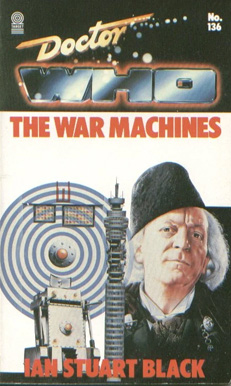
Cover: You really wouldn’t want much more from this cover – a lovely shot of the Doctor, a War Machine and the Post Office Tower, with a close-up of WOTAN’s control panel in the background, broadcasting concentric circles of radio waves. Alister Pearson had help from Graeme Way with the concentric circles.

Final Analysis: Another author delivers his final novel and as with the TV story it’s based on, it’s Ian Stuart Black’s best one. There’s some lovely foreshadowing in Chapter 1 of both the Doctor and Dodo realising this will mark the end of their travels together. That chapter also boasts an introduction to the idea of time travel, and indeed what time itself actually is:

Of course he knew that in one sense Time was a fiction – an attempt by man to measure duration with reference to the sun and stars. But he also knew that although such measurements were based on an impressive formula, all man’s concepts were fraught with error. Time was not as it was supposed to be, for here they were, he and his single crew-member, Dodo, travelling fortuitously across space, splitting Time into fragments – or more exactly, ignoring the passage of time, the rising and setting of the sun, the ebb and flow of tides, the coming and going of the galaxy in which they voyaged. 

While Dodo’s departure is only slightly less abrupt than it was in the original, this very swiftly becomes the story of Ben and Polly, who we first met in Doctor Who and the Cybermen (1975). We’ve long forgotten Gerry Davis’s fudging of their origins in those early Target books and they feel as much a part of ‘Swinging Sixties London’ as a story set in the very heart of the ‘white heat of technology’ can possibly allow.

Chapter 135. Doctor Who – Delta and the Bannermen (1989)

Synopsis: An unexpected holiday for the Doctor and Mel sees them joining a race of shape-changing aliens at a holiday camp in 1950s Wales. Also in the party is a beautiful woman on the run from bloodthirsty killers – and a spy only too happy to betray her. Soon, the holiday camp is the scene for a massacre, retribution… and romance.

Chapter Titles: The chapters are numbered One to Thirty-Two. With additional prologue and epilogue, this steals the record from The Romans for most number of chapters in a novelisation.

Background: Malcolm Kohll adapts his own scripts for a story from 1987. This followed Paradise Towers on TV, so that’s another pair of stories to be released consecutively.

Notes: A prologue reveals that the Doctor takes one sugar in his tea. The TARDIS is in need of a ‘major overhaul’. Now that he’s less burly than his previous incarnation, Mel has stopped forcing carrot juice upon him and is happy to offer him digestive biscuits (which he declines as he doesn’t like how they collapse into his drink – such a beautiful ‘Doctorish’ moment there that I don’t think has ever actually been noted anywhere else). The Doctor keeps a kitty for loose change, which baffles him as it’s always empty. The Tollmaster is ‘a scaly alien wearing a spangly jacket and party hat’; he has ‘a fine set of large white teeth’ (a lovely evocation of Ken Dodd, who played him so memorably on telly). Mel claims she hasn’t been to Earth in ‘ages’, though she’s previously visited the planet Zoth and recognises paintings at the tollgate of ‘Solterns, Giboks and those funny little creatures the Wormese, who, without the aid of appendages of any kind, propel themselves along by the sheer force of their exhalations’. The Navarinos from ‘the tri-polar moon Navarro’ are ‘squat hairy beings which resemble artichokes’; Murray, the Nostalgia Tours pilot, is ‘ a round, leafy, hairy creature’. 

The Chimeron homeworld is called Chumeria – also known as ‘the Garden Planet of the Universe’. Chimerons are ‘soft and pupa-like’ and have ‘silvery-green skin and vivid blue eyes’. The two American agents are Lex Hawk and Jerome P Weismuller; Weismuller’s wife is called May. The ‘soldier of fortune’, Keillor’, knows of ‘the traveller called the Doctor’ (on TV, he knows the Doctor is a ‘traveller in time’). The Doctor has heard of Gavrok and ‘his violent ways’ – is he really the acidental tourist he’s pretending to be?

Outside Delta’s cabin, Billy hears Mels’ scream and shoulders the door open to see the Chimeron baby emerging from its shell (the telly version has him arrive shortly afterwards). Burton was a major in the army twenty years ago, when Vinny had served as his batman; they’ve worked together ever since. Among the party of Navarinos are Adlon, Crovassi, Diptek, Ethnon, Frag, Gil and Herret. Two of the Bannermen are named Arrex and Callon. The Doctor once rode a vehicle similar to Ray’s motorbike on the planet Themlon that left him ‘TARDIS-bound for a week afterwards’. According to Weismuller, Gavrok is ‘about seven feet tall’, though this comes as part of his otherwise rather exaggerated summary of his role in the battle against the Bannermen. In Billy’s chalet is a record player with a copy of ‘Gamblin’ Man’ by Lonnie Donegan. By the time he leaves with Delta, Billy has become ‘pure Chimeron’.

In the epilogue, having safely installed Delta and her child on the Chimeron brood planet, Billy delivers the surviving Bannermen to a galactic court before returning to his new home. The Bannermen decide that, should they ever find themselves free, they’ll set up a weaving collective to make rugs they can sell across the galaxy. Ray takes the Vincent aboard a ferry intent on exploring the world, while, on board the TARDIS, Mel subjects the Doctor to an old recording of Rock Around the Clock.

Infamously, a typo on page 54 presents the Doctor as ‘peeing’ over a shelf. The credits at the front of the book list Michael Ferguson, not Chris Clough, as the director (a hint at the story coming up next). Worst of all though, the spine on the first edition presented the title of the story as ‘Delta and the Bannerman’ – singular. This is corrected for the reprint, which lists the book as number ‘153’ in the library.

Cover: Alister Pearson’s artwork has echoes of Jeff Cummins’ cover for The Face of Evil as the Doctor’s face appears inside a circular frame, with the Shangri-La sign arching above, a Bannerman bearing his gun and the Sputnik satellite and the Chimeron egg at the bottom. Wonderfully, the composition forms the inverted silhouette of Mickey Mouse (hinting at the intended destination of the Navarino bus).

Final Analysis: There are people who don’t love Delta and the Bannermen (I know, right?) and they should be pitied. For the rest of us, we can also enjoy Malcolm Kohll’s sole entry in the Target library. All the joyful craziness of the TV episodes is present and correct, but like all the best authors for the range, Kohll enhances little details as he goes and the epilogue is delicious. In particular, the rather unconvincing romance at the heart of the story is boosted and Billy in particular is shown to be a young man of integrity and decency (especially in his pleading for a little mercy on behalf of the Bannermen at the Galactic Court).

Just a sidenote – back in The Two Doctors we were presented with, er, two Doctors who were resolute in their belief that Androgums cannot be augmented and will always revert to their baser qualities. It’s a rather worrying colonial view of an entire race, though there are actually few examples of aliens having much nuance generally in Doctor Who (the Ice Warriors are a notable exception). Here, while he offers a note of caution towards Billy’s decision to become a Chimeron, ultimately he wishes him well. We have a much more liberal interpretaton of the Doctor here, which feels much more like a ‘modern’ version, willing to be more compassionate and making allowance for personal choices. Delta and the Bannermen might be a little light as Doctor Who stories go, but it’s also an utter gem. I’d have liked to have seen Kohll’s approach to someone else’s scripts.

Chapter 133. Doctor Who – The Smugglers (1988)

Synopsis: It was just a police box, but Ben and Polly are amazed to discover the truth when the Doctor’s TARDIS takes them to 17th-century Cornwall. Soon they are drawn into the machinations of a ring of murderous smugglers and a very sinister squire…

Chapter Titles

  • 1. A Shock for Polly and Ben
  • 2. The Frightened Man
  • 3. Longfoot’s Friends
  • 4. Pike
  • 5. Pirate Treasure
  • 6. Kewper’s Trade
  • 7. Captured
  • 8. The Squire’s Plan
  • 9. Pike’s Revenge
  • 10. Treasure Hunt
  • 11. Cherub’s Move
  • 12. The Treasure

Background: Terrance Dicks adapts scripts by Brian Hayles for the 1966 story, 21 years and just over eight months earlier.

Notes: Terrance Dicks explains what a police box is (the target readership is now far too young to have any memory of them). The events of The War Machines are summarised and we’re told that it was Dodo’s decision to remain behind and leave the TARDIS. The Doctor, though old, is ‘still alert and vigorous and the eyes in the heavily lined face blazed with fierce intelligence’. Polly is wearing a ‘fashionable denim trouser suit [with] her long blonde hair tucked beneath a denim cap’ while Ben is in his uniform, ‘bellbottomed trousers, blue raincoat and jersey… and a sailor’s hat with HMS Teazer on the ribbon’. 

 ‘Cherub’ is a nickname bestowed upon him because of his bald head with a little tuft of hair behind the ear.  The sailor who tells Pike that Cherub is no longer aboard the ship is given the name ‘Crow’. The Doctor tells Ben that he feels he has a ‘moral obligation’ to fix the situation as he’s become ‘involved in the affairs of this village’ and fears that ‘my interference may even have brought about the threat of destruction’ (a slight clarification of the words said on screen). The final scene sees the TARDIS materialise in its next destination, but it’s not specified where.

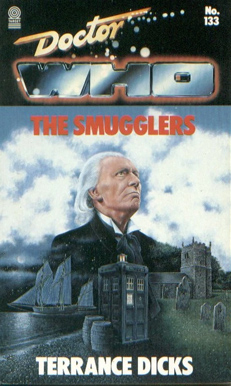
Cover: Beautiful – Alister Pearson paints the Doctor dwarfing two views of a Cornish village, the beach and a ship at night and the church, separated by the TARDIS.

Final Analysis: We’re nearing the end in more ways than one and Terrance Dicks manages to imbue the Doctor with much more vitality than William Hartnell was sadly able to in his final months on the show. We have a Doctor who is alert and analytical at all times, bad tempered with his new young friends but still with a sense of responsibility for their well-being (how far we’ve come since his first stories!). Dicks sticks to the story as usual, so there’s really not much more to report here, but we should still savour every word – there are only two more Dicks novelisations to come!

Chapter 121. Doctor Who – The Massacre (1987)

Synopsis: The Doctor decides to explore 16th-Century Paris and leaves Steven to fend for himself. Steven soon befriends a group of men and a servant girl who are Protestant Huguenots persecuted by the ruling Catholics. A visiting abbot bears a striking facial resemblance to the Doctor, enough for Steven to believe he is really his friend in one of his disguises. But then the abbot is murdered and the public mood makes Paris a dangerous place for the Huguenots – and anyone who has been seen with them, like Steven… 

Chapter Titles

  • Author’s Note
  • Dramatis Personae
  • Prologue
  • 1. The Roman Bridge Auberge
  • 2. Echoes of Wassy
  • 3. The Apothecary
  • 4. Double Trouble
  • 5. The Proposition
  • 6. Beds for a Night
  • 7. Admiral de Coligny
  • 8. The Escape
  • 9. A Change of Clothes
  • 10. The Hotel Lutèce
  • 11. The Royal Audience
  • 12. Burnt at the Stake
  • 13. The Phoenix
  • 14. Talk of War
  • 15. Face to Face
  • 16. A Rescue
  • 17. Good Company All
  • Epilogue

Background: John Lucarotti adapts his own scripts for a story from 1966.

Notes: The book features a Dramatis Personae that is very useful for working out who everyone is. The novel deviates significantly from the TV version, being neither an adaptation of the broadcast story, nor the author’s original submitted storyline; instead, it’s a new story that uses the same characters and basic plot points, but making much more of the Doctor’s similarity to the Abbot of Amboise. The Prologue presents the Doctor, clutching a copy of the diary of Samuel Pepys, in a garden that reminds him of the Garden of Peace that he visited with Susan, Ian and Barbara in the time of the Aztecs. There, he meets with a group of Time Lords (with whom he has resolved his previous ‘differences’) to explain his actions in 16th-Century France. Other than the Doctor being male, there is no indication that this is the first Doctor, or indeed any specific incarnation. We only know that the Time Lords still exist and that the Doctor considers himself in semi-retirement, having brought his travels in the TARDIS to ‘a temporary halt’.

There’s no reference to the Doctor and Steven’s recent quest to defeat the Daleks [see The Daleks’ Master Plan]. Instead, the duo arrives in the TARDIS and they check a ‘time/place orientation print-out’ on the TARDIS console with a faulty yearometer reading. Neither of them elects to wear period clothing until much later (the Doctor while impersonating the Abbot, Steven after he steals clothing from Preslin’s empty house). While training to become an astronaut, Steven performed in plays, including Hamlet, which is how he understood the phrase ‘shriving time’, which he overhears being said by two clerics. The Doctor finds himself joining a band of rebellious Hugenots who at first mistake him for the Abbot of Amboise, but later they force him to pose as the Abbot for a meeting with Catherine de Medici, the Queen Mother. 

The TARDIS is found and brought into the Bastille, where it becomes a talking piece among Parisian society (a locksmith receives an electric shock when he tries to gain entry). They inform the Doctor that the object is to be burned at the stake, which he finds hilarious – and the subsequent pyre leaves the TARDIS looking ‘ impeccably clean, even shiningly so’.

The Doctor and the Abbot meet and the Doctor has to stand by as the Abbot is killed by his loyal secretary Duval, believing him to be an imposter. The Doctor then usurps the Abbot to address the Royal Court and beseech them to stop their religious wars. Anne is sent to safety along with her brother and aunt. There is no surprise arrival of Dodo at the end. Instead, in the Epilogue, we return to the Doctor’s meeting with the Time Lords, where he rebuffs their charges that he interfered with established history, including their claim that his companion Dodo, who he met after this adventure, was proof that he had saved the life of Anne Chaplet. The Doctor recalls that Dodo had been ‘the spitting image of Anne’.

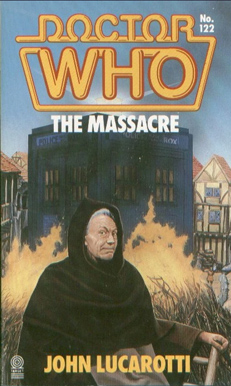
Cover: Tony Masero paints the Abbot of Amboise standing in front of the TARDIS atop a burning pyre. Alister Pearson’s 1992 reprint cover shows two faces of William Hartnell (suggesting one is supposed to be the Abbot), plus Peter Purves as Steven, Joan Young as Catherine de Medici and David Weston as Nicholas Muss, all in front of a church in sunset. Weston previously appeared in character as Biroc on the cover of Warriors’ Gate.

Final Analysis: So the legend goes, John Lucarotti’s first submission to the Doctor Who production office was said to lack historical detail. He more than makes amends here (as his author’s note attests), and as with The Aztecs, he creates a sense of being immersed in a real, lived-in world. Unlike, say, Time Flight, where Peter Grimwade wastes no opportunity to show off his Concord-related research, Lucarotti threads his fact-finding to improve the narrative. The Doctor and Steven explore Paris at the start, prior to making their way to the tavern, and the Doctor’s guided tour serves to help them pin down the approximate year in which they find themselves but also to sketch in the world around them. When we reach the catacombs where the rebels are hiding, we’re shown their peculiar mode of transport around the city – dog carts! I’d have loved to have seen William Hartnell zooming off stage left in one of those! One other addition from Lucarotti is Raoul, Anne’s 14-year-old brother. While the author might have felt that his addition would provide a little more logic to the revelation that future companion Dodo might have inherited the family name, the fact that she is said to be identical to Anne leaves some rather uncomfortable incestuous conotations that we’re best not to unravel.

Bonus chapter #6. The Companions of Doctor Who: K9 and Company (1987)

Synopsis: Journalist Sarah Jane Smith used to travel for a while, companion to an eccentric man with an unpredictable manner. Her journeys ended as abruptly as they began and she never heard from him again – until one Christmas when she paid a visit to her Aunt Lavinia. Lavinia was nowhere to be found, but waiting for her instead were her Aunt’s ward, a schoolboy called Brendan, and a present from her old friend – a computer in the shape of a dog. Together, the trio uncover a terrifying demonic cult hidden away in an English village.

Chapter Titles

  • Prologue
  • 1. Exit Aunt Lavinia
  • 2. Enter Sarah Jane
  • 3. An Invitation
  • 4. A Gift from the Doctor
  • 5. The Black Art
  • 6. A Warning
  • 7. K9 Blunders
  • 8. A Confrontation
  • 9. Brendan is Taken
  • 10. K9 Goes Undercover
  • 11. Human Sacrifice
  • 12. Halstock
  • 13. Evil Under the Moon
  • Epilogue

Background: Terence Dudley adapts his own scripts for this one-off Christmas special from 1981 (or 1982 if you’re from the north-west of England, where a technical fault with the Winter Hill transmitter took BBC One off the air for a night and Northerners had to wait until the following year for a repeat).

Notes: Aunt Lavinia’s house, Bradleigh Manor, is in Hazelbury Abbas, Dorset, not Moreton Harwood, Gloucestershire as on TV; she inherited the manor from ‘Uncle Nicholas’, who Sarah Jane used to visit every summer when he was alive (it’s not clear if Nicholas was Lavinia’s husband or just a mutual relative). Coven member Vince Wilson regrets that the ceremony couldn’t be performed naked to ‘release more cosmic force’ and ‘increase bodily strength’. Doctor Lavinia Smith is ‘a strikingly handsome woman and, undoubtedly, middle-aged’. She’s specifically an ‘anthropologist’, not a ‘virologist’ [see Planet of the Spiders]. Juno Baker is in her late thirties and ‘blessed with a dark, ageless beauty with more than a hint of the voluptuary flowing from her well-poised head to the tips of her Gucci shoes’. 

Sarah Jane Smith had been sent to report on the famine in Ethiopia but after infiltrating rebel forces she was briefly stranded at a North African outpost [presumably after leaving Ethiopia in the east] before she was able to return home. It’s three years since she last saw the Doctor (remember, there’s none of this ‘1980’ stuff in the novel timeline). She’s managed, rather, conveniently, to be commissioned by Harper’s on ‘the revival of English village life’. On her way to her aunt’s house, she finds herself stuck behind a car that prompts her to complain about ‘Women drivers!’ Sarah currently lives in a flat and her friend Ann has keys to enable her to check on Sarah’s mail whenever she’s away (we don’t get any other explanation for Ann, though). Brendan is 14 years old and claims to be able to drive a car. 

At the Post office, Lily Gregson tells Sarah about the (real-life) landmark of the Cerne Abbas Giant chalk man – which she calls ‘ever so rude’  – and warns her that the locals consider anyone not born there before the Roman invasion to be a ‘foreigner’; she herself is a newcomer, her family having moved there after the civil war in the 17th Century (and we later learn that George Tracey is a descendant of Publius Trescus of the Tenth Legion). Brendan and K9 debate the process of peeling potatoes and their relationship is openly antagonistic rather than instantly enthusiastic as on screen. Henry Tobias admires a witch’s sacrificial knife, which Juno Baker says was a gift from Lavinia Smith. George Tracey resents Lavinia Smith and her family, considering their land to be his after all his work on it. He and his son Peter kidnap Brendan by clamping a pad over his mouth before tying him up. There are a few extra scenes of Peter taking care of Brendan and apologising for the situation (including one where Brendan realises that Peter is as much a captive as himself and ponders why he’s not also tied up).

Sarah Jane is greatly concerned that K9 might be seen and ‘finish up in some scrap metal yard’, so she carries him around in a holdall, rather than just propping him up on the back seat of her car. Sarah is a confident driver with a strong sense of direction:

Sarah Jane was afflicted by a curious neurosis when driving which amounted to an unreasonable fear of losing the way. She had a profound distrust of signposts which indicated that her destination lay to the left when she knew, without doubt, that it lay to the right. She drove by the compass which bore little relation to a local authority’s layout of highways.

Bill Pollock distracts Sarah by claiming he’s contacted the police, which she doesn’t expose as a lie for a whole day. Her hunt for a suitable church for a black mass passes East Coker, which she dismisses as it’s the resting place of the writer TS Eliot (‘A great poet and a man of the Church. No witch would dare to go near there, I’m sure,’ she tells K9), and Trent, where the 99th Archbishop of Canterbury, Geoffrey Fisher, is indeed buried. Instead of an inconvenient tractor blocking her route, Sarah has a terrifying encounter with a white TR7 driven by an unidentified  young man who might be in the employ of the coven, or could just be a particularly aggressive road-rager intent on recreating the film Duel. Her quest includes stopping off at a pub asking about nearby ruins, before K9 confirms that the site they are looking for is back where they began, in the grounds of Bradleigh Manor! As part of the ceremony, the coven members strip Brendan naked. In the Epilogue, as everyone recovers at the Bakers’ home, Brendan discusses how the cultists might have disposed of his body and Howard Baker suggests a lime pit ‘or a section of motorway’. Sarah has at least one glass of Howard’s brandy [see The Ark in Space for why this might be odd]. Back at the manor, K9 attempts to sing While Shepherds Watched Their Flocks By Night, rather than We Wish You a Merry Christmas. 

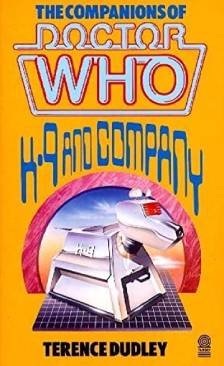
Cover: Peter Kelly airbrushes a very sleek-looking K9 under an arched logo.

Final Analysis: Any problems with the story – and there are a fair few – are present in the TV story (are teenage boys really that excited by the minutiae of market gardening?). What is really missing is the natural warmth of Elisabeth Sladen, who delivered the rather snippy dialogue with at least a little humour, so she remained immensely likeable. That aside though, it’s a beautifully written book with richly drawn characters and a lovely child-friendly flavour of folk horror, while Dudley fulfils the old ‘educate and inform’ remit by name-dropping literary figures such as TS Eliot and WB Yeats

… and that’s it for the Companions of Doctor Who sub-range. Such as shame, because despite a very poor start, the other two have been very entertaining indeed. There were further novels in various stages of discussion, including one written by Janet Fielding about Tegan and a sequel to Harry Sullivan’s War that sadly never came to pass.

Chapter 120. Doctor Who – The Ambassadors of Death (1987)

Synopsis: As a tracking station on Earth awaits the return of a Mars capsule and its crew, the rocket’s inhabitants are kidnapped and hidden away. Liz Shaw discovers that the astronauts are not the ones that left Earth but alien ambassadors. Someone is conspiring to use the aliens for their own means – and start a war in the process…

Chapter Titles

  • 1. ‘Something Took Off From Mars…’
  • 2. ‘That Sound – It Was Some Kind Of Message…’
  • 3. ‘They’ll Never Survive…’
  • 4. ‘Recovery Seven – It’s On The Way Back!’
  • 5. ‘The Capsule Has Landed.’
  • 6. ‘They’ve Started To Crack The Code…’
  • 7. ‘You Must Feed Them Radiation – Or They’ll Die!’
  • 8. ‘We’ve Got To Get That Rocket Up!’
  • 9. ‘Someone’s Threatening To Kill Miss Shaw!’
  • 10. ‘An Attack On The Space Centre?’
  • 11. ‘Do You Really Think They’re Not Human?’
  • 12. ‘Large Unidentified Object Approaching On Collision Course…’
  • 13. ‘The Capsule Will Be Smashed To Fragments…’
  • 14. ‘Your Doctor Friend Is As Dead As A Doornail…’
  • 15. ‘We May Not Have Much More Time!’
  • 16. ‘We’re Being Invaded!’

Background: Terrance Dicks adapts the 1970 story credited to David Whitaker (but which also included passes by Malcolm Hulke and Trevor Ray), completing the run of Season 7 stories – and the Third Doctor’s era as a whole – that began with Target’s first original adaptations back in 1974.

Notes: The TV reporter’s name is given on screen as ‘John Wakefield’, but here it’s now ‘Michael’, while astronaut Charles Van Lyden becomes ‘Van Leyden’. Ralph Cornish at Mission Control is said to be ‘quite literally tall, dark and handsome’. Dicks is not as snide as he was about Chorley in Doctor Who and the Web of Fear, but he still makes a few sly digs at the TV reporter; he’s small, neat and bearded with a ‘low, throbbing, earnest voice that seems to be the exclusive property of a certain kind of TV journalist’. 

It was a voice that conveyed expertise, sympathy, concern and a sort of muted reproach. The implication was that somehow Michael Wakefield already knew all the answers. Luckily for him, he never had to provide them. He only asked the questions, and passed along the background information assembled for him by an expert team of researchers, all kept firmly behind the camera.

For the final time, we have Dicks’ standard description of the third Doctor, with a face that is ‘neither young nor old’, and that Bessie is ‘an Edwardian roadster’ (and I’ve waiting until now to point out that it’s not actually a Roadster, it’s a four-seater Tourer, but Roadster is such a fun word). It’s still early days for the Doctor and Liz, having only had ‘two dangerous adventures’, and we’re reminded of the incident with the Silurians. 

In the assault on the ‘enemy’ in the warehouse, the Brigadier notices that they are ‘simply better than his own men, better shots, better trained in this kind of house-to-house fighting’. It’s the fact that none of his troops has been shot that draws the Brigadier’s suspicions – accurate shots knock the guns away but nobody is actually hit, and he notes that there’s ‘something rather humiliating about fighting an enemy who weren’t even trying to hit back’. The Doctor’s trick with the disappearing tape is ‘a Time Lord technique somewhere between telekinesis and conjuring’. 

The scientist Heldorf had been a refugee and still had a trace of an accent. Reegan was born in Ireland but spent most of his life in America, among other countries, evading the law. He’d been a bank robber for the IRA until they’d discovered he’d been stealing from them. He set himself up as a professional, specialising in ‘kidnapping, extortion and murder for hire’.  

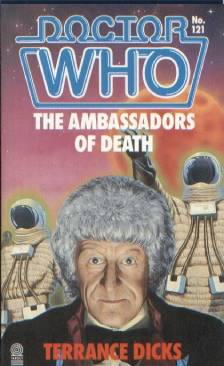
Cover: The Doctor smiles as two ambassadors in space suits approach him from behind. Tony Masero’s original cover had a much more shadowy depiction of Jon Pertwee, but this was changed in response to a request from the actor. This is the first cover to feature the Third Doctor prominently on the initial cover since The Claws of Axos (1977), or on any cover since the 1978 Three Doctors reprint (aside from a small profile as part of a montage on The Five Doctors).

Final Analysis: We begin with a deceptively simple opening line: ‘Far above the Earth, in the infinite blackness of space, two metal capsules were converging.’ That ‘infinite blackness of space’ leapt out at me as a quote from something – Terrance Dicks first used a version of it back in The Claws of Axos – and a quick survey on Twitter led to Paul Rhodes supplying a flurry of suggestions for a possible source. Nasa’s own public information office LB Taylor Jr appears to have coined the phrase in his commentary around the Apollo 11 moon landings, which is appropriate considering the subject of The Ambassadors of Death. An earlier reference can be found in The Transcendent Man, a 1953 novel by future Star Trek and Twilight Zone writer Jerry Sohl, while the earliest I’ve found is a 1920 edition of the handbook of the Boy Scouts of America. It’s a phrase that crops up across science fiction from Star Trek to Marvel Comics’ Silver Surfer but as yet, I’ve not found an origin. Any suggestions?

There are some other lovely turns of phrase here: The warehouse where Carrington’s crew are hiding out has ‘row upon row of arched windows, every one methodically broken by the industrious local vandals’. The little extra biographical details for Heldorf and Reegan feel like something Malcolm Hulke would have added (appropriate considering he contributed to the TV scripts). We’ve come a long way from the days where Terrance was bashing these out one a month and as we reach the end of the third Doctor’s TV adventures, this stands out as one of the author’s very best.

Chapter 119. Doctor Who – The Romans (1987)

Synopsis: The time travellers enjoy a relaxing time in a villa just outside Rome. As the Doctor and Vicki head off on a trip to the city, Ian and Barbara are kidnapped by slave traders. Barbara is bought by a slave-master working for the Emperor Nero, but Ian’s fate is to be placed at the oars of a slave ship. Can the Doctor solve some of the mysteries surrounding Nero without affecting established history?

Chapter Titles

  • Prologue
  • I First Extract from the Journal of Ian Chesterton
  • II First Extract from the Doctor’s Diary
  • III First Letter from Legionary (Second Class) Ascaris
  • IV Second Extract from the Doctor’s Diary
  • V Second Extract from the journal of Ian Chesterton
  • VI Second Letter from Legionary (Second Class) Ascaris
  • VII Third Extract from the Doctor’s Diary
  • VIII Third Letter from Legionary (Second Class) Ascaris
  • IX Third Extract from the Journal of Ian Chesterton
  • X Fourth Extract from the Doctor’s Diary
  • XI First Extract from the Commonplace Book of Poppea Sabina
  • XII Fourth Extract from the Journal of Ian Chesterton
  • XIII First Selection of jottings from Nero’s Scrapbook
  • XIV Fourth Letter from Legionary (Second Class) Ascaris
  • XV Fifth Extract from the Doctor’s Diary
  • XVI Fifth Extract from the Journal of Ian Chesterton
  • XVII Second Extract from the Commonplace Book of Poppea Sabina
  • XVIII A Poisoner Remembers
  • XIX Letter from Barbara Wright
  • XX Second Selection of Jottings from Nero’s Scrapbook
  • XXI Sixth Extract from the Journal of Ian Chesterton
  • XXII Third Extract from the Commonplace Book of Poppea Sabina
  • XXIII Fifth Letter from Legionary (Second Class) Ascaris
  • XXIV Sixth Extract from the Doctor’s Diary
  • XXV Seventh Extract from the Journal of Ian Chesterton
  • XXVI Seventh Extract from the Doctor’s Diary
  • XXVII Sixth Letter from Legionary (Second Class) Ascaris
  • XXVIII Third Selection of Jottings from Nero’s Scrapbook
  • XXIX Eighth Extract from the Doctor’s Diary
  • Epilogue

That ‘most number of chapters in a novelisation’ record (previously held by The Myth Makers) gets smashed here with 29, plus a prologue and epilogue.

Background: Donald Cotton’s adaptation of scripts by Dennis Spooner for a story from 1965 arrives 22 years and two months after it was broadcast on TV. It’s the only time Cotton approaches scripts originally written by someone other than himself.

Notes: Consistent with his previous novels, this version of The Romans is narrated by Tacitus, the great Roman historian. Here though, Tacitus’s role is that of a framing narrative, within which appear certain documents that have fallen into his hands – diaries and letters written by Ian, the Doctor and Barbara, among others (as the chapter listing above shows). As a consequence, this is the first novel to be narrated in part by Ian Chesterton since the very first one. His chapters are addressed to his headmaster (who might or might not be the same one we’ll actually meet in a later story) and he fears his employer assumes that he and Barbara have eloped, which might affect their pensions. In the Doctor’s journal, he confesses that he intends to leave the school teachers behind when he visits Rome, due to his concerns that Ian’s politics might get him into trouble in the heart of an Empire, while Barbara is being punished for spending their money so freely on ‘feminine fal-lals’. He learns from his companions of a passing scholar who they encountered in a nearby town, and who performed ‘a rambling iambic account of the Rape of Lucretia’, which he considers to be inappropriate for ‘a mixed audience’ (a view with which Vicki later agrees). 

We learn more of the scholar in a legionary’s letter to his mother, in which he reveals that he has been ordered to kill said scholar, who is ‘in the running for the Golden Rose Bowl at the Senate Song Contest’, an accolade his employer wishes for himself. Ian learns from the home invaders that Barbara carelessly asked about the conversion rate from pounds to lira in the market, alerting the locals that she and Vicki must be Britons. Ian recalls he’d once contemplated a sailing holiday that would have been roughly the same stretch of water on which he now finds himself after being press-ganged into the rowing crew of a ship. He played rugby as an ‘Old Boy’, which once again suggests he’s a former pupil of Coal Hill School. He also reminds his headmaster that he was deputised as games master after Farthingale ‘lost an ear during a hockey scrimmage’. Ian references the hugely successful American comedian Jack Benny.

Nero sketches out an ode to Barbara – it’s terrible – and he uses the word ‘anapaest’ (incorrectly). There’s an unfortunate scene in the Doctor’s diary where he refers to a character as ‘deaf and dumb’ (very much frowned upon nowadays, but a common enough term even when the book was written); he claims to be ‘well acquainted with the rudiments of sign language’, but as he also calls it ‘mime’, we can take from this that the Doctor knows nothing about sign language (as we later see on TV in Before the Flood), least of all that there is not one universal sign language – not even in English-speaking territories. Let’s hope his efforts are more effective than we see on telly with the Zarbi!

The lions, which the Doctor accidentally frees during the gladiatorial games, find their way into Nero’s suite, where they settle down for a nap. Having embarked upon his adventure solely to disprove the legend that Nero ‘fiddled while Rome burned’, the Doctor leaves with Nero’s lyre and his plans for a new Rome in his hands; he sets fire to the plans, which then causes a major fire in the city and, happy that he has not made any effect on established history, departs while playing the lyre. In the epilogue, Tacitus lays the blame for the fire squarely on the Doctor’s shoulders. He names the tale ‘The Quo Vadis TARDIS Affair’ and also reveals that the failed assassin Ascaris eventually ended up in Britain, causing mayhem and disruption during the construction of Hadrian’s Wall.

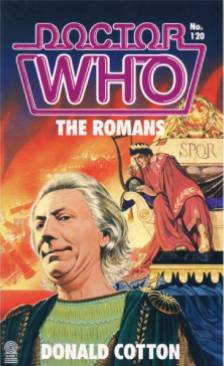
Cover: As Nero looks out to a burning Rome, the Doctor stands dressed in a toga. Tony Masero coincidentally uses the same photo reference of Hartnell that Andrew Skilleter used on The Gunfighters.

Final Analysis: Where to start with this? It’s likely that Donald Cotton has seen the BBC’s I Claudius. He might even have read Robert Graves’ original Claudius novels, too; as with Graves’ notation of the events of the Roman Empire, there’s a sly nod to the modern reader in the way Cotton suggests that his work is too contentious and should be left unpublished until… say, 1987. He definitely watched the historical farce Up Pompeii! though. His Tacitus straddles the centuries, just like Frankie Howerd did as Lurcio, with puns and sly winks that would make little or no sense to the Romans. Indeed, there’s one sequence where the Doctor, in his diary, observes that his would-be assassin was ‘getting away with the lute’, a joke that clearly gives him great satisfaction, until the character (and writer) begin to dissect it and he realises that the musical ‘lute’ wouldn’t be invented for four centuries and the word ‘loot’ wasn’t popularised until the 1920s. 

While the story remains largely the same, Cotton’s use of multiple epistolary narrators leads to some deviations in the telling. The assassin Ascaris becomes a recurring narrator and adds greatly to the sense that the Doctor is in fact a bloody nuisance. The poor Legionary accidentally kills his own superior, is set upon by lions and eventually emerges from his hiding place when the Doctor throws burning documents into the sewers, setting Ascaris alight. This is Cotton’s final novel for the range and it’s a shame. Each of his novels provides an education, not so much in the history, which is wilfully unreliable, but in the sheer unlimited joy of writing. I’ve loved every unbelievable word of these.

Chapter 118. Doctor Who – The Reign of Terror (1987)

Synopsis: The TARDIS lands on Earth and the Doctor is keen to rid himself of the schoolteachers at last. Ian, however, wants assurance that the time is correct as well as the location. He’s right to be cautious as the travellers soon learn they have arrived in France in the 18th Century, when a bloody revolution is sweeping through the country. Separated from the Doctor, his fellow travellers Ian, Susan and Barbara are arrested and face execution, before they receive a surprising offer of help – and face betrayal from a new acquaintance.

Chapter Titles

  • 1. So Near And So Far
  • 2. Under Siege
  • 3. Prisoners Of The People
  • 4. The Diggers
  • 5. Liberty
  • 6. Sanctuary
  • 7. The Tyrant Of France
  • 8. Betrayal Everywhere
  • 9. Illusions Shattered
  • 10. A Hard Bargain
  • 11. A Glimpse Of Things To Come
  • 12. Escaping From History

Background: Ian Marter adapts scripts from a 1964 story by Dennis Spooner. The book was published 10 months after Marter’s death and 22 years and six months after the story originally aired, narrowly missing out on the record for biggest gap between transmission and novelisation by just two weeks. This followed The Sensorites on TV, so that’s another pair of stories to be released consecutively.

Notes: The Doctor apparently has ‘sharp grey eyes’ (and is described as being a ‘Time Lord’!) while Susan is said (rather wonderfully) to have ‘Joan of Arc features’. The TARDIS scanner has a ‘telephoto’ setting. The Doctor has a normal body temperature of ‘sixty degrees fahrenheit’ (which is about 15 degrees celsius). Ian can speak basic, halting French, Barbara is a little better but of course the Doctor is fluent (so, no ‘Time Lord gift’ in play here). On hearing that the French Revolution is the Doctor’s favourite period of Earth history, Barbara realises that this was why Susan had wanted to borrow the book on that particular topic on the night that the two teachers were abducted. We’re reminded repeatedly of the teacher-pupil relationship between Barbara and Susan. Confronted by the innkeeper of The Sinking Ship Inn, Ian pretends that he and Barbara are a married couple (and a generation of fans experience a momentary glow of emotion). It’s Barbara, not Ian, who tells James Stirling about Napoleon Bonaparte’s rise to power as ‘one of three Consuls’, despite assuring Ian that she learned how impossible it is to change history during their encounter with the Aztecs. Once the travellers have made it safely back to the TARDIS, the Doctor tells the two teachers that their involvement in this period of history will have no effect:

‘The mainstream of history is fixed and immutable,’ he reminded them. ‘I think you’re all rather belittling the subject. Our own lives are important in themselves. To us, at present. As we experience things, so we learn.’

The Doctor’s final line on TV is removed here, replaced by an exchange where Ian asks where they’re heading next and the Doctor replied ‘Who knows? Because I certainly don’t!’

Cover: The Doctor in that famous tricolor-adorned outfit stands in front of citizens and a guillotine, in a painting by Tony Masero.

Final Analysis: Everyone expected Ian Marter to approach the French Revolution as if it were a Roger Corman adaptation of an Edgar Allen Poe story. While there is a particularly graphic depiction of Robespierre being shot (‘blood, teeth and fragments of jawbone spurted out between his clawing fingers’), Marter is otherwise remarkably restrained. Here, without oily Cybemen to provide the gore, he instead dwells upon the expectorations of the characters: The roadside foreman spits into a hedge; the gaoler spits before wiping his nose on a sleeve; during the fire in the farmhouse, even the Doctor succumbs to ‘bubbling acid mucus’, which he spits out during ‘a spasm of nauseous coughing’. Marter spares us none of the squalid details of life in the past, where food is poor, medicine involves leeches and everyone’s rather smelly. Our regulars really suffer too, with abrasions to their hands and wrists from all the digging and being chained up. You have to wonder though – why would the Doctor consider a time of mass public executions his favourite period of Earth history? Maybe if Susan had actually brought back that book from school he might have known better…

Chapter 115. Doctor Who – The Faceless Ones (1987)

Synopsis: The TARDIS lands at London Airport and when a startled Jamie flees from his first sighting of an aeroplane, his friends are soon separated. Polly hides from the airport police in a nearby hanger, where she witnesses a murder. Jamie befriends a young woman in search of her missing brother as the Doctor tries to explain his presence to the authorities. Somewhere in the airport, a very quiet invasion is taking place, organised through the travel agency Chameleon Tours…

Chapter Titles

  • 1. Obstruction On Runway Five
  • 2. The Suspects
  • 3. Man Without A Face
  • 4. The Transfer
  • 5. The Missing
  • 6. The Trap
  • 7. The Abductors
  • 8. The Secret Of The Chameleons
  • 9. Death Ray
  • 10. Captured
  • 11. Spaceship
  • 12. The Traitor
  • 13. Flight Into Peril
  • 14. The Bluff
  • 15. The Deal

Background: Terrance Dicks adapts scripts from a 1967 story by David Ellis and Malcolm Hulke.

Notes: We’re reminded of the origins of the three companions, beginning with ‘that terrifying business of the War Machines,’ including the one where Ben and Polly met Jamie, and we’re informed that Ben and Polly have asked the Doctor to bring them back home. 

The manager of the airport is called Charles Gordon: his title ‘Commandant’ is an unflattering ‘Gestapo’-inspired nickname given to him by his staff, not his actual rank. The first Chameleon is a little less gory than it appeared on TV:

There were no features, and except for the eyes nothing you could call a face. Nothing but a completely blank sphere, across which ran pulsating veins…

Samantha Briggs is introduced as ‘a round-faced, dark-haired girl who looked as if she might normally be a rather jolly, cheeky type’ and she has ‘a faint nasal twang to her voice’ that’s evidence of a Liverpool accent. The Doctor uses his sonic screwdriver in a couple of scenes [a device not introduced on screen until Fury from the Deep]. There’s a tiny additional scene after everything’s been resolved [see Final Analysis below] and Dicks corrects the date that Jamie longs for (he’s three years off his original time on TV).

Unusually, the story retains the cliffhanger from the original transmission, even though it’ll be a while before it’s resolved in print. Oh and chapter 13’s ‘Flight Into Peril’ is a neat reworking of the ‘Escape to Danger’ trope.

Cover: As an aeroplane takes off, the TARDIS materialises on the runway, painted by Tony Masero.

Final Analysis: I’m going to get misty-eyed every time we get to a Terrance Dicks story from now on, I suspect, even if it’s another fairly solid transcription of what happened in the original scripts. As on TV, Samantha is invested with so much personality that it’s still a shock when she doesn’t join the Doctor and Jamie on their adventures – just as it’s still a shock when Ben and Polly decide to stay on Earth. Dicks does make a few small changes, such as the addition of the sonic screwdriver, which just help to move things along, and then there’s the conclusion, where Jamie is less than satisfied, and Dicks perhaps suspects that the reader might be too:

‘You mean they’re just going to get away with it, Doctor?’ muttered Jamie. ‘Och, it doesna seem fair!’

‘It isn’t, Jamie. But we can’t undo the wrong they’ve done without their help.’ The Doctor smiled wearily. ‘You don’t always achieve perfect justice, you know. Sometimes you just have to do the best deal you can!’

Chapter 109. Doctor Who – Fury from the Deep (1986)

Synopsis: Playing on a beach near a gas refinery in the English Channel, the Doctor, Jamie and Victoria are arrested for trespassing. Head of the base Robson would rather accuse the Doctor and his friends of sabotage than accept that there might be something in the gas pipes. But there is – a steady heartbeat of… something. Down there… in the dark…

Chapter Titles

  • 1. The Deadly Sound
  • 2. Something in the Pipeline
  • 3. A Pair of White Gloves
  • 4. Mr Oak and Mr Quill
  • 5. Waiting in the Dark
  • 6. The Specimen
  • 7. The Figure on the Beach
  • 8. The Impeller Shaft
  • 9. The Battle of the Giants
  • 10. The Spy Within
  • 11. The Nerve Centre
  • 12. ‘Scream, Victoria! Scream!’

Background: Victor Pemberton adapts scripts from his own 1968 serial. At 189 pages, it’s by far and away the biggest novelisation so far (and the original cover price reflected this!).

Notes: The Doctor is said to have ‘never really liked the sea. In fact, it was the only thing he really feared. It made him feel insecure, restless’ (contradicting the opening scenes of Enemy of the World – and in contrast to Patrick Troughton, who was a lieutenant in the Royal Navy during WWII). Jamie has a bizarre sneezing reaction when he comes into contact with the foam in the sea, something that later becomes an early warning of an impending weed attack. We’re reminded that Jamie grew up in ‘the Scotland of the Jacobean age’ and that Victoria misses ‘the love and protection of her dear father back in the Victorian age’; later, it’s said that she considers Jamie to be ‘a very special person, the sort of brother everyone should have’, which is just adorable. The Doctor uses ‘his own version of a screwdriver’ but it’s not specifically ‘sonic’ [Pemberton had apparently resented that he’d never received credit for inventing the Doctor’s signature device, so this is a little surprising]. When the Doctor is shot on the beach, Jamie struggles to accept that his friend might be dead:

The Doctor had survived so many attacks on his life during their travels through time and space. The Doctor was as indestructible as time itself.

Controller Robson is said to be ‘a burly-looking man, probably in his early fifties, with greying hair, a jutting jaw, and vacant grey eyes.’ The nametag on his uniform says his name is ‘ROBSON. S’, though we’re later told his name is ‘John’ so the ‘S’ name is a mystery; while it’s common for people to be addressed by a middle name, it’s a little confusing that we have that little mystery unexplained (maybe his birth name is St John?!). 

Frank Harris is a skinny young man in his late twenties, ‘weak-looking’ with ‘blue eyes, a pale face and gaunt expression, and a mop of blond, unruly hair that constantly flopped carelessly over his right eye’. Robson resents Harris for being young and educated in a ‘red-brick university’. Pieter Van Lutyens is ‘a likeable little man, dumpy, balding’ and speaks English ‘with no trace of an accent’ (so not a match for John Abineri or his performance on TV); he’s been a member of the team at the refinery since being appointed by the government two years previously. Chief Baxter is in his late-fifties and ‘one of the most experienced drilling engineers in the North Sea gas fields’. He was once in line for the role that eventually went to Robson, but was considered too important to the offshore drilling programme. All of the background details really help to explain why Robson is so paranoid and defensive towards the experts who surround him. A reflective scene reveals that Robson’s wife, Angie, died 22 years earlier in a car accident where Robson was the driver. Megan Jones is ‘an attractive middle-aged woman’ with ‘vivid red hair’; she comes from the Rhondda Valley, the daughter of a coal-miner. Megan’s secretary, Ronald Perkins, is ‘an effete young man, a devoted, ambitious civil servant, who would sooner die than contradict his superiors’. The video operator Price’s first name is ‘David’, while the chief operator of Rig D is Mick Carney.

The Doctor believes that Victoria has ‘the loudest, most terrifying scream he had ever heard’. He also surmises that Maggie Jones was transported to the rig in a cocoon created by the weed creature. The TARDIS makes a ‘grinding and grunting sound’ as it dematerialises. The seabirds return to the area now that the weed parasite has been defeated.

Cover: In front of a North Sea gas platform, a frond of seaweed emerges from the water, as realised by David McAllister.

Final Analysis: The novelisation of Fury from the Deep won the Doctor Who Magazine 25th Anniversary Poll for best Target novel ever. This shouldn’t be a surprise. As one of the infamously completely missing stories, it’s one that the Old Guard lauded as being among the very best without any evidence that younger viewers could point to for a counter-argument. By the close of 1986, many fans only knew the story from this book. It also features the departure of a companion that, for once, is ceded through the entire adventure and the novel makes great use of the space to tell a character-driven story where each individual has clear motivations, strengths and weaknesses. 

This also feels rather traditional. While he isn’t afraid of adding a little extra biographical detail to his characters or polishing a scene to heighten the tension, Pemberton largely sticks to his original plot and doesn’t try to be experimental with the narrative. He also employs an old Terrance Dicks trick of repeating descriptions to establish characters (Harris’s lock of hair, Oak and Quill’s white gloves) and especially to announce the presence of his monster, in this case ‘bubbling white foam’ – later evolving into ‘a mass of white foam’. Pemberton also gets extra points for sneaking a namecheck for the tile into the final chapter:

Down below, the mud-coloured sea was pitted with undulating swells of white spray and bubbling blobs of foam, soon to become a slave of the fury from the deep…

Robson’s transformation into a weed creature is, predictably, more horrific on the page, not quite to the degree that Ian Marter might have offered, but the slowly engulfing menace is beautifully realised, making assets out of elements that might have been weaknesses on TV (we don’t know, we can’t see it, but we can assume that a studio-bound scene involving foam during the second Doctor’s era might look like – there are a fair few of them!):

The Doctor and Jamie stared in horror as the room was flooded with light. They were in a large crew cabin, at the far end of which was a seething mass of bubbling white foam. And in the midst of that foam was a sight that would chill the blood of even the strongest of mortals. The figure of a man was standing there, half demented, his neck and hands sprouting frond-like weed formations. And out of the foam that had almost completely engulfed him, the curling tentacles of the giant Weed Creature were snaking around his lifeless body.

The deafening heartbeat sound stopped abruptly. There was a deathly silence, then the man who had become a creature himself, began to emerge from the foam, arms out-stretched, walking slowly, jerkily, straight towards the Doctor and Jamie.

‘Come in, Doctor,’ whispered the human creature. ‘We’ve been waiting for you…’

It was Robson.

Yes, it’s a much bigger book than we’re used to, but unlike a few other examples published in the same year, this never feels padded and it doesn’t add unnecessary details for the sake of it. 

So is this the best of the Target range so far?

Could be…