
Chapter 153. Doctor Who – The Pescatons (1991)

Synopsis: The Doctor and Sarah Jane Smith witness the appearance of a hideous creature on the banks of the Thames. Seeking help at a nearby research station, they discover that a recent meteorite hidden underwater is actually a crashed spaceship. Its inhabitant, a Pescaton, heads for central London on the rampage before it eventually dies. But this is just the first, as soon hundreds of spaceships disguised as meteorites enter the atmosphere of Earth. The Pescaton invasion has begun!

Chapter Titles

  • 1. The Darkest Night
  • 2. Into the Depths
  • 3. Panic!
  • 4. A Premonition
  • 5. While the City Sleeps
  • 6. The Terror Begins
  • 7. Pesca
  • 8. Creatures of the Night
  • 9. ‘Find Zor!’
  • 10. The Deadly Encounter

Background: Victor Pemberton adapts his scripts for a story released on LP in 1976. Although the range continues under Virgin Books and is later resurrected by BBC Books, this is the last of the original run of Target books. Just to be annoyingly inconsistent, while Slipback was treated as an extra novel outside of the numbered library, The Pescatons is given a number. 

Notes: The Doctor has a poor sense of smell but heightened hearing. Sarah Jane has ‘lovely’, ‘large brown eyes’. The travellers land a couple of miles down the coast from Westcliff, Essex, later confirmed to be  Shoeburyness. The Doctor guesses that they’re in the mid-1970s and while we’re later told that they’re reached ‘the seventh decade of the twentieth century’ (which is, er, the 1960s), Sarah Jane also notes that they’re about ten years or so from ‘the period in time she left behind’ – which would suggest the mid-1980s or an unseen adventure.

The first clue of the Pescaton’s approach is a strong smell of fish, then a hissing sound like ‘a jungle cat stalking its prey’.

… eyes glaring like giant emeralds. It was a huge, towering creature, over twelve feet tall, half-human, half fish, with shining silvery scales covering its sticky body, and hands like talons with sharp nails, and webbed feet which were veined in red, heavy and clumsy. Its face was weird, almost gothic; it was like a gremlin, a manifestation of the Devil itself.

A sticky green stuff blocks the route to the TARDIS so the travellers visit the Essex Coastal Protection Unit (ECPU) where they meet 28-year-old head of research Mike Ridgewell and his colleague and longtime girlfriend Helen Briggs. While Mike accepts the Doctor’s claims about an alien creature. Helen doesn’t trust him and is confused by his relationship with Sarah, wondering if she’s his daughter. Mike does the ‘Doctor who?’ joke (first time we’ve had that in a while) and the Doctor replies ‘if you insist’ and introduces Sarah Jane as his ‘assistant’. Mike is a little sharp with Sarah Jane and snaps at her (mild swear-word warning) ‘don’t talk crap!’

The Doctor is ‘not a good swimmer at the best of times’ but he finds the experience of diving to the depths of the estuary ‘awesome’ and reminiscent of walking in space. The Pescaton spaceship is made of a metal he doesn’t recognise. As he leaps from his recovery bed in the First Aid unit of the ECPU, we discover that the Doctor wears ‘long-leg underpants’! When Sarah Jane asks him how old he is, he replies ‘Trade secret’. The Doctor met Professor Bud Emmerson in a ‘previous generation’. Emmerson is in his mid-sixties, with almost white hair, cropped short, and he’s ‘just as fat as he always had been’, which makes his ‘tall, massive body’ look out of proportion with his ‘really quite small’ head. He was a comedy actor in the 1950s but fell into astronomy. He gained widespread recognition for his discovery of a cluster of planets and invested funding from global astronomical organisations and donations from fans to build the North London Observatory on Highgate Hill. The Doctor helped him identify Pesca and the Professor has been studying the planet ever since. Pesca has hardly any ‘ozone protection’ (a major environmental concern at the time of publication).

Mike and a young member of the team called Pete Conway find a beach hut covered in the green substance which has hardened into a shroud shape. Believing a teenage boy is trapped inside, they use a drill to crack open the cocoon, only to discover that Pescatons can mimic human voices – and from the cocoon emerge small, shrieking Pescaton hatchlings, each about eight inches long and instinctively vicious. Seeing a police presence on the banks of the Thames, Sarah gets through a cordon by flashing a press pass (that’s ten years out of date), then the Doctor claims to be from the Department of the Environment. The Doctor recognises a large cone containing thousands of Pescaton eggs, having seen something similar on a past visit to Pesca. The Doctor carries a mini-telescope, a dynameter for ‘tracing sonic direction’ and a flute (replacing the piccolo from the album).

We first encounter Zor in a flashback to the Doctor’s previous visit to Pesca:

A massive creature, with slanting, luminous green eyes bulging out of an oval head covered with shining, metallic scales. Its teeth were sharp and pointed, like needles, and the gills behind its head pulsated as it breathed. And the body! The fins of a killer shark, hands with sharp claws, and the legs of a human stretching down to veined webbed feet. The creature’s tail, which was long and tough, like that of a crocodile, stretched out behind its body but never seemed to move.

…. through those eyes the Doctor could see right inside the creature’s brain, a hideous mass of living energy, a great beehive shape, crawling with minuscule ‘thought worms’. 

The creature mimics the Doctor’s speech patterns (so, unlike on the record, it doesn’t have a gravelly North American accent that should be selling us aftershave or narrating movie trailers). Back on Earth, Zor is tracked down to an underground tunnel near Aldwych Station and is destroyed by bright arc lights (on the record, it’s found in a sewer and defeated by high-frequency sound).

At the end, Professor Emmerson watches ‘a small object rising up into space through his telescope’ as the TARDIS departs [in the manner it left in Fury from the Deep on TV]. 

Cover: Pete Wallbank uses a photo reference of the Doctor and Sarah from The Seeds of Doom for a composition that includes the dome of St Paul’s Cathedral and a strange scaly creature that appears to be emerging from the Doctor’s coat.

Final Analysis: Slipback – a radio serial produced by the BBC and broadcast on Radio 4 – was novelised as part of the Target range but not part of the numbered library, putting it alongside the Missing Episodes and Companions of Doctor Who as an interesting side-step that’s not part of the official canon. As the programme itself ceased production in 1989 – and thanks to Nigel Robinson’s determination to fill in all those 1960s gaps – the number of TV stories available for novelisation had reached single figures by this point. Two of those stories were about to be ticked off and the rest would eventually join the Target range 25 years later. While Virgin Books editor Peter Darvill-Evans had successfully launched the New Adventures, starring the seventh Doctor, his past-Doctor range of Missing Adventures wouldn’t hit bookshelves until 1994. Aside from a stage play by Terrance Dicks, there was only one other full story that could be novelised.

Argo Records, a subsidiary of British Decca, released Doctor Who and the Pescatons on LP and cassette in 1976, hitting record stores between the TV broadcasts of Seasons 13 and 14. Tom Baker and Elisabeth Sladen recreated the Doctor and Sarah and it all felt rather like an official mini-episode (the duration for the entire story was just 46 minutes, so akin to a modern single-episode story). And while I listened to the cassette many times, this was the first time I’d read the novel.

Returning to Target after his poll-winning adaptation of Fury from the Deep, Victor Pemberton fleshes out what was quite a thinly sketched story into a full novel. In many ways, it’s a little old-fashioned compared to the later Target volumes. There are some over-familiar SF tropes here: The green, parasitical substance that carpets the south-east of England is straight out of HG Wells’ War of the Worlds, while we can look to John Wyndham for sinister meteor showers and a London devastated by monstrous alien beings. Also, possibly a result of adapting the largely narrated album, so much of the novel summarises events, rather than dramatising them – for instance, the Doctor’s previous trip to the planet Pesca and the very accurate and detailed locations around central London (which would make for an unusual walking tour). His approximation of Sarah Jane misses the mark somewhat, casting her mainly as a feed for the Doctor, although she does get to use her journalistic credentials to bluff her way through a police cordon. His depiction of the fourth Doctor is surprisingly accurate though, with a combination of abruptness and other-worldly strangeness.

Where Pemberton succeeds is in creating wholly new characters to populate his world. Mike and Helen take on some of the responsibilities of Professor Emmerson from the record and they have their own dangerous journey of discovery. Then there are the various victims of the Pescatons, who are given distinct personalities and motivations: An obstinate civil servant who ignores the Doctor and comes to a nasty end; the Scottish father and son whose barge is torn apart in a tragic vignette lifted from the pages of Peter Benchley’s Jaws; and a brave young boy and his remote control boat, who is part of a twist that elevates the Pescatons from merely being savage beasts into something much more Stephen King – monsters with sadistic intent. 

There’s also a trio of homeless people: Old Ben, who has been a familiar figure in the West End for over a decade; and two teenage boys who have been living rough for about a year. Jess is from Newcastle and he ran away from home because of disputes with his father about being ‘allowed to make his own decisions about how he wants to live‘ and Tommy had heard ‘what a great time teenage kids like himself could have if they moved into the big city’. The italics in both cases are mine and it strikes me that Pemberton uses coded language here to hint at a relationship between the boys that would have been impossible to suggest on TV but would become more overt in the New Adventures. Old Ben is immediately uncooperative with the police, but is more forthcoming with the Doctor and Sarah, which is how they learn of the fates of the missing teens. These three people represent the generational shift in the homeless that, along with ‘the ozone layer’, was becoming a notable social concern at the time Pemberton was writing this (the charitable magazine The Big Issue began publication in September 1991 as a means of both funding support for – and raising awareness of – the rising homeless population in the UK).

In the course of researching this, I fell down a bit of a rabbit hole looking into Canadian actor Bill Mitchell, who voiced Zor on the record. I particularly wanted to know how the man who was the promotional voice of Carlsberg beer, Denim aftershave and hundreds of movie trailers came to play a giant alien fish on a licensed Doctor Who record. This was actually Mitchell’s second role in Doctor Who; he had recorded a scene for Frontier in Space playing a newsreader, but his role was cut from the final edit due to the episode overrunning. As a voice-over artist in much demand in the mid-70s, he spent most of his days in London’s Soho at John Wood Studios and between jobs he could often be found at the Coach and Horses public house – which was also a regular haunt of such notable names as writer Jeffrey Bernard, the artist Francis Bacon – and an actor called Tom Baker…

Chapter 152. Doctor Who – Battlefield (1991)

Synopsis: Warriors from another dimension bring their fight to a lake reputed to be the last resting place of King Arthur. Nearby, a convoy of UNIT troops is transporting a nuclear weapon. The Doctor and Ace recover Arthur’s sword, Excalibur, observed by the witch Morgaine and the chained beast The Destroyer. But the invaders haven’t reckoned on an old soldier coming out of retirement for one final mission. Brigadier Lethbridge-Stewart has arrived! 

Chapter Titles: Divided into Part One, Two, Three and Four, and subdivided by numbered chapters – eighteen in total.

Background: Marc Platt adapts scripts by Ben Aaronovitch for the 1989 serial, completing the run of stories for Season 26 and the seventh Doctor. This is also the last Doctor Who TV story to be novelised under the original Target banner.

Notes: The prologue details the final hours of Arthur as he and Bedivere leap across dimensions to flee from the war with Morgaine and Mordred. Bedivere casts Excalibur into a lake, before Mordred slits his throat. Arthur is taken to safety, where he’s reunited with Merlin, a man with an ‘avuncular face’ and ‘twin hearts’. He has ‘unruly red hair’ (is this why future Doctors are so excited by the prospect of being ‘ginger’?) and wears a ‘tatty embroidered Afghan coat’ and a floppy, brown felt hat with a saffron Katmandu bandana around the brim. Receiving Excalibur, he places it in the exact position that he remembers finding it in (so ‘Merlin’ is definitely a future Doctor).

Brigadier Bambera is lifted out of a mission in the Zambezi region to command operation ‘Dull Sword’, the name for the removal of ‘Salamander Six-Zero’, a ‘ground-launched cruise missile system, in breach of the Berlin Convention’. She arrives at UNIT HQ, a former ‘finishing school’ located ‘six klicks’ from Geneva; the base itself is 200 metres below ground. Her callsign is ‘Seabird One’. The signal sent by Excalibur to the TARDIS is much more powerful than on TV; it’s responsible for an electronics blackout that hits the south of England – and the TARDIS itself. Inside the darkened main control room, the Doctor has a lectern in the shape of an eagle (the one he had on TV in the 1960s). The electronics blackout is followed by a violent storm greater than the ones in ‘1987 and 1995’. The Doctor finds a copy of Sir Thomas Malory’s 15th-century work Le Morte D’arthur and pops it in his pocket. Mordred has a disappointing night of drinking at a tavern in a place called Gore; he leaves the inn at dawn and is taken by an ornithopter to meet with his mother, the Queen. All of the suits of armour from this other dimension are equipped with display screens in the visor and the ability to leap across the dimensions.

The events in England take place in the spring of 1999 (the tax disc of Peter Warmsly’s car is due to expire on 30 June ’99). Peter has a ‘northern accent’ (the actor who played him, James Ellis, did his best to disguise his Belfast accent, so that accent would be ‘Northern Irish’) and his companion is a large Irish wolfhound called Cerberus. Bambera attended lectures at Sandhurst (the military academy that trains all British officers) delivered by ‘Chunky Gilmore [see Remembrance of the Daleks] and she also remembers that UNIT’s ‘Zen Brigade’ at Aylesbury had been led by Brigadier Lethbridge-Stewart. 

Doris is an economist and she inherited her mock-Tudor home from an aunt. She became reacquainted with Lethbridge-Stewart after seeing him in a TV documentary that insinuated he was keeping secrets from the British public:

‘We may never know what happened at the atomic installation at Wenley Moor, the fate of Mars Probe 7, the Styles Conference on disarmament or the terrible ecological accident at Llanfairfach. But we do know that Brigadier Alastair Lethbridge-Stewart was a leading agent in the Government’s response to these crises.’

Doris arranged to visit Lethbridge-Stewart at his home in the grounds of the school where he taught Mathematics [see Mawdryn Undead] and, reminded of a previous encounter at a Brighton hotel, she suggested they get married. 

Shou Yuing is a student at Exeter University and is surprised by the sight of Ace’s 80s-style clothes. Her family name is ‘Li’ (she introduces herself to the Brigadier as ‘Li Shou Yuing’) and her grandmother, a great story-teller, spoke only Mandarin all her life, despite having been a British subject for 53 years (we might speculate that she was a refugee from the Chinese Civil War, which resumed in 1946). Her brother appears to be a mechanic and he gave her car a respray only a week before she came to the area. Her parents wait for her outside of the exclusion zone and she feels she’ll be in a lot of trouble when they find her (which is possibly why she sticks around long enough to be invited home with the Lethbridge-Stewarts at the end).

At the Gore Crow Hotel, Pat sells four flavours of crisps, ‘plain, roasted peanut, onion gravy or cauliflower cheese’. The Doctor has various units of currency in his pockets, including ‘Pallistratum Gromits’, ‘seven-and-three-eighth Rlarix Sovereigns’ and ‘something shaped like a small mechanoid crab’, but pays for the drinks with a ‘1998 five pound ecucoin’. It might be ten years into Ace’s future, but it’s more than 20 years in our past and £4.95 for half a cider, a lemonade and a packet of crisps is still extortionate in 2022.

Ace is still wearing the same shoes she had in Iceworld and they’re letting in water (even before she gets ejected into the lake!). She tells Bambera to ‘piss off’. Suspecting that his future self might have been ‘too clever for his own good’, the Doctor considers that ‘so many regenerations in so short a span could not be good for the brain.’ The knowledge of the future Merlin makes him suddenly and uncomfortably aware of the mortality of his current form. Morbid thoughts turn to a memory of the Time Lord academy. 

The Doctor and Ace discuss Clark’s Law – ‘Any advanced form of technology is indistinguishable from magic’; The Brigadier tactlessly addresses Ace as ‘the latest one’, which makes her immediately very snarky towards him; and Ace and Shou Yuing deduce that the legend of King Arthur came from the ‘real’ Arthur, and that Excalibur wasn’t inserted into the stone, it was plugged into the console of the ship in the lake – all of which were scenes deleted from original broadcast but restored for a Special Edition edit on the DVD release.

Elizabeth Rowlinson has been blind for 22 years. Her husband, Pat, goes to the crashed helicopter with a first aid kit and helps Lavel to escape; he was in the police force for 23 years before becoming the landlord of the Gore Crow (and Noel Collins, who played him on TV, played a police officer in Juliet Bravo for five years). Morgaine takes control of the UNIT officer and learns that she is ‘Francoise Eloise Lavel’ and that she grew up in Brittany. Morgaine enters Lavel’s mind to see a young Lavel running through a field, watching the birds and telling her mother she wants to fly ‘like a great arrow’. The Witch Queen says to her in French, ‘goodbye my little one. Now you are with me’, before turning her to ash.

Ancelyn was once a general in Morgaine’s army, but an ancient family oath compelled him to answer Arthur’s call and Morgaine branded him a traitor. Despite the switch in allegiances, Ancelyn refuses to share secrets with UNIT that might help them defeat Morgaine with dishonour.

The Doctor uses a dog whistle to summon Warmsly’s dog (recalling that the whistle would have once summoned K9). The Brigadier has never been allowed to use Bessie’s ‘superdrive facility’ before now. He recognises the Doctor’s term ‘interstitial’ from his encounter with ‘The Master with a Greek accent’ (the Doctor jokes ‘You should hear his French One!’, references to The Time Monster and The King’s Demons). Bambera is disappointed to discover ‘armour-piercing’ bullets have no effect on Mordred’s army, which is why she goes into battle with a sword. 

The Destroyer arrives in a different form to how we see it on telly:

Out of the great shadow stepped a figure. A man of aristocratic bearing, impeccably attired in a twentieth-century business suit. He was handsome; so handsome, he was almost ugly. Every beautiful feature on his face was slightly exaggerated, like a near-perfect mask, to conceal something very terrible beneath. His skin had a metallic blue sheen. He moved with a casual, predatory grace and was over seven feet tall. Behind him, the horned shadow traced his every movement.

The Destroyer’s appearance changes slowly as its power builds; small bumps appear at its temples and Ace sees a ‘reptilian eye’ beneath its mask. Finally released from Morgaine’s control, it grows to a monstrous size:

Its shape altered and grew. The tailored suit split as great thorns spiked out across its body like the armour of all Hell’s legions. Its head lost all human features; its skin hardened into scales of metallic blue; its goat horns twisted and blackened in thick murderous spires. As it rose up, its eyes narrowed and darkened into green pits of burning evil.

It finishes up so large that the Brigadier is dwarfed by its hooves.

At the missile camp, Bambera shouts for Zbrigniev to bring her coffee and discovers he has been killed, just as Mordred captures her. Ancelyn finds two more UNIT soldiers slain on his return to the camp. His battle with Mordred is brought to an end by Bambera knocking Mordred unconscious with a rifle butt. 

The Doctor taunts Morgaine by looping his umbrella over the blade of Excalibur. The material of the umbrella is shredded but by story end he fetches himself a new one (he also replaces his hat at one point). It will now be down to the Earth authorities to negotiate with Ancelyn’s world to decide the fate of Morgaine and Mordred. Back home, Doris asks the Doctor for help in arranging a reunion of old friends for Alistair; the Doctor suggests they meet at Christmas to give him time to collect everybody. Ace finds a bag of crusty jelly babies in Bessie’s glove compartment. Ancelyn presents Bambera with a crystal ring ‘inlaid with twining silver leaves, emblem of the House of Garde-Joyeuse’. The story concludes with the Brigadier telling the Doctor that he’s been offered a new job that he can’t turn down.

Cover: Alister Pearson combines the Brigadier, Morgaine, the Doctor and the Destroyer with deceptive simplicity. With this cover, he also steals a title from Andrew Skilleter as he becomes the only cover artist to provide the artwork for two complete seasons of stories. Including art for a reissue of Time and the Rani, he also painted artwork for every single Seventh Doctor story. A 2016 rerelease of Battlefield had cover art by Chris Achilleos that tried to mimic the style of his own 70s classics. A disappointing composition, it featured a fair likeness of Sylvester McCoy as the Doctor, plus Morgaine, Excalibur and a strange, side-on pose for the Destroyer. The audiobook invited Alister Pearson back to create a revised version of his original art with new portraits of the principal elements.

Final Analysis: Full disclosure, I’ve never been a fan of Arthurian mythology, even less a fan of Arthurian science fiction. That this managed to keep my interest from beginning to end is a real credit to Marc Platt’s skill as a writer. It’s impossible to know how close this novel is to how Ben Aaronovich might have approached it, as Ben abandoned work on his version and handed everything over to Marc Platt. What we have though is a novel that immerses us in the legend and explains the backstory while drawing us towards the final confrontation in a war that has lasted for thousands of years. And the book makes it much clearer that none of this is actually what the story is about. 

Once again, this is a beautifully executed adaptation, from the introduction to the Old King and his war with Morgaine to the quieter moments where the supporting characters get time to reflect on the various life-changing revelations they’ve been forced to accept: Warmsly is overwhelmed by the discovery that the mythology that he has spent his life researching is real, teary-eyed while saying to Ancelyn ‘I keep thinking you’re true, young man. I think I’d like that. It’s better than reality, isn’t it?’ The same for the Rawlinsons, having to deal with the inexplicable return of Elizabeth’s sight:

Pat squeezed Elizabeth’s hand. He was looking the other way. She had seen something he had missed. Now she had her own secrets again, not just what she was told.

It was too much to take in. She closed her eyes.

As we might often hope for a novelisation, this is far and away the best version of Battlefield. But the sword-and-sorcery aspect is just a distraction from where Platt really wants to go. Confronted with the possibility that a future Doctor is playing the role of Merlin, our current Doctor is reluctant to accept the evidence that at some future point, his own time as the Doctor will end. To build on the inevitability, Part 4, Chapter 1 is told partly from Mordred’s point of view, where his adversary is very clearly ‘Merlin’. Coming in between this incarnation’s last regular TV appearance and his consignment to the pages of the New Adventures novels (the first of which was published the month before this volume), it’s all rather poignant – and nicely foreshadows a later Doctor’s reluctance to let go. There are other changes coming behind the scenes; although there are some novelisations still to come, this is the last televised story to be novelised under WH Allen’s Target banner.

… but it’s not the last entry for this blog. We still have a few more to come, including a couple of surprises! 

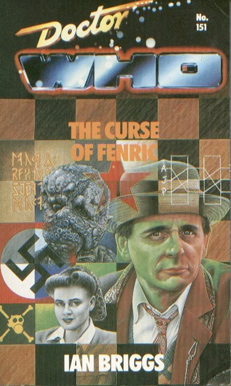
Chapter 151. Doctor Who – The Curse of Fenric (1990)

Synopsis: A World War II military base in North Yorkshire becomes the site for a battle between good and evil. All the pieces have come together: A British officer obsessed with Nazi memorabilia; his chief adviser, the creator of a powerful code-breaking machine; a squad of Soviet soldiers led by a captain driven by destiny; a bereaved young mother, left with a baby; a race of vampiric mutants from the future; and an ancient evil waiting for the arrival of a Time Lord… and his young friend, Ace. Now, the game can begin again…

Chapter Titles

  • Prologue: Dusk
  • Chronicle I: Betrayal
  • Document I: The Wolf-time
  • Chronicle II: Dangerous Undercurrents
  • Document II: The Curse of the Flask
  • Chronicle III: Weapons within Weapons, Death within
  • Death
  • Document III: A Victorian Storyteller
  • Chronicle IV: Vampire City!
  • Document IV: The First Contest of Fenric
  • Chronicle V: Wind and Water, Earth and Fire
  • Epilogue: Dawn

Background: Ian Briggs adapts his own scripts from the 1989 serial, delivering the longest novelisation since Fury from the Deep.

Notes: The author bares the method in a prologue where he dwells on how to start the story. An unidentified woman stands on the beach signalling the Soviet submarine (we find out later who that might be). Sorin is a captain in the Red Army’s Special Missions Brigade and his mission is called ‘Operation Sea-Wolf’ (an echo of the story’s working title, The Wolves of Fenric). When the Soviet commandos reach the beach, it’s Trofimov who acts as look-out; he sees the evacuees and is reminded of his wife, Irene, who he sees dead in a vision. Sorin believes another young soldier, Petrossian, has special gifts that alert him to sounds and danger before everybody else.  

On arriving at the camp, the Doctor berates young Perkins: ‘What would happen if the Germans attacked now? We’d have to write to your mother and tell her you died in filthy boots!’ The Doctor’s forged authorisation documents from the War Office give his name as ‘Dr-‘ but the second name is smudged, while ‘Ace’ is listed as the code-name of his assistant. One of the evacuees, Jean, has cool blue eyes and blonde, tightly wound hair, while Phyllis has ‘a round, smiling face’, and her eyes are ‘a rich chestnut brown’. Ace complains that the Doctor doesn’t pay any attention to her because she’s ‘only the waitress’ (as opposed to ‘a mere mortal’ on TV). Ace goes rock climbing with the evacuees (using ropes instead of the usual ladder) and tells them she ‘gave up’ smoking after her Mum found out. Kathleen is initially nervous when the Doctor and Ace discover her baby. She tries to explain, but the Doctor reassures her: ‘Just as long as you can promise me she’s isn’t a German spy, sent to discover the secret of British nappies.’ 

The chapters are punctuated by four supporting documents, the first of which is an essay about the Viking gods, written by Millington when he was a schoolboy. A teacher’s comment at the end of the essay reads: 

Very good. An extraordinarily vivid piece of writing for a boy of only 12. It is almost as though young Millington really believes that these myths will come true one day.

The essay represents a lifelong obsession with Norse mythology that Millington carries into adulthood, unaware that this is part of Fenric’s curse. On learning from Judson about the new arrivals from ‘the War Office’, Millington assumes that they must be from Bletchley and orders that they should be killed as ‘the enemy’. He recalls an incident on the rugby pitch more than 20 years earlier:

The cold mud of a rugby pitch. The shouts and calls of adolescent young men as they ran and chased. The expression Millington saw on Judson’s face as Judson smiled across to one of the other players, a tall, blond boy with clear blue eyes and a strong body. The sharp, stabbing jealousy that surged through Millington. The black anger that filled him as he ran towards Judson. The hatred, as he drove his shoulder hard in Judson’s back. The cracking sound – the awful cracking sound – as Judson’s body bent backwards and his spine fractured. The expression in Judson’s face, an expression from hell, as he lay paralysed in the mud.

The second document tells of how a traveller from Sweden called Oslaf obtained the flask. He and his party journeyed from Constantinople, through Transylvania, their voyage blighted by black fog and mysterious deaths, before they reached the Baltic sea and were slain by pirates. The pirate leader, Hemming, seized the flask as part of their spoils, but his band of men experienced sudden and grisly deaths just like those of Oslaf’s party. Abandoning his wife, Hemming captured a beautiful villager called Ingelda, with whom he sired a daughter called Wulf-aga as she had shining eyes like a wolf. As his crew were killed off one by one, Hemming concluded that the flask he stole from Oslaf was to blame; he sent his mistress and their daughter to safety and hid the flask, before he and the last of his men were slain by the black fog.

Wainwright visits the graves of his parents and grandparents in the churchyard. His mother died the day after he was born and her gravestone has the wrong date on it; his father died two years ago. Unlike on TV, Wainwright is a young man in his twenties. Millington reveals to the Doctor and Ace his plan to use chemical weapons to bring the war to an end: ‘A few thousand will die. But hundreds of thousands will be saved.’

The Doctor and Ace speak to an agitated Miss Hardaker about her missing evacuees and they try to persuade her not to involve the Home Guard; as soon as they leave, she calls the Home Guard anyway. The six Home Guard soldiers find the girls on the beach but fail to persuade them to go home. When their patrol strays too close to the Soviet hideout, they are killed by Sorin’s men, as witnessed from the clifftops by Sergeant Leigh (a young soldier of just 20, but already ‘hard as stone’)… and Miss Hardaker, who the young sergeant orders to return home. There, she confronts the girls, blaming them for the deaths of the men. Sorin tries to comfort Trofimov, unaware that, having himself become a father back home recently, his sergeant’s trauma comes from killing men who were someone’s sons. 

The third Document is a letter from Bram Stoker to his wife, detailing a story he heard while visiting the area about Maiden’s Point, a murdered girl and vampires living in the waters nearby. He tells his wife ‘I begin to believe that the seeds of some greater story may lie in this tragic incident.’

Miss Hardaker has her own reason for fearing the wider reputation of Maiden’s Point: When she was just 19, she became pregnant out of wedlock. Though the child died aged just two, Miss Hardaker was shunned by her neighbours and she carried the shame with her throughout her life.

The Doctor calls the monstrous army that emerges from the sea ‘homo haemovorax’ and claims that the salt water in the area is similar to human blood plasma:

Their bodies were horrifying mutations of the humans they had once been. Their skin was slimy and slightly wrinkled, like huge white slugs with legs and arms. Their eyes were swollen and bulbous, closed like a foetus in its uterus. And their mouths had turned into large suckers for draining blood. 

Some of them still had traces of human origins – vestigial ears, or a skeleton that was vaguely humanoid – and these creatures still had scraps of recent human clothing hanging off them. But those that had been waiting for a century or more were now completely changed. Instead of clothing, they had thin strands of glistening filament that hung about their bodies. Among the filaments and linked with them were old metal objects – objects that had either been discarded in the waters down the centuries or taken from the creatures’ victims. Keys, locks, coins, scissor-blades were now welded by an iridescent coral into a kind of chain mail.

The assault on the church is a lot more dramatic than was possible on telly. Ace uses her rock-climbing ropes (rather than the ladder) to scale down the church tower. Haemovores scale down the side of the tower after her and Sorin stakes one of them to death. The Doctor remembers his travelling companions as a testament of faith to repel the haemovore attack: Susan, Ian, Barbara, Vicki and Stephen [sic], Jo and Sarah-Jane. He’s surprised that Ace can hear the sound of his faith and surmises that she is slightly telepathic.

The fourth of the quoted documents is a translation by Sir William Judson, recounting the tale-within-a-tale of a game of chess between another traveller, El-DokTar, and an evil dictator called Aboo-Fenran. After 40 days of stalemate, the traveller challenged the dictator to find a solution that could defeat him. Another 40 days and nights passed and, unable to solve the impasse, Aboo-Fenrir surrendered and was trapped inside a flask. A prince mentioned in this story is said to haved journeyed ‘along the Central Way from the Furthest Island of Dhógs to the White City’, which might hold additional meaning if you consider how a person might travel via the Central Line of the London Underground from East London to BBC Television Centre.

The eyes of the bodies that Fenric possesses glow red, not green. Fenric reveals that Nurse Crane is a Soviet agent reporting to Moscow (suggesting she was the figure signalling from the beach to the Russian submarine). The Ancient One is named Ingiger and its voice is said to be part female. Vershinin and Bates both die from being shot by Millington (they survived on TV); Millington allows himself to be engulfed in flames while holding the body of Judson.

In the epilogue, having departed the TARDIS some time before, ‘Dorothée’ is reunited with the Doctor in 1887, where she reveals she has fallen in love with Sorin’s grandfather.

Cover & Illustration: Against a chessboard background, Alister Pearson brings together a Doctor with a sickly green tinge, a haemovore, Ace in her 1940s costume and various symbols – a logic diagram, some ancient runes, a Soviet red star, a Nazi Swastika and a skull-and-crossbones poison label. Inside, for the first time in years, there’s an illustration – a map, captioned ‘The Journey of the Flask’.

Final Analysis: Back in the mid-1960s, the joke behind the Meddling Monk was that he was the sort of character who would deposit a small sum into a bank and then travel forward in time to collect the interest. In 1979 we had Scaroth, last of the Jagaroth, trying to pull off a similar stunt by influencing history to fund his time travel experiments in the 20th century. It was also the driving force behind this story on TV, an ancient evil manipulating individual family lines to ensure they all converge at one point in space and time. In retelling his adventure as a novel, Ian Briggs creates a multi-faceted tale that slowly pushes all the pieces onto the board and shows how they came to be part of Fenric’s trap. That the backstory is presented as a series of documents allows the reader to decide if any of them might be a reliable source: The Doctor really did trap an ancient evil in a flask because it couldn’t grasp that he was cheating at chess, or the scene is just symbolic of whatever it was that happened; Millington’s childhood obsession with Norse mythology was symptomatic of the curse, or just another facet of his obsessive guilt over the crippling attack on Judson; maybe the flask caused the deaths that followed the parties of Oslaf and Hemming, or perhaps they just lived in bloody times; and maybe Bram Stoker was driven by the legends that fuel this story to write one of his own, rather than Ian Briggs taking his inspiration from Stoker…

In the entire history of the Target books, few could be described as being sexually charged. Companions arrive and depart with dispassionate regularity and even the ones tempted by a promise of romance remain largely chaste. The first hints of sexual desires introduced by Ben Aaronovich in Remembrance of the Daleks are continued here. The subtlety of a bay called ‘Maiden’s Point’ is underlined when Ace appears to admit to her new evacuee friends that, like them, she’s not a virgin (even if it’s just a case of teenage bragging to fit in), but then there’s the revelation that Miss Hardaker also has a secret past. The undercurrents that engulf Ace at the end are said to represent ‘laughter, lechery and animal passion. A whorehouse of enjoyment’. Despite this, Ace’s seduction of young Sergeant Leigh is about as awkward as it was on TV and, frankly, the resolution is unpleasant:

‘Too hot,’ murmured Ace. ‘Clothes sticking to me, sticking to my skin, hot, damp…’

‘If they’re too sticky, you know what to do.’

… his cries of ‘You promised’ suggest he feels led on, more than just led away.

There’s also a subtext of sexual tension from Millington towards Judson, who he clearly found compelling when they were schoolboys; as an adult, Millington has no love for women, complaining that they even ‘smelled different’, which adds a little to his dismissal of Ace with ‘no girls’!

Sexual subtexts are all part and parcel of the horror genre, and while this remains teen-friendly, it’s clearly aimed at an older audience than, say, Doctor Who and the Brain of Morbius. Infamously, the disintegration of the Haemovore Jean and Phyllis was shown on children’s TV in a behind-the-scenes feature but cut from the actual broadcast episode. Here, we can enjoy the moment in all its gory glory. The most graphic passage, however, comes during the assault on the church, when Sorin employs a stake to destroy one of the monstrous attackers:

The haemovore gave out a terrible, tortured cry that seemed to tear through the universe. Sorin pushed down on the stake with all his strength, driving it through the haemovore’s body until he felt it hit the slates beneath. The horrible, bloated face of the creature began to twist and change. The skin started to wrinkle and pull back on to the bones as though the creature were growing older by a hundred years every minute. The fleshy lips turned thin and dry and began to crack; the haemovore’s whole skeleton began to show through the thin membrane. Then the skin started to smoke and peel away. The creature’s cry slowly died away as all its flesh disappeared in smoke. Soon, all that was left was a smoking skeleton lying in a pool of slime and a charred wooden stake planted between two ribs.

As I noted just a few chapters ago, Remembrance of the Daleks is often cited by fans as the moment of conception for the New Adventures, but this story informs the tone of that range just as much. It’s a story as much about the companion as the villain, where sex and sexuality are acknowledged as something that actually exists and where the Doctor is manipulating people and events like a Grand Master chessplayer.

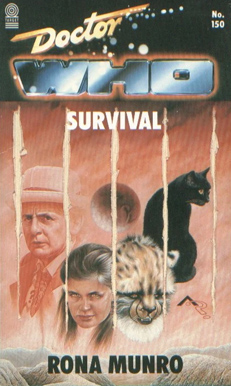
Chapter 150. Doctor Who – Survival (1990)

Synopsis: The Doctor brings Ace home to her own time and place. But the time is Sunday and the place is Perivale, the most boring place ever. Most of Ace’s friends have disappeared and the youth club has been taken over by a fanatical army type with a sadistic streak. On a distant planet, the Master waits for the Doctor’s arrival – only with the help of his oldest enemy can he hope to escape a world that is slowly turning him into a ferocious animal…

Chapter Titles: Numbered One to Eight, with a postscript.

Background: Rona Munro adapts her own scripts from the 1989 serial.

Notes: The man who’s abducted while washing his car is called Dave Aitken. His elderly neighbour who shoos away the cats is Mrs Bates. Ace and her gang used to listen to the music of ‘Guns and Roses’ [sic] and ‘Spondy Gee’. There’s a crack on the youth club door that was the result of a fight between Ace and Midge. They all used to hang around outside the local pub hoping they could persuade older kids to buy ‘cans’ for them. The Doctor puts a gold star-shaped coin from Psion B into Ange’s collection tin. Paterson is a police officer, not a sergeant in the territorial army as on TV (hence why he knows Ace was let off with a ‘warning’). After the sergeant criticises her for never phoning home, Ace recalls the events in 1945 that led to her meeting her mother as a baby. Still confused by the conflicting emotions the relationship with he rparents provokes, she feels distressed that the Doctor appears to be ignoring her in favour of his tins of cat food. This prompts her to walk off alone to gather her thoughts – watched by a kitling.

The kitlings (‘feline vultures’) can teleport from planet to planet in search of carrion and have been to Earth many times. They can ‘smell blood even across the vacuum of space’ – and the Cheetah People follow them in search of sport. Midge has posters for heavy metal bands in his room (on TV, he has a U2 album). 

Returning home in the early hours of Monday morning, Midge goes to the shop run by Len and Harvey and demands money. The Master releases a kitling in the shop, which transports the shopkeepers away. Midge kills both Paterson and Derek. After Karra is killed, Ace sees Shreela and tells her she won’t be staying in Perivale. Shreela helps her obtain some petrol and Ace lights a pyre for Karra and Midge, before walking off arm in arm with the Doctor (who does not deliver the speech we heard on TV). 

Cover: One of the most inventive covers ever, Alister Pearson paints a vista of the Cheetah people’s planet with portraits of a concerned Doctor, a possessed Ace and the Master’s black cat minion. The canvas has been slashed with claw marks. An early pencil draft of this design also showed the Master’s face emerging from the cat’s torso, but this was dropped for the final painting. What’s also rather lovely is that, as the final televised story of the original run, this cover echoes the painting Pearson did for the An Unearthly Child reprint that was publisted just a few months earlier.

Final Analysis: Another cracking novel, it’s largely what we saw on TV but with added violence and a generally more adult tone; as with Ghost Light, it’s beautifully written and visceral. The scene with Ange raising money for hunt saboteurs is enhanced by a shop window containing a dummy wearing a fur coat:

The Doctor pressed closer to the glass. Yellow fur, spotted fur, hung limp and soft on the dummy like the dead thing it was. There was no hint of the long muscles that had animated it, the bone, sinew, heart and lungs of the animal that had worn it as its own skin as it streaked across the dusty yellow savannah, the fastest creature on earth. There was only the barest reminder of the coat’s original owner, the animal that now reminded the Doctor so forcibly of the connection he had been looking for.

With just a couple of novels remaining, the Seventh Doctor era is shaping up to be the most consistent of the Target collection. At the back of this book, in a postscript, range editor Peter Darvill-Evans marked the fact that it appeared unlikely that Doctor Who was returning to our screens any time soon. He also revealed that as well as some remaining novelisations, plans were already underway to start publishing original novels – the continuing adventures of the Doctor and Ace.

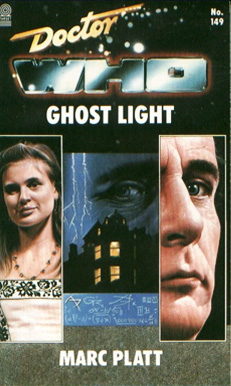
Chapter 149. Doctor Who – Ghost Light (1990)

Synopsis: When the Doctor sets an initiative test, Ace is initially suspicious and then alarmed to discover it involves a spooky old house. It contains a menagerie of strange creatures, a crazed explorer, a lost policeman and a ruthlessly ambitious man who appears to be evolving into… what? Worst of all, the house is in Perivale – the exact same one that emotionally scarred Ace all those years ago…

Chapter Titles

  • 1 Tropic of Perivale
  • 2 Gabriel Chase
  • 3 Uncharted Territory
  • 4 Gaslight Boogie
  • 5 Josiah’s Web
  • 6 That’s the Way to the Zoo
  • 7 Ace’s Adventures Underground
  • 8 Creature Comforts
  • 9 Out of Control
  • 10 Twice upon a Time
  • 11 Trick of the Light
  • 12 Beautiful Soup

Background: Marc Platt adapts his own scripts from the 1989 serial.

Notes: The first chapter presents Ace’s first steps into the derelict Gabriel Chase in 1983 when she was 13 (about a year earlier than Remembrance of the Daleks suggests, although here, Ace herself says she was 14). The house is near Western Avenue (also known as the A40, which becomes The Westway, where it passes within sight of BBC Television Centre, fact fans!) Ace’s friend’s full name was Manisha Purkayastha and her sister also survived the devastating fire. Ace was a fan of Michael Jackson when she was younger and her mum called her ‘Dory’. Back in Ace’s present day, aboard the TARDIS, she is now 17 years old. The Doctor is struggling to get accurate data from the TARDIS – and there’s an elegant description of his relationship with friends past and present:

Anyone who travelled in the TARDIS had a price to pay. However willingly any new companion walked through its doors, leaving their own world behind, and however determinedly they tried to assert control over the bizarre events in which the Doctor’s travels might embroil them, one fact was inescapable: throughout time and space their lives were in the Time Lord’s hands. Even the slickest of jugglers, however, could drop a skittle at one time or another.

…. Call him showman, conjuror, great detective, mentor or tormentor, his speciality was to juggle the past, the present and the possible. No one was safe from that; anyone could be a potential skittle. 

The Doctor rarely bothered with a safety net either; he never considered he needed one. But he didn’t always ask the skittles.

The Reverend Ernest Matthews makes his final approach to Gabriel Chase via a dog-cart that he’s hired from Ealing Station. He is Dean of Mortarhouse College, Oxford (not Merton College as on TV). He has learned that Josiah Samuel Smith has endorsed the theories of Charles Darwin and Alfred Wallace in papers written with ‘scant grasp of literary or scientific style, or even the basic rules of grammar’. While this is his primary concern, he is also worried about Smith’s ward, Gwendoline, after seeing them together at the Royal Opera House in London. As he approaches the front door of the house, he hears ‘the distant grating and wheezing of some large mechanical device’ and sees a flashing light in the observatory turret.

The Doctor heavily implies to Ace that he met Darwin during his voyage on the Beagle. He believes they should follow proper etiquette and leave the house so that they can knock on the front door and be invited in. According to Redvers Fenn-Cooper’s journal, the events take place across the nights of 19-20 September, 1883 – although as at least one entry for this was ‘written’ while he was in a strait-jacket, we might assume the journal itself is a delusion. 

The weary, weather-beaten face that returned his stare belonged to a man apparently in his late thirties. He had a haggard look to him. His thick, fair hair was greying and ruffled and his jacket looked slept in. Along with his bushy moustache, he had several days growth of stubble and accompanying bags under his eyes. Even so, Ace decided there was something dashing about him, despite the spear and being at least twice her age.

Smith insists that the occupant of the cell in the basement is supplied with a copy of The Times every day as a form of mockery, aware that his prisoner cannot read and will use it to build a nest. The Doctor plays some boogie-woogie on the piano, but sensing the outrage from the Rev Matthews, he switches to Beethoven’s Moonlight Sonata, which is interrupted by the arrival of Josiah, our first indication that it is not what it seems:

Its hair was white and long; its skin pale and leech-like. It wore a night-blue, velvet dinner-jacket and black, pebble-lensed spectacles that looked like tiny craters on its wizened, wicked face. As it groped its way into the halflight, grasping at the back of a chair for support, the Doctor saw that the creature’s clothes were covered in strands of cobwebs.

Prompted by Ace’s tuxedo, the Doctor asks if he ever took her to see Georges Sand or Vesta Tilley. He pretends to be appalled by Josiah’s offer of Five thousand pounds, as ‘a gentleman only ever pays in guineas!’ Ace uses the lift in the hope of returning to the attic floor of the house, but Mrs Pritchard has set the lift to go to the basement to delay the prisoner’s escape and remove the problem of Ace in one go. The tunnel leading to the basement chamber is covered in cave paintings. 

Control is able to manipulate the empty husks of Josiah and Ace sees the creature inside the cell – a ‘half-lit shape covered in filthy rags’ – before Nimrod slams and bolts the door. Lady Pritchard’s first name is ‘Margaret’. Distressed at the sight of Control in her rags, Mrs Grose tells the Doctor she’ll be seeking employment elsewhere; the Doctor asks her to pass on his regards to ‘Peter Quint’ (the sinister but absent figure in Henry James’ The Turning of the Screw, which also features a domestic called Mrs Grose). Inspector Mackenzie witnesses ‘Lady Pritchard’, still dressed as a housekeeper, arranging the packing of a number of items away in trunks for despatch to the ‘lodgings in Whitmore Street’. Ace gives Control a book on etiquette, which she touches to her head and absorbs. Light tours the Earth to discover the total scale of evolution across the planet, where only the most basic bacteria in swamps remain unchanged.

Cover: Alister Pearson’s best cover ever, evoking the ‘window’ concepts used by Jeff Cummins, combining Gabriel Chase at night, Ace in her Victorian frock and the Doctor in close-up.  Underneath the house are some symbols, which include the artist’s initials alongside those of then-Doctor Who Magazine reviewer Gary Russell.

Final Analysis: I just had to pull out this line:

‘Professor! What’s going on?’ She almost felt like crying she was so confused.

As with Ben Aaronovich’s Remembrance of the Daleks, Ghost Light benefits immensely from being transferred to the page. The dialogue is easier to understand for one thing and the reader has time to work out the intent behind most of Control’s slowly improving grasp of English. The shifting relationship between Control and Josiah – previously the Survey Agent – is spelled out just a little more as Light begins to understand the change that has come over his former servants. 

One of the greatest disappointments of the final years of Doctor Who on TV is that Marc Platt only got one chance to write a story (he’s made up for it since with his novelisation of Ben Aaronovitch’s Battlefield, the novel Lungbarrow and some hugely popular audios for Big Finish). I’ve both praised and critiqued Terrance Dicks’ economical approach, and been dismissive of some of the more overwrought texts submitted to the range by first-time authors, but it’s genuinely surprising that this is Marc Platt’s debut novel – and the writing is exquisite. Here’s his introduction to Light:

Robed in liquid gold and silver, with skin shimmering, it had the noble and terrible beauty of a seraph, fallen to Earth from its place beside the Throne. It glided from the lift, energy humming from it like a generator and droning fiercely at any mortal it passed.

Slowly, the fans who grew up watching the series and reading the books are taking over and it’s rather exciting at this late stage to find a book where the writing excited me as much as David Whittaker’s did in Doctor Who and the Crusaders, published 25 years before.

Chapter 148. Doctor Who – Remembrance of the Daleks (1990)

Synopsis: The Hand of Omega – a powerful weapon from the dark times of Gallifrey. In 1963, an old man living in a junkyard hid the weapon on Earth. Then the Daleks came looking for it, hoping it could be used to end a civil war between Dalek factions. The Doctor now returns with his new friend Ace to find the Hand of Omega – and give it to the Daleks! But which side gets it, the Renegades led by the Supreme Dalek, or those loyal to the Dalek Emperor? Time will tell…

Chapter Titles: A prologue and 23 numbered chapters, although each chapter also begins with a time, such as ‘Friday, 15:30’.

Background: Ben Aaronovich adapts his own scripts for the 1988 serial, completing the run of stories from Season 25.

Notes: The book opens with a quote from Shakespeare’s Richard III and a prologue that once again adapts the Doctor’s arrival at the junkyard from An Unearthly Child. Ace has destroyed the TARDIS ‘food synthesiser’ by mistaking it for a microwave and accidentally pouring plutonium into it, thinking it was soup. When the Doctor gives her currency appropriate for the time, Ace recalls the savings coupons on Iceworld [see Dragonfire]. This Doctor has ‘intense grey eyes’ and an unnerving gaze.

We’re introduced to more of Gilmore’s squad: There’s a 26-year-old Private John Lewis Abbot; Bellos, a big man from Yorkshire; Sergeant Embery; Quartermaster-Sergeant Kaufman; MacBrewer (a career soldier, ‘Catholic, married, four children’), who is killed by the Dalek at Totter’s Lane; Faringdon, who is decapitated by Dalek fire during the battle at the school; and Corporal Grant, who is the soldier attacked by Mike Smith in the cellar of Coal Hill School.

The Doctor recalls his first visit to Skaro and the death of Temmosus, plus events from The Dalek Invasion of Earth, Planet of the Daleks and Genesis of the Daleks. Thanks to an excerpt from The Zen Military – A History of UNIT by Kadiatu Lethbridge-Stewart (2006), we learn that UNIT emerged out of an earlier operation, the Intrusion Counter Measures Group, a Royal Air Force Regiment established in 1961 under the command of Group Captain Ian Gilmore. The official files refer to the events of this story as ‘the Shoreditch Incident’. Gilmore’s headquarters are at Maybury Hall in Hendon but, recognising he needed a base closer to the centre of the current operation, he asked Sergeant Mike Smith to make enquiries – and Smith brought in Ratcliffe from the Shoreditch Association. Ratcliffe’s men attack Gilmore’s officers at Foreman’s Yard and steal the Dalek remains (an assault missing from the transmitted episode, which cuts straight to the removal of the Dalek remains on the back of Ratcliffe’s truck).

In one of the novel’s most far-reaching additions, we encounter a triumvirate of Time Lords from Gallifrey’s legends: Omega is ‘a huge man with wide shoulders and muscular arms, a definite drift from the regenerative norm’ who is seen by some as a genetic throwback from the dark time; he addresses Rassilon as ‘cousin’ and Omega believes himself and Rassilon to be equally responsible for their varied Time Lord creations; and the unnamed ‘other’, who urges caution, reminding them of Minyos [see Underworld – or, y’know, don’t] and warning that Omega’s ‘magnificent achievement’ might also serve as a weapon. 

The Doctor suspects that the Daleks that invaded Earth in the 22nd Century uncovered information that led them to the Hand of Omega in 1963 [perhaps during the Doctor’s aborted robotisation]. We also learn that the Daleks (or at least the renegade faction) call the Doctor ‘the Ka Faraq Gatri’ and the Imperial Faction are known as ‘the Ven-Katri Davrett’. The Imperial Dalek transmat operator bursts through a wall in the school cellar, behind which it has lain dormant for some time.

The Doctor stops at a roadside tea-stall in the docklands, run by John (it’s not the cafe we saw earlier, as it was on TV). Rachel Jensen is also staying at the boarding house run by Mike’s mum. In a dream, Rachel finds herself inside the synagogue in Golders Green that she attended with her mum as a child, where the familiar Rabbi is replaced by the Doctor. While they’re recovering from the events at Foreman’s Yard, Rachel is surprised to hear Gilmore call her by her first name and we learn that, 23 years earlier, she and Gilmore had enjoyed a night of passion on a beach, before she was dispatched to other manoeuvres in Scotland (neither of them married). She worked with Alan Turing and his description of the human brain put her off porridge for life. When tying the rope for their escape from the school, she recalls her time as a girl guide. According to The Women That Science Forgot by Rowan Sesay (1983), Rachel retired in 1964 and published her autobiography, The Electric Dreamer.

Ace got her first taste for explosives at the age of 12, when she discovered the effects of mixing nitrate fertilizer with a two-pound packet of sugar. As a teenager, Ace attended a modern ‘concrete’ school covered in multicultural murals, where her friends were Manisha, Judy and Claire. Manisha had long black hair – until she was in a fire, which Ace tries to forget. Ace also has a dream while at Mike’s mum’s, in which she remembers visiting Manisha in hospital after she and a sibling escaped the fire that killed her parents and three younger children; Manisha left Perivale to stay with relatives in Birmingham:

It was Dorothy who stared at the burnt house, the burnt face, the burnt life, the racist graffiti. And it was Dorothy who stared at the words ‘Pakis out’ on the wall of the playground. 

It was Ace who blew away the wall with two and a half kilograms of nitro-nine. 

Fireball in the darkness. 

Fire fighting fire.

This attack happened when Ace was 14, two years prior to what the Doctor calls Ace’s ‘adjustment’, which saw her catapulted across time and space to Iceworld.

The junior undertaker is called Martin. As a young captain, the Reverend Parkinson had fought in the Great War in Verdun, where he lost his sight, but found his vocation. Mike’s dad had been in the Navy during World War II and was lost with his ship in 1943 while running weapons to the Russians in the Arctic Sea; a photograph of his father, in uniform, is still on Mike’s mum’s wall in the boarding house. Mike first met Ratcliffe as a child, when the older man had given him some German chocolate. Mike served in Malaya for 18 months and spent some time in Singapore, but stayed in touch with Ratcliffe, who only days before this operation had warned the young soldier that the United States would be getting ‘a new president’.

Allison refers to the situation with ‘Miss Keeler’ that has affected the current government (ie, the ‘Profumo Affair’). Ace sees Muffin the Mule on TV. Her behaviour at the school alerts the Imperial Dalek commander that she must either be from a different planet or a different time period and instructs the Dalek squad to target her. As recounted in The Children of Davros, a Short History of the Dalek Race by Njeri Ngugi (4065), the Daleks suffered 83% casualties in the Movellan war and the remnants factionalised across the galaxy. The arrival of Davros’s new Daleks propelled the Dalek race into civil war. The Dalek mothership is called Eret-mensaiki Ska, or ‘Destiny of Stars’ and it was constructed in orbit around Skaro. It contains hatcheries that nurture Dalek embryos. There are tiny servo-robots providing maintenance across the Dalek mothership and the Doctor sees one aboard the shuttle. Also aboard the shuttle is the special weapons Dalek, also known as ‘the Abomination’, the presence of which unsettles the Imperial Commander. Its past history seems to contain the first reference in Doctor Who to a Time War:

It served in many campaigns: Pa Jass-Gutrik, the war of vengeance against the Movellans; Pa Jaski-Thal, the liquidation war against the Thals; and PaJass-Vortan, the time campaign – the war to end all wars.

The radiation from its gun has sent it insane and it only survives by order of the Emperor. The Dalek Emperor remembers when he was a man – and we might pick up the clues that this man was Davros in a description that is pure body-horror:

He remembered the smell of his own blood, pulsing slowly from severed arteries, the taste of concrete dust in his mouth, and the crackling of his own skin. He hurtled blindly into darkness.

And then resurrection. 

An age of pain and humiliation. He was reconstructed with chrome and plastic, held together by tungsten wire. They drilled sockets through his skull and threaded fibreoptics into his forebrain. 

Ratcliffe had marched on Cable Street with Oswald Mosley, ‘proud to be English, proud to fight against the jew and the Bolshevik, proud to stand up for their race’; he served a prison sentence during World War II, but managed to spend the 1950s setting up a construction company, profiting on the rebuilding of London. Ratcliffe walked into his office one day to find the Renegade Dalek battle computer installed in the shadows; it began to feed him secrets and use his business to install electronic devices – Electronic countermeasures pods, or ECMs – hidden around the rooftops of London and which scramble the circuits of the Imperial forces. The Supreme Dalek and its renegade troops lie dormant, hidden away in Ratcliffe’s warehouse until the Imperial Shuttle lands.

On Skaro, Vekis Nar-Kangli (the Plain of Swords) is where the final Kaled-Thal war ended and where the Dalek city, Mensvat Esc-Dalek, was built. The Hand of Omega destroys one thousand million Daleks along with Skaro, its sun and its other surrounding planets. Ace sprays graffiti on the rear of the Imperial Dalek shuttle: ‘Ace woz ‘ere in 63’. The Doctor befriends a dog – an Alsation [see more of this in Survival]. Allison writes to ‘Julian’ to share some gossip about a possible relationship between Rachel Jensen and Ian Gilmore and reveals that they’re trying to find the parents of the ‘creepy girl’.

Cover: Alister Pearson combines Davros, a gravestone with an ‘omega’ symbol, a smirking Doctor and three types of Dalek in a cover that also draws him equal with Andrew Skilleter in painting all of the covers for a single season of stories.

Final Analysis: Remembrance of the Daleks is seen by many fans as a high-point in the final years of the series. When he took on the role of Target range editor in February 1989, Peter Darvill Evans began to develop plans to publish original novels once the novelisations were complete. His first steps were to encourage the writers of this final run of stories to expand upon the TV scripts, writing the novels for an older audience. Target authors had often tried to expand the depth of their original stories, but here Ben Aaronovich delivers an altogether more cohesive work. We find out why Ratcliffe is more than just a useful fascist for the Daleks – his construction company has been used to create a network of Dalek devices across London. We learn much more about Ace (who is only in her second story, chronologically) and Aaronovich plays with the conflicts burning through a teenage girl who is also wise beyond her years, experiencing her first love and first betrayal. We’re teased with a smattering of Dalek history and allowed inside the minds of various Daleks and even the Emperor himself – to a depth unseen in even the novels of John Peel. The renegade Dalek Supreme in particular is fascinating, experiencing feelings and sensations by proxy through the girl who is the battle computer and an extension of the Supreme.

Aaronovich doesn’t flinch away from the brutality of war and it’s definitely the most er, mature novel since the heady days of Ian Marter: There’s mention of an incident in Gilmore’s wartime past that involved ‘two German soldiers his men had scraped off the interior of a pillbox’ and the gut-wrenching fate of a soldier called Faringdon. Also, while we’ve had passing mentions of orgies and alien reproduction, a flashback to a ‘brief encounter’ between Gilmore and Rachel on a beach – where he calls out her name and then doesn’t say it again for 23 years – is the closest we ever get in the pages of a Target book to an actual sex scene – which I definitely didn’t pick up on during any of the previous times I read this. And of course, Aaronovich’s own heritage enriches the backstory of Rachel.

There are many books in the volumes 100-156 that I’ve read for the first time for this project, Remembrance of the Daleks is one that I’ve come back to repeatedly since it was first published. It’s no exaggeration that it was a game-changer. At this point, we were still a year away from the release of Timewyrm: Genesis but here is where the New Adventures truly begin; it’s a story ‘too broad and too deep’ for the small screen, featuring the Doctor as a mythic figure and with revelations that hint at a history that predates the TV series. Right at the very end of the series, we begin a ‘new golden age’.

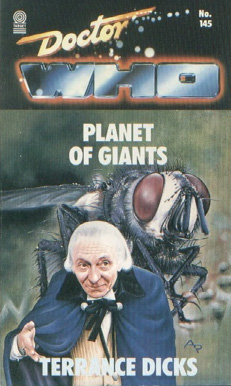
Chapter 145. Doctor Who – Planet of Giants (1990)

Synopsis: When a government inspector fails to approve a new pesticide, the chemical’s inventor takes drastic action. Meanwhile, the Doctor finally succeeds in getting his schoolteacher friends back to their own time and place – but at the wrong scale! Shrunk to the size of an ant, the travellers suddenly face danger at every turn, from running water and the attentions of a curious cat to the very same pesticide that has just driven a man to murder…

Chapter Titles

  • 1. Dangerous Landfall
  • 2. The Unknown
  • 3. The Terrible Truth
  • 4. The Destroyer
  • 5. Death in a Country Garden
  • 6. Getting Away with Murder
  • 7. Dangerous Rescue
  • 8. Whirlpool
  • 9. Suspicion
  • 10. The Doctor’s Plan
  • 11. Barbara’s Peril
  • 12. Plan of Action
  • 13. Fire!
  • 14. A Question of Size

Background: Terrance Dicks adapts scripts by Louis Marks for the 1964 serial (inspired by an idea from CE Webber), completing the run of stories from the second season and the first Doctor’s era as a whole! At 25 years and two months, this is now the holder of the record for biggest gap between broadcast and novelisation. It’s also the first novel to be released after the end of Doctor Who as an on-going TV series – not that we knew this for certain at the time.

Notes: The opening chapter summarises each of the stories of Season One, from the teachers’ first meeting with the Doctor through to the Daleks, Sensorites and the Reign of Terror (and they’ve just left 18th-century France. There’s also a curious sentence: ‘Her name was Susan Foreman and she called the Doctor “grandfather.”‘ – as opposed to ‘she was the Doctor’s granddaughter’. Apparently, one of the Doctor’s favourite sayings is ‘all the savage species in the galaxy, few were more dangerous and bloodthirsty than man’.

The Doctor tries to explain the complexities of time-travel to Ian and Barbara by comparing the action of moving a chair from one room to another to that of moving the chair from a house in 1796 to a house in 1964 – ‘a different matter altogether’. Susan elaborates:

‘If you put a dish in a bowl of water, the water rises, doesn’t it?’

‘Yes of course, that’s simple,’ said Barbara impatiently.

‘But, suppose the water was filling the bowl to the very top and there was a tight lid on as well? There’d be no room for displacement. Well, it’s rather like that when the weight of the TARDIS suddenly enters the atmosphere. Something has to give way.’

Ian shrugged. ‘The air, presumably…’

The Doctor spoke without looking up from the fault indicator. ‘Exactly! And the atmospheric pressure on Earth is fourteen point seven pounds to the square inch. You’re getting the idea, Chesterton. It’s all right when the TARDIS is fully materialized, the envelope of air can always give way somewhere.’

‘Just as we’re entering the time dimension,’ said Susan. ‘That’s the danger point.

The Doctor admits to Barbara that he’s never visited Africa and Australasia, asking if gigantic earthworms might be common there (she confirms that they are not). 

The cat that continues to bring jeopardy for the time-travellers is a ginger tom. Farrow is a civil servant whose motto is ‘waste not, want not’, hence why he picks up the box of matches he finds in the garden. He recognises Mark Forester from his photo, which he’s seen in the newspaper. Forester is dark haired, thick-set and ‘beetle-browed’ with a ‘heavy jaw’ and a ‘deep authoritative voice’; he’s not a big man but in his expensive suit from Savile Row, he gives off ‘a feeling of power’, looking ‘every inch the tycoon’. The scientist, Smithers, worked on famine relief projects for the United Nations when he was a young man. He saw ‘hundreds’ of people die while locusts devoured their food; ‘the terrible sights of death by starvation were burned into his memory’.

The village where Smithers lives is so small that the village shop and the police station are in the same building. The exchange operator Hilda Rowse is married to the local police officer, Bert. Hilda has been curious about the cottage ever since it was bought by a London company who installed lots of scientific equipment and a man called Smithers moved in. She recognises that Forester is not Farrow, as she met the civil servant when he came into the shop for provisions for his boat. Smithers is distressed to find that the cat has died, which is what alerts him to the dangers of DN6.

Cover: Alister Pearson’s cover shows a friendly Doctor beckoning (a reworking of a photo reference from The Celestial Toymaker) as a giant fly approaches him from behind.

Final Analysis: The last novelisation of the first Doctor’s era and the penultimate book in the range by Terrance Dicks, Planet of Giants is another example of a rather sleight story being expanded just enough. Dicks fills in some of the details that were removed when the TV story was truncated from four episodes to three. He also adds explanations for things that might be alien to young readers in 1990, such as ‘reversing the charges’ and a telephone operator who manually connects the calls. There’s a final treat as the final chapter concludes with a huge tease into the next story (also novelised by Dicks back in 1977):

Outside in the ruins of London the Daleks were waiting…

Chapter 143. Doctor Who – Silver Nemesis (1989)

Synopsis: Three different groups await the arrival of a meteor as it passes the Earth for the first time in 25 years: A 17th-Century witch and her servant; an army of fanatics led by an elderly war criminal; and a unit of tall, silver, cybernetic men. The Doctor has also expected the meteor’s arrival, for it contains a terrible weapon – the Nemesis. The Doctor must influence events to make sure the Nemesis falls into the right hands – but even with an Ace up his sleeve, can he defeat a player who has decided to change the rules of the game?

Chapter Titles: Numbered One to Eleven.

Background: Kevin Clarke adapts his own scripts from the 1988 serial.

Notes: Kevin Clarke dedicated the book to ‘DHF Somerset’, the then-chief cashier of the Bank of England, whose signature appeared on bank notes at the time. The first chapter opens with a very cheeky line:

The closer one travels towards it from the cold silent darkness of infinite space, the more the planet Earth appears as a backcloth to some small theatrical performance taking place on a limited budget. 

[See The Ambassadors of Death for more on the ‘darkness of infinite space’]. The scene at the jazz gig takes place in late summer. The musician whose gig the Doctor and Ace attend is, in the Doctor’s opinion, ‘the most exciting musical discovery since John Coltrane’ (and on screen was played by Courtney Pine). The Doctor claims to have met and influenced Louis Armstrong. The Cybermen’s henchmen are ‘twins’. By 1988, Lady Peinforte’s house has been converted into the Princess of Wales Burger Bar. The Doctor and Ace travel by TARDIS from an afternoon in late summer to the early hours of 23 November the same year, at the same point that Lady Peinforte and Richard arrive and the Nemesis statue lands. The meteorite lands inside a building site. The Cyberman’s ship is ‘disc-shaped’.

The previous time the Doctor was with the Nemesis, he was under attack by Lady Peinforte and ‘agents of the Inquisition’ (on TV he says it was the Roundheads). Peinforte doesn’t initially recognise the Doctor but quickly deduces that his face has changed – ‘The wench’s too’ (so the original Doctor had a female companion). One of the police officers who was knocked out by the nerve gas survives the attack and witnesses the Cybermen, their two controlled thugs and the statue disappear (they walk up into the space ship, which is camouflaged).

One of the skinheads wields a ‘ninja fighting stick’, which ends up being used to tie his feet to suspend him from a tree branch. The American tourist who offers Lady Peinforte a lift is called Lavinia P Hackensack of Connecticut, not Mrs. Remington of Virginia. Ace’s battle with the Cybermen takes place back at the building site where the Nemesis meteorite landed; she spends some time keeping the Cybermen distracted while the Doctor does his calculations using an abacus. The Doctor tells the Cyber Leader that he cannot hand the Nemesis statue over to him and when the Leader becomes riled, the Doctor mocks him for showing emotions and being ‘defective’. The final scene takes place in a pub garden in 1988, not Richard’s time; Ace has taught Richard how to get served at the bar and he returns laden with drinks.

Cover: The back cover text on the first edition stated: ‘This story celebrates 25 years of Doctor Who on television’. Alister Pearson painted the original and reprint versions of the cover, both of which feature a subtle swastika in the design (Pearson claimed in an interview for DWB that he started work on the original cover on Hitler’s birthday, but the interview was full of exaggerations and apocryphal tales largely for Pearson’s own amusement so this might not be true). The first cover shows the Doctor with a smirk on his face, the Cyberleader, Ace and the Nemesis encased in rock. For the 1993 reprint, Ace is in attack mode with her catapult (really impressive, this pose) on the opposite side to the Cyberleader, while a more sombre Doctor holds up his question-mark umbrella in front of Lady Peinforte’s tomb.

Final Analysis: We often find that authors who have just the one entry in the Doctor Who library tend to throw everything they have at their text. In places, Kevin Clarke gets a little purple with his prose (as the excerpt from the opening chapter above shows). It’s a shame then to reach the climax and have to reread the paragraph where Lady Peinforte joins with the Nemesis statue, as it feels like a summary of what happens on screen without any real explanation as to why it’s happening.

There was a blinding flash of radiant light as Lady Peinforte and the statue shimmered and then coalesced. The rockets fired and the statue of Nemesis was launched once again to return into space.

Seriously – what?

We realised with the TV version that the mystery surrounding the Doctor wouldn’t be answered and it was largely just one huge tease, but here it’s almost glossed over as Clarke rushes to get to the final page. There’s no additional insight into what any of the interested parties want to do with the Nemesis and as a consequence the story merely fizzles out. In some aspects, it’s a very traditional novelisation, transposing the script to prose, but without any of the additional nuances we might have gained from Terrance Dicks or any other author.

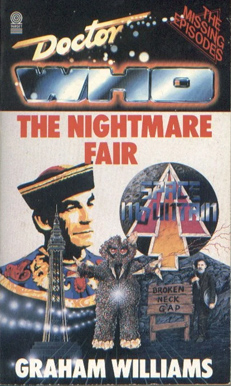
Bonus chapter #7. Doctor Who – The Nightmare Fair (1989)

Synopsis: After surviving an encounter with The Nexus of the Primeval Cauldron of Space-Time, the Doctor and Peri arrive in Blackpool, where a visit to the famous Pleasure Beach sees them ensnared by the Celestial Toymaker. But why is the eternal villain there and what does he want with the Doctor? It can’t be anything as mundane as revenge, can it?

Chapter Titles: Numbered One to Nine.

Background: Graham Williams adapts his scripts for an unmade serial intended for broadcast in 1986 before the original Season 23 was cancelled.

Notes: The Doctor and Peri begin their adventure on the observation platform of the Blackpool Tower, just as the Doctor nearly promised at the end of Revelation of the Daleks. The young guest hero this time is called ‘Kevin Stoney’ [see The Daleks’ Master Plan, The Invasion and Revenge of the Cybermen for why that’s funny] and he’s from Liverpool. The Toymaker – also referred to as The Mandarin – uses a crystal ball to observe the Doctor and other points of interest. The Doctor boasts that he has ‘shot through Black Holes’, ‘sailed through Supernovae and ‘eaten Vanarian Sun Seed Cake’ but has never experienced such a ‘magnificent’ thrill as the roller coaster; although there is a coaster in Blackpool called ‘The Roller Coaster, this one is most likely the Revolution, Europe’s first full-loup rollercoaster, which opened in 1979 and, like the Sixth Doctor, once featured in a memorable episode of a BBC wish-fulfilment entertainment show that we can’t really talk about any more. By the way, the Doctor’s also never had candy floss before; Peri pays for it with a £5 note she found in a sporran in the TARDIS wardrobe, prompting the Doctor to note that it must have been Jamie’s and he was always so careful with money [so putting aside offensive stereotypes for a second, Jamie having legal tender from the mid-1980s suggests an unseen adventure].

After hearing Kevin’s statement about seeing ‘red giants’, Detective Inspector Truscott suggests that if the lad sees any more that he directs them towards Preston North End, as they could do with the help; Preston North End’s kit at the time was white with blue piping, and the away kit was yellow and blue – but they did eventually adopt a red jersey as their main away kit for the 95-6 season. 

As in the Toymaker’s debut adventure, it’s suggested that he and the Doctor have sparred on many occasions. The Doctor took part in the Globus Wars of Independence. His pockets contain a single jelly baby and ‘the signet-ring of Rasillon’, which is ‘the most powerful single object in the known Universes. He tells Peri and Kevin that he doesn’t actually know who the Toymaker is:

‘Nobody knows. He existed before the start of Time Lord records. There was an attempt to track him back through his own continuum – trace his path through the fabric of time, but the researchers got bored with all the games, which was possibly what they were there for. As they do so often,’ he sighed, ‘my erstwhile colleagues met something they didn’t understand, and they ran away from it. If they’d been able to control him, they would have investigated further, I’m sure. But they couldn’t, so they didn’t.’ 

The Toymaker is known to be telepathic and telekinetic, ‘up to a point’, and he was once ‘observed playing with a supernova as though it was a kiddies’ paddling pool… and we know he’s old beyond imagining…’

If fact, the Doctor realises that the Toymaker is from another universe and that he carries his own matter with him – but not anti-matter – concluding that the Toymaker will live for millions of years; the Toymaker confirms that he already has done, having spent thousands of years creating and destroying civilisations until he came up with the idea of his games.  

Cover: Alister Pearson’s composition includes the Toymaker, the Blackpool Tower, a sign for Space Mountain, a miner and a fanged-and-clawed alien. The first edition featured a flash proclaiming ‘The Missing Episodes!’

Final Analysis: The whole concept of a ‘celestial’ toymaker is an archaic pun, ‘celestial’ meaning both ‘of the stars’ and ‘from China’ (a loose translation of ‘Tianchao’, the former name for the Chinese Empire). While the word might have been used to signify ‘exotic’ or mysterious qualities, it was also a racial descriptor that is now largely forgotten. As previously mentioned in (among other chapters) The Sensorites, the word ‘oriental’ can also be problematic for some. Meaning simply ‘from the East’, it’s a colonial view of the world map, positioning China solely in relation to how it appears on a British Empire map with the United Kingdom (well, let’s be honest, England) at its centre.

… and in Doctor Who, we then have the Celestial Toymaker as a Chinese-presenting character played by an English actor. While Michael Gough didn’t resort to the kind of theatrical make-up we saw in The Talons of Weng Chiang, it’s still an example of cultural appropriation – or at best cosplaying – based on a suspicion of the Chinese. How might that have seemed had this story made it to air in 1986? In a season where a story set in Singapore had a working title ‘Yellow Fever and How to Cure It’…. you can draw your own conclusions as to how this might have played out at the time – and how it might have been received by young viewers discovering the era for themselves 36 years later. Despite spending two paragraphs discussing this issue, it’s not really something I dwell on, but it’s a handy distraction to ruminate on while trying to avoid thinking about the rest of the book.

What we have here is something that feels authentic to the period it might have been a part of had Michael Grade not stepped in and saved us. By which I mean, the Doctor is fairly unlikeable and while the adventure features a returning villain, he’s one that few of the viewers would have actually remembered and he doesn’t even act like the character as portrayed in his original appearance. The story is, like the original, a series of events rather than a plot and, sadly, it’s all a bit dull. The greatest joy comes from the Doctor’s two companions being called ‘Kevin and Peri’ in a book published a year before Harry Enfield’s teenage characters Kevin and Perry made their TV debut. All entirely coincidentally. 

To be fair, there is one scene though where Williams captures that alien quality that Colin Baker had so wanted to portray, able to comprehend the vastness of eternity:

‘The isolation of aeons,’ whispered the Doctor, overcome with compassion for the being he’d detested all his adult life. ‘The crushing loneliness of thousands of millennia… you poor, poor creature…’

Chapter 138. Doctor Who – Attack of the Cybermen (1989)

Synopsis: The Doctor and Peri follow a distress beacon only to discover it was sent by Commander Lytton, formerly of the Dalek taskforce. Lytton has now allied himself with the Cybermen in a bid to escape Earth. The Cybermen have a plan to change the web of time and it’s down to the Doctor to stop them.

Chapter Titles

  • 1. The Day Begins
  • 2. The Perfect Crime
  • 3. The Peripatetic Doctor
  • 4. The Search Begins
  • 5. A Close Encounter of a Very Nasty Kind
  • 6. Telos
  • 7. The Tombs of the Cybermen
  • 8. The Great Escape
  • 9. Caught
  • 10. The Final Encounter

Background: Eric Saward adapts scripts for a 1985 story attributed to Paula Moore, but actually written by Saward and Ian Levine.

Notes: There’s some major restructuring in play here. The original opening scene with the sewer workmen is removed and scenes on the surface of Telos are bumped to the second half, which makes so much more sense. The opening chapter is reminiscent of the scenes with Shughie McPherson in Malcolm Hulke’s Doctor Who and the Dinosaur Invasion, as we’re introduced to Lytton’s gang members. We meet Charles ‘Charlie’ Windsor Griffiths, whose poor, single-parent childhood inspired a life of petty crime. Now at the age of 35 (15 years younger than Brian Glover, who played the role on TV), he’s already spent a total of eight years and seven months in prison, though he currently lives with his mother at 35 Milton Avenue (a real address, so probably Highgate, North London). He’s been a part of Lytton’s gang for some time now. The driver, Joe Payne, is a very heavy smoker who runs a garage. He’s never been in prison, despite his business being a front for numerous illegal activities. Joe had sourced the getaway car for a recent job from his own pool of vehicles, which had then been caught on camera and traced back to him – hence why, for the first time in two years, the gang is now being investigated by Special Branch. Joe lies about seeing someone lurking in the sewers, so he can sneak away for a cigarette – and is then killed by something lurking in the sewers. Charlie Griffiths doesn’t like Vincent Russell; he reminds him of a policemen he once knew, which is unusually perceptive of him: Russell is an undercover police office – something Lytton is aware of and is exploiting for his own means. 

Commander Gustave Lytton is an alien Charnel mercenary from Vita Fifteen, in the star system Tempest Dine, though on TV he tells the Cyber Leader that it’s called ‘six-nine-zero’ and the planet (not the ‘satellite’ as on TV) is ‘Riften five’. He has been trapped on Earth for two years [so either he’s counting his service to the Daleks as part of this, or Resurrection of the Daleks took place in 1983]. The site of his audacious robbery is Hatton Garden, the famous ‘Diamond District’ of London that was also the location of a 2015 safe deposit robbery that involved tunnelling (tempting to ponder if any of the perpetrators were fans of this story). 

The sentinel in the sewers ‘looks like ‘a huge black suit of medieval plate armour’. Lytton introduces the aliens to Griffiths as ‘‘Cybermen! Undisputed masters of the galaxy!’ The Cybermen have rasping respirators on their chests (reminiscent of the oily creatures depicted by Ian Marter in his Cybermen stories). The creature later looms through the darkness towards Lytton and his gang:

Where there should have been eyes and a mouth, there were slits. Instead of ears, there were what appeared to be inverted horns that continued parallel with the side of the head, until turning ninety degrees and joining some sort of bosslike device situated at its crown.

Consistent with The Twin Dilemma, Saward once again claims that Time Lord regeneration is made possible by the release of a hormone called ‘lindos’. The corruption of the Time Lords – and the inability of the propaganda to cover up various scandals – is what prompted the Doctor to leave behind both his home planet and his original name when he stole a TARDIS to explore the universe. While at college, Peri dated a ‘first-year engineering student’ called ‘Chuck’. The Doctor recognises the two policemen who he encounters at Joe’s garage, but can’t remember who they worked for, due to the effects of his regeneration. The time travellers find Lytton’s ‘well-polished shoes… fashionable grey suit, a crisp white shirt and a silk tie’

Cybermen convert human bodies by covering them in a substance called ‘arnickleton’, which smothers and eventually replaces body parts, all except for the processed brain. A strict hierarchy governs the Cybermen, led from the top by the Controller, then Senior Leaders who command a Major Phalanx; these are assisted by Leaders and Junior Leaders – and below them are the army troopers (and we encounter more than just the one Cyber Leader once the Doctor reaches Telos). Later, when Lytton is captured, we learn that the Cyber Controller has been fighting to cure a poison released by the Cryons that has resulted in ‘only a few hundred surviving Cybermen’. It’s this imminent threat of extinction that has motivated the Controller’s plan to change the timelines.

The bodies of Russell and a Cyberman are dumped in a corridor off from the main TARDIS console room. The Doctor remembers the ‘last time’ he’d encountered the Cybermen, when Adric had been killed [is his regenerative amnesia making him forget The Five Doctors?]. The Doctor thinks that he’d rather trust a wounded speelsnape [see Slipback] than trust Lytton.

The two partly Cybernised men are Flight Leader Lintus Stratton and Time Navigator Eregous Bates. They come from the planet Hatre Sedtry in ‘the star system known as Repton’s Cluster’ – and they were the original crew of the time ship now possessed by the Cybermen. The TARDIS’s arrival in the tombs on Telos (instead of Cyber Control) seems to concern the Cyber Leader, prompting the Doctor to wonder if these Cybermen have been programmed with ‘limited emotional response’. He could be right there, as the Cyber Controller chooses to have the Doctor thrown into a refrigerated cell with the express purpose of humiliating him before they can meet again.

The Cryon Thrast is renamed Thrust here (really, Eric…). The physiques of the Cryons resemble those of Earth women, but their faces are covered in a ‘translucent membrane’ with ‘large bulbous eyes’ and ‘coarse white hair’ on their jaws. Flast is ‘grotesquely disfigured’ with a gouge that runs the length of her face, the result of Cyber-torture. The rogue Cybermen’s condition is explicitly stated as a side effect of the Cryon toxin; it poisons the Cyberman’s brain and sends it insane before it eventually dies. After being stabbed in the arm by Lytton, the Cyber Controller strikes a blow to his neck, killing him outright. The surviving Cryons take refuge deep within the caves, watching the destruction of the tombs and planning to rebuild their planet.

Cover: The first cover was by Colin Howard, showing a Cyberman and a Cryon, a soaring comet and the frozen planet Telos. Alister Pearson’s 1992 cover presents the Doctor, holding a tracking device, and a Cyberman with the black handles of the Leader (something Pearson had wanted to do for the original cover, before it was awarded to Colin Howard). The figures are presented within frames against the backdrop of a dark, foreboding planet.

Final Analysis: Many years ago, before Doctor Who’s 21st-Century return to our screens, I did my first ever pilgrimage with a friend through every episode of Doctor Who, in order. We managed to get through over 600 episodes in less than a year and then we reached episode one of Attack of the Cybermen. About four months later, we picked up with episode two and it was a struggle. So obviously, I wasn’t looking forward to this novelisation, especially because Eric Saward’s track record after his initial volume hasn’t been the most encouraging.

This is such a surprise. It still has all the clunky backstory and references to the past that made the TV version such a chore, but right from the start, Saward puts the effort in to make sense of the story he helped to create. He’s hugely sympathetic towards Charlie Griffiths (always ‘Charlie’ here), who might be a petty criminal hired for his muscle, but we’re shown how he feels happy seeing someone catch a bus and still worries about the risk of a local shopkeeper being mugged. Later, as he tries to take in the new information about Cybermen having ‘no emotions’, Charlie reviews the things that he feels give his life purpose, like walking in the park, eating one of his mother’s breakfasts, stroking his cat, drinking with his friends, or snuggling under his duvet; it’s a rather sweet encapsulation of the Doctor’s similar speech in Earthshock, but made a bit more tangible thanks to our privileged insight into Charlie’s mundane life in the first chapter.

This eagerness to make the characters more sympathetic extends to the Doctor himself. Saward always had a difficult relationship with this incarnation, yet this shows just how little needed to be changed to make him much more likeable. After an early outburst about his being ‘unstable’, the Doctor apologises to Peri:

‘Listen, Peri..’ The Doctor was now calmer. ‘Inside, I am a peaceful person… Perhaps on occasion,’ he demurred, ‘I can be all noise and bluster.’ Gently he took her arm. ‘But it is only bluster… You’ve nothing to fear. You’re quite safe.’ The Doctor looked baleful. ‘You will stay?’

Saward makes a real attempt to ‘fix’ this Doctor, removing a lot of the rough edges and bullying traits we saw on telly. Of course, the greatest effort of all goes into making us like – or at least respect – Lytton. In tone, he’s a lot closer to Kline, the character Maurice Colbourne played in the TV show Gangsters; he’s pragmatic and a little cold, but his claim to the Doctor that he’s a ‘reformed character’ is a lot more credible here, reinforced by a few peeks into his psyche and how Charlie notices changes in his behaviour, including the addition of a few jokes here and there.

The main plus point here is that the whole story is structured much more coherently. Without the need (if there really ever was one) to keep cutting frantically from location to location, Saward is able to introduce locations and characters when they become relevant. So, Stratton and Bates only appear once we’re on our way to Telos, while the Cyber Controller is foreshadowed but not actually seen until Lytton is presented to him. One of the few joyful moments we had with this story during our pilgrimage was a scene where, realising they’re in a room about to explode, two Cybermen push each other away in a panic, as if saying to each other, ‘Save yerself, Margaret!’ It’s a glorious moment of two under-directed performers improvising their motivations and turning it into farce. While that particular scene is played here strictly for drama, we’re treated to something almost as ridiculous when we finally encounter the Cyber Controller:

Dwarfing all around him, the Cyber Controller stood well over two metres high. With legs slightly apart and hands on hips he appeared like a mighty Colossus dominating the middle of the room. Surrounded by counsellors and guards, who fussed and responded to his every need, he made an impressive and terrifying sight.

Christopher Robbie made the same mistake in Revenge of the Cybermen: Cybermen do not look ‘impressive and terrifying’ with their hands on their hips.