Bonus chapter #12. Doctor Who – The Androids of Tara (2022)

Synopsis: Count Grendel has ambitions to rule Tara. He possesses the greatest android technician in the land, he holds Princess Strella captive in his castle and his personal army outnumbers that of his rival, Prince Reynart. Soon, the sickly prince will die and Grendel will take his place. Just so long as an itinerant Time Lord doesn’t arrive and interfere…

Chapter Titles

  • Prologue – The Rhino Bear
  • I. The Doctor Goes Fishing
  • II. Princess Strella
  • III. The Pavillion of the Summer Wind
  • IV. The Duel
  • A Note on the Text(s) – by Steve Cole

Background: This novelisation is again taken from David Fisher’s audiobook adaptation, released in 2012, and based on his scripts for the 1978 TV serial.

Notes: Fisher provides plenty of back-story for the families of Tara, in particular the lineage of Count Grendel of Gracht, beginning with Zagreus Gracht, who married into a noble family then poisoned them all and stole their land and castle. The Gracht family motto is ‘All Shall Fear’.

Madame Lamia was a peasant who was bought by the Gracht family at a market. She eventually became the property of Grendel, who later took her as his mistress. Thanks to her skills as an engineer, she now holds the highest position a woman could achieve in Tara ‘where “the gentle sex” had always been subservient to the male’. Divorce is frowned upon in Tara – they prefer to wall up their ex-wives in the catacombs.  

A century earlier, a plague wiped out much of the peasant population which also devastated the agricultural economy. A peasant called Septimus Hornland invented a kind of tractor, which was how peasants developed skills as robot builders. Inevitably, the ingenuity of the peasants merely inspired the aristocracy to seize their assets as their own. 

The Taran Wood Beast becomes a ‘rhino-bear’, which we first see in the form of one of Madame Lamia’s robots, which Grendel uses to practice hunting. Fisher matches Dicks’ temptation to improve upon the rather sorry creature we see on telly:

The creature stood at least eight feet tall on its hind legs, but seemed taller still because both forepaws were upraised to strike. The paws were four times the size of Romana’s hands and equipped with razor-sharp claws. Set within the animal’s massive head was a huge jaw with the teeth of a large carnivore and tusks like those of a wild boar. The creature was covered in short black fur, and in all was like nothing she had ever seen before. 

The robot has been programmed to react to the safe word ‘excelsior’; the fact that the one attacking Romana doesn’t halt to Grendel’s command alerts him to the fact that it’s not a robot but the real thing.

The TARDIS has clothes from the planet Aardo and Zoguna, the latter of which once presented a fish-related problem for the Doctor. There are few animals of any kind on Gallifrey. The Doctor claims that his scarves are knitted for him by an arachnoid on Altair Three’, though we’re also warned that this might be a lie. Romana is a ‘Time Lady’. The Doctor boasts that he was taught how to fence by ‘Chevalier d’Éon’. When Zadek and Farrah first encounter the Doctor, they charge him with fishing without a license; Farrah repeatedly asks Zadek if he can kill the stranger (on TV, it happens just the once).

Tara has three moons [which would account for the unconvincing ‘day-for-night’ scenes in the TV version, at least]. The spear that Gracht propels at the robot Reynart has an explosive tip that rips the android to pieces. Grendel and Strella played together as children – Grendel tied Strella up and tried to burn her as a witch. There’s a useful flashback to the moment when Grendel kidnapped Strella immediately prior to this adventure.

A huge bell in a tower of Castle Gracht is introduced early on as the traditional signal that the current master of Castle Gracht has died; the Doctor later uses it as a distraction to help the Prince’s forces to storm the castle. As revealed in the wedding ceremony, Taran myth states that Kong the Creator made man, then the animals, then, ‘as an afterthought, he created Woman’.

Grendel swims across the moat, is confronted by K-9 and flees to the pavilion, where he finds a clean set of clothes,money and weapons. He vows to make his return, enact revenge on Reynart and retake his castle. As thanks for the Doctor’s efforts, Zadek awards him a fishing license.

Cover: Anthony Dry gives us the Fourth Doctor, Count Grendel and a segment of the Key to Time with Romana’s / Strella’s face reflected in it.

Final Analysis: Fisher really gets his teeth into the family of Gracht, teasing us with tales of generations of rogues, thieves and murderers. While Grendel is every bit the nasty piece of work we had on TV, this novel is critical of the whole notion of an aristocracy that survived a great plague by locking the doors of their castles and waiting for the peasants to die out. The survivors faced starvation as the agricultural economy floundered until they discovered a talent for technology – a neat explanation for why android maintenance is considered a ‘peasant skill’.

The critique of the supposed noble class extends to the Prince and Princess who, on TV at least, we’re supposed to be rooting for. Prince Reynart is a rather unsympathetic aristocrat who believes peasants to be incapable of finer feelings such as love and picks fault in Romana’s suggestion to offer free pardons to Gracht’s men because it would be ‘irregular’ and ‘demeaning’; Princess Strella is equally beastly. Far from battling to maintain the status quo, the Doctor and Romana merely wish to extricate themselves from the problems of Tara as swiftly as possible. The final chapter suggests that Grendel plans on returning to take Reynart’s castle – and the Doctor speculates, without much sense of regret, that this is exactly what will happen.

Steve Cole provides a note on editing the novel, providing examples from the audiobook of some of Fisher’s improvements on both the original script and how it turned out on screen once it had been filtered through Tom Baker. Overall, this is so much richer than Terrance Dicks’ previous effort, it’s the novelisation this much loved story deserves.

David Fisher died in 2018, aged 88.

I’ve cheated a bit, as there’s one more novel I want to cover. So let’s meet back next time, just for fun, to bring this project to a close.
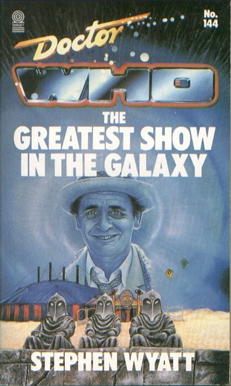
Chapter 144. Doctor Who – The Greatest Show in the Galaxy (1989)

Synopsis: The Psychic Circus has travelled the universe and amassed many fans over the years. Now, it has settled on the planet Segonax, where it has fallen on hard times while under the influence of a malign power. As visitors compete for the approval of the audience, the Doctor has to overcome a major obstacle – Ace’s deep hatred of clowns…

Chapter Titles

  • Overture
  • 1. Beginners
  • 2. Welcome to Segonax
  • 3. Captain Cook
  • 4. The Hippy Bus
  • 5. The Psychic Circus
  • 6. Nord’s Finest Hour
  • 7. The Well
  • 8. The End of Bellboy’s Dream
  • 9. That Old Devil Moon
  • 10. Kingpin
  • 11. The Gods of Ragnarok
  • 12. Positively Last Performance
  • Coda

Background: Stephen Wyatt adapts his own scripts from the 1988 serial. This followed Silver Nemesis on TV, so this was the last time that a pair of stories was released consecutively.

Notes: The approach of the advertising satellite is written in the present tense. Ace is hunting for a new batch of nitro-9 that she recently concocted but is now missing from her rucksack. The Doctor monitors the approaching satellite on the ‘observation screen’ and tells Ace that the TARDIS has a few levels of defence – all of which the satellite bypasses. The satellite lands in the Control Room (hurrah – Wyatt uses the proper name!) and sprouts eight legs to position itself nearer the console. The view of Segonax projected onto the screen shows the circus tent in the middle of a ‘beautiful, lush, green meadow’. The Doctor believes that the founders of the Psychic Circus originally came from Earth. 

‘Nord the Vandal of the Roads’ is a thick-set man, with ‘big muscles, large tattoos, masses of black leather clothing, a brutal unshaven face and a fearsome Viking-style crash-helmet’. When we first meet Captain Cook, he’s delivering a lecture to Mags about the planets Treops and Neogorgon; the latter was where he encountered ‘a whole valley full of electronic dogs’ heads submerged in mud’, which he assumes was a ‘primitive burglar alarm system’. The buried robot begs to be released in a sweet voice, until Ace and Mags get close, when it turns nasty, shouting threats, gnashing its teeth and firing lasers in all directions. Captain Cook, with Mags in tow, drives off and briefly abandons the Doctor and Ace, until they are reunited at the site of the abandoned bus. The bus reminds Ace of when she was a child, when her Aunt Rosemary used to tell her about the Beatles and the Swinging Sixties. 

Nord is given a strongman costume to wear for his act. Whizzkid asks for autographs from the Chief Clown, Morgana and the Ringmaster – which is what propels them into submitting him as a contestant.

By the time Ace first sees Bellboy, his hair is almost white and she suspects he might have received an electric shock. Ace is said to be unable to cope with ‘deep emotion in other people’ and Bellboy’s trauma over Flowerchild makes her feel uncomfortable. She’s ‘never been so close to such naked grief before’. She briefly considers stealing Nord’s bike to help her escape from the circus, but realises it’s useless as Nord didn’t fix the valve properly.

There is a small team of ‘makeup clowns’ who prepare each contestant for the stage – though they allow the Doctor, Mags and the Captain to enter the ring without making them change their costumes. The robot clowns seal Morgana and the Ringmaster into boxes and then when they’re opened, they contain smaller boxes, which contain even smaller boxes until the final two boxes are opened and revealed to be empty. The chief caretaker’s hearse crashes into the Stallholder’s cart, which gets entangled in the limousine’s wheels (on TV, it merely comes to an abrupt halt as she blocks the way). The Doctor has apparently ‘always enjoyed juggling’. His act for the Gods of Ragnarok includes fire eating and a bed of nails. The stallholder claims to have seen the final end of the Psychic Circus, as did everyone else on Segonax as a huge wind scattered leaflets for the circus for miles around.

Cover: Alister Pearson paints a smiling Doctor in the blue sky above the Circus marquee as the three Gods of Ragnarok sit in judgement.

Final Analysis: Stephen Wyatt approaches the TV scripts methodically, delivering a straightforward adaptation with a few minor changes to scene order. The value he brings to the text is a deeper insight into the regular characters: it’s quite a brave thing to show Ace as emotionally under-developed, unable to react appropriately to Bellboy’s grief ; and we get a greater sense of the Doctor’s frustration at being tricked twice because he’s focusing all his attention on the mystery that’s at the heart of the Psychic Circus. The highlight of the TV episodes was the transformation of Mags into a feral beast and it’s beautifully realised here:

The moonlight was working its awful transformation. The hands had grown longer and hairier. The nails had turned to claws. The eyes were becoming blood-shot and savage, the face darker and more bestial, the hair like fur. And, worst of all, the mouth. Mags was slavering now. Huge teeth sprouted in her gums. Her tongue lolled hungrily. Then she snarled, baring her terrible fangs. This was no longer Mags: this was a werewolf. And if the Captain had his way, the werewolf would kill the Doctor.

It’s also interesting that, while she’s under the effects of the moonlight, Mags is described as ‘the werewolf’ except where the Doctor tries to connect with Mags to calm her atavism. A solid story well told.

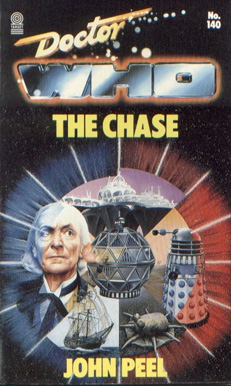
Chapter 140. Doctor Who – The Chase (1989)

Synopsis: A brief holiday on the planet Aridius is interrupted when the Doctor gains advance warning that the Daleks are coming for him. So begins a frantic flight through time, each stop brings their pursuers ever closer. Their final battleground is Mechanus, home to killer plants, the robotic Mechanoids and their sole prisoner, a space pilot called Steven. As the Doctor prepares to confront his enemies at last, his friends have no idea that this will be their last adventure together in the TARDIS.

Chapter Titles

  • Author’s Note
  • 1. The Executioners
  • 2. A Speech in Time
  • 3. The Sands of Death
  • 4. The Victims
  • 5. Deadline
  • 6. Flight through Eternity
  • 7. Nightmare
  • 8. Journey into Terror
  • 9. Fallen Spirits
  • 10. Who’s Who?
  • 11. To the Death!
  • 12. The Mechanoids
  • 13. The End of the Hunt
  • 14. Home!

Background: John Peel adapts scripts from a 1965 serial by Terry Nation. As the author’s note explains, he worked mainly from early drafts, before they were rewritten by story editor Dennis Spooner, so he explains that the book is ‘not strictly an adaptation of the televised version of The Chase’ (ie, it’s not written as if by Terrance Dicks).

Notes: The opening chapter depicts a grand Dalek control room with ‘a background pulse, like an electronic heart slowly beating’. The Black Dalek looks down from a raised platform onto various other Dalek units, including a Chief Scientist. The Daleks know the Doctor by name. They’re also aware that his appearance ‘has changed many times over the years’ and they have tracked him through his ‘basic metabolic pattern’ [meaning these Daleks come from the Doctor’s own future]. 

The Doctor ‘borrowed’ the TARDIS and lost the operational notes while on prehistoric Earth. He is nearly 750 years old and has not yet experienced his first regeneration. We’re reminded of the introduction stories of Ian and Barbara, that Susan left the TARDIS after falling in love and that Vicki recently joined them after being rescued from the planet Dido. The space/time visualiser is just one of many trinkets that the Doctor has picked up over the years. Neither Ian nor Barbara recognise the Beatles song that appears on the visualiser. Vicki has not encountered a Dalek up to this point, but knows of them from her history books.

The Daleks are led by the Dalek Prime, which is ‘larger than most, and painted a uniform golden colour’ (similar to the Emperor from the comic strips). The TARDIS team have encountered the Daleks twice before. The Daleks use flying discs to survey the surface of Aridius. Aridians have blue skin and they wear the skins of mire beasts as cloaks. We’re party to the meeting of the Aridian elders with the Daleks where they’re given the ultimatum. Ian and Barbara had an unseen adventure on Cetus Alpha. The TARDIS dematerialises with a ‘customary groaning and wheezing’. The Dalek time ship is powered by Taranium, ‘both the rarest and most unstable element in the Universe’; one gram can power a time ship for centuries and it took the Daleks two decades to obtain that amount. 

It’s clear the author has done a little research into the crew of the Mary Celeste as the characters are named and fleshed out (he also has one of them exterminated by a Dalek – something that we don’t see on TV). The schoolteachers debate whether they were responsible for the death of the passengers and crew of the ship and Ian reminds Barbara of her attempts to change the history of the Aztecs; they take some comfort from the possibility that the Marie Celeste was always fated to become a mystery. Morton C. Dill is from Alabama. He encounters the TARDIS crew and a Dalek in 1967. The Dalek considers killing him, but then decides to let him live, considering it ‘far worse for the human race to allow this fool to live on’. Ever since that day. Dill has been a resident of the Newman Rehabilitation Clinic for the bewildered (a reference to a routine by American humourist Tom Lehrer). The haunted house is a part of Battersea Funfair, London, and is closed for repair. Vicki uses her months of experience of operating the radio on the crashed spaceship on Dido to use the Dalek radio. After the robot Doctor is destroyed, the real Doctor proves his credentials by reminding his companions of their past adventures, how Ian was knighted by Richard Coeur de Lion, Vicki, led a ‘revolution on the planet Xeros’ and Barbara ‘escaped with the Menoptera from the Crater of Needles’.

Steven Taylor explains that the Earth’s plans for expansion were brought to an end by the Draconian conflict, followed by the Third Dalek War. Realising that the execution squad is outnumbered by Mechonoids and facing defeat, the Dalek squad leader separates from the battle to hack into a computer and trigger the city’s destruction in a final attempt to trap the TARDIS crew. 

Steven manages to escape, makes his way through the jungle and reaches the TARDIS, where he collapses. The Doctor is initially very dismissive of the unstable and brutish Dalek technology of their time ship, but quickly becomes more tactful to avoid frightening Ian and Barbara. He’s pragmatic enough to help the schoolteachers to use the Dalek time ship to return home, but he deliberately sets the time of their destination a couple of years in their future to offset the three years they’ve spent travelling with him. They return to the TARDIS to collect their belongings, including souvenirs of their travels. Barbara wonders if she owes back-rent on her flat, while teasing Ian about the amount of dust that will have settled in the house that he owns. They stow their belongings at King’s Cross Station before enjoying a visit to a pub by the Thames and exploring their home city anew.

Cover: Against a backdrop of the time vortex, divided like a 16-hour clock, the Doctor looks across at a Mechanoid and the city of Mechanus, a Dalek, a mire beast and the Mary Celeste. A suitably busy composition from Alister Pearson.

Final Analysis: There was a lot of build-up to this, the first of the remaining Terry Nation Dalek stories to be novelised, courtesy of a deal struck with author John Peel. I’m a fan of the TV story – comical elements included – and the scattergun approach is the set-up for the next Dalek story, which is similarly meandering but on a grander scale. Glad to say, I’m also a fan of this novel. It’s determined to be grown-up about it all, so the jokey aspects are cut back massively, and some of the additional details appeal mainly to the fan gene in linking this story to ones broadcast later or told in other media. At this point in the history of Target, that’s who the readership was. Peel manages to make the Daleks menacing, scheming and not remotely comical (something their own creator chose not to do in the original TV version). His real success though is in capturing the TARDIS team, the growing relationship between the schoolteachers, Vicki’s resourcefulness and most of all the Doctor’s contrary nature, clearly lamenting the departure of two people who forced their way into his life and became good friends – but refusing to let this show. It’s rather wonderful to have another adventure with this particular crew, as this is the last of their adventures to be novelised. And there are only two more stories from this era left to come… 

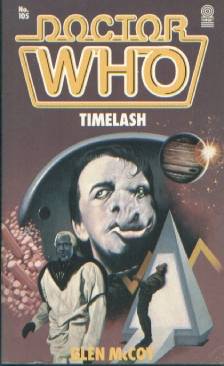
Chapter 105. Doctor Who – Timelash (1986)

Synopsis: The people of Karfel live under the rule of the Borad and his sole point of contact, an official known as the Maylin. When the ruthless Tekker assumes the role of Maylin, he takes the opportunity to remove all political opponents by casting them into the Timelash, a gateway directly into the time vortex. When the Doctor returns to Karfel after many years, he is appalled by the actions of Tekker and this ‘Borad’. He allies himself with the underground rebellion, determined to bring an end to the dictator and his lackey – but the Borad is not so easily defeated… 

Chapter Titles

  • 1. No Escape
  • 2. The Time Vortex
  • 3. Whirlpool
  • 4. Return of the Time Lord
  • 5. Negotiating the Timelash
  • 6. Stirring Embers
  • 7. Fight or Perish
  • 8. Battle Stations
  • 9. Regrouping
  • 10. Legacy of the Borad
  • 11. The Bandrils’ Bomb
  • 12. Double Trouble

Background: Glen McCoy adapts his own scripts from the 1985 serial.

Notes: Sezon and Katz were the leaders of separate rebel cells until recently, when they decided to combine their resources into a single unit. Katzin Makrif was the daughter of the Maylin who ‘died mysteriously’ when the Borad took control in a ‘so-called bloodless coup’. Katz was 16 at the time and lived in ‘servile submission and indignity’ for ten years before joining the rebellion. The rebels have lived a nomadic life, moving from place to place, and are now hiding in a disused mine that’s lain empty since the great famine that nearly wiped out the planet’s civilisation almost a century ago. While hunting for food, the pair are trapped in a cave by the arrival of a family of Morlox, only able to escape when the mother Morlox protects her brood against attack from another Morlox. Later, we’re told that both Katz and Sezon were once respected scientists and had suffered the Borad’s tyranny for six years before choosing to rebel.

The Doctor knowingly goads Peri purely to remain in control of their relationship. The Borad’s ageing device reduces the victim to dust, rather than the bouncy skeleton we saw on telly. Peri doesn’t encounter a rebel with a note for Sezon, nor does she throw a potentially deadly plant into the face of a guardollier. Her pendant, which is snatched from her neck by an android, is specifically a St Christopher, which suggests she’s either a Catholic or she’s still trying to rid herself of a Madonna obsession from her teens. Her flight from the Karfel dome takes her outside onto the planet’s surface, where she sees the twin suns of Rearbus and Selynx in the crimson sky. Eventually, she finds her way into the cave system (on screen, the caves connect directly to the city).

The Doctor fends off a Morlox with a wooden stake, which has been sprayed with Mustakozene 80. The chemical reacts with the creature, spearing it with sharp wooden spines that instantly grow through its body. The Borad sends a command to his androids to destroy all life in the citadel, resulting in a pitch-battle between the mechanical servants and the terrified citizens. Prior to the Borad’s reappearance, the Doctor and Mykros discover a chamber of capsules containing numerous Borad clones. The Doctor’s escape from the Bandril missiles is explained slightly more clearly than it was on screen.

Cover: A fine composition by David McAllister of the Borad, a blue-faced android and someone about to fall into the timelash.

Final Analysis: So the legend goes, Glen McCoy offered his services to novelise his TV scripts before the story was even on Target editor Nigel Robinson’s radar. His resulting novel presents us with a few extra scenes and the scale of the story is much greater than on TV, but there’s also a sense of McCoy telling rather than showing, with a lot of action reported rather dispassionately. At the time of release, Doctor Who Magazine praised the characterisation of the Doctor bursting into rooms and taking control, but his willingness here to gaslight his companion for the fun of it is as distasteful and difficult to accept as it was back in 1986.

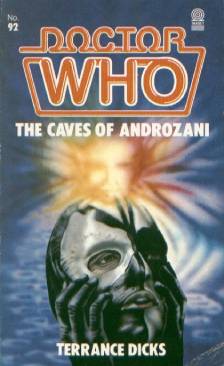
Chapter 93. Doctor Who – The Caves of Androzani (1985)

Synopsis: Troops from Androzani Major are losing in a war against the android soldiers of Sharaz Jek, an arms trader who controls his operations from deep within the catacombs of the twin planet Androzani Minor. Driven by revenge, Jek has a stranglehold over the supply of spectrox, a substance that, when refined, is a much-valued elixir. In its raw state, however, it can be a deadly poison. And both the Doctor and Peri are already suffering from the effects of spectrox toxaemia. Can the Doctor hold off an impending regeneration long enough to rescue Peri and get them both to safety? 

Chapter Titles

  • 1. Androzani Minor Revisited
  • 2. Spectrox War
  • 3. The Execution
  • 4. Sharaz Jek
  • 5. The Escape
  • 6. The Magma Beast
  • 7. Spy!
  • 8. The Boss
  • 9. Crash Down
  • 10. Mud Burst
  • 11. Takeover
  • 12. Change

Background: Terrance Dicks adapts scripts by Robert Holmes for a serial broadcast eight months earlier. This followed Planet of Fire on TV, so that’s another pair of stories to be released consecutively.

Notes: Androzani Major and Minor are two of the five planets that make up the Sirius system. Peri gets her very own Terrance Dicks summary, she’s ‘an attractive American girl, her piquant features framed in short dark hair.’ She considers the Doctor’s interest in everything to be one of his ‘endearing and aggravating characteristics’, which might indicate that they’ve been together for some time, even though soon after she says that the mud of Androzani Major would make ‘a change from lava’, which would suggest this is her first trip since Sarn – or they’ve visited a lot of volcanic locations. We’re shown what happened to Trooper Boze (a scene only recounted on TV in reported speech by the android Salateen) and the reference to ‘Chacaws’ is explained; they’re a ‘fiercely-spiked fruit grown on the penal plantations of Androzani Major’, which leave the chacaw pickers covered in scars.

The Magma Beast is the recipient of this volume’s ‘let’s beef up the monster’ award:

The body resembled that of a giant tortoise, or perhaps an armadillo, though the creature stalked upright on two powerful back legs, like a Tyrannosaurus Rex. The massive fanged head was like that of a tyrannosaurus too, though it also bore two ferocious-looking horns. The powerful arms were short and stubby, ending in two enormous claws. As the monster stalked forwards, the massive carapace, at once protection and camouflage, covered the back of its body like an armoured cloak.

When the Doctor finds the beast dead, he surmises that it was caught in a mud burst and ‘either choked or boiled to death’. Sharaz Jek removes his mask to reveal ‘two mad eyes blazing from a face that was no more than a formless blob, a lump of peeling corrugated skin, devoid of all features’. He strangles Morgus until he’s dead (rather than shoving his head into the laser of one of his machines). 

Cover: Andrew Skilleter’s cover shows Sharaz Jex clutching his mask forlornly while an explosion overhead has a blurred and very subtle approximation of the sixth Doctor’s face. A 1992 reprint uses the VHS cover, again by Skilleter, which shows the fifth Doctor, Sharaz Jek (inset), some androids and the twin Androzani planets.

Final Analysis: Terrance Dicks is back, working on his friend Robert Holmes’s most popular story – and doesn’t put a foot wrong. He adds little details to help build upon the societies Holmes created, puts in a few extra bits to bridge gaps – and unlike the omissions by Bidmead in Logopolis, he describes the onscreen visions of the Doctor’s past companions and the Master’s taunting. It’s the idea that the Master might literally get the last laugh that propels him towards choosing to survive. And so, once again, Terrance gets to describe the first moments of a new Doctor:

He had a broad, high forehead and a mop of curly light-brown hair. There was something cat-like about the eyes, a touch of arrogance in the mouth.

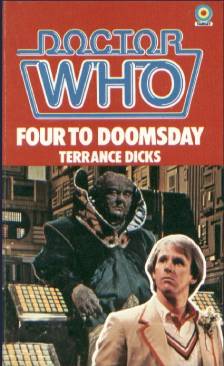
Chapter 77. Doctor Who – Four to Doomsday (1983)

Synopsis: The TARDIS lands on a huge spaceship heading towards Earth. The inhabitants appear to come from different periods in Earth’s history, providing entertainment for three amphibious Urbankans called Enlightenment, Persuasion and the imperious Monarch. Given the freedom to explore the ship, the Doctor and his friends begin to understand the terrifying scale of Monarch’s ambitions…

Chapter Titles

  • 1. Ship of Mystery
  • 2. A Meeting with Monarch
  • 3. The Transformation
  • 4. The Invaders
  • 5. The Explorers
  • 6. The Android
  • 7. The Convert
  • 8. Tegan’s Gamble
  • 9. Death Warrant
  • 10. Reprieved
  • 11. Riot!
  • 12. Spacewalk

Background: Terrance Dicks adapts Terence Dudley’s scripts for the 1982 serial. This followed Castrovalva on TV, so that’s another pair of stories to be released consecutively.

Notes: Terrance gets his first go at this TARDIS crew, so we get decent descriptions of them all – at last!: Nyssa is ‘an attractive-looking girl with brown hair and an aristocratic, somewhat haughty air’; once again, Adric is ‘a smallish, round-faced youth wearing a yellow tunic’; the Doctor’s ‘third, least willing companion [is] an ‘Australian air-hostess called Tegan Jovanka’ who is said to be ‘exceptionally forceful, even for an Australian’; and the new Doctor, who we’re told is now in his fifth incarnation, is a ‘rather slight, fair-haired young man with a pleasant, open face’ (entirely coincidentally a cricket pun there – Dicks had no idea  it was a term for how a cricketer grips the bat!). Each of the companions gets a one-line origin summary.

Observing a device that can reduce matter, Nyssa recalls that it’s a favoured method of the Master and was the way he murdered Tegan’s aunt. As the Doctor tells Monarch that only he can operate the TARDIS, it dematerialises under Tegan’s control, rather undermining his boast. Nyssa’s fainting cliffhanger that leads into the next story is omitted. 

Cover: An almost competent photo montage of Stratford Johns as Monarch with Peter Davison as the Doctor. Alister Pearson’s 1991 cover is just a noble portrait of Monarch with a suggestion of his chamber lightly etched into the background. 

Final Analysis: By this point in time, TARDIS companions exist solely to bicker and Terrance Dicks relishes the opportunity to show the previously impish Adric as an utter brat. Tegan’s brashness is accentuated too, which rather underlines how empty and bland Nyssa is. We’re even told that she manages to save the Doctor from execution because she’s ‘ standing unnoticed in the background, ignored because nobody considered her a threat’. Four to Doomsday is unlikely to be anyone’s favourite story, or indeed anyone’s favourite book; it does the job, nothing more.

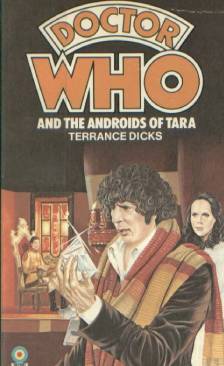
Chapter 56. Doctor Who and the Androids of Tara (1980)

Synopsis: The Doctor has gone fishing, leaving Romana to hunt down the next segment of the Key to Time. She completes her hunt with surprising ease, but just as quickly she becomes a prisoner of the scheming Count Grendel. Meanwhile, the Doctor’s holiday is interrupted by guards who serve Prince Reynart, a sickly monarch-in-waiting, whose reign is about to be cut short by Grendel. The Prince has an android duplicate of himself, which he hopes to use as a decoy long enough to ascend the throne. The android, however, doesn’t work. Separately, the Doctor and Romana work from opposite sides to fix the state of Tara. 

Chapter Titles

  • 1. The Doctor Goes Fishing
  • 2. Count Grendel
  • 3. The Double
  • 4. The Princess
  • 5. The Prisoner of Gracht
  • 6. The Android King
  • 7. Invitation to an Ambush
  • 8. The Android Killer
  • 9. Flag of Truce
  • 10. Count Grendel plans a Wedding
  • 11. Attack by Night
  • 12. Victory

Background: Terrance Dicks adapts scripts by David Fisher for his second story from 1978. This followed The Stones of Blood on TV, so that’s another pair of stories to be released consecutively.

Notes: The statue that transforms into the Key to Time segment depicts ‘a vaguely dragon-like heraldic beast, thrusting time-blunted claws towards the blue summer sky’. The very-much-alive creature that attacks Romana is a very generous evolution of the short, comedic beast seen on telly:

The monster was a good eight feet tall – and it walked upright like a man. It had coarse black fur, slavering jaws filled with yellow, pointed teeth and a stubby horn projecting from the centre of its forehead. A mixture of bear, ape and boar, with the nastiest features of all three. 

Count Grendel is said to possess a ‘darkly handsome face’ which is ‘marred only slightly by a fiercely jutting beak of a nose’ – an unflattering description of actor Peter Jeffrey. At the end, the Doctor rescues the adrift K9 – and Romana jokes that he ‘managed to catch a fish on Tara after all’ – before the time travellers depart in the TARDIS.

Cover: A scene painted by Andrew Skilleter shows the Doctor inspecting a segment of the Key to Time, watched by Romana (in her Ribos costume), appearing on a cover for the first time. In the background, K9 makes his first appearance on a book cover too, looking up at the Prince on his throne. The back cover announces ‘THE ANDROIDS OF TARA is a novel in the Key To Time Sequence. Read THE RIBOS OPERATION and THE STONES OF BLOOD available now.’ (said books didn’t carry this linking text).

Final Analysis: Around the time that this book was published, Shredded Wheat had an advertisement campaign that boasted that the product had ‘nothing added, nothing taken away’. Aside from the exaggerated details of the beast in the woods, this is all we get here. I still think it’s not fair to dismiss Dicks’ writing simply as just adding ‘he said / she said’ to the script, as he paints a vivid picture of the castles and woodlands of Tara, but this is a great example of Dicks at his most perfunctory. Everything that we might like about this came from David Fisher.

Chapter 44. Doctor Who and the Android Invasion (1978)

Synopsis: The TARDIS brings the Doctor and Sarah to an English village where something is wrong. The locals seem cold and machine-like, while a group of blank-faced astronauts patrol the area and shoot at the new arrivals. The Doctor tries to piece together the clues around him, but it’s Sarah who reveals the truth; the village isn’t a real village, this isn’t really Earth – and Sarah is not the real Sarah! The whole thing is an elaborate copy created by Styggron – chief scientist of the Kraals. And the real invasion is about to begin…

Chapter Titles

  • 1. Strange Arrival
  • 2. Village of Terror
  • 3. The Watcher
  • 4. Hunted
  • 5. Captured
  • 6. The Test
  • 7. The Countdown
  • 8. Braindrain
  • 9. Blastoff
  • 10. Hero’s Return
  • 11. Takeover
  • 12. Death of a Doctor

Background: Terrance Dicks adapts Terry Nation’s 1975 scripts, completing the run of Season 13 stories for Target.

Notes: Sarah wears ‘casual late-twentieth-century clothes, with a brightly coloured scarf at her throat’. The army soldier who throws himself off the cliff isn’t from UNIT and the android Sarah finds inside the capsule by the TARDIS is an old lady. Chased by patrol dogs, the Doctor has a curious thought that anyone who thinks foxes enjoy being hunted should try being chased across country by dogs themselves. Styggron is described thusly:

The face hovering over her was broad and flat with leathery greenish skin. It was heavily jowled with a squashed pig-like snout, underhung jaw, and enormous ears set flat against a massive skull. Huge eyes glowed in cavernous sockets beneath the jutting brows. 

The calendar in the Fleur de Lys only shows the month of September (on TV, it’s a day-by-day calendar with solely ‘Friday July 6th’ pages). The entrance to the Kraal bunker is hidden inside an empty barn. When Styggron says ‘There is no time for pleasantries’, the Doctor asks rudely: ‘How about unpleasantries, pig face?’ Haha!

Benton has promised to take his sister to the village dance (not The Palais). It’s not exactly clear on TV, but the android Benton is found leaning over Benton’s body. Here’s the paragraph:

The kneeling man turned and looked up at him and Adams gave a gasp of astonishment. The soldier leaning over Benton, was Benton… He opened his mouth to shout an alarm, and a savage blow struck him down from behind. The android technician caught the falling body and laid it down beside the body of the real Benton. The android Benton got to its feet, and gave a nod of satisfaction. ‘Good. Have them taken away…’

That’s not just ‘the unconscious Benton’, it’s ‘Benton’s body’. Eek!

It’s the Benton android, not the Doctor Android, that points out that there’s ‘much to do’. Once the Doctor has bluffed his way past Android Benton, the scene is not repeated with the android Doctor. We don’t get the final scene of the Doctor and Sarah leaving in the TARDIS; instead, the Doctor plans to collect up all the androids and dismantle them before the scanner beam can be switched off. Marshal Chedaki, meanwhile, waits in vain for Styggron’s signal to begin the invasion. ‘With Styggron dead, his master plan had come to nothing. The android invasion was over.’

Cover: Another brilliant cover by Roy Knipe, it’s just the Doctor being tied to the village memorial by spacemen while Styggron looks off into middle distance, but it’s so effective.

Final Analysis: Often dismissed as lightweight because of the grittier stories that surround it, I’m very fond of The Android Invasion. Here, Dicks adds a little to the playfulness between Sarah and the Doctor where, in the past, that might have been trimmed. Chedaki is more of an antagonist to Styggron, as a disgruntled leader of the military wing, and he’s more threatening a presence than the subservient TV version. Dicks then tidies up all the loose ends in a final section that unfortunately stresses just how rushed the conclusion was on telly.

And just in case we’re in any doubt – it’s Benton’s BODY! Not so lightweight now, eh?