

Synopsis: The Master has stolen information from the Time Lords regarding a mythical weapon, which can be found on a planet recently occupied by Earth colonists. The desperate people are caught between hostile attacks from the indigenous natives and a mining corporation intent on taking the planet’s resources for their own ends. All this awaits Jo in her first trip in the Tardis.
Chapter Titles
- 1. A Missing Secret
- 2. Into Time and Space
- 3. The Planet
- 4. The Monster
- 5. Starvation
- 6. The Survivor
- 7. The Robot
- 8. The Men from IMC
- 9. The Spy
- 10. The Claw
- 11. Face-to-face
- 12. The Bomb
- 13. The Attack
- 14. The Adjudicator
- 15. Primitive City
- 16. The Ambush
- 17. Captain Dent Thinks Twice
- 18. The Master’s TARDIS
- 19. The Return of Captain Dent
- 20. The Doomsday Weapon
At twenty, this book sets a record for the most number of chapters in a novelisation, which will remain unbroken until 1985.
Background: Malcolm Hulke adapts his scripts from 1971 for Colony in Space.
Notes: Another prologue of a scene that never happened, as an old Time Lord shares stories with an apprentice, revealing the history of early TARDISes and his own personal involvement in the resolution of The War Games returning the kidnapped soldiers to their rightful times. He refers to the Doctor’s TARDIS and the fact that it’s lost its ‘chameleon-like quality’. There’s also another cheeky ‘Who’ reference as the old Time Lord explains the Doctor’s inability to pilot his TARDIS: ‘‘Who? No, Who can’t control it… not always.’
Newly qualified security agent Jo Grant is introduced, having come top of her year in spy school before getting her uncle to pull some strings to arrange a posting to UNIT, where she’s ignored by everyone except Sergeant Benton and attempts to reprimand the Doctor before she finds herself whisked off to an alien world as her very first adventure. A lovely if inconsistent flashback. Meanwhile, Jane Lesson recalls being aware of other ‘terrifying space creatures’ ‘Monoids, Drahvins, some small metallic creatures called Daleks’ before referencing Hulke’s own creations, the ‘reptile men’.
The story’s set a bit further forward in time, 2972, and there’s a grim but casual detail in the Doctor realising that the colonists describe a creature ‘like a big lizard… from the picture books’ because the Earth animals were ‘exterminated by Mankind by the year 2500’ and not because, for example, they were describing dinosaurs. The Doctor speculates on the size of an attacking creature as ‘about twenty feet high’ and then corrects himself to ‘six metres’ as he remembers that all of Earth went metric a thousand years before. Surprisingly, the IMC robot is described as humanoid – a much more achievable look on TV than the bulky robot we ended up with (and the illustrations don’t quite match this new design either). Hulke provides an unsettling vision of the future: The entire surface of Earth in this time is covered in tiny cube apartments within huge buildings; The Interplanatary Mining Corporation arranges marriages based on computer-decided compatibility (though strangely Dent’s marriage seems happy while Caldwell’s has ended in separation); food is sourced solely from the sea; even when IMC chief Dent offers his team champagne, it’s from a can.
There’s a hint of the first pioneers across America here as the colonists have never done physical work (‘on Earth machines did everything’) so they’re even more badly equipped to found a new civilisation than it might appear. But when they have to consider how to bury their dead, Ashe recalls an ‘audiobook’ from back when Earth ‘still had open land’; it seems that even the disposal of dead bodies on Earth is automated as the Doctor has to explain to the colonists the rituals of graves, religious services and the importance of ‘a time for tears, and then a time to rejoice in the continuation of life. Hence the tea.’
The leader of the primitives is described as the size of a doll, explaining the earlier foreshadowing of the primitives reaction to a child’s doll, while the primitive priests have the faces of otters – and the rest of the primitives are stark naked!
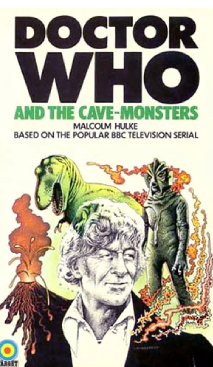
Cover & Illustrations: The original cover and illustrations were by Chris Achilleos (though my first edition was the 1979 reprint with Jeff Cummins’ impressive portrait of Roger Delgado as the Master). I’m really not keen on the illustrations here, they’re a bit scrappy – some are clearly working from set photos while others show people who we don’t see in the TV version (Caldwell could just be an Auton!). I love the pic of the Doctor and the Master at the controls of the Doomsday machine though, as it looks like the Master is washing his hands.
Final Analysis: We’re only three books into Target’s own run of books and there’s still no guarantee that every story will be novelised, so we get a new introduction to Jo Grant that ignores all of her adventures prior to this, but gives her a marvellous backstory too. Some of the supporting characters benefit from an expanded biography too, specifically Ashe and Dent. Hulke’s second novel for the range hints at the author’s politics in the way it describes Earth in the far future as a desperate place: IMC represents the worst excesses of capitalism, dictating a person’s quality of life by how much debt they owe to the company and all minimal perks can be removed at the say-so of a cruel boss like Dent. Hulke doesn’t make the colonists too perfect either, as they’re more than happy to kill to survive (there’s none of the Thal-like pacifism here, and Smedley’s disposal of Norton, however justified, is quite callous. It seems the new (unnamed) world offers new hope to the colonists; as the Doctor and Jo leave, the entire landscape has already begun to sprout with grass and shrubs.
As Doctor Who Magazine writer Alan Barnes points out, the original title, Colony in Space, might have been exciting for viewers who’d become used to the Doctor’s Earthbound adventures, but as part of the mix-and-match releases of Target, it’s less of a draw. The Doomsday Weapon’ is a much better title anyway.
 Escape to Danger