Chapter 76. Doctor Who – Castrovalva (1983)

Synopsis: The Doctor is struggling after a particularly distressing regeneration. He seeks rest deep within the TARDIS, but an external force sends the time machine racing towards the Big Bang. A narrow escape brings the travellers to the quiet town of Castrovalva. The locals are friendly and offer the Doctor room to recuperate. But there’s something strange about the town; how can the local chemist be in four places at once? Who is exploiting the Doctor’s weakened state and for what purpose? And where is Adric?

Chapter Titles

  • 1. Escape from Earth
  • 2. Towards Zero
  • 3. Destination: Event One
  • 4. Russian Roulette
  • 5. Jettisoned
  • 6. The Quest for Castrovalva
  • 7. Within the Walls
  • 8. The Dark Reflection
  • 9. The Occlusion Closes In
  • 10. The Clue of the Chronicle
  • 11. The World through the Eyes of Shardovan
  • 12. The Web is Broken

Background: Christopher H.Bidmead adapts his own scripts for the 1982 serial.

Notes: We’re told that the ‘apocalyptic events’ of Logopilis led to the previous and future Doctors overlapping in the form of the Watcher. We’re drawn to consider the new Doctor’s ‘strangely smooth and vacant face’, while  Adric has a ‘strange smile and wicked black button eyes’ and Nyssa possesses ‘a remote, aristocratic quality that was somehow unEarthly’. Based on the scant hours he’s spent there, Adric considers Earth to be a ‘planet of fools and bullies’. We’re reminded of Adric’s former home on the starliner on Alzarius. Tegan is said to have ‘once been lost in that maze of white corridors during her involuntary first trip in the TARDIS’… which took place… yesterday? She also utters the mild expletive ‘strewth’ a couple of times.

Nyssa tries to explain recursion to Tegan by discussing family trees (and Tegan feels awkward as she realises Nyssa’s family and everyone she knows has been wiped out by the Master). The Doctor’s new coat is ‘a cream coloured garment that was too summery to be a morning coat but too long to be a sports jacket’. As Tegan and Nyssa look at the scanner to see the Master waving at them, they can see Adric behind him, trapped in the electronic web. The TARDIS has a surgery and a trolley laden with medical supplies rolls out of it towards the Doctor during the Event One incident.

Apparently, ‘the Gallifreyan temperament tends to see the world from the other person’s point of view’, so the Doctor feels empathy for a roast pig. There’s also an ‘official Time-Lord strategy’ that’s taught to small children that… :

… in circumstances of near-defeat you take stock of the forces that are working on your behalf, your assets, and then separately assess the forces working against you, your liabilities. This leads directly to the next stage: devising a logical plan that will increase the former and diminish the latter. 

The Doctor views this ‘arid, abstract and artificial’ edict as ‘typically Gallifreyan’ – he prefers ‘blind panic’. He is said to be ‘nearly eight hundred’ years old, while Castrovalva was created by the Master as a trap 500 years ago. So was this created in the Master’s distant past and he’s only just come back to it? Did he set it up and then jump forward 500 years? Did he play at Portreeve for half a millennium while Adric was held in stasis in the electronic web?! (Or is this just not actually true and he knocked it up yesterday in between wrestling with the Doctor on a gantry and choosing a nice hat for his Portreeve cosplay?). On the jog back to the TARDIS, Adric is ‘still a little pallid after his long ordeal’ – a real-world cheeky dig at actor Matthew Waterhouse’s overindulgence in the bar the night before the filming of that sequence for TV. The Doctor opts not to dampen Tegan’s enthusiasm by telling her she didn’t land the TARDIS after all and it was all Adric’s doing.

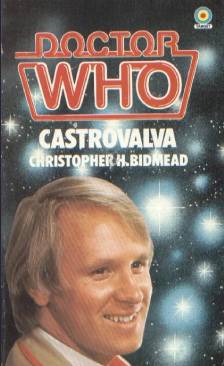
Cover: Somebody clearly resents being made to work on these as the cover design is woefully lazy – a photo of a smiling Peter Davison against a starfield backdrop. Alister Pearson’s reprint cover from 1991 is predictably better, to be fair, with an almost identical picture of Davison (which makes him look old) next to a beautifully realised, geometrically impossible walkway from the Castrovalva town square.

Final Analysis: ‘Euclidian topology’? Really, Bidmead? We’ve come a long way since the days of writing these books for eager seven-year-olds, but there really is no concession for the child reader here. It all fits together rather neatly, especially the way so much of the dialogue is there to underline the theme of recursion, but as with Logopolis, there’s also the suspicion that the author’s making himself a little too visible in the text by showing off.
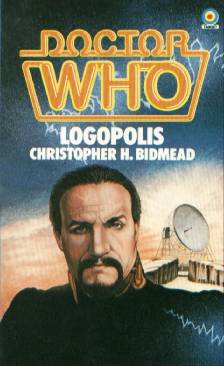
Chapter 74. Doctor Who – Time Flight (1983)

Synopsis: A supersonic aeroplane has disappeared. Retracing its last known flight path aboard another Concorde, the Doctor, Nyssa and Tegan are as surprised as the crew when they touch down on a prehistoric plateau. Nearby is a huge temple, the home to a strange wizard called Kalid, who seems amused by the time travellers’ plight…

Chapter Titles

  • 1. Flight to Infinity
  • 2. An Unauthorised Police Box
  • 3. The Doctor Goes Supersonic
  • 4. The Coming of the Plasmatons
  • 5. The Magic of Kalid
  • 6. The Doctor and the Magician
  • 7. The Enemy Unmasked
  • 8. The Power in the Sanctum
  • 9. On a Wing and a Prayer
  • 10. In Transit

Background: Peter Grimwade adapts his own scripts for the 1982 serial.

Notes: The first TARDIS scene is, if anything, even briefer than the one on screen, although in the aftermath of Adric’s death, the companions at least acknowledge that the Doctor might be grieving too, in his own way – and they also realise they didn’t know the boy all that well at all. Does the Doctor’s mention of Adric’s brother Varsh come as news to them? Tegan identifies their landing site as ‘London Airport’ (so assumes they’ve arrived in 1966?). Kalid has a ‘thin, strangulated voice’ and a:

… yellow oriental face, bloated like the body of a drowned dog and gangrenous with age and excess, with broken teeth and rotting gums that contorted his mouth into a permanent leer. His height too, for a Chinaman – if that was his race – was remarkable, and his girth, concealed by a bright coat of damask, as monstrous as the force he invoked.

When he emerges from Kalid’s body like ‘a pupating beetle’, the Master is introduced without any further explanation or description (as is the Tissue Compression Eliminator, which makes its debut in the books here!). I’m beginning to suspect this is perhaps a new house style. Having stolen the Doctor’s TARDIS, the Master is indignant that it’s typical of the Doctor to ‘travel in a machine that was unserviced, unsafe, and light years out of date!’ As she helps to change the wheels of Concord, Tegan remembers the wheels on her Aunt Vanessa’s car.

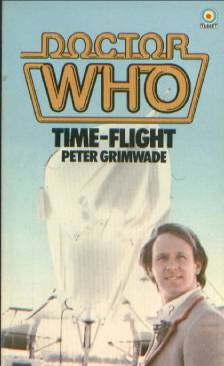
Cover: A drab photo of Peter Davison next to a Concorde.

Final Analysis: Another original author steals food from Terrance Dicks’ plate.The opening chapter suggests that Grimwade is keen to show off all of the extra research into Concord that remained unused from his TV scripts and he has a fondness for bizarre similes that somehow work, such as ‘The Professor’s lips moved silently like an elderly goldfish that has just been fed’. I look forward to reading something from the author that’s based on something a little more substantial.

Chapter 72. Doctor Who – Logopolis (1982)

Synopsis: A sudden whimsy to reconfigure the TARDIS’s chameleon circuit leads the Doctor to confront a terrifying and certain future. The Master has returned and his new scheme puts the entire universe at risk. Surrounded by companions he didn’t choose and forced to enter a partnership with his oldest enemy, the Doctor has finally reached the end – and it really has been prepared for…

Chapter Titles: The chapters are simply numbered one to twelve. Bidmead could have at least done them in binary!

Background: Christopher H. Bidmead adapts his own scripts from the 1981 story. Making good use of his past life as an actor, he also reads the audiobook, making him the first credited author to do so (although Barry Letts read The Daemons, the scripts were co-written and credited to ‘Guy Leopold).

Notes: The police officer killed by the Master is named Donald Seagrave. The police box he investigates is on the Barnet bypass (not specified on screen). Aunt Vanessa lives in ‘a cottage house in a quiet village-like street’ less than 50 miles from the Barnet bypass.  The Doctor recalls that Romana is ‘at the Gateway with Biroc and the Tharils’ (though we’re not told what this actually means for any reader who didn’t yet catch Warriors’ Gate). Adric is said to have a badge for mathematical excellence, but his ‘grasp of physics wasn’t very good’. As he inspects the real police box, he queries the wording on the telephone hatch:

Adric had seen identical wording on the outside of the TARDIS, and had taken it to be some sort of joke of the Doctor’s. Officers and Cars had never, to his knowledge, responded to Urgent Calls, although there were several occasions when he and the Doctor could have used a little extra help.

This is his first time on Earth, so it’s possible that the only encounters Adric has had with ‘officers’ is Proctor Neman on Traken – that pillar of the community who accepted bribes. The Doctor has cause to recall the recent events on Traken and is reassured that Tremas and his daughter are ‘happy’ but begins to worry that the Master might have escaped. Adric refers to the ‘console room’ (the first time this phrase has been used – it doesn’t even appear in the TV version). 

Tegan is ‘barely twenty years old’. When he sees Tegan on the TARDIS scanner, Adric has a feeling he has known her very well; he observes that her face ‘looked rather beautiful, framed by that dark red hair under the severe purple cap that matched her uniform.’ Tegan’s plane ‘back home’ is a Cesna. 

The TARDIS cloisters have a ceiling with an ’emulation of the sky, even as far as the suggestion of clouds’. The Doctor gives Adric a copy of The Complete Poetry of John Milton and the boy observes a similarity between a fallen angel and the Master. The Doctor hovers the TARDIS above Logopolis to give the Logopolitans advance notice of his arrival. As viewed from above, the City of Logopolis looks like ‘a giant brain’. 

The Master’s (unnamed) weapon is silver and leaves a whiff of ozone after discharge. The Doctor falls from the telescope when the cable he’s hanging from snaps. Adric realises the Doctor is ‘regenerating’, as he and Nyssa confirm their suspicions that the Watcher was the Doctor all along. The new Doctor has a ‘smoother, younger face’ and beams ‘somewhat vacuously’ at his friends. We’re presented with his first words::

‘Well, that’s the end of that,’ said a voice they had not heard before. ‘But it’s probably the beginning of something completely different.’ 

Cover: Andrew Skilleter paints a simple composition of the Master in front of the Pharos project. Alister Pearson’s 1991 cover has the Doctor looking tired, Tegan and Nyssa grinning, leaving the Monitor and Adric to look at the shrinking TARDIS.

Final Analysis: The opening paragraph warns us that…

When some great circumstance, hovering somewhere in the future, is a catastrophe of incalculable consequence, you may not see the signs in the small happenings that go before.

Accordingly, Bidmead progresses to foreshadow events: Tegan is about to embark on a journey that ‘she would never forget for the rest of her life’; Adric hears the cloister bell for ‘the first but not the last time’;  … and so on.

As with The Visitation, there’s no introduction for or description of the Doctor or Adric, but there’s a palpable enthusiasm for showing off Bidmead’s knowledge of modern science, such as Maxwell’s Second Law of Thermodynamics and ‘Mr Heisenberg’. The assumption is that the reader already knows who the Doctor and Adric are (which I’ve grumbled about with other writers), but we at least get a clear idea of the new arrival, Tegan. The best bit is the conclusion of Chapter 5:

Tegan’s voice exploded like a shrapnel-bomb in the quiet of the console room. ‘I demand to see whoever is in charge of this ship.

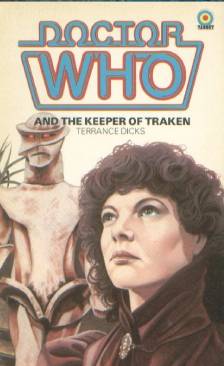
Chapter 68. Doctor Who and the Keeper of Traken (1982)

Synopsis: The Keeper of Traken presides over a union of harmony. Nearing the end of his very long life, he visits the Doctor and invites him to visit Traken. Instead of being honoured guests, the Doctor and Adric find themselves mistaken for the evil that the Keeper has warned about. In a nearby grove, Kassia, the wife of a consul bares her soul to a lonely statue, fearful that her loving husband will be taken from her if he is nominated to be the new Keeper. But then the statue speaks – and promises everything will be okay, so long as she obeys without question. Within the statue, in an impossibly large chamber, a decaying figure observes his plan coming together, a plan that will find him power to regenerate his husk of a body – and enact revenge on his nemesis, the Doctor!

Chapter Titles

  • 1. Escape to Danger
  • 2. Melkur Awakes
  • 3. Intruders
  • 4. The Voice of Melkur
  • 5. Melkur’s Secret
  • 6. The Net
  • 7. Prisoners of Melkur
  • 8. A Place to Hide
  • 9. Death of a Keeper
  • 10. The Rule of Melkur
  • 11. The Last Resort
  • 12. The Enemy

Background: Terrance Dicks adapts Johnny Byrne’s 1981 scripts, which followed Warriors’ Gate on TV, making this the second time that three consecutive stories have been released together.

Notes: The first chapter is called ‘Escape to Danger’ (yay!) and it directly follows on from Warriors’ Gate, explaining the disappearance of Romana and K9. Adric’s standard description now tells us he’s ‘a smallish, round-faced, snub-nosed lad with an expression of cheerful impudence’. We’re also told he ‘usually eats enough for two’ and Adric observes that ‘practically everyone on Traken was old, eminent, and bearded’, which is a brilliant line. We only discover the identity of Melkur at the same time as the Doctor. The description of the Master matches that from The Deadly Assassin:

The figure in the chair was both wizened and decayed, the body as worn out as the tattered robes. One eye glared madly from the crumbling ruin of a face and blackened lips drew back in a ghastly chuckle.

As he confronts the Master in his TARDIS, The Doctor recalls his nemesis back in his prime:

The stocky, powerful figure, the darkly handsome face with its pointed beard and burning eyes, the deep, hypnotic voice. All of that was gone, decayed, so that all that was left was a walking corpse.

The new Master’s first words are ‘Now begins my new life!’

Cover: Andrew Skilleter gives us a simple scene of Nyssa and Melkur. Alister Pearson’s 1993 reprint cover is another montage of faces, depicting the Doctor, the Keeper and Melkur, along with the screaming, decaying face of the Master.

Final Analysis: A lot more effort with this, even though it’s largely a straight translation from screen to page, as Terrance provides points of view and character insights throughout. One slightly odd thing is that it’s not exactly clear in the TV episodes when exactly the Keeper reveals that Tremas is to be his successor, as this is merely reported by the Keeper after he shows the Doctor and Adric the wedding scene. Here, the appointment is very much part of the wedding, meaning Tremas and Kassia are married for less than two days before they’re both killed.  As on TV, Nyssa is not signposted as the new companion and if anything her role is minimal, even though Terrance makes sure to tell us that she and Adric quickly become friends.

Chapter 36. Doctor Who and the Deadly Assassin (1977)

Synopsis: The Time Lords of Gallifrey enjoy immense power, living in isolation from the rest of the universe. On the day that the President of the Time Lords is expected to announce his successor, security is tight! Yet somehow, an obsolete and unauthorised time capsule – a TARDIS – has landed right in the heart of the Capitol. Its owner, a criminal called the Doctor, is nowhere to be found. Then the President is assassinated – and the Doctor is found holding the gun. But could there really be two rogue Time Lords at play? Soon, the future of the Time Lords will depend on a battle of wits between two bitter rivals – and it will be a fight to the death.

Chapter Titles

  • 1. Vision of Death
  • 2. The Secret Enemy
  • 3. Death of a Time Lord
  • 4. Trapped
  • 5. The Horror in the Gallery
  • 6. Into the Matrix
  • 7. Death by Terror
  • 8. Duel to the Death
  • 9. The End of the Evil
  • 10. The Doomsday Plan
  • 11. The Final Battle
  • 12. The End – and a Beginning

Background: Terrance Dicks adapts Robert Holmes’s 1976 scripts.

Notes: That epic crawl from the start of the TV version is dropped, though its main details are absorbed into the rest of the book. In his youth, the Doctor trained for a seat on the High Council on Gallifrey, but he grew frustrated at the ‘never-ending ceremonials and elaborately costumed rituals’ and the ‘endless accumulation of second-hand knowledge that would never be used’. The Doctor recalls ‘boyhood memories of forbidden games, of hide-and-seek’, while the spark that sent him to flee Gallifrey is described as ‘a final crisis’. Dicks builds in vague gaps in the story deliberately, as none of this completely contradicts other explanations for why he left Gallifrey, but it does add to his possible reasons. There are a few references to ‘the Omega crisis’ and the ‘Omega file’ [see The Three Doctors]. The Doctor’s TARDIS control room is in the more traditional configuration, with a console that has a column at the centre (the one on telly is the wooden one without a central column).

The large dome at the heart of the Capitol (not actually seen on TV until 2007) houses the Panopticon. Spandrell is ‘unusually broad and muscular for a Time Lord’ and Goth is ‘tall, handsome, immensely impressive in his elaborate robes’. Goth is now head of the Prydonians, with Borusa elevated to the status of ‘High Cardinal’. The captain of the Guard is Hildred (not Hilred). Runcible and the Doctor had been at school together, where Runcible had been ‘utterly fascinated by rituals and traditions’. Now, he’s a ‘small plump figure’ unlike his onscreen depiction. When the hypnotised guard, Solis, tries to wreck the APN cables, Spandrell shoots him repeatedly. 

The villain at the heart of the tale was revealed on TV in the end credits but it wasn’t spelled out until the Doctor saw the shrunken corpse of the cameraman and realised who he was up against. For the reader, Dicks teases the identity and after his accomplice calls him ‘Master’, he starts to use this as the villain’s title, but it’d still be fairly easy for a new reader to wonder if this is the Master, or just a master, especially as this Master is even more gruesome than on telly:

The cracked, wizened skin, stretched tight over the skull, one eye almost closed, the other wide open and glaring madly. It was like the face of death itself.

Later, the Master’s ‘bloodless lips [draw] back in a smile of hatred. The Doctor describes his enemy to Borusa thus:

He was always a criminal, sir, throughout all his lives. Constant pressure, constant danger. Accelerated regenerations used as disguise… He was simply burnt out.

During the trial, the Doctor interjects to confirm that the witness, an elderly Time Lord, can hear loud voices, thereby disputing the prosecution’s claim that he misheard the Doctor’s cries of ‘They’ll kill him’.

The final chapter uses a variation of a Terrance Dicks favourite – ‘The End – and a Beginning’.

Cover: The decaying Master leers from the top of the cover, while a stern-looking Doctor, flanked by two Time Lords in ceremonial robes and collars, looks off to the side. I can scarcely believe this is by Mike Little, it’s a huge step up from his previous efforts. 

Final Analysis: Not much to add to this, to be honest; it’s a straightforward adaptation, which is going to be the norm for a while now. Dick adds a few little details here and there, so as is often the case, it’s just a matter of scale – the Panopticon houses many more Time Lords from many other chapters than we could see on telly – but doesn’t change anything too much. When he’s working from scripts by his pal Robert Holmes, perhaps he doesn’t feel the need or the inclination.

Chapter 31. Doctor Who and the Claws of Axos (1977)

Synopsis: A strange object from space lands on Earth near a nuclear power station. Inside are Axons, a family of golden beings who offer unlimited power in return for help with their damaged spacecraft. While the Doctor tries to keep an open mind, an ambitious politician rushes to seize the Axon’s power for his own interests. Deep inside the alien craft, the Master is being held captive – and as Jo Grant discovers, that’s not the only secret the Axons are keeping…

Chapter Titles

  • 1. Invader from Space
  • 2. The Landing
  • 3. The Voice of Axos
  • 4. Enter the Master
  • 5. The Doctor Makes a Plan
  • 6. Escape from Axos
  • 7. The Axons Attack
  • 8. The Power Robbers
  • 9. The Sacrifice
  • 10. Brainstorm
  • 11. The Feast of Axos
  • 12. Trapped in Time

Background: Terrance Dicks adapts scripts by Bob Baker and Dave Martin from the 1971 production.

Notes: As we first saw in Revenge of the Cybermen, Terrance alludes to the ‘blackness of deep space’ (and see The Ambassadors of Death for more on this). As it soars towards Earth, the Axos ship has a ‘constantly changing’ shape and glows with a ‘myriad of colours’ – its intention is to be noticed. The first scene with the two radio operators is expanded here; they’re not UNIT operators here, but personnel at the tracking station – Ransome and his assistant, Harry – who work down the list of people they need to contact and find ‘something called UNIT’. The first interaction between the Brigadier and Chinn also provides background information – the minister in overall charge of Chinn’s department cannot stand him, and as the Brigadier is also a problem, he decides to set the two men against each other in the hope that the winner will eliminate one or the other. Although UNIT is governed from Geneva, the Brigadier’s operations are part-funded by the British Government. Corporal Bell is not part of this story, her role is given to a nameless male technician.

We get an introductory scene (cut from the TV version but included as an extra on DVD) where Bill Filer is on the hunt for a man called ‘Joe Grant’ – and Jo corrects him. Bill is described as having ‘closely trimmed brown hair and a pleasantly ugly face’ – wow, that’s a pretty mean swipe at the reasonably handsome Paul Grist who played him.

The Doctor and Jo drive to the landing site in Bessie (yay!). The Axon who first frightens Jo subsequently appears as a male identical to the Axon leader. The Axon leader does not assume that the toad is livestock, but spells out the potential, had it been a ‘food animal’. The process transforms the toad into a huge form that overwhelms Chinn and makes him scream. Later, as Axos reacts to the Doctor’s experiment, the Eye of Axos is said to be ‘lashing wildly to and fro on its stalk’, which is much more fluid a movement than the TV prop could manage.

Jo overhears the Doctor speculating about Axonite’s potential for time travel and suspects he has selfish intentions early on. The Doctor spots straight away that the Axon-Filer is a fake thanks to his experience of the Autons replicating humans. He also baffles a sentry to gain access to the arrested Brigadier: ‘Good heavens, man, I know the Brigadier’s incommunicado. I’m incommunicado myself. There’s no reason why we can’t talk to each other.’ Delightful!

The Master enters the Nuton complex disguised as a visitings scientist and recalls the time he broke into UNIT HQ dressed as a ‘humble telephone engineer’. The Master’s TARDIS is a white dome, not a filing cabinet.

To the Eye of Axos’s surprise, the Doctor reveals that he’s deduced that Axos already has some limited ability for time travel; he realised that Axos reached Earth before the missiles were fired and Axos confesses that they can ‘move only moments in Time.’ Hardiman’s assistant (credited on screen as ‘Technician’) is named ‘Ericson’.

Cover: Achilleos gives us an eerie female Axon with rays of light coming from her eyes while an Axon monster looms behind her and the Doctor (taken from a photo from Frontier in Space) is pictured inset looking concerned. A 1979 edition had a cover by John Geary showing the adult male Axon and two very green Axon monsters.

Final Analysis: I’m hugely fond of The Claws of Axos TV episodes, one of those comfort stories I can bung on while I decide what I’d sooner be watching and then settle down and enjoy it. Terrance Dicks captures all of the conflicted loyalties that the Axons draw out of our heroes – are they victims in need, or should they have been blasted into bits from the start? –  but he enhances the suspicion that the Doctor is solely interested in using Axos to escape Earth and relishes in making Chinn hated by absolutely everyone he encounters. The Master once again enjoys the thrill of the adventure, deciding on a whim to jump from a bridge onto a UNIT truck and then exploiting his good fortune when it turns out to be going where he wants to be. The ending is also less rushed than on TV, as Bill Filer says his goodbyes and jokes that he’d thought England would be ‘dull’, Chinn scampers back to the Minister to try framing the success as his own, while the operation to rescue the TARDIS and get it onto the back of a UNIT truck turns into a huge argument, which Jo welcomes as things getting ‘back to normal’. 

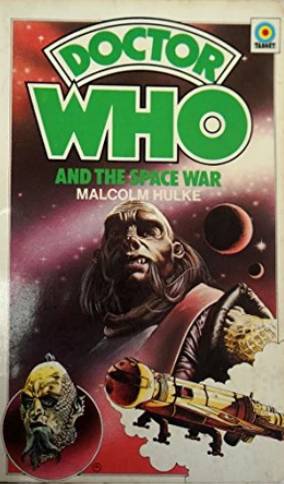
Chapter 25. Doctor Who and the Space War (1976)

Synopsis: In the year 2540, an uneasy peace exists between the empires of Earth and Draconia. When the Doctor and Jo are mistaken for space raiders, only they recognise the true culprits as the Ogrons, who have been employed to shatter the truce between the two worlds. At the centre of the conspiracy is the Master, but the Doctor’s old enemy is also working for an equally familiar foe…

Chapter Titles

  • 1. Link-up in Space
  • 2. The Draconian Prince
  • 3. Stowaways
  • 4. The Mind Probe
  • 5. Kidnap
  • 6. Prison on the Moon
  • 7. The Master
  • 8. Space Walk
  • 9. Frontier in Space
  • 10. The Verge of War
  • 11. Planet of the Ogrons
  • 12. The Trap

Background: Malcolm Hulke adapts his own scripts for the 1973 serial, Frontier in Space. This is the last novelisation to have a significantly different title to its TV original (unless we’re counting ‘The Mutation of Time’ or ‘The TV Movie’).

Notes: We get a single use of the name ‘Doctor Who’ very early on. There’s another brief recap of Jo’s entry into UNIT thanks to her uncle, a high-ranking civil servant who pulled strings to help her, and how the Brigadier’s decision to dump her onto the Doctor has led to her exploring the universe. There’s a particularly breathless exchange with the Doctor where Jo spells out her position at UNIT: 

Some people think intelligence work is all very romantic, all glamorous dinner parties with James Bond types. Instead, I’m either filing letters at UNIT Headquarters or I’m off with you in some ghastly place being chased by monsters…

The President and General Williams had a relationship when they were younger, but politics saw them as opponents in the last election. The President selected Williams as her military adviser in the hope that it would unite the voters behind her policy of peace. The President is respectful towards the Draconians, even noting that Willliams’ accusations of espionage have caused them offence and Hulke adds a rather florid form of etiquette between the Draconian Prince and the Earth President: The Draconian says ‘May you live a long life and may energy shine on you from a million suns,’ to which the President responds ‘And may water, oxygen and plutonium be found in abundance wherever you land’ (and the Master uses the same greeting to the President later on).

We’re shown Williams’ first interrogation of the Doctor and Jo and presented with a lot more detail about the journey to their first prison cell, as well as the jailor’s sadistic enthusiasm at the thought of starving his prisoners a little (and later it’s said that he’s been ‘conditioned to have no feelings for prisoners’).

In a detailed flashback, the President recalls how the previous war with Draconia began, when she was a young aide to a diplomat en route to a meeting with Draconians. Williams was a communications lieutenant on the ship and when their ship was caught in a ‘neutron storm’, the ‘inexperienced’ Williams was left as the sole surviving officer. Hulke tries to provide a version of events sympathetic to Williams’ point of view – before revealing that after Williams blasted the Draconian diplomatic vessel to pieces, the resulting war led to the deaths of 500 million Draconians and Earthmen (combined figures!) in just three days. 

The Master’s disguise is a commissioner from Alderberan Four, not Sirius 4. He specifically references the time the Doctor visited him in prison and laments that his partnership with the Sea-Devils wasn’t a success. He also reveals to the reader halfway through the book that he’s in league with the Daleks and is much more callous than the Delgado performance suggests, telling Jo that, unlike the Doctor, she is ‘totally useless’ to him.

‘There are men with an eye for a girl with a pretty face, adventurers with a touch of pity for the innocent victim of a situation. I am not one of those men.’

Jo gets particularly affronted by being told females cannot speak in the presence of the Emperor, much more than on telly (she refuses to let it go – quite right too!).

The beast that terrorises the Ogrons is a giant lizard, replacing the whatever-that-was in the TV version, and Jo finds an Ogron chained up, awaiting sacrifice to the lizard. The ending, which is a bit of a mess on screen, is simplified, but it also loses the Doctor being shot and sending a message to the Time Lords – which is a shame, considering the next release in the range. 

Cover: Another classic from Chris Achilleos as an Ogron dominates a starfield, with a Draconian inset and the Master’s prison ship blasting off. The ‘Changing Face of Doctor Who’ note on the title page tells us that the cover ‘portrays the third DOCTOR WHO’… except it doesn’t show the Doctor at all!

Final Analysis: We might be used to Malcolm Hulke’s personal politics influencing his writing but there’s something here that I’ve only just picked up on. Hulke draws attention to the pilot of a spacecraft fastening his seat belts; seat belts in cars were a recurring theme in the 1970s, with TV adverts recommending them with a ‘clunk click every trip’ slogan while the issue was debated in Parliament – while it was UK law to have a seat belt fitted in a car from 1968, it wasn’t mandatory for all occupants of a car to wear the things until 1991. After his escape from the Draconian Embassy, the Doctor is recaptured by a driverless car, so er… is this Hulke pushing a road safety agenda?

As we’d expect from Hulke, he treats his characters with respect, their motivations guiding their actions. Hardy’s blind adherence to the claim of the ‘Dragon attack’ is driven by preexisting racism, which he casually reveals with his frequent use of the slur ‘Dragon’, even in front of the President. The President herself is idealistic but also politically aware enough to know her best chance of success is with alliances and compromise, while the bullish Williams is shown to have been placed in an impossible position at a relatively young age, the burden of which he carries into middle-age. Even the Draconian Emperor is shown as a pragmatist, pushing aside protocol in allowing Jo to speak and forcing his wayward son to join forces with the apologetic Williams in chasing down the Master. In fact, it’s really only the Master who appears more shallow than he does on the telly. It shows just how much Roger Delgado brought to the role, adding a layer of charm that the script alone didn’t offer.

Chapter 14. Doctor Who and the Terror of the Autons (1975)

Synopsis: A renegade Time Lord calling himself ‘The Master’ has followed the Doctor to Earth and as an introductory calling card he’s brought the Autons with him. The Doctor has even more trouble on his hands with a new assistant forced upon him by the Brigadier, the very keen and very newly qualified agent Jo Grant.

Chapter Titles

  • 1. The Terror Begins
  • 2. Sabotage at the Space Probe
  • 3. The Master Takes Over
  • 4..Death at the Plastics Factory
  • 5. The Killer Doll
  • 6. In the Hands of the Autons
  • 7. The Battle of the Forest
  • 8. The Killer Doll Attacks
  • 9. The Deadly Daffodils
  • 10. Prisoners of the Master
  • 11. The Final Assault
  • 12. The End of Round One

Background: Terrance Dicks adapts Robert Holmes’ 1971 scripts.

Notes: Our introduction to Luigi Rossini (real name here is ‘Lew Ross’) presents a much more consciously obnoxious figure, employing labour of a mainly criminal type as they’re cheap and won’t risk complaining. This includes Tony the Strongman, who’s wanted by the police. Rossini manages to persuade his crew that the Doctor and Jo blew up Phillips as they were trying to steal the mob’s wages. The Auton meteorite device glows green as in The Auton Invasion, while the Master says that the plastic chair that kills McDermott is made of ‘polynestine’. The Doctor recognises the visiting Time Lord as being a member of the High Council who exiled the Doctor to Earth.

The Doctor recognises the device that the Master leaves in the cabin of the radio telescope is a ‘Volataliser’, a product of ‘The Xanthoids [who] use them for mining operations’, while the one that Jo tries to detonate in the UNIT lab is ‘a Saturnian Solar Bomb’. One of the best / nastiest additions is the revelation that the Master uses Professor Phillips to help him operate controls within his Tardis, but when he’s not on duty, he is both disguised as – and forced to work as – an actual clown, because it amuses the Master to ‘degrade a brilliant scientist into a mindless buffoon’. There’s a gap of a few days between Mr Farrel’s death and the Doctor’s visit to his wife, and the distribution of the daffodils spans a few more days too. Brownrose from the Ministry is completely removed and I didn’t even notice until just now. And of course, as the cover reveals, the description of the Nestene’s arrival is much more impressive than on TV.

Considering the Master’s crimes, the Doctor provides an insight into their race:

Once captured by the Time Lords, the Master’s life-stream would be thrown into reverse. Not only would he no longer exist, he would never have existed. It was the severest punishment in the Time Lords’ power.

The text refers to the ‘chameleon mechanism’ and ‘chameleon circuits’ for the first time in print (and ‘chameleon circuit’ won’t be said on screen until Logopolis!). There’s also a reference to a ‘Sontaran fragmentation grenade’ (the story came before their first appearance, but the novelisation was published a year after The Time Warrior aired). The Doctor makes good use of his sonic screwdriver, dismantling a bomb, opening the Auton-containing safe and trying to break into the Master’s Tardis. We’re party to the Master’s thought processes as he weighs up his options in turning against the Nestene, swayed by the Doctor’s persuasive argument – and the Brigadier’s pistol.

Cover & Illustrations: Peter Brookes’ original cover depicts a scene that doesn’t actually happen on TV as the one-eyed crabtopus Nestene creature envelops the radio telescope and, inset, the Doctor makes a surprise entrance as the Master plays with a lever. The back cover again features an illustration, Captain Yates inspects a fallen auton carnival dummy while another soldier in silhouette takes on a horde of autons. The 1979 reprint boasts a cover by Alun Hood, again depicting the imagined Nestene but in a more photorealistic style more akin to a Pan horror book; this was the edition I first owned and I was convinced this was a photo of the prop they used (what a disappointment the TV version turned out to be!). Alan Willow provides six illustrations, all of which expand upon what we saw on TV. It’s hard to pick a favourite although I love the one of the radiotelescope technician working away as ‘A dark shape peered down at him’ – the Master, snooping through a skylight, is much more dramatic than him just stepping through a door. 

Final Analysis: Another good job by Dicks here, covering a lot of ground and adding nuance where appropriate. Jo’s previous ‘debut’ in The Doomsday Weapon is glossed over, but there’s some decent continuity between this and The Auton Invasion, including the Brigadier asking why they can’t just do what they did last time and the Doctor points out all the flaws in his previous attack plan.

Chapter 9. Doctor Who and the Sea-Devils (1974)

Synopsis: The Master has been tried and imprisoned with a ‘life-long’ sentence (commuted from a death sentence by the Doctor’s plea for mercy). When the Doctor and Jo visit him in his high-security home, they are only briefly reassured that he’s secure before he escapes and sets into motion a plan to resurrect more of the homo reptilia race – this time from beneath the sea.

Chapter Titles

  • 1. ‘Abandon Ship!’
  • 2. Visitors for the Master
  • 3. The Vanished Ships
  • 4. Stranded!
  • 5. Air-Sea Rescue
  • 6. ‘This Man Came to Kill Me!’
  • 7. Captain Hart Becomes Suspicious
  • 8. The Submarine
  • 9. Visitors for Governor Trenchard
  • 10. The Diving Bell
  • 11. ‘Depth Charges Away!’
  • 12. Attack in Force
  • 13. Escape

Background: Malcolm Hulke adapts his scripts from the 1972 serial (the smallest gap so far between story transmission and novelisation, at two years, six months and two weeks).

Notes: It’s a little less even-handed this time as Hulke plays the Sea-Devils (not ‘Sea Devils’) as the aggressors from the start (and what a great opening scene as the crew of the ss Pevensey Castle abandon ship and are pulled under water one by one). Hulke also doesn’t give names to any of the Sea-Devils. There’s some background from the Master’s trial, where the Doctor begged for his best enemy’s life; although the death penalty was repealed for murder in the UK (except Northern Ireland) in 1965, it was still available for treason until 1998.

Governor George Trenchard’s backstory is elaborated upon to be both comical and rather tragic. The Doctor and Jo’s walk up to the chateau is given extra detail with the engraved wall-tap and the mysterious poem that reveals ancient local legends and somehow inspires the Doctor to deduce a pun on ‘the scales of justice’. The Master reveals that he’s worked with the Ogrons before (not in the TV version, but this was written soon after Frontier in Space, so would be fresh in the mind of the author and his audience). And the lead character is referred to as ‘Doctor Who’ twice.

Cover & Illustrations: The first cover by Chris Achilleos (a yellow maelstrom with the Doctor, Jo, two Sea Devils and a submarine). The first cover I owned was the 1979 John Geary reprint with the green and yellow Sea Devils and a bluey-pink background. The illustrations are once again by Alan Willow and my favourite is either the Doctor ducking as a Sea-Devil fires a heat ray or a Sea-Devil watching the submarine on TV.

Final Analysis: Another corker from Hulke. Even though the Sea-Devils are more overtly villainous than their cave cousins, they repeat their claim on the planet and at least appear to waver before going on the assault (stirred up by the Master). There’s the oft-quoted business about Trenchard wanting to be brave but being killed by Sea-Devils because he left the catch on his gun, and the Doctor switching it off before Captain Hart notices, but this is only one of many moments of charm for the characters – in fact if anything, it’s Jo who comes across worst, brash and impatient and occasionally compelled to back down when she gets too hot-headed.

Chapter 8. Doctor Who and the Daemons (1974)

Synopsis: The Master’s up to no good in an English village, posing as both a vicar and the leader of a satanic cult. The Doctor and Jo appear on TV and they take on the Master, a gargoyle and an ancient god – with the help of UNIT and a self-proclaimed white witch.

Chapter Titles

  • Prologue
  • 1. The White Witch
  • 2. The New Vicar
  • 3. The Opening of the Barrow
  • 4. The Appearance of the Beast
  • 5. The Heat Barrier
  • 6. Meetings
  • 7. Explanations
  • 8. The Second Appearance
  • 9. Into Danger
  • 10. The Third Appearance
  • 11. The Rescue
  • 12. Into the Cavern
  • 13. The Sacrifice
  • Epilogue

Background: Barry Letts adapts the 1971 scripts he co-wrote with Robert Sloman as ‘Guy Leopold’.

Notes: An early manifestation of Azal is much more dramatic, involving the death of the verger. Benton recalls earlier adventures with the cybermen, Axons and the daffodil-touting autons, none of which have been novelised by this point, while Jo recalls her first meeting with the Master as seen on TV but which flatly contradicts the books so far. We also get the first revelation that the Doctor and the Master were schoolfriends – and that the Doctor wasn’t a particularly keen student. Azal reveals that his race were responsible for the dispassionate destruction of all life on the planets Talkur and Yind. The character of Stan Wilkins is new to the book, on TV he’s just a nameless acolyte in the coven who recognises that the Master is evil and tries to save Jo and the Doctor. His courage serves to make Jo’s attempted self-sacrifice all the braver. Stan also gets to review events with ‘mixed feelings’ in the epilogue; while he acknowledges the number of people who’ve died, he also realises that he’ll inherit his uncle’s garage and be able to care for his ‘Mam’.

Cover & Illustrations:  The original cover was by Chris Achilleos following the now-familiar formula of the Doctor’s face with a head-shot of Azal and a teeny Bok. Internal illustrations are by Alan Willow. There’s a lovely drawing of Jo back against an ivy-covered wall (that’s based on a photo from The Sea Devils), but Azal and Bok are both faithfully reproduced. My first cover was the 1980 reprint with a portrait by Andrew Skilleter of Azal in the cavern, while the 1993 reprint used Alister Pearson’s VHS cover, with an almost-Celtic cross that shows the Doctor and Master both in half-portrait, Azal at the top and Bok at the bottom against a sunburn-pink background.

Final Analysis: Barry Letts adapts the scripts well, so it’s surprising this is his only novelisation of a TV story (though it’s not his only entry in this blog – as you’ll find out in about 146 chapters). It enhances what was possible on telly but doesn’t elaborate vastly; the prologue is just everything that happens on TV before the Doctor appears, where Mac Hulke might have given us an insight into Azal’s arrival on Earth. Azal gets a better motivation to implode though – being both confused by Jo’s illogical actions and on the verge of death anyway. We do gain some lovely insight into the Squire (a minor character on TV), who is perplexed by his regular headaches that always arrive the morning after a night in the pub. And the lead character is referred to as ‘Doctor Who’, right at the start of the first chapter.