Synopsis: The city of the Exxilons, one of the Seven Hundred Wonders of the Universe. Somehow, the city is alive, draining the energy from any visiting spacecraft – including the TARDIS. Abandoning the time ship, the Doctor and Sarah find a similarly marooned expedition team in search of minerals needed to cure a deadly space plague. But a platoon of Daleks also intend on taking the minerals for themselves. The explorers form an uneasy truce as they decide to find answers inside the city – and the native Exxilons are determined not to let them..
Chapter Titles
Prologue
1. Death of a TARDIS
2. The Ambush
3. Expedition from Earth
4. The Deadly Arrivals
5. A Truce with Terror
6. The Sacrifice
7. Escape to the Unknown
8. Bellal
9. The Pursuit
10. The City Attacks
11. The Trap
12. The Nightmare
13. The Antibodies
14. The Last Victory
Background: Terrance Dicks adapts Terry Nation’s scripts from the 1974 story.
Notes: The prologue is an atmospheric retelling of the first scene – which was cut from the story’s first release on home video, so it’s kind of a deleted scene with a cracking first line: ‘He was a dead man running.’ The Doctor is ‘a tall, white-haired man with a deeply-lined, young-old face’ (the first time we see this description and it won’t be the last). Sarah has only known the Doctor for a brief time, as she recalls her trips to Medieval England and a London ‘infested with dinosaurs’. The fog on the planet Exxilon is (wait for it!) green. The Exxilons wear black robes and speak a form of ‘pidgin Galactic’ that Galloway can understand. Bellal is a ‘subterranean Exxilon’ and he introduces his friend as ‘Gotal’ (a name only revealed in the end credits on TV), while another subterranean Exxilon is called ‘Jebal’.
Jill Tarrant is blonde, not red haired, Dan Galloway lost his entire family in the Dalek wars, grew up in poverty as a refugee and joined the Marine Space Corps as soon as he could, working his way up the ranks. The ‘hopscotch’ floor in the City lies in a wide hall, not a narrow corridor and there are many antibody creatures, not just the two on telly. Realising Jill has escaped, the Dalek sentry begins a frantic search but doesn’t self destruct. The Doctor offers to continue aiming for Florana but Sarah just wants to go home.
Chapter 7 is ‘Escape to the Unknown’ – another one so close to the lesser-sighted ‘Escape to Danger’ but… not quite.!
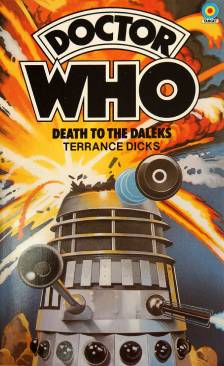
Cover: Roy Knipe paints this Target Doctor Who cover and creates an instant classic – a Dalek’s head explodes. Alister Pearson was onto a hiding for nothing with his 1991 reprint cover, which shows Bellal in front of a different blazing Dalek.
Final Analysis: It’s hard to go wrong with this and Dicks doesn’t put a foot out of place. He doesn’t add much either, to be fair, but it’s still a lot creepier than the over-lit, jazz-fused TV version. It’s peak-Terrance, where eyes are red and glowing, robes are black and Daleks glide.
Synopsis: Scientists have disappeared from across the country. In an attempt to keep them safe, the remaining experts have been brought to a research centre under the guard of UNIT – but still they continue to vanish. The Doctor identifies the cause must be someone with access to time travel. Following the trail in the TARDIS back to the Middle Ages, the Doctor discovers the time-hopping kidnapper is a Sontaran warrior – unaware that the TARDIS has brought alomg a 20th-Century stowaway aboard in the form of intrepid journalist Sarah Jane Smith.
Chapter Titles
Prologue
1. Irongron’s Star
2. Linx’s Bargain
3. Sarah’s Bluff
4. Irongron’s Captive
5. The Doctor Disappears
6. A Shock for Sarah
7. Prisoner in the Past
8. The Robot Knight
9. Linx’s Slaves
10. Irongron’s Wizard
11. The Rescue
12. The Doctor’s Magic
13. Counter Attack
14. The Robot’s Return
15. Shooting Gallery
16. Return to Danger
17. Linx’s Departure
Background: Terrance Dicks adapts Robert Holmes’ scripts for the 1973-4 serial, except from the prologue, which Holmes wrote himself before handing the task over to Dicks.
Notes: Three years after the word ‘Sontaran’ first appeared in a Target book [see Terror of the Autons], we finally meet one – in the most exciting prologue ever, written by an uncredited Robert Holmes! We join Sontaran Commander Jingo Linx as his ship faces certain obliteration after an unsuccessful battle against the Rutans in their third galactic war. We learn that the Sontarans come from the planet Sontara and he listens to the ‘sweet strains of the Sontaran Anthem’ (presumably the same one that accompanies Linx’s flag when he erects it in front of Bloodaxe) as his ship makes a last desperate escape from the black, dart-shaped Rutan pursuit ships. Sontarans are cyborgs, thanks to implants in the back of their neck that allow them to draw energy through a ‘probic vent’. The procedure that allows this is undergone on entry to the Space Corps and although it gives him a rush of energy, Linx always dreads taking a ‘power burn’.
The flood of power through his tissues was like a roaring madness, a chaotic maelstrom of colour and sound depriving him of all sentient knowledge of the outside world. He felt himself clinging like a limpet within some solitary crevice of consciousness, aware only that he still existed… still existed… still…
His cruiser is destroyed, driven into a sun as a diversion to allow him to escape the Rutans in a small scout ship. As the ship heads towards a little blue planet orbiting the sun, Linx allows himself a smile usually reserved for the ‘ the death throes of an enemy’. Most of the details here have been forgotten by subsequent authors, even Holmes himself [see The Two Doctors], but it should be mandatory reading for any hopeful Sontaran scribes.
Irongron and his band of men had once ‘roamed the forest like wolves’ before stumbling upon a castle abandoned by a lord away ‘at the wars’. His group attacked the castle at night, its inhabitants massacred, and the castle became his. His nearest neighbour, Sir Edward Fitzroy, is sickly, having returned from the Crusades with a fever. Sir Edward’s son and most of his soldiers are still fighting the king’s crusades overseas, leaving him with a depleted defence. His young squire, Eric, is given a splendid introduction, riding through the forest, wary of being too close to Irongron’s castle and falling victim to a simple trap laid by Bloodaxe.
When he first addresses Irongron, Linx speaks with ‘a booming metallic voice… strangely accented but clearly understandable English’ and the suggestion is that this is due to a translation device, not his natural voice.
The Brigadier brings the Doctor in to investigate the missing scientists and equipment to distract him as he’s missing Jo since she had got married and has refused a new assistant ever since. The Doctor is described as ‘a tall man with a lined young-old face and a shock of white hair’ (we’ll be seeing this description regularly from now on). He insists on having the TARDIS brought to the research centre in case there’s an alien influence he needs to trace. Sarah Jane Smith is introduced, ‘an attractive dark-haired girl’ who is a freelance journalist (the ‘freelance’ bit is new to the book) who has been ‘making her own way in a man’s world for some years now, and she strongly resented any suggestion that her sex doomed her to an inferior role’. The Doctor tells Rubeish that ‘Lavinia Smith’ is a woman in her ‘late sixties’ as well as being in America. The Brigadier reminds the Doctor about his failed attempts to reach Metabelis III (‘I got there eventually’, says the Doctor defensively). We get Sarah’s first reaction to the inside of the TARDIS and she hides inside a wardrobe when the Doctor enters. Realising that the wardrobe is bigger than the police box she entered – and the central control room even bigger again – she quickly forms a theory that the Doctor is an alien responsible for kidnapping the scientists. She also watches the switch the Doctor uses to open the door and uses the same switch to escape.
We might want to note that Hal makes his first attempt to assassinate Irongron by taking up position on a ‘grassy knoll’.
Linx rides on horseback for the attack on Sir Edward’s castle. The attack on Linx, the destruction of Irongron’s castle and the Doctor’s departure with Sarah all happen at night. Although Hal’s arrow kills Linx, the hand of the dead warrior hits the launch button and his ship escapes the burning castle to be returned with Linx’s corpse to the war in the stars. And hurrah for Hal as he rescues Squire Eric from the dungeon!
Oh and there’s a chapter title called ‘Return to Danger’ – so close!!
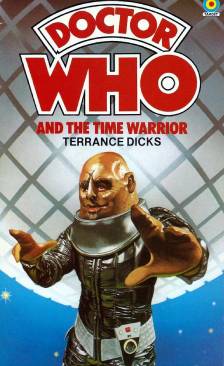
Cover: Linx the Sontaran strikes a dramatic pose before his globe-shaped craft, a superb photorealistic portrait by Roy Knipe. The cover for the 1993 reprint by Alister Pearson places the Doctor, Sarah and Irongron in square tiles behind Linx, who’s side on and holding his helmet by his side.
Final Analysis: It might be heresy but I’m not a fan of this story on TV and reading this story I can put it down to Alan Bromly’s static, leaden direction. But look at all the notes in this chapter and join me in wondering if Terrance Dicks was spurred on by his friend Holmes’ wonderful opening prologue – top three in the series so far (See also Doctor Who and the Crusaders and Doctor Who and the Day of the Daleks.). Compare the two descriptions of Linx’s face – the first is by Holmes, the second by Dicks, picking up the baton:
… the heavy bones, the flat powerful muscles, the leathery, hairless epidermis, the calculating brain.… little, red eyes that were like fire-lit caves under the great green-brown dome of a skull…
The face beneath was something out of a nightmare. The head was huge and round, emerging directly from the massive shoulders. The hairless skull was greenish-brown in colour, the eyes small and red. The little nose was a pig-like snout, the mouth long and lipless. It was a face from one of Earth’s dark legends, the face of a goblin or a troll.
This extends to the major and minor characters – how Sir Edward waits for his wife to ‘run out of words’, (and on the very next line ‘It was a considerable wait’) and how Lady Eleanor’s eyes ‘gleamed’ at the prospect of the Doctor poisoning Irongron’s dog’. It’s clear Dicks enjoyed this. I know I did.
Synopsis: A lighthouse off the coast of England at the start of the 20th Century. A light in the sky heralds the arrival of an alien warrior separated from its fleet, far from the battlefield. It explores the lighthouse, examines and dismembers one of its staff – and takes his form. The Doctor and Leela arrive shortly before they are joined by the survivors of a shipwreck. When the body of the lighthouse crewman is discovered, the Doctor realises they are locked inside the lighthouse with a murderer…
Chapter Titles
Prologue
1. The Terror Begins
2. Strange Visitors
3. Shipwreck
4. The Survivors
5. Return of the Dead
6. Attack from the Unknown
7. The Enemy Within
8. The Bribe
9. The Chameleon Factor
10. The Rutan
11. Ambush
12. The Last Battle
Background: Terrance Dicks adapts his own scripts from the 1977 serial.
Notes: A prologue! Dicks sets up the location, a craggy rock in a furious sea, upon which stands a lighthouse. He tells of the legends of Fang Rock, the historic deaths and the glowing beast said to inhabit the waters that surround it. The Doctor wears a soft floppy hat and not the bowler hat he sports on the cover. Reuben, Vince and the Doctor help the survivors of the shipwreck from their lifeboat onto the shore of the east crag. As Leela ponders Reuben’s tale about the ‘Beast of Fang Rock’, the Doctor tries to rationalise the story, surmising that two men fought, one was killed, the other jumped into the sea, full of remorse, the third man was sent ‘out of his mind’ after spending weeks with a corpse for company. When Skinsale mocks Leela for sensing the temperature drop, Adelaide enters the room and complains about suddenly feeling cold. After Palmerdale’s death, Vince realises that he has his Lordship’s money and coded message in his pocket. Worried that it might incriminate himself in Palmerdale’s death, Vince sets fire to the evidence. There’s a detailed description of the Rutan that’s not quite what we see on screen.
In place of Reuben’s form there was a huge, dimly glowing gelatinous mass, internal organs pulsing gently inside the semi-transparent body. Somewhere near the centre were huge many-faceted eyes, and a shapeless orifice that could have been a mouth.
The Rutan’s habit of speaking in the first-person plural isn’t an affectation; Rutans don’t have individual identity, but are just one element of the whole race. It can move with ‘appalling speed’. The Doctor’s improvised rocket launcher is backed with ‘nuts and bolts, nails, cogs and other engineering debris’, as opposed to coins from various pockets.
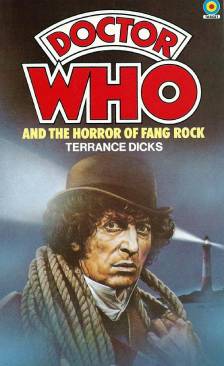
Cover: For the first edition, Jeff Cummins paints a superbly creepy scene of the Doctor standing in front of the lighthouse (which Clayton Hickman later mimicked for the DVD cover). Such a shame that the reprints were canceled, as we lost Alister Pearson’s cover, featuring a lesser-seen Doctor pic with a Rutan and the lighthouse.
Final Analysis: The legend goes that Robert Holmes insisted Terrance Dicks should research lighthouses for the scripts for this story and it’s possible some of his studies ended up in the novelisation (such as the description of each room on each level of the structure). I suspect that Terrance Dicks might have been working from an earlier script version for this, with a couple of scenes that feel like they might have been abandoned for the final TV edit. Vince’s disposal of Palmerdale’s bribe and message is a welcome addition, especially how it conveys Vince’s conflict, not just in doing the right thing but also in protecting himself from accusation:
It was more money than he’d ever see again in his lifetime – but there was nothing but relief in Vince’s heart as he watched it burn.
One thing that’s missing is a sense of the Rutans point of view – literally how we see many scenes on TV – Dicks creates a sense of menace through a ‘faint crackling sound’ that denotes the Rutan’s presence, but we get little sense of how it feels, how it considers the humans and their environment.
Synopsis: In the village of the Sevateem, the great god Xoanon speaks through his High Priest, Neeva, and his word is law. When he uncovers a lack of faith in a young huntress called Leela, Neeva banishes her under threat of death. In the jungle that surrounds the village, Leela encounters a stranger called The Doctor. She shows him a nearby mountain into which is carved a huge bust of Xoanon – and it bears the face of the Doctor…
Chapter Titles
1. The Outcast
2. The Invisible Terror
3. Captured
4. The Face on the Mountain
5. Attack
6. Danger for Leela
7. The Test of the Horda
8. Beyond the Wall
9. The Tesh
10. The Summons
11. Xoanon
12. The Trap
13. The Last Battle
14. Recovery
15. Departure
Background: Terrance Dicks adapts 1977 scripts by Chris Boucher.
Notes: Tomas is in love with Leela and it’s expected that he will father many children with her, but after the verdict of her trial, he consoles himself that there are ‘other women’ in the tribe (you might spot the other one in film sequences in the original series). The Doctor arrives fresh from his adventure on Gallifrey fighting the Master [See The Deadly Assassin] and immediately misses having Sarah Jane Smith by his side; he recalls that he chose not to bring her to Gallifrey in respect for Time Lord law, and that she’s now back on Earth with Harry Sullivan and the Brigadier. The Doctor’s heading for Earth when the TARDIS brings him to the unnamed jungle planet. Leela is introduced on the first page and it’s a handsome description unlike that for any other companion, capturing her distinctive appearance and overall character in just three lines:
She was tall, with brown hair and dark eyes, a broad clear forehead and a firm chin. Her arms and legs, exposed by her brief skin costume, were brown and smoothly muscular. She stoodbefore her accusers wary but unafraid, like a captured wild animal.
There’s a cheeky namecheck for the story title as Leela explains that the Tesh ‘set the Face of Evil on the mountain’ with their ‘magic’. A Horda is a ‘white, snake-like creature, rather like a giant slow-worm’, (unlike the purple bug / fish-like creature on telly).
Dicks places the Doctor’s first meeting with Xoanon within the haze of his last regeneration [a trip from some point in between his first and second appearances in Robot]. It’s an unseen adventure that his recuperating mind has forgotten until now. Xoanon speaks in three voices – the Doctor’s, that of a woman and a ‘young man’ (so not a child). The Sevateen village is wrecked by the invisible monsters, forcing the villagers to seek refuge in the jungle, explaining why Calib’s assault force is so depleted. The Doctor and Leela work their way through a foil tray of concentrated food cubes (not chocolates). The final scene takes place inside the TARDIS as Leela willfully ignores the Doctor and pulls a ‘large important-looking lever’ that closes the doors and sets them off on their next adventure together.
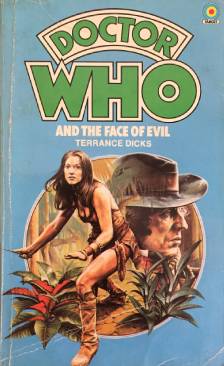
Cover: The original release has one of the very best covers ever, thanks to Jeff Cummins, with Leela stepping out of the jungle through a circular frame, while the face of the Doctor looms large in the background, all against a blue background. The 1993 reprint has a very jolly-looking Leela in front of two faces of the Doctor.
Final Analysis: Another basic adaptation and, around this time, Terrance Dicks was beginning to receive criticism from fans for his ‘script-to-book’ approach, but I think this is unjustified – at least here. While the prose lacks some of the depth we might expect from Malcolm Hulke or even newcomer Ian Marter, there’s still a lot of subtlety at play. The simple scene where Leela knocks out a Tesh guard gains a little from being told from the guard’s point of view, getting excited by the thought of capturing the aliens and the expectation that ‘he would win great praise from Jabel if he destroyed them’. We get a much better sense of Calib’s ambitions and of course Leela is well served in the way she begins to trust the strange Doctor precisely because his actions are at odds with her understanding of what Xoanon should be like. Readers had already met Leela just two books earlier, but as the text on the back of the 1993 edition states proudly, this is ‘the creation of one of the TV Series’ most memorable teams’.
Synopsis: A London music hall in the late 19th Century is the setting for murder. Its proprietor, Mr Henry Gordon Jago, has just secured the services of a master magician of Chinese origin while a mortician called Litefoot examines a body fished from the Thames and covered in huge bite marks. The Doctor and Leela follow the clues that lead them into the lair of a Chinese God…
Chapter Titles
1. Terror in the Fog
2. The Horror in the River
3. Death of a Prisoner
4. The Monster in the Tunnel
5. The Quest of Greel
6. The Tong Attacks
7. The Lair of Weng-Chiang
8. The Sacrifice
9. In the Jaws of the Rat
10. A Plan to Kill the Doctor
11. Death on Stage
12. The Hunt for Greel
13. The House of the Dragon
14. The Prisoners of Greel
15. The Firebomb
Background: Terrance Dicks adapts the 1977 scripts by Robert Holmes, just seven months after they were broadcast.
Notes: The ghoulish woman on the dockside who (on telly) discovers the body of the cabby, Alf Buller, becomes an old man who wants his reward – until he sees the state of the mutilated body. The young woman who Leela saves from becoming a victim of Magnus Greel is named Teresa Hart and Dicks explains that she’s up in the small hours of the morning because she’s employed as a waitress in a gambling club across London in Mayfair – just in case there’s any possibility of some other reason why a woman might be walking the streets alone at that time of night.
As he did with the cuddly Yeti in The Abominable Snowmen, Dicks also solves the basic failure of the giant rat on TV, too clean and plodding in its original form, but now ‘huge and savage’ with red eyes’, a ‘trumpeting scream’ and ‘yellow fangs bared in fury’.
The Doctor taunts Greel by offering him a jelly baby (although North American editions change this for a jelly bean – utter sacrilege!). On TV, the Doctor recalls that Mr Sin – aka ‘the Peking Homunculus’ – was given to the Icelandic Commissioner’s children as a toy, but ‘something went wrong’ and the thing was ‘almost’ the cause of World War Six, but here there’s a little more more detail: the homunculus was really a programmed assassin, which ‘massacred the Commissioner and all his family’, which then ‘set off’ the World War. We later learn that Magnus Greel was the inventor of Mr Sin and that he triggered the war intentionally. As part of a ‘Supreme Alliance’ of dictators, he was defeated at the Battle of Reykjavik and, branded a war criminal, used the time cabinet to flee with Mr Sin to 19th-Century China.
There’s a slight addition to the last scene, as Jago invites Litefoot to a ‘little tavern’ for a ‘celebratory libation’. And it’s the beginning of a beautiful friendship.
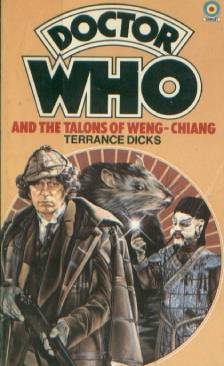
Cover: Jeff Cummins provides a wonderful composition of the Doctor in his Holmesian gear, holding a shotgun, while behind him are Mr Sin, a giant rat and a circular design evoking the sewer. This is his first cover for Target, even though The Mutants was published earlier – and apparently it was later stolen from his portfolio, never to return. The 1994 reprint boasted Alister Pearson’s final reprint cover (as this was also the final release of the original Target books run), featuring the Doctor, Greel, Mr Sin and the head of the ornate dragon-shaped ray gun.
Final Analysis: Recently, this story has come under attack for the unsettling undertones inherent in the very racist genre it takes its inspiration from. While much of the problems are still here – an assumption that all the Chinese population of Limehouse are opium addicts, Irish Casey having ‘a weakness for the bottle’ as well as the general racism of characters from the time – there’s one section that suggests Dicks was at least aware of certain ironies; as Jago appraises the great magician Chang, Dicks makes a dig at the casting in the TV serial:
Perhaps he really was from China as he claimed. After all he really was Chinese, unlike most Oriental magicians who were usually English enough once the makeup was off.
But Dicks also spells out that Chang’s own stage persona, speaking in pidgin English, is an artifice he employs solely to appease his English audience’s expectations; in this version, it’s the audience who are very much at fault.
The opening chapter feels like Malcolm Hulke has stepped in to provide some social context by focusing on the different strata within the audience of the Palace Theatre:
The body of the theatre and the Grand Circle above were filled with local people, tradesmen and their wives and families, bank clerks and shop assistants. High above in the top-most balcony, known as the ‘Gods,’ the poorer people were crowded onto hard wooden benches. Labourers, dock workers, soldiers and sailors, even some of the half starved unemployed – they’d all managed to scrape together a few coppers for the big night of the week.
It’s an atypical observation for Dicks, but there’s plenty of social commentary throughout the story. Professor Litefoot is from a ‘wealthy upper-class family’ and his ‘aristocratic relations’ have ceased trying to get him to relinquish his calling to do proper work in the East End, instead of pampering ‘silly women’ in Harley Street. Chang considers the workers of London as ‘peasants’ – but presumably this is a description that places himself on an equal level to them – all subjects to higher powers. It’s a difficult challenge, respecting the original author’s work while also taking opportunities to polish up the stories, so this one’s really down to your own background and exposure to ‘language and attitudes of the time’, I guess.
Synopsis: The Time Lords of Gallifrey enjoy immense power, living in isolation from the rest of the universe. On the day that the President of the Time Lords is expected to announce his successor, security is tight! Yet somehow, an obsolete and unauthorised time capsule – a TARDIS – has landed right in the heart of the Capitol. Its owner, a criminal called the Doctor, is nowhere to be found. Then the President is assassinated – and the Doctor is found holding the gun. But could there really be two rogue Time Lords at play? Soon, the future of the Time Lords will depend on a battle of wits between two bitter rivals – and it will be a fight to the death.
Chapter Titles
1. Vision of Death
2. The Secret Enemy
3. Death of a Time Lord
4. Trapped
5. The Horror in the Gallery
6. Into the Matrix
7. Death by Terror
8. Duel to the Death
9. The End of the Evil
10. The Doomsday Plan
11. The Final Battle
12. The End – and a Beginning
Background: Terrance Dicks adapts Robert Holmes’s 1976 scripts.
Notes: That epic crawl from the start of the TV version is dropped, though its main details are absorbed into the rest of the book. In his youth, the Doctor trained for a seat on the High Council on Gallifrey, but he grew frustrated at the ‘never-ending ceremonials and elaborately costumed rituals’ and the ‘endless accumulation of second-hand knowledge that would never be used’. The Doctor recalls ‘boyhood memories of forbidden games, of hide-and-seek’, while the spark that sent him to flee Gallifrey is described as ‘a final crisis’. Dicks builds in vague gaps in the story deliberately, as none of this completely contradicts other explanations for why he left Gallifrey, but it does add to his possible reasons. There are a few references to ‘the Omega crisis’ and the ‘Omega file’ [see The Three Doctors]. The Doctor’s TARDIS control room is in the more traditional configuration, with a console that has a column at the centre (the one on telly is the wooden one without a central column).
The large dome at the heart of the Capitol (not actually seen on TV until 2007) houses the Panopticon. Spandrell is ‘unusually broad and muscular for a Time Lord’ and Goth is ‘tall, handsome, immensely impressive in his elaborate robes’. Goth is now head of the Prydonians, with Borusa elevated to the status of ‘High Cardinal’. The captain of the Guard is Hildred (not Hilred). Runcible and the Doctor had been at school together, where Runcible had been ‘utterly fascinated by rituals and traditions’. Now, he’s a ‘small plump figure’ unlike his onscreen depiction. When the hypnotised guard, Solis, tries to wreck the APN cables, Spandrell shoots him repeatedly.
The villain at the heart of the tale was revealed on TV in the end credits but it wasn’t spelled out until the Doctor saw the shrunken corpse of the cameraman and realised who he was up against. For the reader, Dicks teases the identity and after his accomplice calls him ‘Master’, he starts to use this as the villain’s title, but it’d still be fairly easy for a new reader to wonder if this is the Master, or just a master, especially as this Master is even more gruesome than on telly:
The cracked, wizened skin, stretched tight over the skull, one eye almost closed, the other wide open and glaring madly. It was like the face of death itself.
Later, the Master’s ‘bloodless lips [draw] back in a smile of hatred. The Doctor describes his enemy to Borusa thus:
He was always a criminal, sir, throughout all his lives. Constant pressure, constant danger. Accelerated regenerations used as disguise… He was simply burnt out.
During the trial, the Doctor interjects to confirm that the witness, an elderly Time Lord, can hear loud voices, thereby disputing the prosecution’s claim that he misheard the Doctor’s cries of ‘They’ll kill him’.
The final chapter uses a variation of a Terrance Dicks favourite – ‘The End – and a Beginning’.
Cover: The decaying Master leers from the top of the cover, while a stern-looking Doctor, flanked by two Time Lords in ceremonial robes and collars, looks off to the side. I can scarcely believe this is by Mike Little, it’s a huge step up from his previous efforts.
Final Analysis: Not much to add to this, to be honest; it’s a straightforward adaptation, which is going to be the norm for a while now. Dick adds a few little details here and there, so as is often the case, it’s just a matter of scale – the Panopticon houses many more Time Lords from many other chapters than we could see on telly – but doesn’t change anything too much. When he’s working from scripts by his pal Robert Holmes, perhaps he doesn’t feel the need or the inclination.
Synopsis: When the Doctor receives a mysterious object, it leads him and Jo to the planet Solos, a colony in Earth’s future empire ruled by a cruel and sadistic Marshal. The native Solonians are fighting for their rights to independence while also battling something far more puzzling – some of them are transforming into hideous insect-like creatures…
Chapter Titles
1. The Hunters
2. Mutant on the Loose!
3. Assassination!
4. Hunted on Solos
5. The Experiment
6. Escape
7. The Attack
8. The Trap
9. The Fugitive
10. The Crystal
11. Condemned
12. The Message
13. The Investigator
14. The Witness
15. The Change
Background: Terrance Dicks adapts scripts from a 1972 story by Bob Baker and Dave Martin.
Notes: Solos is a ‘planet of jungles’, but still looks grey from orbit due to the mists. Varan’s son is called ‘Vorn’. Dicks writes that the Doctor was exiled by the Time Lords ‘for some unknown offence’; obviously Dicks himself knows why – he co-wrote the story that saw the Doctor exiled (and so do we), but Jo actually doesn’t – the closest she gets is in The Doomsday Weapon, where the Doctor explained that he used to roam the universe before the Time Lords caught him and trapped him on Earth – but he never explains to her precisely why!
Professor Jaeger is ‘a vain and unprincipled man, desperate for scientific recognition, but without the talent to attain it on his own’; he’s disgraced back on Earth after some scandal involving results stolen from a junior colleague. The Marshal, meanwhile, came to Solos as a security guard and slowly climbed his way up the ranks to his current position; he sees himself as the supreme power over Solos, which is why he is so desperate not to lose his position. Standing at the mouth of the caves, the Marshal uses a device with a ‘directional microphone’ to overhear Stubbs and Cotton talking to the Doctor to uncover their treachery. The Marshal has a secret exit behind the desk in his office, which Cotton knows about.
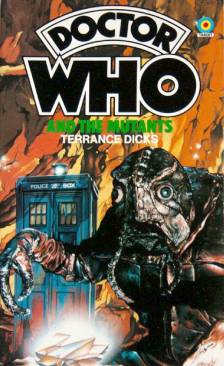
Cover: Jeff Cummins makes his first appearance with a splendid photorealistic cover. A mutant leers into frame just as the TARDIS materialises in a red-lit cavern. As with Doctor Who and the Space War, the title page in early editions of this book claimed that the front cover showed ‘the third DOCTOR WHO, whose physical appearance was altered by the Time Lords when they banished him to the planet Earth in the Twentieth Century’. Er…
Final Analysis: Despite being a huge fan of the Third Doctor, this has always been my least favourite of his stories, largely because the Marshal is such a relentless bully. He’s still that here, but it’s at least useful to get the perspective of every character working around him. Even Jaeger, who is enabling his ‘scorched Solos’ policy, is doing so for scientific glory, not for anything that might benefit the marshal politically. Dicks manages to edit down the six episodes in a tidy fashion, so even though some speeches are summarised or cut back, all the beats are there in the right order.
Synopsis: An expedition party on the remote planet Zeta Minor has been devastated by unexplained deaths and a rescue mission finds only one survivor. The arrival of the Doctor and Sarah provides convenient suspects for the murders, but the Doctor realises there’s another possible culprit – the planet itself…
Chapter Titles
1. Killer Planet
2. The Probe
3. Meeting with a Monster
4. Tracked by the Oculoid
5. The Lair of the Monster
6. The Battle for the Spaceship
7. The Creature in the Corridor
8. Marooned in Space
9. Sentenced to Death
10. The Monster Runs Amok
11. An Army of Monsters
Background: Terrance Dicks adapts Louis Marks’ 1975 scripts.
Notes: The plaque marking the grave reads ‘Edgar Lumb’ (not Egard as on TV). We’re reminded that this follows on from The Loch Ness Monster and on leaving the TARDIS, Sarah is not ‘in the least surprised to find that they’d arrived in the middle of a particularly sinister-looking alien jungle’, which might just be a comment on Sod’s Law, but this is the first alien jungle she’s ever visited – and, on TV at least, she doesn’t visit any others!
Ponti is said to be ‘tall and dark’ (played onscreen by Gambian actor Louis Mahoney) and De Haan is a ‘stocky fair-haired’ chap (unlike the dark-haired Graham Weston on TV). The Morestran advance party are transported to Zeta Minor by ‘force beam’, disintegrated in a capsule and reassembled on the planet’s surface. The Doctor’s descent into the Black Pool is surrounded by ‘many coloured swirling currents’, while the anti-matter beast appears to resemble a dragon at many points. We learn that Vishinsky returns home to a hero’s welcome and a much-deserved promotion, while Sorenson becomes ‘the most famous scientist in the Morestran Empire’.
Cover: The first edition has a cover by Mike Little, which again lacks the sophistication of the previous artists, showing the Doctor (inset) cowering from a fanged, snarling Anti-Man in the jungle. Andrew Skilleter uses the same photo reference of the Anti-Man for the 1982 reprint but to a much higher standard.
Final Analysis: Continuing the horror theme of this period is a mash-up of The Tempest and Stephenson’s perennial Jekyll and Hyde. Dicks takes the time to create backstories for Vishinsky (overlooked for promotion but very experienced) and Salamar (ambitious with friends in high places, but under-qualified) that really enhance the characterisation. Other than this though, it’s a fairly consistent adaptation from screen to page.
Synopsis: The planet Karn is home to a secret Sisterhood who administer a sacred flame that can provide the secret to everlasting life. It’s also home to Dr Solon, a scientist with a very singular purpose – the resurrection of a Time Lord war criminal called Morbius. Only his brain survives, but Solon, with the help of his brutish servant Condo, has fashioned a monstrous new body to house the brain. All it needs is a compatible head – and the Doctor and Sarah have just dropped in for a visit…
Chapter Titles
1. A Graveyard of Spaceships
2. The Keepers of the Flame
3. The Horror Behind the Curtain
4. Captive of the Flame
5. Sarah to the Rescue
6. The Horror in the Crypt
7. Solon’s Trap
8. The Doctor Makes a Bargain
9. The Monster Walks
10. Monster on the Rampage
11. Deathlock!
12. A Time Lord Spell
Background: Terrance Dicks adapts his own scripts, which were hurried rewrites of scripts by Robert Holmes and broadcast in 1976 under the name ‘Robin Bland’.
Notes: The alien in the first scene is not specifically a ‘Mutt’ from The Mutants, but is identified as Kriz, a member of ‘The Race’, who are six-limbed mutant insects who ‘colonise, not conquer’ as they are a moral species, led by a ‘Great Mother, Goddess and Queen in one’.
The sisterhood are dressed in black, not various shades of red as on screen. Maren uses a crystal ball. She enjoys immortality like the rest of the Sisterhood, but when they first discovered the secret of the flame, she was already old – hence why she looks ancient. Solon has made many clay busts of Morbius, destroying each one for not being right (yet he feels enthusiastic about his body for Morbius; maybe he just can’t draw fingers…).
The mind-wrestling battle skims over the other faces on the screen (you know the ones) without explanation, merely covered by Sarah having ‘a confused impression of even more faces on the screen’. Read after the events of The Timeless Children, it’s handy that Dicks saw not to lock down the identities of those other faces one way or the other.
Cover: New artist Mike Little has a large portrait of the Fourth Doctor (using a photo reference from Robot) with Solon facing down the Morbius creature, all three outlined with a thick red line and electrical crackle (the red is dropped for later reprints). It’s a bit… basic compared to earlier efforts. The 1991 reprint cover used Alister Pearson’s gorgeously moody VHS cover, which shows the Doctor (as seen in Seeds of Doom) plus Solon, Maren, Sarah and the Morbius creature.
Final Analysis: It’s surely just a coincidence, or maybe just a product of the era being adapted, but Terrance Dicks follows Ian Marter’s debut with another horror novel. Considering the original script that Dicks wrote differed greatly from what became The Brain of Morbius, he resists the temptation to make sweeping changes to Robert Holmes’s transmitted version. What we get is a straightforward but sombre adaptation, not shying away from the more visceral descriptions, yet not quite reaching the levels of violence we enjoyed with Marter.
Although it’s purely transferring the TV characters to the page, we can note here that this story boasts by far the largest number of roles for women in this era (a period of three years where the overall ratio of female to male is roughly 1:6, excluding Sarah Jane, but where six entire stories feature no women guest characters at all). This is especially relevant as a reworking of the Frankenstein story, where the underlying subtext, created by a woman writer, was a man trying to create life by completely removing women from the process. Here, we have a man failing to create an authentic lifeform, hiding out mere feet from a community of women who have survived for centuries entirely without men. Our leading lady runs around literally blind to the horrors around her but the hero only survives thanks to a sacrifice on the part of the main female guest character.
Solon’s laboratory lacks the traditional lightning converters and sparks we might expect, but the Sisterhood’s own future is assured thanks to a ‘spark’ (in the form of a firework that clears a blockage in the flue of the sacred flame). All of this is present in both the TV story and this book too, but we’ll have to wait a while for the best adaptation of this. Clue: It’s aimed at much younger readers…
Synopsis: A strange object from space lands on Earth near a nuclear power station. Inside are Axons, a family of golden beings who offer unlimited power in return for help with their damaged spacecraft. While the Doctor tries to keep an open mind, an ambitious politician rushes to seize the Axon’s power for his own interests. Deep inside the alien craft, the Master is being held captive – and as Jo Grant discovers, that’s not the only secret the Axons are keeping…
Chapter Titles
1. Invader from Space
2. The Landing
3. The Voice of Axos
4. Enter the Master
5. The Doctor Makes a Plan
6. Escape from Axos
7. The Axons Attack
8. The Power Robbers
9. The Sacrifice
10. Brainstorm
11. The Feast of Axos
12. Trapped in Time
Background: Terrance Dicks adapts scripts by Bob Baker and Dave Martin from the 1971 production.
Notes: As we first saw in Revenge of the Cybermen, Terrance alludes to the ‘blackness of deep space’ (and see The Ambassadors of Death for more on this). As it soars towards Earth, the Axos ship has a ‘constantly changing’ shape and glows with a ‘myriad of colours’ – its intention is to be noticed. The first scene with the two radio operators is expanded here; they’re not UNIT operators here, but personnel at the tracking station – Ransome and his assistant, Harry – who work down the list of people they need to contact and find ‘something called UNIT’. The first interaction between the Brigadier and Chinn also provides background information – the minister in overall charge of Chinn’s department cannot stand him, and as the Brigadier is also a problem, he decides to set the two men against each other in the hope that the winner will eliminate one or the other. Although UNIT is governed from Geneva, the Brigadier’s operations are part-funded by the British Government. Corporal Bell is not part of this story, her role is given to a nameless male technician.
We get an introductory scene (cut from the TV version but included as an extra on DVD) where Bill Filer is on the hunt for a man called ‘Joe Grant’ – and Jo corrects him. Bill is described as having ‘closely trimmed brown hair and a pleasantly ugly face’ – wow, that’s a pretty mean swipe at the reasonably handsome Paul Grist who played him.
The Doctor and Jo drive to the landing site in Bessie (yay!). The Axon who first frightens Jo subsequently appears as a male identical to the Axon leader. The Axon leader does not assume that the toad is livestock, but spells out the potential, had it been a ‘food animal’. The process transforms the toad into a huge form that overwhelms Chinn and makes him scream. Later, as Axos reacts to the Doctor’s experiment, the Eye of Axos is said to be ‘lashing wildly to and fro on its stalk’, which is much more fluid a movement than the TV prop could manage.
Jo overhears the Doctor speculating about Axonite’s potential for time travel and suspects he has selfish intentions early on. The Doctor spots straight away that the Axon-Filer is a fake thanks to his experience of the Autons replicating humans. He also baffles a sentry to gain access to the arrested Brigadier: ‘Good heavens, man, I know the Brigadier’s incommunicado. I’m incommunicado myself. There’s no reason why we can’t talk to each other.’ Delightful!
The Master enters the Nuton complex disguised as a visitings scientist and recalls the time he broke into UNIT HQ dressed as a ‘humble telephone engineer’. The Master’s TARDIS is a white dome, not a filing cabinet.
To the Eye of Axos’s surprise, the Doctor reveals that he’s deduced that Axos already has some limited ability for time travel; he realised that Axos reached Earth before the missiles were fired and Axos confesses that they can ‘move only moments in Time.’ Hardiman’s assistant (credited on screen as ‘Technician’) is named ‘Ericson’.
Cover: Achilleos gives us an eerie female Axon with rays of light coming from her eyes while an Axon monster looms behind her and the Doctor (taken from a photo from Frontier in Space) is pictured inset looking concerned. A 1979 edition had a cover by John Geary showing the adult male Axon and two very green Axon monsters.
Final Analysis: I’m hugely fond of The Claws of Axos TV episodes, one of those comfort stories I can bung on while I decide what I’d sooner be watching and then settle down and enjoy it. Terrance Dicks captures all of the conflicted loyalties that the Axons draw out of our heroes – are they victims in need, or should they have been blasted into bits from the start? – but he enhances the suspicion that the Doctor is solely interested in using Axos to escape Earth and relishes in making Chinn hated by absolutely everyone he encounters. The Master once again enjoys the thrill of the adventure, deciding on a whim to jump from a bridge onto a UNIT truck and then exploiting his good fortune when it turns out to be going where he wants to be. The ending is also less rushed than on TV, as Bill Filer says his goodbyes and jokes that he’d thought England would be ‘dull’, Chinn scampers back to the Minister to try framing the success as his own, while the operation to rescue the TARDIS and get it onto the back of a UNIT truck turns into a huge argument, which Jo welcomes as things getting ‘back to normal’.




 Escape to Danger