Synopsis: The planet Pluto has been colonised and made habitable by the addition of artificial suns. But life for the citizens is hard with astronomically high taxes that keep everyone in constant debt to the Company. When the Doctor, Leela and K9 arrive in the city Megropolis One, they quickly fall in with a band of inept rebels. Soon, they come up against the Gatherer, who controls the city’s finances, and the head of the Company, the slimy Collector.
Chapter Titles
1. The Cost of the Golden Death
2. The Fugitive
3. The Others
4. The Collector
5. The Reprieve
6. The Trap
7. The Rebels
8. The Prisoner
9. The Steaming
10. Revolt
11. The Confrontation
12. Liquidation
Background: Terrance Dicks adapts scripts for Robert Holmes’ 1977 serial The Sun Makers (slight change of title there), completing the run of Season 15 stories for Target. This is also Leela’s final adventure to be novelised and they’ve all been written by Terrance!
Notes: Leela is unsettled when she discovers three people awaiting erasure on their ‘death day’; Condo tells her it’s called ‘business economy’ and Leela says ‘I call it murder’. When Mandrel threatens him with a poker, the Doctor responds:
‘You’re really not very good at this sort of thing, are you Mandrel? I don’t think you’re really nasty enough at heart. I can see it in the eyes – no conviction.’
Although they’re named in the TV episodes, Terrance makes sure we pick up on the names of two technicians – ‘Synge and Hakit’ – surely a reference to the popular drag performers ‘Hinge and Bracket’, who were emerging radio stars around the time of the TV broadcasts. On screen, Hade is thrown from the top of a building with a cheer; here, it’s with shame and disgust:
There was a general feeling things had got out of hand, gone a bit too far. But there wasn’t very much that they could do about it now. From the top of a thousand-metre building, it’s a very long way down.
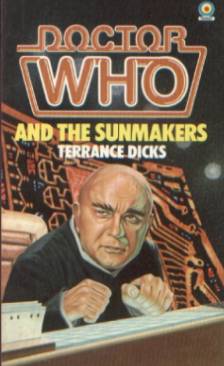
Cover: The last novelisation to have ‘and the’ in the title. Andrew Skilleter’s cover art is an effective portrait of the Collector. It’s very subtle, but the spotlights behind him represent Pluto’s six suns.
Final Analysis: There’s almost a reworking of The Dalek Invasion of Earth with the opening line: ‘In a drab and featureless corridor, a drab and featureless man stood waiting before a shuttered hatch.’ It’s otherwise a predictably solid adaptation from Terrance, which is becoming a rare thing around this time, though as the above quote about Gatherer Hade’s demise shows, he still has room to add a tinge of dark humour that’s very much in the spirit of his friend Robert Holmes’ original scripts.
Synopsis: The Keeper of Traken presides over a union of harmony. Nearing the end of his very long life, he visits the Doctor and invites him to visit Traken. Instead of being honoured guests, the Doctor and Adric find themselves mistaken for the evil that the Keeper has warned about. In a nearby grove, Kassia, the wife of a consul bares her soul to a lonely statue, fearful that her loving husband will be taken from her if he is nominated to be the new Keeper. But then the statue speaks – and promises everything will be okay, so long as she obeys without question. Within the statue, in an impossibly large chamber, a decaying figure observes his plan coming together, a plan that will find him power to regenerate his husk of a body – and enact revenge on his nemesis, the Doctor!
Chapter Titles
1. Escape to Danger
2. Melkur Awakes
3. Intruders
4. The Voice of Melkur
5. Melkur’s Secret
6. The Net
7. Prisoners of Melkur
8. A Place to Hide
9. Death of a Keeper
10. The Rule of Melkur
11. The Last Resort
12. The Enemy
Background: Terrance Dicks adapts Johnny Byrne’s 1981 scripts, which followed Warriors’ Gate on TV, making this the second time that three consecutive stories have been released together.
Notes: The first chapter is called ‘Escape to Danger’ (yay!) and it directly follows on from Warriors’ Gate, explaining the disappearance of Romana and K9. Adric’s standard description now tells us he’s ‘a smallish, round-faced, snub-nosed lad with an expression of cheerful impudence’. We’re also told he ‘usually eats enough for two’ and Adric observes that ‘practically everyone on Traken was old, eminent, and bearded’, which is a brilliant line. We only discover the identity of Melkur at the same time as the Doctor. The description of the Master matches that from The Deadly Assassin:
The figure in the chair was both wizened and decayed, the body as worn out as the tattered robes. One eye glared madly from the crumbling ruin of a face and blackened lips drew back in a ghastly chuckle.
As he confronts the Master in his TARDIS, The Doctor recalls his nemesis back in his prime:
The stocky, powerful figure, the darkly handsome face with its pointed beard and burning eyes, the deep, hypnotic voice. All of that was gone, decayed, so that all that was left was a walkingcorpse.
The new Master’s first words are ‘Now begins my new life!’
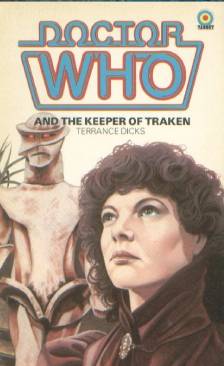
Cover: Andrew Skilleter gives us a simple scene of Nyssa and Melkur. Alister Pearson’s 1993 reprint cover is another montage of faces, depicting the Doctor, the Keeper and Melkur, along with the screaming, decaying face of the Master.
Final Analysis: A lot more effort with this, even though it’s largely a straight translation from screen to page, as Terrance provides points of view and character insights throughout. One slightly odd thing is that it’s not exactly clear in the TV episodes when exactly the Keeper reveals that Tremas is to be his successor, as this is merely reported by the Keeper after he shows the Doctor and Adric the wedding scene. Here, the appointment is very much part of the wedding, meaning Tremas and Kassia are married for less than two days before they’re both killed. As on TV, Nyssa is not signposted as the new companion and if anything her role is minimal, even though Terrance makes sure to tell us that she and Adric quickly become friends.
Synopsis: Exploring more of E-Space, the Doctor and Romana land on a planet where a small village lies in the shadow of a huge, sinister-looking tower, home to The Three Who Rule. A growing suspicion leads the Doctor to realise that the rulers are vampires, the mortal enemies of the Time Lords. As the pair try to form a plan to defeat them, they are unaware of a complication. A boy called Adric stowed aboard the TARDIS during their last landing and now he is about to become a servant of the Great Vampire…
Chapter Titles
1. The Selection
2. The Strangers
3. The Stowaway
4. The Messengers of Aukon
5. The Tower
6. Tarak’s Plan
7. The Secret Horror
8. The Resting Place
9. Escape
10. The Vampires
11. The Traitor
12. Attack on the Tower
13. The Arising
14. Departure
Background: Terrance Dicks adapts his own scripts from the 1980 serial, which in turn were adapted from scripts he originally wrote for the series in 1977 before they were cancelled. This is a completely separate adaptation to the one he wrote for an audiobook published by Pickwick the previous year.
Notes: Habris introduces us to this world, the village, the tower and the Lords who ‘weren’t quite human’. There’s no trace of any references to the original title, ‘The Wasting’, which had survived to the broadcast version. Adric is introduced as ‘a small, round-faced, dark-haired youth’. The Doctor sticks around ‘well into the next day’ to help with explanations and clearing everything up. Ivo and Kalmar jointly agree to set up a new government, using the old rebel headquarters as its base.
Cover: Andrew Skilleter creates a composition of the Doctor, Aukon, a bat and more bats flying across a moonlit sky.
Final Analysis: This is the fourth complete version of the story that Terrance Dicks wrote – preceded by the abandoned one for Season 15, the broadcast one for Season 18 and that Pickwick audiocassette version from 1981. The Pickwick edit was significantly abridged, so this is a much more faithful adaptation and Terrance even borders on Ian Marter-style violence towards the end. The desiccation of the vampire Lords is particularly effective:
Grouped in front of him in a semi-circle, the three vampires paused for a moment, as if to savour their final triumph. Eyes flaring red, teeth gleaming, hands outstretched like claws, they lunged forwards in unison — and then froze.
Their faces seemed to dry up, to wither and crack, like sun-baked earth.
The dessicated flesh crumbled from their bodies and for one horrible moment, three gorgeously robed skeletons stood leering at the Doctor, bony fingers reaching out, as if to rend him. Then the skeletons, too, crumbled, leaving three huddled heaps of clothes resting on scattered dust piles on the floor of the cave.
Synopsis: A thing that looks like a police box, standing in a junkyard. Home to a secretive old man and his strange granddaughter. Two schoolteachers allow curiosity to lead them into a terrifying journey back to a time where the greatest power is the ability to make fire, and the second greatest is merely to survive.
Chapter Titles
1. The Girl Who Was Different
2. Enter the Doctor
3. The TARDIS
4. The Dawn of Time
5. The Disappearance
6. The Cave of Skulls
7. The Knife
8. The Forest of Fear
9. Ambush
10. Captured
11. The Firemaker
12. Escape into Danger
Background: Terrance Dicks adapts Anthony Coburn’s scripts for the very first TV story. At 17 years, ten months and three or so weeks, this is now the record holder for the longest gap between broadcast of a story and release of the novelisation. Though this record will be broken a few times more in the future, this book can lay claim to another odd record in that the novelisation was released 18 days prior to being repeated in full for the first time.
Notes: We learn from the policeman in the opening scene that the old man who recently became the proprietor of the junkyard in Totter’s Lane has disappeared, along with his granddaughter and two teachers from a local school – so the rest of the story here is told in flashback (and the later flashback to Susan in the classroom is flashing even further back!). We briefly meet Susan in the first Coal Hill School scene as she waits for Miss Wright to fetch the book, and she’s ‘tall for her age, with short dark hair framing a rather elfin face’. Apparently Barbara Wright doesn’t ‘stand for any nonsense’ and Terrance Dicks gives her a rather balanced but critical appraisal:
Someone had once said, rather unkindly, that Barbara Wright was a typical schoolmistress. She was dark-haired and slim, always neatly dressed, with a face that would have been even prettier without its habitual expression of rather mild disapproval.
There was undeniably some truth in the unkind remark. Barbara Wright had many good qualities, but she also had a strong conviction that she knew what was best, not only for herself but for everyone else. It suited her temperament to be in charge.
Ian in contrast is said to be ‘a cheerful, open-faced young man… about as different in temperament from Barbara Wright as could be imagined.’ Ian teaches Science and Mathematics, which explains why he sets his class a problem involving the dimensions ‘a, b and c’. When Barbara tells Ian about Susan’s mistake over decimal currency, she adds that ‘The United States and most European countries have a decimal system’, but Susan then claims ‘You’ll change over in a few years’ time!’ Susan explains that TARDIS stands for ‘Time and Relative Dimension in Space’ (singular) as on TV [see The Daleks, The Time Meddler and others]. As he removes his jacket in the TARDIS control room, the Doctor has the impression of ‘a family solicitor from some nineteenth-century novel’. When Barbara calls him ‘Doctor Foreman’, the Doctor confesses that he stole that name from the gates of the junkyard and suggests ‘It might be best if you were to address me simply as Doctor’. Most helpful of him, even if he then acts as if he’s never heard the name when Ian uses it in the next chapter!
It’s confirmed that Za is the son of Old Mother, who he saved from being cast out by the Tribe (as is their custom) after the death of his father, Gor after (it’s presumed, but not confirmed) a hunting accident. This act of kindness was viewed by the old woman as weakness, hence why she undermines him at every opportunity.
The final chapter is called ‘Escape into Danger’. It ends with a foreshadowing of the next adventure, on a wartorn planet called Skaro – home of the Daleks!
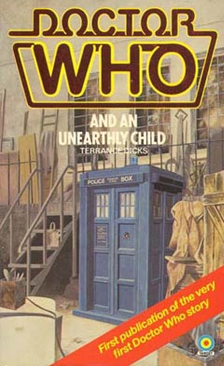
Cover: The first cover to use the Sid Sutton-designed ‘neon’ logo from the TV show, with metallic foil effect on the first edition’s logo, and with a red flash across the corner to tell us this is the ‘First publication of the very first Doctor Who story’. It’s such a simple cover really, as Andrew Skilleter recreates the set of the junkyard from a photo now believed to be lost. It could have done with being set at night, but the details are very satisfying as this cover is now our best view of that very cluttered set. A 1990 reprint used Alister Pearson’s VHS cover and it’s beautifully simplistic. Taking its inspiration from the cover art for Queen’s The Miracle (1989), Pearson merges the Doctor and Susan so they share an eye, positioned above a rocky landscape where the TARDIS is materialising.
Final Analysis: Terrance had just two weeks to complete this, to tie in with the ‘Five Faces of Doctor Who’ repeats, on the suggestion of producer John Nathan-Turner. It was also Target’s first novelisation in six months, due to a writers’ strike that Terrance felt compelled to honour. There’s a Reithian hand at work here, as Terrance guides the young Target reader through some fairly alien concepts: Through the police officer in the opening scene, we learn that police boxes used to be a common sight on British streets and the policeman speculates that they might soon be phased out in favour of individual walkie-talkies; Ian tries to remember what kind of animals might have existed in the time of the cavemen, such as mammoths and sabre-tooth tigers, but making the point that there’d be no dinosaurs as ‘that was a common mistake’; and of course, Anthony Coburn’s original script included a means to make fire that every eager Scout or pyromaniac should know.
One other lovely detail is how Dicks describes Kal as having a ‘short jutting beard’. It’s the kind of description Malcolm Hulke might have used for the same purpose, as later, when the time travellers’ escape route is cut off by tribesmen, their leader is said to have a ‘short jutting beard’ – the viewers would recognise him as Kal, but the travellers wouldn’t, yet – so the reader is given this subtle clue. There’s one small issue with the first edition though – as Za enters the clearing and hears a low growl behind him; it’s such an amazing paragraph that it was repeated a few lines later… oops!
So we now have a novel of the first story, which leads directly into the next – the novel of which is hugely contradictory as we’ve already seen. Heaven help anyone trying this pilgrimage in broadcast order. Much better this way!
Synopsis: The Doctor returns to Peladon with his new friend Sarah Jane Smith. Though membership of the Federation has brought some benefits to the planet, there is growing discontent among its people. The young Queen Peladon rules with kindness, but the old ways of superstition still have influence and when manifestations of the great beast Aggedor disrupt the mining of minerals, a force of Ice Warriors arrives to ensure that mining continues. But Sarah Jane saw an Ice Warrior in the mines before they officially arrived – and the Doctor’s old friend Alpha Centauri begins to suspect that these Ice Warriors aren’t even part of the Federation, but are traitors intent on gaining the minerals for themselves.
Chapter Titles
1. Return to Peladon
2. Aggedor Strikes Again
3. The Fugitives
4. The Hostage
5. The Wrath of Aggedor
6. The Intruder
7. The Ice Warriors
8. The Madman
9. The Return of Aggedor
10. Trapped in the Refinery
11. The Threat
12. Aggedor’s Sacrifice
Background: Terrance Dicks adapts the 1974 scripts by Brian Hayles (who had started work on the novel before his death in 1978). This completes the Target run of adaptations of stories from Season 11.
Notes: Peladon has three moons. We’re told this as part of an introductory chapter that summarises both the events of The Curse of Peladon and the intervening years up to this point, during which a war with Galaxy Five has made Peladon a key resource for the Federation. Apparently, Sarah Jane Smith has been the Doctor’s ‘more or less unwilling companion on a number of adventures’ and she instantly regrets allowing herself to be persuaded by the Doctor’s stories of a ‘picturesque and primitive planet, just making the transition from feudal savagery to technological civilisation’.
Ettis is said to be ‘a thin, wiry young man’ (so the casting for the TV version clearly shows what a hard life it is, being a miner, because he’s not ‘young’). Sarah observes a number of differences between Commander Azaxyr and his subordinates:
Although equally large, Azaxyr was built on slenderer, more graceful lines than his tank-like troops. He moved more easily, and in particular his mouth and jaw were differently made, lessof a piece with the helmet-like head. While the other Ice Warriors grunted and hissed in monosyllables, Azaxyr spoke clearly and fluently, though there was still the characteristic Martian sibilance in his voice.
The Doctor notes that, as a member of an aristocratic Martian line, Azaxyr is ‘almost a different species from the ordinary warriors’.
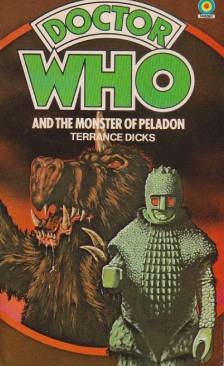
Cover: Steve Kyte’s design shows an Ice Warrior and the hulking form of a roaring Aggedor. Simple but effective. Alister Pearson’s 1992 cover shows the Aggedor statue and the Doctor as the background to a cluster of Sarah, Azaxyr, Alpha Centauri and Eckersley.
Final Analysis: It’s a welcome return for the Third Doctor, our first story to feature him since Death to the Daleks 19 books ago. Terrance Dicks might not attribute the colourful cuttlefish properties to Alpha Centauri that Bryan Hayles did in Doctor Who and the Curse of Peladon, but instead Alpha’s tentacles are the indication of his moods. Aggedor is said to be even bigger than he was the last time the Doctor saw him (and considering the illustrations of him in the previous novelisation, that must make him really huge now) and Dicks adjusts the Martian Commander to be as imposing as his warriors.
Synopsis: Romana and the Doctor land aboard a stricken ship heading for Skonnos with a group of terrified Anethans. The youngsters are intended as tributes to the fearsome Nimon. As soon as the Doctor has repaired the ship, its captain absconds, leaving the Doctor stranded. By the time the TARDIS gets him to Skonnos, Romana has discovered that the Nimon, a bull-headed alien, is just the first arrival, a spearhead for a race of parasites that intend to lay waste to Skonnos…
Chapter Titles
Prologue
1. Ship of Sacrifice
2. The Skonnons
3. Sardor in Command
4. Asteroid
5. The Nimon
6. The Maze
7. Sardor’s Bluff
8. K9 in Trouble
9. The Journey of the Nimon
10. Journey to Crinoth
11. Time Bomb
12. The Legend
Background: Terrance Dicks adapts Anthony Read’s scripts from 1979. This followed Nightmare of Eden on TV, so that’s another pair of stories to be released consecutively.
Notes: A brilliant prologue sketches the events of the rise and fall of the First Skonnan Empire in which we’re told ‘No enemy had ever defeated the Skonnans. They destroyed themselves.’ In-fighting led to civil war and the collapse of a once-proud race – and then came the Nimon, a god-like being who promised the restoration of the Empire in return for tributes, which the Skonnans, led by Soldeed, acquired on the peaceful neighbouring planet of Aneth. The ship we see in the first proper scene is the last surviving vessel of the former empire.
The Captain is here named Sekkoth and his co-pilot, Sardor, is younger, ‘plump-faced and overweight’. Sardor was too young to have fought in the wars, which accounts for his being ‘even more fiercely militaristic than his superior.’ The Doctor is curious as to why Romana has decided to dress like a fox-hunter. When Romana flees the Nimon’s chamber with Seth and Teka, it’s left to an unnamed Anethan girl to explain the plot so far to the Nimon. After the Complex is destroyed, we’re told what happened next: The Doctor takes Sorak aside and persuades him to enter into a peace treaty with the people of Aneth and lay the blame for previous enmity on the Nimon.
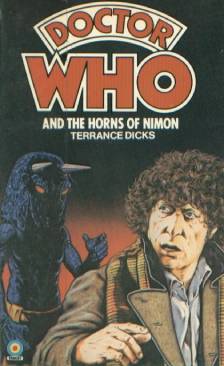
Cover: Steve Kyte’s first of three covers for the range, with the Doctor looking over his shoulder at a blue Nimon.
Final Analysis: Terrance Dicks often said that his favourite novels were the ones where the scripts were already good, so he had little to do, or the ones that were bad, where he got to fix them. Few fans would say Horns of Nimon is their favourite story, but the opening prologue suggests Terrance approached this with determination and a willingness to polish as he progressed. We might lose some of Tom Baker’s onscreen excesses here, but Terrance also takes things much more seriously than anyone in the TV version seems to have done: The opening prologue is as portentous as any other scene-setting chapter we’ve had, as a civilisation rises and falls; the comic trouser-splitting co-pilot is given a zealous determination that makes his ultimate demise a relief; Teka tells Romana that her fellow sacrifices are ‘too frightened even to talk’, which explains why only two of them are given any dialogue (genius!); Soldeed’s rise to power is shown to be a fluke and he clings to power knowing he’s ill-equipped to rule – something that Sorak seems to recognise and hopes to exploit; and of course, it’s the dreaded Nimon who Terrance really beefs up with customary relish – just have a look at this:
It was a fearsome, extraordinary creature, not unlike the great buffalo of Earth. Presumably on the Nimon’s planet some similar creature had developed intelligence and become the dominant life form. The Nimon was like a great black bull that had learned to talk and walk upon its hind legs like a man. The massive head merged directly into the enormous torso, with no suggestion of a neck. Great golden eyes blazed with a fierce intelligence and two amber-coloured horns jutted from the broad flat forehead. The creature wore only a wide jewelled belt and a kind of metallic kilt.
The most terrifying thing about the Nimon was that it was never still. It was as if so much energy was packed into the enormous body that it throbbed with continual power, pacing restlessly to and fro like a great caged beast. Even when it was not speaking it gave off a constant series of low, rumbling growls.
That is how to polish a cow-pat, even making the bizarre choreography something to fear. Right in the middle of his infamous ‘script-to-page’ period, Terrance gives us a surprising little gem.
Synopsis: The Doctor and Sarah land on the planet Karn, which is home to a secret Sisterhood, a mad scientist – and a brain in a jar. The brain belonged to an evil Time Lord called Morbius and Solon wants to bring him back to life. Just like he wanted to do in the original novelisation.
Chapter Titles
Identical to the original novel
1. A Graveyard of Spaceships
2. The Keepers of the Flame
3. The Horror Behind the Curtain
4. Captive of the Flame
5. Sarah to the Rescue
6. The Horror in the Crypt
7. Solon’s Trap
8. The Doctor Makes a Bargain
9. The Monster Walks
10. Monster on the Rampage
11. Deathlock!
12. A Time Lord Spell
Background: Terrance Dicks once again rewrites his earlier adaptation of the story he originally wrote (ish) for TV – this time for a younger readership.
Notes: The murder of the alien Kriz by Condo is excised, with the book beginning instead with the arrival of the TARDIS. Solon’s first scene is also cut, jumping straight to the introduction of the Sisterhood. Maren’s sacrifice is both excised and glossed over, with Maren presenting the Doctor with the last drops of the elixir before he gives the soot-clearing firework to Ohica.
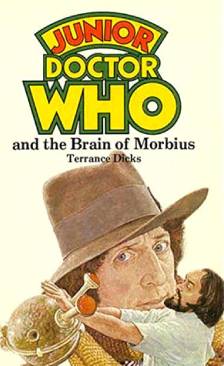
Cover & Illustrations: Harry Hants gives us a much better cover for this than we got for the fuller version; even though it’s a very similar basic idea (the Doctor’s face huge in the background as Solon wrestles with the monster), it’s beautifully painted. Peter Edwards provides 35 wonderful illustrations and the gothic setting really suits his style. His Morbius monster has huge taloned feet like those of a bird of prey and pretty much every picture of blind Sarah is unnervingly creepy, but especially the one where she enters the room containing Morbius’ brain in a tank. Best illustrations so far.
Final Analysis: Confession time – this was the version of the story I had as a kid and I didn’t read the full novel prior to this project. It’s a great introduction for children to the genre of horror, enhanced greatly by Peter Edwards’ gritty illustrations, which truly are the stuff of nightmares. It’s a shame this was the last of these experimental junior editions and I wonder how a version for younger readers of The Android Invasion (the Fourth Doctor story with the lowest death count) might have looked.
Synopsis: Two planets locked in war, Atrios and Zeos. A princess tries to help her people while her zealous Marshal fights to win the war. Unseen, a shadowy figure is manipulating events as he awaits the final pawns in his game. The Doctor, Romana and K9 arrive on Atrios in search of the final segment of the Key to Time, and help comes from an unexpected source as the Doctor is reunited with an old friend. Soon, the Key to Time will be assembled – and the hidden enemy will be revealed.
Chapter Titles
1. The Vanishing Planet
2. Missile Strike
3. Kidnapped
4. A Trap for K9
5. The Furnace
6. Behind the Mirror
7. The Shadow
8. Lost on Zeos
9. The Armageddon Factor
10. The Planet of Evil
11. Drax
12. The Bargain
13. Small World
14. The Key to Time
Background: Terrance Dicks adapts the 1978 scripts by Bob Baker and Dave Martin. This is now four stories to be released consecutively in the order they were broadcast on TV.
Notes: The first TARDIS scenes are condensed and moved to the beginning of the first chapter, with an additional explanation of the on-going mission to find the Key to Time. The Marshall’s description is a love-letter to actor John Woodvine:
Tall and broad shouldered, straight-backed with iron-grey hair, he wore a magnificent scarlet tunic with gold epaulettes, the eagle of Atrios emblazoned in silver on the breast. His stern face was rugged and handsome, his voice deep and commanding.
Merak is apparently the son of one of Atrios’ oldest families and has secretly been in love with Astra since they were both children. They are both members of an underground peace party. Drax is from the ‘Class of Ninety-Three’ (not Ninety-Two) and has heard that the Doctor ‘got done by the High Court’ for stealing a TARDIS and ‘served a stretch’ on Earth – Drax himself bought a TARDIS second hand and he agrees to stop calling the Doctor ‘Thete’ (short for Theta Sigma, which we’re told was a ‘Time Lord coding’), though he’s sensitive that, unlike the Doctor, he didn’t get his degree. Once exposed, the Black Guardian contorts into a demonic creature and it’s both his callousness about Princess Astra and his inability to set things right with the Key already assembled that alerts the Doctor to his true identity.
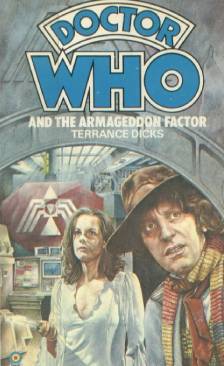
Cover: Bill Donohoe paints the Doctor (using a surprising photo reference from The Seeds of Doom) and Romana with the Key to Time locator core in her hand, with the red bird motif from the War Room on Atrios in the background. Apparently producer John Nathan-Turner didn’t like this cover – he was wrong though.
Final Analysis: Yet another fairly straightforward adaptation, with the only major omissions being those scenes with the Marshall preparing to fire on Zeos that are repeated on TV, which don’t need to be replayed here.
And so ends a long, long journey towards this point. There have been trials, tribulations and many disappointments on this quest, but finally we’re done… we’re out of the worst run of books in the series so far – perhaps ever. A combination of poor original stories and a very lacklustre approach to adapting them makes me so glad we’ve got a treat coming up next.
Synopsis: On the marshy moon of Delta Three, a methane refinery plant squats in the murky swamp. The small service staff have only minimal contact with the Swampies – primitive green natives whose village is nearby. The arrival of gun-runner Rohm Dutt on the planetoid coincides with that of the Doctor and Romana, still hunting for the Key to Time. Soon, the new arrivals will be forced into an uneasy partnership as they face the terrifying power of the Swampies’ god, Kroll.
Chapter Titles
Prologue
1. The Swamp
2. The Gun-Runner
3. The Sacrifice
4. The Tunnel
5. The Thing in the Lake
6. The Attack
7. The End of Harg
8. The Storm
9. Escape Through the Swamps
10. The Rocket
11. Countdown
12. The Power of Kroll
Epilogue
Background: Terrance Dicks adapts Robert Holmes’s scripts from 1978. This followed The Androids of Tara on TV, so this is the first time that three stories are released consecutively.
Notes: In the prologue (and with a lovely opening line: ‘Deep beneath the waters of the immense lagoon, Kroll slept’), we learn that Kroll has slept for hundreds of years, drawing power and growing in size due to swallowing whatever it was that the Key to Time had been disguised as. Then the men in rockets land on the planet and set up their rigs, which awakens the beast below the lagoon. In chapter 1, we’re told more about the Sons of Earth, an environmental pressure group concerned that the overpopulation of Earth is happening again on Delta Magna, and also regret over the displacement of the Swampies from their original home on Delta Magna to this moon (named here as Delta Three). Romana is again called a Time Lady and she’s wearing a bright orange tunic as well as boots to guard against the mud. We’re once more reminded of the mission to find the segments of the Key to Time.
Unusually for this kind of story, we’re told that Thawn’s crew are ‘all expert at their jobs and they worked well together, an efficient team’. Thawn tells Fenner that he’s seen Rohm Dutt on Delta Magna many times, which is how he knows the Doctor isn’t him. The roles of the named Swampies are clarified, so in addition to the chief, Ranquin, we have the war-chief, Varlik, and Skart is the High Priest, rather than just a part-time rubbish Kroll impersonator. Rohm Dutt thinks Romana might be a government spy. When the deception over the monster in the sacrifice is exposed, Romana is ‘disgusted with herself for being so terrified by such a simple device’. Significantly, when Thawn calls the Sons of Earth ‘fanatics’, Dugeen says ‘We are not fanatics’ (on TV, it’s ‘they’), so he’s not just sympathetic to the Sons of Earth’s cause, he is one of them. After he’s salvaged the Key to Time segment and saved the day, the Doctor suggests to Fenner that he should share his food stocks with the Swampie survivors.
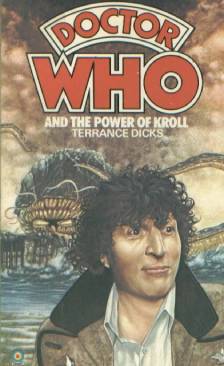
Cover: It’s not immediately obvious but this is a game-changing cover by Andrew Skilleter. A bemused Doctor smirks as Kroll thrashes behind him in the swamp, but it’s believed that this is the first cover to take reference from a screenshot from the episode itself instead of a publicity still (it’s the frame where the Doctor escapes Kroll’s tentacles and grabs the Key to Time segment). The back-of-book text included another promotional block: ‘THE POWER OF KROLL is a novel in the Key To Time Sequence. Also available THE RIBOS OPERATION, THE STONES OF BLOOD and THE ANDROIDS OF TARA. Coming soon: THE ARMAGEDDON FACTOR’. Hmm – one story is conspicuous by its absence (and will be for over thirty years!).
Final Analysis: We’re so very close to the end of this rather dry period for the books. Dicks once again translates the TV story onto the pages and makes it look easy, but he’s working from one of Robert Holmes’ worst scripts so there’s very little to work with. Dicks manages to add a little socio-economic commentary, but I can’t help feeling Malcolm Hulke would have done something more with this, had he still been around. We only have to wait a few years to see Holmes’ second attempt at the same story, for the fifth Doctor’s finale, and wait to see what Terrance Dicks does with that. Until then, we just have that final segment to find in the next book…
Synopsis: The Doctor has gone fishing, leaving Romana to hunt down the next segment of the Key to Time. She completes her hunt with surprising ease, but just as quickly she becomes a prisoner of the scheming Count Grendel. Meanwhile, the Doctor’s holiday is interrupted by guards who serve Prince Reynart, a sickly monarch-in-waiting, whose reign is about to be cut short by Grendel. The Prince has an android duplicate of himself, which he hopes to use as a decoy long enough to ascend the throne. The android, however, doesn’t work. Separately, the Doctor and Romana work from opposite sides to fix the state of Tara.
Chapter Titles
1. The Doctor Goes Fishing
2. Count Grendel
3. The Double
4. The Princess
5. The Prisoner of Gracht
6. The Android King
7. Invitation to an Ambush
8. The Android Killer
9. Flag of Truce
10. Count Grendel plans a Wedding
11. Attack by Night
12. Victory
Background: Terrance Dicks adapts scripts by David Fisher for his second story from 1978. This followed The Stones of Blood on TV, so that’s another pair of stories to be released consecutively.
Notes: The statue that transforms into the Key to Time segment depicts ‘a vaguely dragon-like heraldic beast, thrusting time-blunted claws towards the blue summer sky’. The very-much-alive creature that attacks Romana is a very generous evolution of the short, comedic beast seen on telly:
The monster was a good eight feet tall – and it walked upright like a man. It had coarse black fur, slavering jaws filled with yellow, pointed teeth and a stubby horn projecting from the centre of its forehead. A mixture of bear, ape and boar, with the nastiest features of all three.
Count Grendel is said to possess a ‘darkly handsome face’ which is ‘marred only slightly by a fiercely jutting beak of a nose’ – an unflattering description of actor Peter Jeffrey. At the end, the Doctor rescues the adrift K9 – and Romana jokes that he ‘managed to catch a fish on Tara after all’ – before the time travellers depart in the TARDIS.
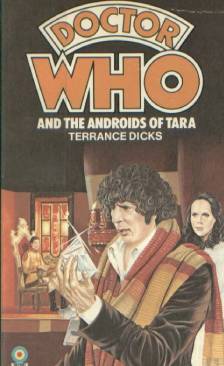
Cover: A scene painted by Andrew Skilleter shows the Doctor inspecting a segment of the Key to Time, watched by Romana (in her Ribos costume), appearing on a cover for the first time. In the background, K9 makes his first appearance on a book cover too, looking up at the Prince on his throne. The back cover announces ‘THE ANDROIDS OF TARA is a novel in the Key To Time Sequence. Read THE RIBOS OPERATION and THE STONES OF BLOOD available now.’ (said books didn’t carry this linking text).
Final Analysis: Around the time that this book was published, Shredded Wheat had an advertisement campaign that boasted that the product had ‘nothing added, nothing taken away’. Aside from the exaggerated details of the beast in the woods, this is all we get here. I still think it’s not fair to dismiss Dicks’ writing simply as just adding ‘he said / she said’ to the script, as he paints a vivid picture of the castles and woodlands of Tara, but this is a great example of Dicks at his most perfunctory. Everything that we might like about this came from David Fisher.


 Escape to Danger