
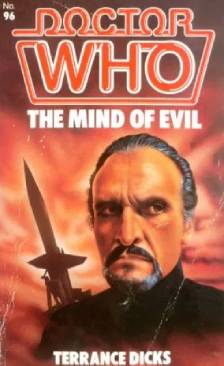
Chapter 96. Doctor Who – The Mind of Evil (1985)

Synopsis: The Doctor and Jo attend a presentation at Stangmoor Prison, where a pioneering new machine for treating violent criminals is being tested. UNIT is providing security at an international conference while also overseeing the transportation of a missile. A series of seemingly unconnected deaths at the prison and among the peace conference are further complicated by a riot breaking out at the prison. The chaos is another scheme by the Master and the Doctor has it in his power to bring it all to an end – but is the price too high even for him?

Chapter Titles

  • 1. The Sentence
  • 2. The Terror
  • 3. The Inferno
  • 4. The Listener
  • 5. The Pistol
  • 6. The Dragon
  • 7. The Hostage
  • 8. The Mutiny
  • 9. The Test
  • 10. The Mind Parasite
  • 11. Hijack
  • 12. The Escape
  • 13. The Attack
  • 14. The Reunion
  • 15. The Mind of Evil
  • 16. The Farewell

Background: Terrance Dicks adapts scripts by Don Houghton for the 1971 serial, completing Target’s run of stories from Season 8.

Notes: A few characters gain additional back-stories. The governor of Stangmore is named ‘Victor Camford’; he’s ‘a massive, heavy-featured man with dark hair and bushy eyebrows’. Professor Kettering is revealed to be completely out of his depth, adept at politics but completely ignorant of the workings of the Keller machine. He was hired personally by Emil Keller and it’s clear the eminent scientist (who is the Master of course) was exploiting Kettering’s personality flaws. Barnham ‘choked the life out of a security guard’ who disturbed him during a robbery. Harry Mailer has ‘a weathered, corrugated look, as if made of leather rather than normal skin’. A gang leader who organised a ‘highly successful’ protection racket in London, Mailer was arrested and convicted after killing someone within sight of witnesses. It’s suggested that he might have been responsible for many other murders, bodies that have never been found as they’re ’embedded in the foundations of bridges and motorways all over England’ (see also Meglos for another example of hiding bodies in motorway constructions). 

Captain Yates is ‘a thin, sensitive-looking young man, a good deal tougher than he looked’. Benton relishes the opportunity for some plain-clothes work and imagines himself as ‘James Bond’. We’re treated to the best description of him so far:

The Sergeant had many excellent qualities. He was a burly, handsome young man, a fine figure in his military uniform. He was completely fearless and utterly loyal. But he wouldn’t have been the Brigadier’s first choice for an undercover assignment. For one thing, he was just too big. Benton lurking in a doorway with his raincoat collar turned up, was about as inconspicuous as an elephant at a tea party. 

The Brigadier nods off at his desk and he dreams he is a young subaltern again, with a young lady called Doris [see Planet of the Spiders and Battlefield]. The Doctor eventually recalls that the parasite inside the machine comes from a planet from which ‘no expedition had ever returned’. As it begins an attack on the Master, the Keller Machine is said to be ‘fully aroused’.

Cover: Andrew Skilleter paints a portrait of the Master with the missile.

Final Analysis: Considering how those mid-to-late Tom Baker books saw a surfeit of Dicks, it really is a treat to find one of his books is next on the list. Terrance dominated the first 100 releases, but there are few of them left by this point. We can rejoice in this one being the second and last of Don Houghton’s scripts to be novelised, from an era where, along with producer Barry Letts, Terrance was king of Doctor Who. There’s a sense that the story is made up largely of three ‘episode two’s sandwiched between an opening and closing episode; Terrance does little to change this, but it’s enjoyable to see a few additional bits of detail that sketch in the lives of our supporting characters.

On TV, Professor Kettering reacts against the Doctor at his most obnoxious, whereas here, we find out he is completely winging it and the Doctor is (unconsciously) correct to pick apart his claims. Barnham and Mailer are both revealed to be extremely violent thugs, so the contrast between them after Barnham has been processed is even more stark – and Mailer is immediately as threatening a presence as he is on screen. A surprise and disappointment comes with the arrival of the Chinese dragon, which kills the delegate. While it provides an appropriate point to conclude a chapter, Dicks doesn’t make much of it or make any attempt to make it more dramatic than the ‘Puff the Magic Dragon’ that so failed to impress the production team as it waddled onto set. For once, he chooses just to say ‘it happened’ and move on. Whether this was down to word-count or he was just trying not to resurrect painful memories of the costume, we’ll never know.

Further Listening

I was a guest on the Dr Who Literature Podcast to discuss this book, which you can hear in the link below, on YouTube, or via the podcast provider of your choice.

Chapter 31. Doctor Who and the Claws of Axos (1977)

Synopsis: A strange object from space lands on Earth near a nuclear power station. Inside are Axons, a family of golden beings who offer unlimited power in return for help with their damaged spacecraft. While the Doctor tries to keep an open mind, an ambitious politician rushes to seize the Axon’s power for his own interests. Deep inside the alien craft, the Master is being held captive – and as Jo Grant discovers, that’s not the only secret the Axons are keeping…

Chapter Titles

  • 1. Invader from Space
  • 2. The Landing
  • 3. The Voice of Axos
  • 4. Enter the Master
  • 5. The Doctor Makes a Plan
  • 6. Escape from Axos
  • 7. The Axons Attack
  • 8. The Power Robbers
  • 9. The Sacrifice
  • 10. Brainstorm
  • 11. The Feast of Axos
  • 12. Trapped in Time

Background: Terrance Dicks adapts scripts by Bob Baker and Dave Martin from the 1971 production.

Notes: As we first saw in Revenge of the Cybermen, Terrance alludes to the ‘blackness of deep space’ (and see The Ambassadors of Death for more on this). As it soars towards Earth, the Axos ship has a ‘constantly changing’ shape and glows with a ‘myriad of colours’ – its intention is to be noticed. The first scene with the two radio operators is expanded here; they’re not UNIT operators here, but personnel at the tracking station – Ransome and his assistant, Harry – who work down the list of people they need to contact and find ‘something called UNIT’. The first interaction between the Brigadier and Chinn also provides background information – the minister in overall charge of Chinn’s department cannot stand him, and as the Brigadier is also a problem, he decides to set the two men against each other in the hope that the winner will eliminate one or the other. Although UNIT is governed from Geneva, the Brigadier’s operations are part-funded by the British Government. Corporal Bell is not part of this story, her role is given to a nameless male technician.

We get an introductory scene (cut from the TV version but included as an extra on DVD) where Bill Filer is on the hunt for a man called ‘Joe Grant’ – and Jo corrects him. Bill is described as having ‘closely trimmed brown hair and a pleasantly ugly face’ – wow, that’s a pretty mean swipe at the reasonably handsome Paul Grist who played him.

The Doctor and Jo drive to the landing site in Bessie (yay!). The Axon who first frightens Jo subsequently appears as a male identical to the Axon leader. The Axon leader does not assume that the toad is livestock, but spells out the potential, had it been a ‘food animal’. The process transforms the toad into a huge form that overwhelms Chinn and makes him scream. Later, as Axos reacts to the Doctor’s experiment, the Eye of Axos is said to be ‘lashing wildly to and fro on its stalk’, which is much more fluid a movement than the TV prop could manage.

Jo overhears the Doctor speculating about Axonite’s potential for time travel and suspects he has selfish intentions early on. The Doctor spots straight away that the Axon-Filer is a fake thanks to his experience of the Autons replicating humans. He also baffles a sentry to gain access to the arrested Brigadier: ‘Good heavens, man, I know the Brigadier’s incommunicado. I’m incommunicado myself. There’s no reason why we can’t talk to each other.’ Delightful!

The Master enters the Nuton complex disguised as a visitings scientist and recalls the time he broke into UNIT HQ dressed as a ‘humble telephone engineer’. The Master’s TARDIS is a white dome, not a filing cabinet.

To the Eye of Axos’s surprise, the Doctor reveals that he’s deduced that Axos already has some limited ability for time travel; he realised that Axos reached Earth before the missiles were fired and Axos confesses that they can ‘move only moments in Time.’ Hardiman’s assistant (credited on screen as ‘Technician’) is named ‘Ericson’.

Cover: Achilleos gives us an eerie female Axon with rays of light coming from her eyes while an Axon monster looms behind her and the Doctor (taken from a photo from Frontier in Space) is pictured inset looking concerned. A 1979 edition had a cover by John Geary showing the adult male Axon and two very green Axon monsters.

Final Analysis: I’m hugely fond of The Claws of Axos TV episodes, one of those comfort stories I can bung on while I decide what I’d sooner be watching and then settle down and enjoy it. Terrance Dicks captures all of the conflicted loyalties that the Axons draw out of our heroes – are they victims in need, or should they have been blasted into bits from the start? –  but he enhances the suspicion that the Doctor is solely interested in using Axos to escape Earth and relishes in making Chinn hated by absolutely everyone he encounters. The Master once again enjoys the thrill of the adventure, deciding on a whim to jump from a bridge onto a UNIT truck and then exploiting his good fortune when it turns out to be going where he wants to be. The ending is also less rushed than on TV, as Bill Filer says his goodbyes and jokes that he’d thought England would be ‘dull’, Chinn scampers back to the Minister to try framing the success as his own, while the operation to rescue the TARDIS and get it onto the back of a UNIT truck turns into a huge argument, which Jo welcomes as things getting ‘back to normal’. 

Chapter 14. Doctor Who and the Terror of the Autons (1975)

Synopsis: A renegade Time Lord calling himself ‘The Master’ has followed the Doctor to Earth and as an introductory calling card he’s brought the Autons with him. The Doctor has even more trouble on his hands with a new assistant forced upon him by the Brigadier, the very keen and very newly qualified agent Jo Grant.

Chapter Titles

  • 1. The Terror Begins
  • 2. Sabotage at the Space Probe
  • 3. The Master Takes Over
  • 4..Death at the Plastics Factory
  • 5. The Killer Doll
  • 6. In the Hands of the Autons
  • 7. The Battle of the Forest
  • 8. The Killer Doll Attacks
  • 9. The Deadly Daffodils
  • 10. Prisoners of the Master
  • 11. The Final Assault
  • 12. The End of Round One

Background: Terrance Dicks adapts Robert Holmes’ 1971 scripts.

Notes: Our introduction to Luigi Rossini (real name here is ‘Lew Ross’) presents a much more consciously obnoxious figure, employing labour of a mainly criminal type as they’re cheap and won’t risk complaining. This includes Tony the Strongman, who’s wanted by the police. Rossini manages to persuade his crew that the Doctor and Jo blew up Phillips as they were trying to steal the mob’s wages. The Auton meteorite device glows green as in The Auton Invasion, while the Master says that the plastic chair that kills McDermott is made of ‘polynestine’. The Doctor recognises the visiting Time Lord as being a member of the High Council who exiled the Doctor to Earth.

The Doctor recognises the device that the Master leaves in the cabin of the radio telescope is a ‘Volataliser’, a product of ‘The Xanthoids [who] use them for mining operations’, while the one that Jo tries to detonate in the UNIT lab is ‘a Saturnian Solar Bomb’. One of the best / nastiest additions is the revelation that the Master uses Professor Phillips to help him operate controls within his Tardis, but when he’s not on duty, he is both disguised as – and forced to work as – an actual clown, because it amuses the Master to ‘degrade a brilliant scientist into a mindless buffoon’. There’s a gap of a few days between Mr Farrel’s death and the Doctor’s visit to his wife, and the distribution of the daffodils spans a few more days too. Brownrose from the Ministry is completely removed and I didn’t even notice until just now. And of course, as the cover reveals, the description of the Nestene’s arrival is much more impressive than on TV.

Considering the Master’s crimes, the Doctor provides an insight into their race:

Once captured by the Time Lords, the Master’s life-stream would be thrown into reverse. Not only would he no longer exist, he would never have existed. It was the severest punishment in the Time Lords’ power.

The text refers to the ‘chameleon mechanism’ and ‘chameleon circuits’ for the first time in print (and ‘chameleon circuit’ won’t be said on screen until Logopolis!). There’s also a reference to a ‘Sontaran fragmentation grenade’ (the story came before their first appearance, but the novelisation was published a year after The Time Warrior aired). The Doctor makes good use of his sonic screwdriver, dismantling a bomb, opening the Auton-containing safe and trying to break into the Master’s Tardis. We’re party to the Master’s thought processes as he weighs up his options in turning against the Nestene, swayed by the Doctor’s persuasive argument – and the Brigadier’s pistol.

Cover & Illustrations: Peter Brookes’ original cover depicts a scene that doesn’t actually happen on TV as the one-eyed crabtopus Nestene creature envelops the radio telescope and, inset, the Doctor makes a surprise entrance as the Master plays with a lever. The back cover again features an illustration, Captain Yates inspects a fallen auton carnival dummy while another soldier in silhouette takes on a horde of autons. The 1979 reprint boasts a cover by Alun Hood, again depicting the imagined Nestene but in a more photorealistic style more akin to a Pan horror book; this was the edition I first owned and I was convinced this was a photo of the prop they used (what a disappointment the TV version turned out to be!). Alan Willow provides six illustrations, all of which expand upon what we saw on TV. It’s hard to pick a favourite although I love the one of the radiotelescope technician working away as ‘A dark shape peered down at him’ – the Master, snooping through a skylight, is much more dramatic than him just stepping through a door. 

Final Analysis: Another good job by Dicks here, covering a lot of ground and adding nuance where appropriate. Jo’s previous ‘debut’ in The Doomsday Weapon is glossed over, but there’s some decent continuity between this and The Auton Invasion, including the Brigadier asking why they can’t just do what they did last time and the Doctor points out all the flaws in his previous attack plan.

Chapter 8. Doctor Who and the Daemons (1974)

Synopsis: The Master’s up to no good in an English village, posing as both a vicar and the leader of a satanic cult. The Doctor and Jo appear on TV and they take on the Master, a gargoyle and an ancient god – with the help of UNIT and a self-proclaimed white witch.

Chapter Titles

  • Prologue
  • 1. The White Witch
  • 2. The New Vicar
  • 3. The Opening of the Barrow
  • 4. The Appearance of the Beast
  • 5. The Heat Barrier
  • 6. Meetings
  • 7. Explanations
  • 8. The Second Appearance
  • 9. Into Danger
  • 10. The Third Appearance
  • 11. The Rescue
  • 12. Into the Cavern
  • 13. The Sacrifice
  • Epilogue

Background: Barry Letts adapts the 1971 scripts he co-wrote with Robert Sloman as ‘Guy Leopold’.

Notes: An early manifestation of Azal is much more dramatic, involving the death of the verger. Benton recalls earlier adventures with the cybermen, Axons and the daffodil-touting autons, none of which have been novelised by this point, while Jo recalls her first meeting with the Master as seen on TV but which flatly contradicts the books so far. We also get the first revelation that the Doctor and the Master were schoolfriends – and that the Doctor wasn’t a particularly keen student. Azal reveals that his race were responsible for the dispassionate destruction of all life on the planets Talkur and Yind. The character of Stan Wilkins is new to the book, on TV he’s just a nameless acolyte in the coven who recognises that the Master is evil and tries to save Jo and the Doctor. His courage serves to make Jo’s attempted self-sacrifice all the braver. Stan also gets to review events with ‘mixed feelings’ in the epilogue; while he acknowledges the number of people who’ve died, he also realises that he’ll inherit his uncle’s garage and be able to care for his ‘Mam’.

Cover & Illustrations:  The original cover was by Chris Achilleos following the now-familiar formula of the Doctor’s face with a head-shot of Azal and a teeny Bok. Internal illustrations are by Alan Willow. There’s a lovely drawing of Jo back against an ivy-covered wall (that’s based on a photo from The Sea Devils), but Azal and Bok are both faithfully reproduced. My first cover was the 1980 reprint with a portrait by Andrew Skilleter of Azal in the cavern, while the 1993 reprint used Alister Pearson’s VHS cover, with an almost-Celtic cross that shows the Doctor and Master both in half-portrait, Azal at the top and Bok at the bottom against a sunburn-pink background.

Final Analysis: Barry Letts adapts the scripts well, so it’s surprising this is his only novelisation of a TV story (though it’s not his only entry in this blog – as you’ll find out in about 146 chapters). It enhances what was possible on telly but doesn’t elaborate vastly; the prologue is just everything that happens on TV before the Doctor appears, where Mac Hulke might have given us an insight into Azal’s arrival on Earth. Azal gets a better motivation to implode though – being both confused by Jo’s illogical actions and on the verge of death anyway. We do gain some lovely insight into the Squire (a minor character on TV), who is perplexed by his regular headaches that always arrive the morning after a night in the pub. And the lead character is referred to as ‘Doctor Who’, right at the start of the first chapter.

Chapter 6. Doctor Who and the Doomsday Weapon (1974)

Synopsis: The Master has stolen information from the Time Lords regarding a mythical weapon, which can be found on a planet recently occupied by Earth colonists. The desperate people are caught between hostile attacks from the indigenous natives and a mining corporation intent on taking the planet’s resources for their own ends. All this awaits Jo in her first trip in the Tardis.

Chapter Titles

  • 1. A Missing Secret
  • 2. Into Time and Space
  • 3. The Planet
  • 4. The Monster
  • 5. Starvation
  • 6. The Survivor
  • 7. The Robot
  • 8. The Men from IMC
  • 9. The Spy
  • 10. The Claw
  • 11. Face-to-face
  • 12. The Bomb
  • 13. The Attack
  • 14. The Adjudicator
  • 15. Primitive City
  • 16. The Ambush
  • 17. Captain Dent Thinks Twice
  • 18. The Master’s TARDIS
  • 19. The Return of Captain Dent
  • 20. The Doomsday Weapon

At twenty, this book sets a record for the most number of chapters in a novelisation, which will remain unbroken until 1985.

Background: Malcolm Hulke adapts his scripts from 1971 for Colony in Space.

Notes: Another prologue of a scene that never happened, as an old Time Lord shares stories with an apprentice, revealing the history of early TARDISes and his own personal involvement in the resolution of The War Games returning the kidnapped soldiers to their rightful times. He refers to the Doctor’s TARDIS and the fact that it’s lost its ‘chameleon-like quality’. There’s also another cheeky ‘Who’ reference as the old Time Lord explains the Doctor’s inability to pilot his TARDIS: ‘‘Who? No, Who can’t control it… not always.’

Newly qualified security agent Jo Grant is introduced, having come top of her year in spy school before getting her uncle to pull some strings to arrange a posting to UNIT, where she’s ignored by everyone except Sergeant Benton and attempts to reprimand the Doctor before she finds herself whisked off to an alien world as her very first adventure. A lovely if inconsistent flashback. Meanwhile, Jane Lesson recalls being aware of other ‘terrifying space creatures’ ‘Monoids, Drahvins, some small metallic creatures called Daleks’ before referencing Hulke’s own creations, the ‘reptile men’.

The story’s set a bit further forward in time, 2972, and there’s a grim but casual detail in the Doctor realising that the colonists describe a creature ‘like a big lizard… from the picture books’ because the Earth animals were ‘exterminated by Mankind by the year 2500’ and not because, for example, they were describing dinosaurs. The Doctor speculates on the size of an attacking creature as ‘about twenty feet high’ and then corrects himself to ‘six metres’ as he remembers that all of Earth went metric a thousand years before. Surprisingly, the IMC robot is described as humanoid – a much more achievable look on TV than the bulky robot we ended up with (and the illustrations don’t quite match this new design either). Hulke provides an unsettling vision of the future: The entire surface of Earth in this time is covered in tiny cube apartments within huge buildings; The Interplanatary Mining Corporation arranges marriages based on computer-decided compatibility (though strangely Dent’s marriage seems happy while Caldwell’s has ended in separation); food is sourced solely from the sea; even when IMC chief Dent offers his team champagne, it’s from a can.

There’s a hint of the first pioneers across America here as the colonists have never done physical work (‘on Earth machines did everything’) so they’re even more badly equipped to found a new civilisation than it might appear. But when they have to consider how to bury their dead, Ashe recalls an ‘audiobook’ from back when Earth ‘still had open land’; it seems that even the disposal of dead bodies on Earth is automated as the Doctor has to explain to the colonists the rituals of graves, religious services and the importance of ‘a time for tears, and then a time to rejoice in the continuation of life. Hence the tea.’ 

The leader of the primitives is described as the size of a doll, explaining the earlier foreshadowing of the primitives reaction to a child’s doll, while the primitive priests have the faces of otters – and the rest of the primitives are stark naked!

Cover & Illustrations: The original cover and illustrations were by Chris Achilleos (though my first edition was the 1979 reprint with Jeff Cummins’ impressive portrait of Roger Delgado as the Master). I’m really not keen on the illustrations here, they’re a bit scrappy – some are clearly working from set photos while others show people who we don’t see in the TV version (Caldwell could just be an Auton!). I love the pic of the Doctor and the Master at the controls of the Doomsday machine though, as it looks like the Master is washing his hands.

Final Analysis: We’re only three books into Target’s own run of books and there’s still no guarantee that every story will be novelised, so we get a new introduction to Jo Grant that ignores all of her adventures prior to this, but gives her a marvellous backstory too. Some of the supporting characters benefit from an expanded biography too, specifically Ashe and Dent. Hulke’s second novel for the range hints at the author’s politics in the way it describes Earth in the far future as a desperate place: IMC represents the worst excesses of capitalism, dictating a person’s quality of life by how much debt they owe to the company and all minimal perks can be removed at the say-so of a cruel boss like Dent. Hulke doesn’t make the colonists too perfect either, as they’re more than happy to kill to survive (there’s none of the Thal-like pacifism here, and Smedley’s disposal of Norton, however justified, is quite callous. It seems the new (unnamed) world offers new hope to the colonists; as the Doctor and Jo leave, the entire landscape has already begun to sprout with grass and shrubs.

As Doctor Who Magazine writer Alan Barnes points out, the original title, Colony in Space, might have been exciting for viewers who’d become used to the Doctor’s Earthbound adventures, but as part of the mix-and-match releases of Target, it’s less of a draw. The Doomsday Weapon’ is a much better title anyway.