Chapter 155. Doctor Who – The Evil of the Daleks (1993)

Synopsis: The TARDIS has been stolen and the Doctor and Jamie follow clues to an antiques shop where the items for sale appear to be both genuine yet brand new. Suddenly, the two men are gassed into unconsciousness and when they awake they find themselves a hundred years in the past. Two inventors, Theodore Maxtible and Edward Waterfield, ask the Doctor for help with their experiments, before revealing that they are prisoners of the Daleks. As Jamie tries to rescue Waterfield’s daughter, Victoria, the Doctor is forced to help his enemies in a project that will lead him back to the Daleks’ home planet, Skaro, where he will meet the Dalek Emperor at last.

Chapter Titles

  • Prologue
  • 1. To Set A Trap
  • 2. The Old Curiosity Shop
  • 3. The Net Tightens
  • 4. Further Curiosities
  • 5. Curioser and Curioser
  • 6. Kennedy’s Assassination
  • 7. The Net Tightens
  • 8. The Better Mousetrap
  • 9 Portrait Of Innocence
  • 10. The True Enemy
  • 11. The Kidnapping
  • 12. Recovery
  • 13. A Trial Of Strength
  • 14. Friction
  • 15. Double Dealing
  • 16. The Test Begins
  • 17. A Test Of Skills
  • 18. Friend And Foe
  • 19. Terall’s Agony
  • 20. The Traitor
  • 21. Fencing
  • 22. Pawn Of The Daleks
  • 23. The Human Factor
  • 24. Awakening
  • 25. Dalek Superior
  • 26. Time Bomb
  • 27. Skaro
  • 28. Emergency!
  • 29. At Last!
  • 30. Waiting
  • 31. Transmutation
  • 32. The Dalek Doctor
  • 33. The End Of The Daleks?
  • Epilogue

With 33 chapters, a prologue and an epilogue, The Evil of the Daleks steals the crown for most number of chapters from Delta and the Bannermen. Even though two of the chapters have the same title!

Background: John Peel adapts the scripts from David Whitaker’s 1967 story, published by Virgin as a continuation of the Doctor Who novels range. It’s the longest novelisation so far, with 288 pages. At 26 years and a month, it doesn’t quite beat its immediate predecessor for the record of the gap between broadcast and novelisation, but it does complete the run of stories from Season 4, the Second Doctor’s era and the 1960s as a whole. The book also means that at this point, there’s a complete run of adaptations right up to The Ribos Operation

Notes: A prologue, set 1,000 years after the events of The Daleks’ Master Plan, sees the Dalek Emperor on the verge of defeat on all sides, as separate wars with the Earth Empire, Draconia and the Thals. The Emperor had been the very first of Davros’s creations – and the one that exterminated him. This Dalek became the Dalek Prime and conducted experiments on other lifeforms before releasing the resulting mutants into the petrified forest or the lake of mutations at the foot of the Drammankin Mountains [see Doctor Who and the Daleks]. Eventually the Prime began to experiment on itself to become ‘a hundred times greater than any other member of the race’ and inhabiting a new casing for its enlarged body.

The Doctor realises that at the very moment that Ben and Polly are returning to their old lives, across London they’re just about to disembark in the TARDIS with his previous self [see The Faceless Ones and The War Machines]. The Tricolour coffee bar plays French music like Edith Piaf and Maurice Chevalier (on telly, they play ‘Nobody Knows the Trouble I’ve Seen’ by the Seekers and ‘Paperback Writer’ by the Beatles). The Doctor checks a selection of daily newspapers available in the Tricolour, which are filled with reports of the War Machines incident and the problems at Gatwick Airport (he’s relieved that his own involvement in both instances have been omitted). 

The Daleks permit Victoria to write letters to her father. Victoria’s captivity is introduced much earlier than on TV, explaining Waterfield’s prime motivation and making him a much more sympathetic character. Waterfield has agents who took the photos of the Doctor and Jamie; they also took pictures of Ben and Polly but Waterfield has been informed that the former companions have returned to their old lives so he discards their photos. In his photo, the Doctor is wearing the tall hat that he didn’t wear in any televised adventure on 1960s Earth, so that suggests an unseen adventure, although as he hasn’t worn that hat recently, the Doctor believes the photo might be alien in origin or from his own future.

Bob Hall flees his rented digs and drives north in his Ford Popular (on TV he’s said to have fled via Euston, presumably by train). Kennedy did National Service in the 1950s, which he considers to have been worse than prison. He plans on stealing money from Waterfield, confident that the antiques dealer won’t go to the police. When he discovers that Waterfield hasn’t locked his safe he utters a mild swear word (‘bloody hell!’ and later ‘for God’s sake’). He sees the Dalek and thinks it looks like something the BBC might have designed for the science fiction anthology Out of the Unknown or ‘one of those daft Quatermas serials’ (a Dalek did actually appear in a 1969 episode of Out of the Unknown – ‘Get Off My Cloud’ – which was the first time one of the props had been shown on TV in colour). Waterfield’s shop assistant Perry is plotting behind his back to steal some of Waterfield’s best clients for himself. Perry is an ‘avid viewer of Z-Cars and No Hiding Place’, so knows not to touch anything at the scene of a crime, such as the position of Kennedy’s corpse.

Jamie wakes up feeling like he’s been ‘partying for a week and left his brain somewhere in a Glasgow slum, where it was being stomped on by a party of hooligans on the rampage (we’ll have to assume this is the narrator’s interpretation, not Jamie’s, as none of those references would mean much to a Jacobite). After finally meeting Maxtible and Waterfield, the Doctor ponders as to why there’s a portrait of Waterfield’s late wife in Maxtible’s house and whether it’s on display to keep Waterfield in line (we later learn that it was placed in the house as an enticement specifically to lead Jamie to Victoria, a clever explanation on Peel’s part to resolve an issue from the TV version). The Doctor asks if the two scientists have read Edgar Allen Poe and Waterfield confesses he only reads textbooks while Maxtible reads ‘the financial papers’.

Jamie claims that he’s heard the Doctor talk about those ‘nasty wee creatures’ the Daleks before – and the Doctor once showed him a book from the future with ‘moving pictures’ of the Daleks (he’s also aware that Daleks use flying discs and wonders if this is how they reached the upper levels of Maxtible’s house). Victoria recalls how she and her father had been invited to live with Maxtible, who was funding Waterfield’s experiments. She and Maxtible’s daughter Ruth had become good friends but the strange change in mood of Ruth’s fiance Arthur Terrell has led her to suspect him of becoming obsessed with Victoria. Alongside the standard ‘grey’ Daleks, the operations in Maxtible’s house are overseen by a red Dalek, an ’emissary of the Supreme Council’. 

Kemel comes from the Tekir Dag [sic] mountains in Turkey, which is where he first met Maxtible, helping him to repair a broken carriage. Kemel has always been aware that Maxtible has assumed his muteness was also a sign of stupidity, but it’s the discovery that his employer has lied to him that finally tips him over the edge and he begins to actively work against him. Jamie quotes Macbeth to Kemel (‘Lead on, Macduff’) – is he copying something he’s heard the Doctor say or has he actually read Shakespeare or seen it performed since joining the TARDIS? Maxtible cites the Rothschilds as an example of the kind of successful family he wishes to be part of.

The Doctor takes a break from working on the experiment, explaining to the Dalek guard that if he doesn’t rest, he risks making mistakes. The freedom that he’s allowed to explore the house forces him to realise that the TARDIS cannot be inside the house and must have been taken elsewhere. With the experiment complete, he explains to Jamie how Daleks are ‘grown from the genetic basis of their being inside vast vats of nutrients’ and then, once the creature has reached maturity, it’s placed inside the ‘travel machine shells’, where the shell’s computer teaches them everything they need to know to be a Dalek. Identifying the three human-Daleks, the Doctor scratches the symbols for the Daleks’ names on the domes of each unit (on TV, he drew on their skirts).

Once Terrall collapses, the Doctor inspects him and discovers a metal collar around his neck and a small box on his chest, the Dalek control unit. It reminds him of the Robomen (on TV, the control unit is merely a box in Terrall’s pocket. The Doctor stops Maxtible from killing Waterfield. On their arrival on Skaro, the Doctor remembers how Ian and Barbara had fetched water from the Lake of Mutations and he tells Waterfield about the war between the Daleks and the Thals that left the planet desolate. Later, he recalls the Slyther [The Dalek Invasion of Earth] and the Varga Plants [Mission to the Unknown].

The Red Dalek leads Maxtible to a Dalek that is ‘almost entirely black’. The Doctor initially speculates that this might be the same one he destroyed on Kembel in an earlier point in time, until he sees more all-black Daleks in the approach to a chamber containing the Emperor:

It looked at first superficially like a Dalek, but it was over forty feet tall. The gigantic base rose upwards. There were few of the semi-circular sensors that covered the other Daleks’ lower halves. This part of the casing was honeycombed with panels. Above this section was a thick ‘neck’ made of metal struts supporting a vast domed head. This monstrous creature possessed neither arm nor gun, but it had a huge eye-stick that was trained on the captives. It appeared to be completely immobile, supported by huge struts; a web-like arrangement that filled the entire far wall of the control room. There were about a dozen huge tubes leading into the immense form: power supplies and nutrients, the Doctor assumed, for the creature within this casing.

We’re later told that the Emperor sacrificed mobility in favour of brain-power – a decision it comes to regret.

Among the various weapons being developed by the Daleks are a dust cannon – which can shatter asteroids into dust that clogs up the engines of enemy ships – a Magnetron that can ‘draw passing starships out of the sky’ and the Dreamwave, which projects ’emotional waves’ at other worlds, subjecting the population to ‘abject terror or dark, lingering, suicidal despair’ which makes resistance impossible. When they finally meet on Skaro, Victoria reminds the Doctor of Susan, while she sees in him ‘an underlying compassion, thoughtfulness and steel’. In the epilogue, the Doctor speculates whether other Daleks failed to return to Skaro from other times and worlds, but takes some comfort from knowing the Dalek Emperor is no more.

Cover: Alister Pearson’s majestic cover uses interlocking segments containing the Doctor, a black-domed Dalek and the Dalek Emperor centre.

Final Analysis: The last 60s story to be novelised and it’s an epic – closer in scale to a modern season finale. As he’s done with each of his books, John Peel builds upon the established history of the Daleks so far to create a sense that it’s all been leading to this point, while the prologue also connects the Emperor Dalek to the very first ‘Mark III Travel machine’ as seen in Genesis of the Daleks. 

It’s often been pointed out that the middle episodes involving Jamie’s quest sag a little and feel like padding, but here the events manage to maintain a decent pace. The entire subplot involving Arthur Terrall (including the characters Toby and Molly) might easily have been deftly omitted had this been a traditional novelisation, but with the increased word-count even these elements manage to serve the story well. Peel uses Toby to expand upon the theme of corruption through greed that’s introduced with Kennedy and, to a lesser extent, Perry, while Toby’s ultimate fate provides us with a reminder that, while they’re deliberately not attacking Jamie and Kemal, the Daleks are still a lethal force. Terrall’s role as a Dalek agent is developed as an additional mystery for the Doctor to solve, as well as to undermine Maxtible’s belief that he is invaluable to his new ‘partners’ (had he failed them, they might well have controlled him as they did Terrall). 

So that’s the final TV novelisation for some time – and John Peel has secured joint-fifth place with Gerry Davis among the most prolific authors to contribute to the Target library (even if, as with Power of the Daleks and the next entry, this has become an imprint of Virgin books and an actual Target logo is nowhere to be seen).
Chapter 154. Doctor Who – The Power of the Daleks (1993)

Synopsis: The Doctor is gone and a new man stands in his place. Polly suspects this person is the Doctor in a new form, but this is something Ben cannot accept. The TARDIS lands near a colony on the planet Vulcan, where the Doctor assumes the role of an investigator to help solve a murder. Instead, he discovers a nasty surprise – the colony has been infiltrated by Daleks. But none of the colonists will believe that the beings are evil, especially when all they want to do is serve the humans. Even the Doctor cannot imagine the scale of the Daleks’ deception as they work in secret to mass-produce more of their kind and take over the colony…

Chapter Titles

  • Prologue
  • 1. We Must Get Back to the TARDIS
  • 2. It’s Beginning to Work Again
  • 3. I Think We’ll Make Some Changes
  • 4. So You’ve Come At Last
  • 5. They’re Not Going to Stop Me Working on the Capsule
  • 6. Why Have You Come to Vulcan?
  • 7. Alien? Yes – Very Alien
  • 8. Nothing Human, No
  • 9. You Don’t Half Make Mountains
  • 10. Plenty of Nuts
  • 11. They’ll be too Frightened to do Anything Else
  • 12. It’s Watching Me, Lesterson
  • 13. What Have you Done, Lesterson?
  • 14. I Obey
  • 15. You’ve Done Nothing But Meddle
  • 16. Keep Her in a Safe Place
  • 17. When I Say Run. Run Like a Rabbit
  • 18. Insanity
  • 19. These Things Are Just Machines
  • 20. We Want No Accidents
  • 21. The Doctor Was Right
  • 22. I’m Going to Wipe Out the Daleks
  • 23. I Can’t Stop Them
  • 24. The People Will Do Exactly as They Are Told
  • 25. Every One Must Be Killed
  • 26. You Have to Admire Them
  • 27. The Law of the Daleks is in Force
  • Epilogue
  • Author’s Note

Even with the author’s note, it’s not quite enough to beat Delta and the Bannermen‘s record for the most number of chapters in a novelisation.

Background: John Peel adapts the scripts from David Whitaker’s 1966 story, published by Virgin as a continuation of the Doctor Who novels range. At 26 years and seven months, this is now the holder of the record for biggest gap between broadcast and novelisation. It’s also the longest novelisation to date, with 256 pages, beating the previous record-holder, Fury from the Deep.

Notes: The story opens at the end of The Tenth Planet with Lieutenant Benton leading a team from ‘the English division of UNIT’ [so either he came out of retirement, or the Brigadier’s story about him becoming a second-hand car salesman in Mawdryn Undead was perhaps an official cover story]. UNIT comes with a scientific team headed up by Professor Allison Williams [Remembrance of the Daleks]. The operation was later summarised by Sarah Jane Smith, UNIT’s ‘official chronicler’, who described the contents of the cyber space ship as ‘The Aladdin’s lamp of applied technology’; as it turns out, that technology provides the means for Earth’s expansion beyond the stars and the Cybermen invasion was ‘both the greatest disaster and most astonishing blessing ever to have happened to the human race’.

The second chapter adapts the conclusion to The Tenth Planet. Ben Jackson spent his teens ‘barely keeping on the right side of the law’ (and he later tells Polly that he grew up opposite a brewery) before he joined the Navy. He’d read HG Wells’ The Time Machine prior to meeting the Doctor and since stepping aboard the The TARDIS he’s been to 17th-Century Cornwall and now 30 years into Earth’s future [in line with Gerry Davis”s Doctor Who and the Tenth Planet, Peel sets the arrival of Mondas in the 1990s]. He appreciates that Polly isn’t a snob. 

The Doctor is ‘tall, thin, with a pinched face and expression to match’. He has a ‘sergeant-major pay-attention-to-me-you-‘orrible-little-man voice’.  Inside the TARDIS, a ‘large octagonal device’ descends from the ceiling (neatly explaining why the similar hexagonal ceiling decoration is seen so infrequently after its appearance in An Unearthly Child). As the old Doctor begins to change, Ben wonders if he’ll crumble, like the Cybermen, or ‘like Christopher Lee did in those Dracula films’ (Lee’s cycle of Dracula movies for Hammer had begun in 1958 with Dracula, followed in 1966 with Dracula: Prince of Darkness)

 The new Doctor’s skin is ‘no longer pale and transparent, but almost tanned and thicker’ and instead of the silver mane, he has ‘a shock of jet-black hair’. Ben notes that he’s not only changed his face but ‘his tailor as well’:

The battered black coat and trousers were different. They were now a loose, stain-covered black jacket several sizes too large for the small man who wore it. The trousers were yellow, with a large chequered pattern on them. He wore a faded shirt with a very large bow tie that seemed to have been tied by a blind man in a rush to be somewhere else.

The renewal has left the new Doctor in ‘agony’ with ‘a burning sensation inside all of his bones’ and his new muscles and tissues are ‘filled with pain’. He senses the ringing of a ‘Cloister Bell’ but can’t remember where he heard it [see Logopolis]. He checks his pulses (plural) and notes they’re ‘quite far apart’. He tells Polly that the renewal is a painful process but ignores Ben when he asks if this is the first time he’s done it 

Exploring the chest in the TARDIS wardrobe room, the Doctor finds the gift from Saladin as well as a broach from the Aztec Cameca. The piece of metal, which prompts him to remember ‘extermination’ on TV, was found by his granddaughter Susan on their one visit to Skaro. Trying to explain his renewal in simpler terms, he challenges Ben to summarise his understanding of the mechanics of time travel and asks Polly to rationalise the dimensions of the TARDIS. He tells them that he left his home planet over 750 years ago. The Doctor’s old diary is written in High Gallifreyan [see The Five Doctors]. He knows how to measure in kroliks but not where that unit comes from. He considers taking some of the mercury as a supply for the TARDIS fluid links and he’s worried about losing consciousness in the swamp in case the agonising regeneration process starts again.

The capsule was found in the swamp when the colony was still being built; Lesterson ordered that his laboratory be built around the capsule so that it could be studied (this partly explains why Lesterson is unaware that the capsule is so much bigger inside than it appears – and how it happens to be inside a room without hangar-bay doors that it could fit through). The colony’s chief medical officer is Thane, a’ fortyish woman with short cropped blonde hair and a very efficient air’; she’s later revealed to be part of the rebel underground. According to Thane, the colony is wheel-shaped and was established to mine minerals that the ‘home world’ so desperately needs. The colony is only the third to be established and ‘quite a way out’ from the frontier. There are about 8,000 colonists, about a thousand of whom are in the main city. The planet Vulcan is surrounded by a network of satellites, each one with the power to ‘punch holes through the sub-ether’ and contact Earth with a minimal delay. The time travellers notice that the colony doesn’t appear to be affiliated to any one nation – there are no UK or US flags – and later Polly learns from Dr Thane that it’s funded by the International Mining Corporation [sic – see Colony in Space for what IMC originally stood for]. 

After the Doctor uses the piece of metal from Skaro to open the capsule, Polly asks him if the Daleks destroyed his home planet. He doesn’t think so, as he remembers leaving with Susan;  he tries to recall where his granddaughter is now, knowing only that it’s something else to do with Daleks. The old Doctor had mentioned his greatest enemy to his young companions before and Ben knows that they will invade Earth at some point in the future. Valmar sided with the rebels when he was demoted by Governor Hensell after an accident that killed four people. Lesterson asks the Doctor to help him and the Doctor says the best help he could offer would be to shoot him in the head. 

The Dalek mutant is more detailed than the shapeless blob seen on screen (as far as we can tell from the surviving off-air photos), possibly inspired by Ray Cusick’s unused designs for the mutant’s first appearance in The Daleks:

The thing was a writhing mass of tentacles, a bilious green in colour. Two of these limbs ended in bird-like claws that flexed and clicked. Some kind of slime enveloped the sickening bundle. It was pulsing slowly but regularly. Lesterson realized instantly that this, this whatever-it-was, was alive.

In the final showdown, it takes Valmar three shots to kill Bragan – the final one is to the head.

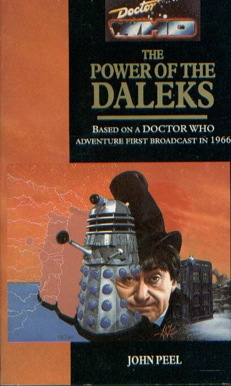
Cover: Alister Pearson’s cover art is working around a new template – the ‘Slatter-Anderson’ design similar to the one used on Virgin’s ‘Missing Adventures’ range. It’s a strange affair, a stunning portrait of the new Doctor in his Paris Beau hat (we all know it’s not a stovepipe now, don’t we?), which merges into a Dalek with two silhouettes echoing backwards, surrounded by electrical sparks. To the right lies the TARDIS, standing in a Vulcan swamp.

Final Analysis: At last! Thanks to his connections to Terry Nation and some frankly miraculous archiving on the part of David Whitaker’s widow, June Barry, John Peel gets to adapt the remaining Troughton Dalek stories. We’ve come a long, long way since the days of Whitaker’s own adaptations, written with a mass-market child audience in mind; these final entries were very much for the aging completist fans. 

Peel had already put some effort into ensuring his novels drew from wider references than just the individual scripts, creating a more cohesive universe where the Daleks view the Doctor as an ever-increasing threat and tararium is an essential mineral beyond The Daleks’ Master Plan. We’ll see more of this next time, but here the story is self-contained with few links to Dalek continuity. Instead, Peel looks to the end of The Tenth Planet, linking the events to UNIT, Counter Measures and Sarah Jane Smith. The references might feel gratuitous (the term ‘fanwank’ was growing in popularity around this time, personal tastes dictating whether it was meant to be abuse or celebration), but I’m not sure it is – certainly not as sure as I was when I first read the book in 1993.

Unlike David Whitaker – who was writing without any knowledge that the books or even the TV show that inspired them would have any kind of longevity – Peel has the benefit of hindsight; he knows these books are likely to be the closing chapters to the story, at least as far as Target’s readership is concerned. His references add to the wider universe (Benton lives!) while creating a really intelligent connection between two adjacent stories novelised decades apart. Just as we read An Unearthly Child knowing that Old Mother’s prophecy that ‘fire will kill us all’ would be echoed in the radioactive wastelands of Skaro, so the Earth’s ‘first contact’ with an alien invader leads to humanity’s expansion across the universe in colonies such as the one we encounter in Vulcan. Similarly, the discovery that the colony is run by IMC means nothing to Polly, but its connection to Colony in Space on TV (novelised as Doctor Who and the Doomsday Weapon) helps to explain why there’s a rebellion in the first place and add a greater level of jeopardy without spending pages detailing mining rights and the kind of ground already handled by Malcolm Hulke in his own novelisation, published 19 years earlier.

A couple of other items of note. The addition of Thane means that Janley isn’t the colony’s only prominent female (on TV she’s the Smurfette of Vulcan), but it also gives us a more balanced view of the rebellion. We know that the Governor is vain, lazy and self-serving, but on screen the rebels are fanatics, whereas here, they’re individuals motivated by wide-ranging concerns. They criticise the lack of support from IMC, the poor leadership from Governor Hensell and the stresses that come with a new colony on the frontier of known space; they also reveal more selfish desires – greed, lust, pride – which Bragen and Janley exploit to their cost.

Writing for a much older audience now, Peel is able to introduce a little violence, including one of the most graphic scenes to date, the death of Bragen: 

Bragen choked on his own blood and staggered forwards. Then his heart gave a final spasm. Valmar’s third bullet went through his brain, killing him instantly.

It’s not one of Ian Marter’s bubbling-pus corpses, but it comes suddenly and is so matter-of-fact that Peel doesn’t need to overdo it – it’s sufficiently shocking. Though the departure of the Doctor and his friends is just as abrupt as on TV, we’re given some reassurance as the new Doctor recalls that Vulcan eventually grows into something of a paradise:

The surface of Vulcan was unchanged. One day, the Doctor knew, the humans would remake the world. The bleakness would vanish under a canopy of green. The colony would become just the first of many cities. The humans would thrive. 

Chapter 133. Doctor Who – The Smugglers (1988)

Synopsis: It was just a police box, but Ben and Polly are amazed to discover the truth when the Doctor’s TARDIS takes them to 17th-century Cornwall. Soon they are drawn into the machinations of a ring of murderous smugglers and a very sinister squire…

Chapter Titles

  • 1. A Shock for Polly and Ben
  • 2. The Frightened Man
  • 3. Longfoot’s Friends
  • 4. Pike
  • 5. Pirate Treasure
  • 6. Kewper’s Trade
  • 7. Captured
  • 8. The Squire’s Plan
  • 9. Pike’s Revenge
  • 10. Treasure Hunt
  • 11. Cherub’s Move
  • 12. The Treasure

Background: Terrance Dicks adapts scripts by Brian Hayles for the 1966 story, 21 years and just over eight months earlier.

Notes: Terrance Dicks explains what a police box is (the target readership is now far too young to have any memory of them). The events of The War Machines are summarised and we’re told that it was Dodo’s decision to remain behind and leave the TARDIS. The Doctor, though old, is ‘still alert and vigorous and the eyes in the heavily lined face blazed with fierce intelligence’. Polly is wearing a ‘fashionable denim trouser suit [with] her long blonde hair tucked beneath a denim cap’ while Ben is in his uniform, ‘bellbottomed trousers, blue raincoat and jersey… and a sailor’s hat with HMS Teazer on the ribbon’. 

 ‘Cherub’ is a nickname bestowed upon him because of his bald head with a little tuft of hair behind the ear.  The sailor who tells Pike that Cherub is no longer aboard the ship is given the name ‘Crow’. The Doctor tells Ben that he feels he has a ‘moral obligation’ to fix the situation as he’s become ‘involved in the affairs of this village’ and fears that ‘my interference may even have brought about the threat of destruction’ (a slight clarification of the words said on screen). The final scene sees the TARDIS materialise in its next destination, but it’s not specified where.

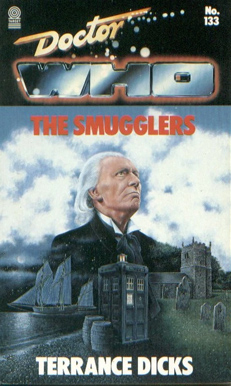
Cover: Beautiful – Alister Pearson paints the Doctor dwarfing two views of a Cornish village, the beach and a ship at night and the church, separated by the TARDIS.

Final Analysis: We’re nearing the end in more ways than one and Terrance Dicks manages to imbue the Doctor with much more vitality than William Hartnell was sadly able to in his final months on the show. We have a Doctor who is alert and analytical at all times, bad tempered with his new young friends but still with a sense of responsibility for their well-being (how far we’ve come since his first stories!). Dicks sticks to the story as usual, so there’s really not much more to report here, but we should still savour every word – there are only two more Dicks novelisations to come!

Chapter 129. Doctor Who – The Underwater Menace (1988)

Synopsis: In an undersea base live the last survivors of Atlantis. It’s also home to Zaroff, a scientist believed dead. His experiments on the locals have resulted in strange fish-like people inhabiting the nearby ocean, but that’s not where Zaroff’s ambitions lie. His latest scheme could literally tear the Earth apart.

Chapter Titles

  • Prologue
  • 1. Under the Volcano
  • 2. Sacrifices to Amdo
  • 3. Professor Zaroff
  • 4. Escapees
  • 5. An Audience With the King
  • 6. The Voice Of Amdo
  • 7. Kidnap
  • 8. ‘Nothing In The World Can Stop Me Now!’
  • 9. Desperate Remedies
  • 10. The Prudence of Zaroff
  • 11. The Hidden Assassin
  • Epilogue

Background: Nigel Robinson adapts scripts for a 1967 serial by Geoffrey Orme.

Notes: Jamie’s first sight of the inside of the TARDIS is told in the prologue; the ‘gleaming white walls’ are covered with ‘large circular indentations’ that emit an ‘eerie light, while the walls are lined with strange looking machines’. There’s also a large chest, a ‘splendid Louis XIV chair’, plus a mahogany hatstand upon which a ‘stove-pipe’ rests (though a popular description of the Doctor’s hat for many years, we now understand it to be a ‘Paris Beau’, unless the Target Doctor really does wear a top hat like Abraham Lincoln’s). The Doctor is ‘a little man dressed in baggy check trousers several sizes too big for him and a scruffy frock coat which had obviously seen better days’: he has ‘jade-green eyes’. Ben is, succinctly, a ‘wiry Cockney sailor’, while Polly is ‘a tall, long-legged blonde with long heavily-made-up eyelashes; her clothes – a ‘revealing multi-coloured mini-skirt and a white silk scarf’ – reveal that, like Ben, she comes from London, 1966 [once again contradicting Gerry Davis’s origins for them in the Target universe as shown in Doctor Who and the Cybermen]. The rather nice sequence from the telly episode of interior thoughts for the TARDIS team (‘Prehistoric monsters!’) is cut.

Professor Zaroff’s first name is ‘Hermann’. He disappeared 20 years ago and created the ‘Fish people’ by manipulating the genetic coding of the Atlaneans. His pet octopus is called Neptune. There is a Labour Controller who looks after the slaves (on TV, Damon fulfils this role too). Ara was the daughter of a councillor who spoke out against Zaroff and was killed. She keeps her former high status secret by hiding as a servant. Before he died, her father showed her the speaking grill behind Amdo’s statue. Zaroff and his high priest Lolem are left fighting to the death when they are caught in the flood and drown. The majority of the Atlanteans do survive the disaster (and possibly Zaroff’s pet octopus, Neptune, too). Unusually, the cliffhanger from TV of the TARDIS veering out of control is retained.

Cover: The Oliver Elmes logo is used here. The main artwork is a lovely evocative painting of the fish people, a great effort by artist Alister Pearson, making his debut here. 

Final Analysis: It’s a bit of a kindness on Nigel Robinson’s part that this unloved story gets such a decent treatment here. As the story was missing three of its four episodes at the time of writing, Robinson had to rely on the scripts, so some of the improvisations from the studio are missing; when episode two was discovered and screened at the BFI”s Missing Believed Wiped event, fans in the audience were charmed by such details as the Doctor knocking on his own head while discussing Zaroff’s madness, but that’s understandably absent from the book. What we do get is the now traditional tidying up of motivations and thought processes, such as the Doctor actively searching for Zaroff because he’s been told that he often strolls in the market (it’s much more coincidental on screen) or Zaroff failing to recognise Ben and Jamie because, when he first met them, his attentions were solely focused on the Doctor. The problems with the story are inherent in the original broadcast, but we get the sense that our heroes at least know how ridiculous it all is, which makes them just as determined to put a stop to the mad scientist. Extra points to Robinson for using the story’s most infamous line – ‘Nothing In The World Can Stop Me Now!’ as the title of Chapter 8, building up to it and giving it more context than we had when this was published.

Chapter 122. Doctor Who – The Macra Terror (1987)

Synopsis: When the Doctor and his three friends visit a colony on a distant world, they find a community of cheerful, contented people who are free to enjoy life. There are machines for pampering and relaxation and nobody is unhappy or scared. Especially Medok, who is ill and needs to be taken care of, because he is shouting nonsense and disturbing the peace. The Doctor and Polly aren’t convinced, but Ben and Jamie know the truth – there is no such thing as Macra men! No such thing as Macra men!

Chapter Titles

  • 1. Interference on the Scanner
  • 2. A Wash and Brush-up
  • 3. The Man Who Suffered from Delusions
  • 4. There’s Really Nothing There
  • 5. A Voice in the Night
  • 6. The Colony by Night
  • 7. Down the Pit
  • 8. Escape
  • 9. A Breath of Fresh Air
  • 10. One of the Dancers
  • 11. Forbidden Territory
  • 12. Four Minutes to Countdown

Background: Ian Stuart Black adapts his own scripts for the 1967 story.

Notes: The time travellers have seen something on the TARDIS scanner. The Doctor tries to pass it off as mere ‘atmospherics’:

‘Atmospherics cause interference. A build-up of forces. Electrical discharges. A thunderstorm. A number of things can cause the normal pattern to be broken, and then a radio signal or a television picture suddenly is broken into, and you get an alien signal. We have checks and balances on board the TARDIS to counteract such interference, but every now and again a message or picture breaks through from another point in space and we pick it up.’

He fails to convince his young friends and while Polly refuses to discuss it any further, Jamie makes sure to grab a big branch as he leaves the TARDIS (as he did on TV). The TARDIS scanner has ‘vision control’, an automatic program that scans for items of importance and allows the travellers to see into the colony before they arrive. The Controller initially orders that ‘There is no such thing as Macra men’, though Medok hears ‘There is no such thing as Macra’ during his later programming and Ben chants ‘There is no such thing as the Macra’.

Medok says the Macra are ‘horrible to look at… like insects…. like huge crabs’, while Jamie notes its ‘scaly flanks’, ‘long feelers’ and a ‘rope-like tentacle’. The creature has heavy eyelids (so not like an insect) and it moves at ‘the speed of a tortoise’. The Doctor gives a multi-sensory observation:

It was more horrible than he had visualised, more nauseating – giving off a suffocating odour – a very alien creature; moonlight glinting on its hard shell, a skin that glistened, prehistoric, giving the Doctor a feeling it was already dead… Yet moving slowly, with the speed of a gigantic slug, towards them.

He speculates to Polly that the Macra lived on the unnamed planet for millions of years, but that maybe the atmosphere changed, the natural gases that the creatures thrive on dried up, or ‘some other factor altered’, so they had to bury underground where the gases were available. There’s no direct correlation between the changing atmosphere and the arrival of the colonists, which is something we’d instantly assume nowadays [and see Gridlock for how that played out].

Medok survives his encounter with the Macra and is present to witness the departure of the four strangers in the TARDIS but decides on not ‘pushing his luck’ by telling anyone about it. Strangely, Medok doesn’t recall ever seeing the TARDIS before, even though he ran past it at the start of the book (presumably he was too distracted or distressed to remember it).

Cover: Tony Masero takes great artistic license in creating a slavering, oozing Macra that still bears a strong resemblance to what was seen on screen. 

Final Analysis: Another solid novelisation from Ian Stuart Black with very little changed from what we can gather from the surviving footage and audio tracks (although apparently the author worked solely from the scripts, so any changes made by the actors and director during rehearsals would have been absent anyway). The nature of the Macra remains non-specific – even the Doctor can’t be drawn as to whether they’re crabs, insects or overgrown bacteria – and they’re often described as being ‘alien’ despite the likelihood that they’re an indigenous lifeform. In 2021, we’re a little more sensitive to post-colonial views and this does stand out as an unresolved gap in the text, from a time when monsters were fought and destroyed, rather than understood and accommodated – and perhaps not even thought of as ‘monsters’.

Chapter 115. Doctor Who – The Faceless Ones (1987)

Synopsis: The TARDIS lands at London Airport and when a startled Jamie flees from his first sighting of an aeroplane, his friends are soon separated. Polly hides from the airport police in a nearby hanger, where she witnesses a murder. Jamie befriends a young woman in search of her missing brother as the Doctor tries to explain his presence to the authorities. Somewhere in the airport, a very quiet invasion is taking place, organised through the travel agency Chameleon Tours…

Chapter Titles

  • 1. Obstruction On Runway Five
  • 2. The Suspects
  • 3. Man Without A Face
  • 4. The Transfer
  • 5. The Missing
  • 6. The Trap
  • 7. The Abductors
  • 8. The Secret Of The Chameleons
  • 9. Death Ray
  • 10. Captured
  • 11. Spaceship
  • 12. The Traitor
  • 13. Flight Into Peril
  • 14. The Bluff
  • 15. The Deal

Background: Terrance Dicks adapts scripts from a 1967 story by David Ellis and Malcolm Hulke.

Notes: We’re reminded of the origins of the three companions, beginning with ‘that terrifying business of the War Machines,’ including the one where Ben and Polly met Jamie, and we’re informed that Ben and Polly have asked the Doctor to bring them back home. 

The manager of the airport is called Charles Gordon: his title ‘Commandant’ is an unflattering ‘Gestapo’-inspired nickname given to him by his staff, not his actual rank. The first Chameleon is a little less gory than it appeared on TV:

There were no features, and except for the eyes nothing you could call a face. Nothing but a completely blank sphere, across which ran pulsating veins…

Samantha Briggs is introduced as ‘a round-faced, dark-haired girl who looked as if she might normally be a rather jolly, cheeky type’ and she has ‘a faint nasal twang to her voice’ that’s evidence of a Liverpool accent. The Doctor uses his sonic screwdriver in a couple of scenes [a device not introduced on screen until Fury from the Deep]. There’s a tiny additional scene after everything’s been resolved [see Final Analysis below] and Dicks corrects the date that Jamie longs for (he’s three years off his original time on TV).

Unusually, the story retains the cliffhanger from the original transmission, even though it’ll be a while before it’s resolved in print. Oh and chapter 13’s ‘Flight Into Peril’ is a neat reworking of the ‘Escape to Danger’ trope.

Cover: As an aeroplane takes off, the TARDIS materialises on the runway, painted by Tony Masero.

Final Analysis: I’m going to get misty-eyed every time we get to a Terrance Dicks story from now on, I suspect, even if it’s another fairly solid transcription of what happened in the original scripts. As on TV, Samantha is invested with so much personality that it’s still a shock when she doesn’t join the Doctor and Jamie on their adventures – just as it’s still a shock when Ben and Polly decide to stay on Earth. Dicks does make a few small changes, such as the addition of the sonic screwdriver, which just help to move things along, and then there’s the conclusion, where Jamie is less than satisfied, and Dicks perhaps suspects that the reader might be too:

‘You mean they’re just going to get away with it, Doctor?’ muttered Jamie. ‘Och, it doesna seem fair!’

‘It isn’t, Jamie. But we can’t undo the wrong they’ve done without their help.’ The Doctor smiled wearily. ‘You don’t always achieve perfect justice, you know. Sometimes you just have to do the best deal you can!’

Chapter 90. Doctor Who – The Highlanders (1984)

Synopsis: In the aftermath of the battle of Culloden in 1745, a group of Jacobite rebels try to evade capture by the English army. The Doctor, Ben and Polly help a wounded laird but are then captured by an incompetent English officer. The Doctor adopts a fun disguise as Polly uses guile to free her new friends and escape. One young Scot in particular impresses the time-travelling trio – a piper by the name of Jamie McCrimmon.

Chapter Titles

  • 1. Where are We?
  • 2. The Cottage
  • 3. The Captives
  • 4. The Handsome Lieutenant
  • 5. Polly and Kirsty
  • 6. Polly’s Prisoner
  • 7. The Water Dungeon
  • 8. Blackmail!
  • 9. The Doctor’s New Clothes
  • 10. Aboard the Annabelle
  • 11. At the Sea Eagle
  • 12. The Little Auld Lady
  • 13. A Ducking for Ben
  • 14. Where is the Prince?
  • 15. The Fight for the Brig
  • 16. Algernon Again
  • 17. A Return to the Cottage

Background: Gerry Davis adapts the scripts he co-wrote with Elwyn Jones for the 1967 serial.

Notes: The bonhomie of TV’s Ben and Polly is replaced by something closer to the bickering of 1980s companions; Ben insists on calling Polly ‘Princess’ (not ‘Duchess’) and thinks she is ‘uppity and toffee-nosed’. He also thinks the sounds of battle drifting over the moor are just celebrations from ‘the Spurs Supporters Club’ (ahem, a reference to the er, London-based football team Tottenham Hotspurs) or a historical society. Polly resents Ben’s ‘big brother’ protectiveness, especially as she is ‘about a head taller than he was’; later, it’s confirmed she’s an ‘independent girl from the sixties’ – so her ‘seventies’ origins have been properly reset from previous Gerry Davis novels. The Doctor admits to Polly that the discovery of a cannon ball makes him afraid. There’s a dump of history at the start too, as we’re told of the battle for the British monarchy between the Scottish Stuarts and the ‘Hanoverian German Georges’. The Scots had been booted out 40 years ago and we join the story in the aftermath of the battle of Culloden Moor. As this wasn’t taught in English schools in my day, this is especially welcome and helpful.

As the Doctor inspects a tam-o’-shanter, we’re told it’s a ‘standing joke in the TARDIS that he could never resist trying on any new hat he came across’; as this is the first TV story where his hat fetish became a regular thing, this suggests the trio have had a fair few offscreen adventures since the Doctor’s regeneration. He adopts the pseudonym ‘Doctor von Verner’ (not the more obvious meta-joke ‘von Wer’ on telly). Algernon Ffinch stammers ‘in a way approved by the London dandies of the time’, which could mean it’s an affectation for fashionable purposes. The Sergeant’s name is spelled ‘Klegg’, not ‘Clegg’. While in the prison, Jamie plays a mournful tune on his bagpipes before the Doctor creates a disruption in the gaol by playing the Jacobite ‘Lillibulero’ on his recorder. The name of the pub where Solicitor Grey has installed himself is called the Sea Eagle Inn. As Jamie boots Trask overboard during the final battle, Ben tries to regain some composure as he claims he was about to use karate to save himself. There’s a more pressing reason for Jamie to join the travellers; having escorted them to the TARDIS, Jamie boasts that he’ll be fine on his own as they hear the sound of muskets being fired nearby. We then join Jamie as he sees the inside of the TARDIS for the first time (see below).

Cover: A smashing portrait by Nick Spender of Jamie, accompanied by Alexander, a Saltire flag and the TARDIS. Unusually for this period, there are likenesses of recognisable actors here!

Final Analysis: Gerry Davis returns to adapt a script that he originally oversaw to production. It was the last of the pure historicals on TV, yet it’s the second one we’ve had in novel form in the space of a year. The Highlanders is often overlooked in favour of the more monster-focused stories of the era and, perhaps it won’t come as a surprise to learn that this is the first time I’ve read this particular book. Davis keeps things light, even with the threat of violence and a very sudden and shocking death early on. The stakes are high, but so’s the sense of adventure and Polly in particular has a rare old time running rings around every man she encounters. Effectively, she gets her own companion in the form of Kirsty and it’s easy to forget that this is the debut of Jamie, even though his future role as a companion isn’t foreshadowed at all, he’s just one of a number of likeable characters that we meet. Poor Ben’s experience in Scotland isn’t quite so jolly. Despite having spent very little time with Jamie, Polly takes an immediate shine to him and the final scene sees him adopted as a fully-fledged TARDIS member at last:

As he hesitated, Polly turned back and grasped his hand. ‘Don’t be afraid,’ she said, ‘it’s much nicer inside than it is out. There’s so many wonderful surprises waiting for you, you’ll see.’

Jamie allowed himself to be drawn through into the small police box. The door closed behind him and he saw to his astonishment the large, hexagonal, brightly-lighted interior of the time-machine.

Chapter 20. Doctor Who and the Tenth Planet (1976)

Synopsis: A new planet appears in Earth’s solar system. The Doctor seems to know what it is and what will happen next. The planet, which bears a striking similarity to Earth, is home to a race of plastic and metal beings called ‘Cybermen’. As Ben and Polly help the staff of an Antarctic tracking station to fight off the invaders, the Doctor prepares for his final adventure. 

Chapter Titles

  • The Creation of the Cybermen
  • 1 The Space Tracking Station
  • 2 Disaster in Space
  • 3 The New Planet
  • 4 Mondas!
  • 5 The Cyberman Invasion
  • 6 Ben into Action
  • 7 Battle in the Projection Room
  • 8 Two Hundred and Fifty Spaceships
  • 9 Z-Bomb Alert!
  • 10 Prepare to Blast Off
  • 11 Cybermen in Control
  • 12 Resistance in the Radiation Room
  • 13 The Destruction of Mondas!

Background: Gerry Davis adapts the 1966 scripts he co-wrote with Kit Pedler.

Notes: The book begins with a summary of the creation of the Cybermen, claiming they originated on the planet Telos before taking refuge on the ‘lost sister planet of Earth – Mondas’. An American called Tito is reading a Captain Marvel comic (presumably a vintage edition as the character didn’t have a comic of his / her own in either 1986 or 2000). Although this is only the third TV adventure for Ben and Polly, it’s suggested that they’ve been on many uneventful journeys since they joined the Doctor. Continuity from Davis’s Doctor Who and the Cybermen is preserved, as Ben and Polly are from the early 1970s, not the mid-60s, so Ben can recognise a Roger Moore Bond film that he saw for the first time a few weeks before he joined the Doctor’s travels (very possibly The Man with the Golden Gun, which would mean the Doctor’s young friends are from 1974). And yes, Polly discovers they’re in the more futuristic year 2000 (not 1986 as in the original. At the time of writing, the year 2000 is over 20 years in my past!). The Cybermen use a ‘short silver baton-like object’ for a weapon, rather than the cumbersome lamps hooked onto their chest units as on screen. The Cyberleader from the second wave has a ‘black impassive mask’ (similar to Revenge of the Cybermen and Doctor Who and the Cybermen), The regeneration scene is so different that it upset some fan reviewers at the time.

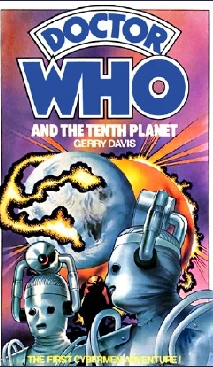
Cover: Chris Achilleos makes up for the monochrome Cybermen and snowy setting by placing them in front of a vivid aurora background that’s really thrilling. There’s also an illustration on the rear cover of a Cyberman firing a blast from its headlamp (something that doesn’t actually happen in the TV series for 51 years) and a defiant first Doctor inset. The 1993 reprint cover by Alister Pearson is almost symmetrical, with a saggy-looking Cyberman on each side, the first full-face shot of a Cyberman from the cliffhanger of episode 1 and a mid-length portrait of Hartnell from The Celestial Toymaker. It’s very tidy but not that dramatic, sadly.

Final Analysis: Davis handles the Doctor’s departure much better than circumstances allowed in the TV production (where Hartnell’s illness led to him missing episode 3 with just a few days’ notice). He seeds the Doctor’s illness and frailty beautifully. 

Was it Ben’s imagination, or had the Doctor’s hair gone a shade whiter and finer during the last few hours? His skin, which looked as transparent as old parchment, was stretched tightly over his prominent cheek bones.

I have to note the use of outdated terms to describe a couple of black characters (Williams is described as ‘a tall, handsome American negro of about thirty’), while also commending that the characters were there in the first place at a time where multicultural casting was still rare. Whether this was originally scripted or down to the casting by director Derek Martinus is another matter.

The slow, steady breakdown of Cutler as he struggles with the pressure of his son’s peril helps to elevate the later chapters from the absence of the Cybermen. But having built up the Doctor’s demise so subtly throughout the book, it’s surprising that the actual change happens out of sight of Ben and Polly. Emerging from a sarcophagus in the control room, the old Doctor has disappeared and in his place is a much younger man:

The stranger looked at him in slight surprise. ‘You ask me that, Ben? Don’t you recognise me?’
The Doctor’s two companions shook their heads.
‘I thought it was quite obvious,’ Again, he smiled his gently mocking smile and winked at them with his bluegreen eyes. ‘Allow me to introduce myself then. I am the new Doctor!’

Chapter 12. Doctor Who and the Cybermen (1975)

Synopsis: The Cybermen tried to invade the Earth once but were ‘humiliatingly defeated’. Their second attempt comes via the Moon, where they are already lying in wait for the perfect moment to attack. As the personnel of the Moonbase fall ill one by one, the Doctor and his friends scramble to find the cause.

Chapter Titles

  • 1. Prologue: The Creation of the Cybermen
  • 2. The Landing on the Moon
  • 3. The Moon Base
  • 4. Attack in the Medical Unit
  • 5. The Space-plague
  • 6. The Doctor Investigates
  • 7. The Cybermen’s Plot
  • 8. The Battle with the Cybermen
  • 9. Victory, perhaps…
  • 10. The March of the Cybermen
  • 11. Into Battle with the Gravitron!

Background: Gerry Davis adapts the scripts he co-wrote with Kit Pedlar for the 1967 serial The Moonbase.

Notes: We begin with a prologue that’s a potted history of the Cybermen that (in line with later stories but contradicting The Tenth Planet) states that the Cybermen come from Telos. Later on, when discussing Mondas, the Cybermen say they come from ‘the other Cyberman planet, TELOS’. Ben and Polly are from the 1970s now, so they’re familiar with the Apollo Moon landings, although Davis seems to think Ben is still wearing his sailor’s uniform and Polly is in a mini-skirt and tee-shirt. Oh and Jamie is tagged as ‘a little thick, even by 1745 standards’, which seems hugely unfair. There’s a Cyberman with a red line down the front of his chest unit, which Davis draws attention to but doesn’t elaborate on, and a couple of others with black helmets similar to those seen in Revenge of the Cybermen, who have names (as in The Tenth Planet).

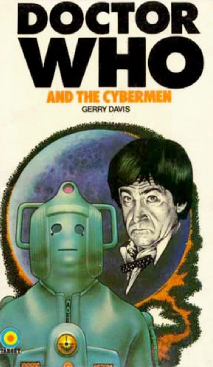
Cover & Illustrations: Chris Achilleos painted the original cover using a Troughton pic from The Three Doctors and a Cybermen from The Invasion. I had the 1981 reprint with the cover by Bill Donohoe that appears to depict the Cyber-space walk from the end of The Wheel in Space. Illustrations by Alan Willow show the correct Moonbase Cybermen, and the best pic is of Ralph, the Moonbase crewman, staring in horror as (the caption explains) ‘the shadow of a large figure’ looms over him.

Final Analysis: It’s nice when the originators of a story get to give us their version. Davis largely sticks to the story as televised, but he really goes to town with a nautical theme with chapter two’s description of the TARDIS’s dramatic journey to the Moon (‘Like a ship in a heavy sea,’)  including a reference to the TARDIS ‘cabin’, ‘bulkheads’ and ‘deck’. In the prologue there’s a line that ‘although revenge was not a part of their mental makeup any more than the other emotions,’ which I suspect was pushing against Davis’s recent experience with Robert Holmes changing his title (and most of the script) for Tom Baker’s Cyberman adventure.