Chapter 53. Doctor Who and the Underworld (1980)

Synopsis: A group of space travellers seek the lost gene banks of the Minyans, a race of beings with tragic connections to the Time Lords. When their space craft becomes surrounded by a planet, the Minyan travellers discover a subjugated race – the Trogs – who live in underground tunnels as the slaves of the Seers and the god-like Oracle. Could these slaves be the descendants of the lost Minyans? The answers rest with the Oracle – and the quest is the quest…

Chapter Titles

  • Prologue
  • 1. The Nebula
  • 2. The Minyans
  • 3. The Intruders
  • 4. The Quest
  • 5. Buried Alive
  • 6. The Trogs
  • 7. Skyfall on Nine
  • 8. The Smoke
  • 9. The Mouth of the Dragon
  • 10. The Sword of Sacrifice
  • 11. The Crusher
  • 12. The Battle
  • 13. Doomsday
  • 14. The Legend

Background: Terrance Dicks adapts the 1978 scripts by by Bob Baker and Dave Martin.

Notes:  We begin with a prologue (how I love a prologue!) that details the events that led to the loss of Minyos and the isolation policy of the Time Lords. Back in The Invisible Enemy, the Doctor complained that the TARDIS control room is such a boring colour – ‘No aquamarines, no blues. No imagination!’ – and here, he’s trying to paint the control room aquamarine and getting paint everywhere (but in the final scene, he’s painting it white again). On learning of the sword ritual, the Doctor reminds Leela that her own tribe had a similar trial by ordeal. Leela suggests that they return to the TARDIS and leave the Minyans to their fate but the Doctor wants to solve the mystery of the P7E.

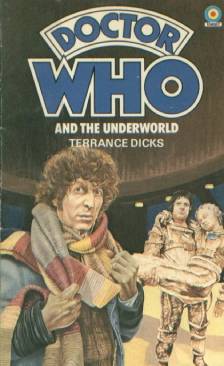
Cover: Bill Donohoe combines two photo reference from this story to create something rather like a pulp sex book you’d find in the saucy rack in a 1970s newsagent – the Doctor looks pensive  while Herrick carries a near-death Tala – as if we’ve just walked in on a scene we don’t really want to be a part of.

Final Analysis: This would always be a tricky one, a real clunker from Bob Baker and Dave Martin (the kings of overambition) and it’s one that’s always been unpopular for good reason. Devoid of the visibly low budget of the TV version, we’re left with a story with no recognisable human interaction, just mythology that gets a bit repetitive. It’s a relief that Terrance Dicks finds a way to highlight that humanity: The father who grieves for his lost wife and daughter after they’re killed in a landfall is a rare highlight. Something I’ve noticed though is that the Fourth Doctor in this period is brash and often his overconfidence borders on bullying, which makes him hard to like. The real highlight is that Dicks makes great use of K9 for his comedy potential, the wilfully over-literal explanations are hilarious.

Chapter 52. Doctor Who and the Ribos Operation (1979)

Synopsis: The White Guardian compels the Doctor (on pain of nothing… ever) to undertake a mission to find the six segments of the Key to Time. As part of the mission, the Doctor is given a new companion in the form of Romana. On the planet Ribos, a pair of grifters called Garron and Unstoffe are setting up an elaborate con, assuming the locals are too primitive to see through their scheme. Unfortunately, they have underestimated a visiting despot by the name of the Graff Vynda Ka .

Chapter Titles

  • 1. Unwelcome Strangers
  • 2. The Beast in the Citadel
  • 3. A Shaky Start
  • 4. Double Dealings
  • 5. Arrest and Capture
  • 6. Unlikely Allies
  • 7. Escape Into the Unknown
  • 8. The Doctor Changes Sides
  • 9 .Lost and Found
  • 10. Conjuring Tricks

Background: Ian Marter adapts the 1978 scripts by Robert Holmes.

Notes: The opening scene has the Doctor and K9 being rather snarky with each other. The Doctor suggests ‘Occhinos’ as a holiday destination.The TARDIS doors are opened from the inside by a brass handle. The Guardian sits within an exotic garden that features huge orchids and fountains. The garden disappears along with the Guardian, leaving the Doctor teetering on the edge of space and he has to propel himself backwards into the TARDIS. The Guardian makes no mention of a new companion for the Doctor; it’s left to Romana to introduce herself. Her tracer device is presented as the ‘Locatormutor Core’ and she knows of the existence of the Guardian (on TV, she’s left under the belief that she was selected for the mission by the President of the Time Lords). She graduated from the Academy with a ‘Triple Alpha’ and claims the Doctor achieved a ‘Double Gamma… on [his] third attempt’. The initial destination is Cyrrhenis Minimis (not ‘Minima’). 

We learn that, while he was away fighting campaigns alongside his Cyrrhenic allies, the Graff Vynda Ka (‘not ‘K’) was deposed by his half-brother on the Levithian throne; his alliance forgotten, he received no help from his former allies and he now lives in exile (we lose the rest of his back story from the TV episodes). Thanks to its elliptical orbit, Ribos’s summer (the ‘Sun Time’) lasts 11 years. The Doctor refers to Garron and Unstoffe as ‘Laurel and Hardy’ before apologising to Romana for the reference. When the Doctor is searched, Sholakh finds ‘an ear trumpet. a corkscrew, string, marbles, a magnifying glass, a paper bag with a few jelly babies melted into a lump…’ – some of which have been referenced by Marter in his previous books. There are many Shrivenzales living in the catacombs under the city. The Seeker is…:

… a scrawny hag dressed in long strips of crudely dyed remnants. Her frizzled grey hair was parted on the crown of her domed head, and it reached almost to her feet in a thickly tangled cascade.

She survives the knives of the Graff Vynda Ka and crawls off towards the Hall of the Dead, only to be caught in the blast of the Shrieve’s cannon. Despondent after the cave-in, Garron wonders if it would be possible to commit suicide with the Locatormutor Core. 

Chapter 7 brings Ian Marter’s take on a popular title, ‘Escape into the Unknown’, almost the same one Terrance Dicks used in Death to the Daleks. 

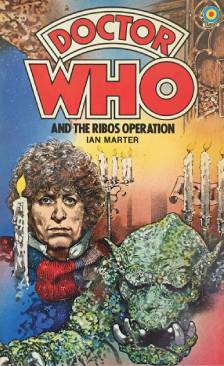
Cover: John Geary created an atmospheric shot of the Doctor, a shrivensale and some moody candles.

Final Analysis: It wasn’t one of Robert Holmes’ greatest scripts and sadly it’s not one of Ian Marter’s best books either. There’s little room for Marter’s violent imagery here and it’s all a bit flat. Without the performances to help sell the characters, Garron and Unstoffe lack any depth beyond their grift, while the Doctor is a horrific bully to Romana (something that was thankfully phased out on screen within a couple of stories, but which comes across as much more savage here). Marter is able to make the lumbering TV shrivenzale into a fearsome beast with claws that make sparks against the catacomb walls and he takes on the death of Sholakh and makes it a little bloodier, but… no, this is largely as dull as I’d expected.

I’ve got to be honest, this is the beginning of a run of books I’ve been dreading.

Chapter 51. Doctor Who and the Destiny of the Daleks (1979)

Synopsis: The Doctor and Romana explore a dead world, unaware that one of them has been there before. A spaceship arrives containing the beautiful Movellans who inform the Doctor that the planet is Skaro – home of the Daleks – and their mission is to find the Dalek creator, Davros. But Davros is dead… and coincidentally, so is Romana!

Chapter Titles

  • 1. The Dead City
  • 2. Underground Evil
  • 3. The Daleks
  • 4. The Movellans
  • 5. Slaves of the Daleks
  • 6. Escape
  • 7. The Secret of the Daleks
  • 8. The Prisoner
  • 9. The Hostages
  • 10. The Bait
  • 11. Stalemate
  • 12. Suicide Squad
  • 13. Blow-up
  • 14. Departure

Background: Terrance Dicks adapts Terry Nation’s scripts for a story that aired just two months earlier.

Notes: Dicks calls Romana a ‘Time Lady’ and summarises the events from the climax of The Armageddon Factor, which hasn’t been novelised yet. The Doctor surmises that Romana’s higher score at the academy accounts for her greater control over how she regenerates, unlike his own traumatic experiences. They arrive on the strange dead world at night during a storm (it’s a bright, sunny day on TV). The slaves bury their dead under rocks because the foundations of the city ruins are too thick to dig up. The dead body that the Doctor investigates was a ‘Space Major Dal Garrant’ (so close to that familiar ‘Tarrant’ that Nation often used). While pinned under the fallen masonry, the Doctor reads ‘The Origins of the Tenth Galaxy’,  written by a ‘particularly pompous Time Lord historian’ who he has never liked. He’s interrupted by the arrival of just two Movellans (Lan and Agella) and they’re wearing ‘simple, military-type space coveralls’, rather than the beautifully distinctive space-dreadlocks and Top of the Pops dance-troop suits. On the Movellan spaceship, Commander Sharrell’s rank is denoted by an insignia on his uniform. 

Sharrel does not identify the planet they’re on beyond the serial number. Only later does the Doctor discover that it’s Skaro, when Tyssan tells him. As Davros revives, his eyes open [see The Witch’s Familiar in 2015]. The journey to the surface with Davros involves a long, steep, spiralling ramp. The Daleks cheat and make their way to Davros’s level using ‘eerily silent anti-grav discs’ as seen in Planet of the Daleks. Disappointingly, the Doctor doesn’t tell the Daleks to ‘spack off’. The Dalek mutant that he encounters in the sand dunes is more active than the blob of Slime-with-Worms from TV. It’s a ‘pulsating green blob, a kind of land-jellyfish’ that crawls up his arm. There’s a fair bit of gender-swapping here: Veldan and Jall’s genders are reversed, the Daleks’ sacrificial victims are both male and the Movellan that captures the Doctor and Tyssan is also male. Romana doesn’t dismember Sharrel during their fight, she merely kicks away his power tube.

Cover: Welcome Andrew Skilleter, who surrounds an image of the Doctor (based on a pic from The Pirate Planet) with very TV Century 21-style Daleks moving around in fog, as if at a disco. Alister Pearson’s 1990 reprint cover puts the Doctor and Romana alongside a moody Davros in profile, a Dalek and Agella against a salmon background.

Final Analysis: Destiny of the Daleks seems to polarise opinion, but as it was the first Dalek story where I was old enough to follow the plot in full, I didn’t care about how tatty the props looked or that the central point about a robotic impasse shouldn’t have worked because Daleks aren’t robots. I just enjoyed it for being Daleks on my telly. This novelisation is, for me, the first point in this project where Terrance Dicks’ straightforward script-to-page approach feels a little lacking. Racing to get this story novelised meant that Romana v2 is introduced before V1 – we’ve leapt past a season and a half of stories, which is quite confusing – but there’s no real explanation as to who Romana is, only that she’s changed and she’s from Gallifrey. The Movellan costumes are described in such generic terms that they lose some of their onscreen glamour, and it’s all a little… thin. However, there is this lovely harkback to Genesis of the Daleks, which highlights a decision the Doctor has returned to time and time again:

The Doctor sighed. He had hesitated once before, at a time when he could have destroyed the Daleks before their creation, simply by touching the two wires that would complete an explosive circuit. Who knows what horrors he had unleashed upon the Universe? The Daleks were stronger now and more numerous, and with Davros to help them… He must not hesitate again. The Doctor pressed the switch. 

Chapter 47. Doctor Who and the Invisible Enemy (1979)

Synopsis: The Doctor is unwell, fighting off an alien virus that is trying to possess him. Heading to a hospital in deep space, the Doctor meets Professor Marius and his robot dog K9, who eagerly assists Leela in fighting off an army of infected people. Realising they need to take the fight to the cause of the infection, the Doctor and Leela are cloned, miniaturized and injected inside the Doctor’s brain to find the nucleus of the virus before it can take hold permanently and use the Doctor to spread its swarm throughout the galaxy.

Chapter Titles

  • 1. Contact
  • 2. The Host
  • 3. Death Sentence
  • 4. Foundation
  • 5. Counter-Attack
  • 6. The Clones
  • 7. Mind Hunt
  • 8. Interface
  • 9. Nucleus
  • 10. The Antidote
  • 11. The Hive
  • 12. Inferno

Background: Terrance Dicks adapts the scripts for a 1977 story by Bob Baker and Dave Martin; that’s three consecutive books to be based on their scripts.

Notes: Terrance Dicks was using the very latest information available, so the reference to Saturn having ten moons is based on the discovery of Janus in 1966. In 1978, it was suspected that Janus shared its orbit with another moon – named Epimetheus – a theory confirmed two years later by the Voyager probe, which also revealed three more moons. It’s now believed that Saturn has over 80 satellites, plus many others embedded within its rings. Considering the definitions of ‘Moon’ and ‘Planet’ have shifted repeatedly in the last 40 years, we can therefore accept that the narrator of this book is using a classification of a significant size of satellite that was common in the year 5000. Or that something terrible happened to Epimetheus or Janus. So there.

The Doctor has high regard for Leela, despite his teasing of her as a savage, and has apparently shown her the basics of TARDIS piloting – and she’s retained the training enough to input coordinates, despite otherwise struggling with general levels of technology. Professor Marius came to the BI-AL foundation from the New Heidelberg University. Growing bored waiting for news of the Doctor, Leela explores the station, bypassing the lifts because she doesn’t trust them and scaling numerous flights of stairs before she finds the Doctor’s ward.

We’re introduced to the legendary K-9, who is a ‘squat metallic creature’ that looks like ‘a kind of squared-off metal dog’, with a ‘computer display screen for eyes, and antennae for ears and tail’.

Dicks manages to work around the visuals of the nucleus of the swarm, which, at micro-scale has ‘waving antennae, glistening wet red flesh, and a bulbous black eye that seemed to swivel to and fro’, while the version in the macro-world is rather unpleasant:

A horrible, incredible shape [which] was filling the booth. It was blood-red in colour and was as big as a man with a bony glistening body and lashing tentacles. The huge black bulbous eyes swivelled malevolently around the ward.

… and definitely not a giant prawn.

The virus tries to reinfect the Doctor through Marius and when it fails, the Doctor is full of glee. Marius gains help from the entire surviving staff at the Foundation in preparing the antidote samples. Back on Titan, the nucleus swells to an enormous size while its hatching brood look like ‘huge, malevolent dragonflies’.

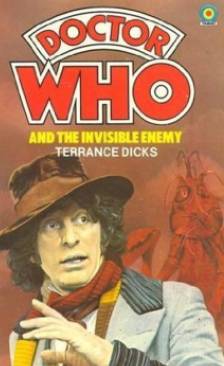
Cover: A rather lovely portrait of the Doctor with the nucleus of the swarm in the background, courtesy of Roy Knipe.

Final Analysis: The opening scene adds a very subtle message that the people of the future are trained for their jobs, but then their environments are controlled so extensively by technology that they’re never required to put any of that training into practice. We also get a decent paragraph that explains the back-history behind Marius’s casual use of the term ‘spaceniks’. Once again though, it’s the little details added to give the monster of the week a greater sense of scale and menace than they could have achieved onscreen.