Chapter 155. Doctor Who – The Evil of the Daleks (1993)

Synopsis: The TARDIS has been stolen and the Doctor and Jamie follow clues to an antiques shop where the items for sale appear to be both genuine yet brand new. Suddenly, the two men are gassed into unconsciousness and when they awake they find themselves a hundred years in the past. Two inventors, Theodore Maxtible and Edward Waterfield, ask the Doctor for help with their experiments, before revealing that they are prisoners of the Daleks. As Jamie tries to rescue Waterfield’s daughter, Victoria, the Doctor is forced to help his enemies in a project that will lead him back to the Daleks’ home planet, Skaro, where he will meet the Dalek Emperor at last.

Chapter Titles

  • Prologue
  • 1. To Set A Trap
  • 2. The Old Curiosity Shop
  • 3. The Net Tightens
  • 4. Further Curiosities
  • 5. Curioser and Curioser
  • 6. Kennedy’s Assassination
  • 7. The Net Tightens
  • 8. The Better Mousetrap
  • 9 Portrait Of Innocence
  • 10. The True Enemy
  • 11. The Kidnapping
  • 12. Recovery
  • 13. A Trial Of Strength
  • 14. Friction
  • 15. Double Dealing
  • 16. The Test Begins
  • 17. A Test Of Skills
  • 18. Friend And Foe
  • 19. Terall’s Agony
  • 20. The Traitor
  • 21. Fencing
  • 22. Pawn Of The Daleks
  • 23. The Human Factor
  • 24. Awakening
  • 25. Dalek Superior
  • 26. Time Bomb
  • 27. Skaro
  • 28. Emergency!
  • 29. At Last!
  • 30. Waiting
  • 31. Transmutation
  • 32. The Dalek Doctor
  • 33. The End Of The Daleks?
  • Epilogue

With 33 chapters, a prologue and an epilogue, The Evil of the Daleks steals the crown for most number of chapters from Delta and the Bannermen. Even though two of the chapters have the same title!

Background: John Peel adapts the scripts from David Whitaker’s 1967 story, published by Virgin as a continuation of the Doctor Who novels range. It’s the longest novelisation so far, with 288 pages. At 26 years and a month, it doesn’t quite beat its immediate predecessor for the record of the gap between broadcast and novelisation, but it does complete the run of stories from Season 4, the Second Doctor’s era and the 1960s as a whole. The book also means that at this point, there’s a complete run of adaptations right up to The Ribos Operation

Notes: A prologue, set 1,000 years after the events of The Daleks’ Master Plan, sees the Dalek Emperor on the verge of defeat on all sides, as separate wars with the Earth Empire, Draconia and the Thals. The Emperor had been the very first of Davros’s creations – and the one that exterminated him. This Dalek became the Dalek Prime and conducted experiments on other lifeforms before releasing the resulting mutants into the petrified forest or the lake of mutations at the foot of the Drammankin Mountains [see Doctor Who and the Daleks]. Eventually the Prime began to experiment on itself to become ‘a hundred times greater than any other member of the race’ and inhabiting a new casing for its enlarged body.

The Doctor realises that at the very moment that Ben and Polly are returning to their old lives, across London they’re just about to disembark in the TARDIS with his previous self [see The Faceless Ones and The War Machines]. The Tricolour coffee bar plays French music like Edith Piaf and Maurice Chevalier (on telly, they play ‘Nobody Knows the Trouble I’ve Seen’ by the Seekers and ‘Paperback Writer’ by the Beatles). The Doctor checks a selection of daily newspapers available in the Tricolour, which are filled with reports of the War Machines incident and the problems at Gatwick Airport (he’s relieved that his own involvement in both instances have been omitted). 

The Daleks permit Victoria to write letters to her father. Victoria’s captivity is introduced much earlier than on TV, explaining Waterfield’s prime motivation and making him a much more sympathetic character. Waterfield has agents who took the photos of the Doctor and Jamie; they also took pictures of Ben and Polly but Waterfield has been informed that the former companions have returned to their old lives so he discards their photos. In his photo, the Doctor is wearing the tall hat that he didn’t wear in any televised adventure on 1960s Earth, so that suggests an unseen adventure, although as he hasn’t worn that hat recently, the Doctor believes the photo might be alien in origin or from his own future.

Bob Hall flees his rented digs and drives north in his Ford Popular (on TV he’s said to have fled via Euston, presumably by train). Kennedy did National Service in the 1950s, which he considers to have been worse than prison. He plans on stealing money from Waterfield, confident that the antiques dealer won’t go to the police. When he discovers that Waterfield hasn’t locked his safe he utters a mild swear word (‘bloody hell!’ and later ‘for God’s sake’). He sees the Dalek and thinks it looks like something the BBC might have designed for the science fiction anthology Out of the Unknown or ‘one of those daft Quatermas serials’ (a Dalek did actually appear in a 1969 episode of Out of the Unknown – ‘Get Off My Cloud’ – which was the first time one of the props had been shown on TV in colour). Waterfield’s shop assistant Perry is plotting behind his back to steal some of Waterfield’s best clients for himself. Perry is an ‘avid viewer of Z-Cars and No Hiding Place’, so knows not to touch anything at the scene of a crime, such as the position of Kennedy’s corpse.

Jamie wakes up feeling like he’s been ‘partying for a week and left his brain somewhere in a Glasgow slum, where it was being stomped on by a party of hooligans on the rampage (we’ll have to assume this is the narrator’s interpretation, not Jamie’s, as none of those references would mean much to a Jacobite). After finally meeting Maxtible and Waterfield, the Doctor ponders as to why there’s a portrait of Waterfield’s late wife in Maxtible’s house and whether it’s on display to keep Waterfield in line (we later learn that it was placed in the house as an enticement specifically to lead Jamie to Victoria, a clever explanation on Peel’s part to resolve an issue from the TV version). The Doctor asks if the two scientists have read Edgar Allen Poe and Waterfield confesses he only reads textbooks while Maxtible reads ‘the financial papers’.

Jamie claims that he’s heard the Doctor talk about those ‘nasty wee creatures’ the Daleks before – and the Doctor once showed him a book from the future with ‘moving pictures’ of the Daleks (he’s also aware that Daleks use flying discs and wonders if this is how they reached the upper levels of Maxtible’s house). Victoria recalls how she and her father had been invited to live with Maxtible, who was funding Waterfield’s experiments. She and Maxtible’s daughter Ruth had become good friends but the strange change in mood of Ruth’s fiance Arthur Terrell has led her to suspect him of becoming obsessed with Victoria. Alongside the standard ‘grey’ Daleks, the operations in Maxtible’s house are overseen by a red Dalek, an ’emissary of the Supreme Council’. 

Kemel comes from the Tekir Dag [sic] mountains in Turkey, which is where he first met Maxtible, helping him to repair a broken carriage. Kemel has always been aware that Maxtible has assumed his muteness was also a sign of stupidity, but it’s the discovery that his employer has lied to him that finally tips him over the edge and he begins to actively work against him. Jamie quotes Macbeth to Kemel (‘Lead on, Macduff’) – is he copying something he’s heard the Doctor say or has he actually read Shakespeare or seen it performed since joining the TARDIS? Maxtible cites the Rothschilds as an example of the kind of successful family he wishes to be part of.

The Doctor takes a break from working on the experiment, explaining to the Dalek guard that if he doesn’t rest, he risks making mistakes. The freedom that he’s allowed to explore the house forces him to realise that the TARDIS cannot be inside the house and must have been taken elsewhere. With the experiment complete, he explains to Jamie how Daleks are ‘grown from the genetic basis of their being inside vast vats of nutrients’ and then, once the creature has reached maturity, it’s placed inside the ‘travel machine shells’, where the shell’s computer teaches them everything they need to know to be a Dalek. Identifying the three human-Daleks, the Doctor scratches the symbols for the Daleks’ names on the domes of each unit (on TV, he drew on their skirts).

Once Terrall collapses, the Doctor inspects him and discovers a metal collar around his neck and a small box on his chest, the Dalek control unit. It reminds him of the Robomen (on TV, the control unit is merely a box in Terrall’s pocket. The Doctor stops Maxtible from killing Waterfield. On their arrival on Skaro, the Doctor remembers how Ian and Barbara had fetched water from the Lake of Mutations and he tells Waterfield about the war between the Daleks and the Thals that left the planet desolate. Later, he recalls the Slyther [The Dalek Invasion of Earth] and the Varga Plants [Mission to the Unknown].

The Red Dalek leads Maxtible to a Dalek that is ‘almost entirely black’. The Doctor initially speculates that this might be the same one he destroyed on Kembel in an earlier point in time, until he sees more all-black Daleks in the approach to a chamber containing the Emperor:

It looked at first superficially like a Dalek, but it was over forty feet tall. The gigantic base rose upwards. There were few of the semi-circular sensors that covered the other Daleks’ lower halves. This part of the casing was honeycombed with panels. Above this section was a thick ‘neck’ made of metal struts supporting a vast domed head. This monstrous creature possessed neither arm nor gun, but it had a huge eye-stick that was trained on the captives. It appeared to be completely immobile, supported by huge struts; a web-like arrangement that filled the entire far wall of the control room. There were about a dozen huge tubes leading into the immense form: power supplies and nutrients, the Doctor assumed, for the creature within this casing.

We’re later told that the Emperor sacrificed mobility in favour of brain-power – a decision it comes to regret.

Among the various weapons being developed by the Daleks are a dust cannon – which can shatter asteroids into dust that clogs up the engines of enemy ships – a Magnetron that can ‘draw passing starships out of the sky’ and the Dreamwave, which projects ’emotional waves’ at other worlds, subjecting the population to ‘abject terror or dark, lingering, suicidal despair’ which makes resistance impossible. When they finally meet on Skaro, Victoria reminds the Doctor of Susan, while she sees in him ‘an underlying compassion, thoughtfulness and steel’. In the epilogue, the Doctor speculates whether other Daleks failed to return to Skaro from other times and worlds, but takes some comfort from knowing the Dalek Emperor is no more.

Cover: Alister Pearson’s majestic cover uses interlocking segments containing the Doctor, a black-domed Dalek and the Dalek Emperor centre.

Final Analysis: The last 60s story to be novelised and it’s an epic – closer in scale to a modern season finale. As he’s done with each of his books, John Peel builds upon the established history of the Daleks so far to create a sense that it’s all been leading to this point, while the prologue also connects the Emperor Dalek to the very first ‘Mark III Travel machine’ as seen in Genesis of the Daleks. 

It’s often been pointed out that the middle episodes involving Jamie’s quest sag a little and feel like padding, but here the events manage to maintain a decent pace. The entire subplot involving Arthur Terrall (including the characters Toby and Molly) might easily have been deftly omitted had this been a traditional novelisation, but with the increased word-count even these elements manage to serve the story well. Peel uses Toby to expand upon the theme of corruption through greed that’s introduced with Kennedy and, to a lesser extent, Perry, while Toby’s ultimate fate provides us with a reminder that, while they’re deliberately not attacking Jamie and Kemal, the Daleks are still a lethal force. Terrall’s role as a Dalek agent is developed as an additional mystery for the Doctor to solve, as well as to undermine Maxtible’s belief that he is invaluable to his new ‘partners’ (had he failed them, they might well have controlled him as they did Terrall). 

So that’s the final TV novelisation for some time – and John Peel has secured joint-fifth place with Gerry Davis among the most prolific authors to contribute to the Target library (even if, as with Power of the Daleks and the next entry, this has become an imprint of Virgin books and an actual Target logo is nowhere to be seen).
Chapter 154. Doctor Who – The Power of the Daleks (1993)

Synopsis: The Doctor is gone and a new man stands in his place. Polly suspects this person is the Doctor in a new form, but this is something Ben cannot accept. The TARDIS lands near a colony on the planet Vulcan, where the Doctor assumes the role of an investigator to help solve a murder. Instead, he discovers a nasty surprise – the colony has been infiltrated by Daleks. But none of the colonists will believe that the beings are evil, especially when all they want to do is serve the humans. Even the Doctor cannot imagine the scale of the Daleks’ deception as they work in secret to mass-produce more of their kind and take over the colony…

Chapter Titles

  • Prologue
  • 1. We Must Get Back to the TARDIS
  • 2. It’s Beginning to Work Again
  • 3. I Think We’ll Make Some Changes
  • 4. So You’ve Come At Last
  • 5. They’re Not Going to Stop Me Working on the Capsule
  • 6. Why Have You Come to Vulcan?
  • 7. Alien? Yes – Very Alien
  • 8. Nothing Human, No
  • 9. You Don’t Half Make Mountains
  • 10. Plenty of Nuts
  • 11. They’ll be too Frightened to do Anything Else
  • 12. It’s Watching Me, Lesterson
  • 13. What Have you Done, Lesterson?
  • 14. I Obey
  • 15. You’ve Done Nothing But Meddle
  • 16. Keep Her in a Safe Place
  • 17. When I Say Run. Run Like a Rabbit
  • 18. Insanity
  • 19. These Things Are Just Machines
  • 20. We Want No Accidents
  • 21. The Doctor Was Right
  • 22. I’m Going to Wipe Out the Daleks
  • 23. I Can’t Stop Them
  • 24. The People Will Do Exactly as They Are Told
  • 25. Every One Must Be Killed
  • 26. You Have to Admire Them
  • 27. The Law of the Daleks is in Force
  • Epilogue
  • Author’s Note

Even with the author’s note, it’s not quite enough to beat Delta and the Bannermen‘s record for the most number of chapters in a novelisation.

Background: John Peel adapts the scripts from David Whitaker’s 1966 story, published by Virgin as a continuation of the Doctor Who novels range. At 26 years and seven months, this is now the holder of the record for biggest gap between broadcast and novelisation. It’s also the longest novelisation to date, with 256 pages, beating the previous record-holder, Fury from the Deep.

Notes: The story opens at the end of The Tenth Planet with Lieutenant Benton leading a team from ‘the English division of UNIT’ [so either he came out of retirement, or the Brigadier’s story about him becoming a second-hand car salesman in Mawdryn Undead was perhaps an official cover story]. UNIT comes with a scientific team headed up by Professor Allison Williams [Remembrance of the Daleks]. The operation was later summarised by Sarah Jane Smith, UNIT’s ‘official chronicler’, who described the contents of the cyber space ship as ‘The Aladdin’s lamp of applied technology’; as it turns out, that technology provides the means for Earth’s expansion beyond the stars and the Cybermen invasion was ‘both the greatest disaster and most astonishing blessing ever to have happened to the human race’.

The second chapter adapts the conclusion to The Tenth Planet. Ben Jackson spent his teens ‘barely keeping on the right side of the law’ (and he later tells Polly that he grew up opposite a brewery) before he joined the Navy. He’d read HG Wells’ The Time Machine prior to meeting the Doctor and since stepping aboard the The TARDIS he’s been to 17th-Century Cornwall and now 30 years into Earth’s future [in line with Gerry Davis”s Doctor Who and the Tenth Planet, Peel sets the arrival of Mondas in the 1990s]. He appreciates that Polly isn’t a snob. 

The Doctor is ‘tall, thin, with a pinched face and expression to match’. He has a ‘sergeant-major pay-attention-to-me-you-‘orrible-little-man voice’.  Inside the TARDIS, a ‘large octagonal device’ descends from the ceiling (neatly explaining why the similar hexagonal ceiling decoration is seen so infrequently after its appearance in An Unearthly Child). As the old Doctor begins to change, Ben wonders if he’ll crumble, like the Cybermen, or ‘like Christopher Lee did in those Dracula films’ (Lee’s cycle of Dracula movies for Hammer had begun in 1958 with Dracula, followed in 1966 with Dracula: Prince of Darkness)

 The new Doctor’s skin is ‘no longer pale and transparent, but almost tanned and thicker’ and instead of the silver mane, he has ‘a shock of jet-black hair’. Ben notes that he’s not only changed his face but ‘his tailor as well’:

The battered black coat and trousers were different. They were now a loose, stain-covered black jacket several sizes too large for the small man who wore it. The trousers were yellow, with a large chequered pattern on them. He wore a faded shirt with a very large bow tie that seemed to have been tied by a blind man in a rush to be somewhere else.

The renewal has left the new Doctor in ‘agony’ with ‘a burning sensation inside all of his bones’ and his new muscles and tissues are ‘filled with pain’. He senses the ringing of a ‘Cloister Bell’ but can’t remember where he heard it [see Logopolis]. He checks his pulses (plural) and notes they’re ‘quite far apart’. He tells Polly that the renewal is a painful process but ignores Ben when he asks if this is the first time he’s done it 

Exploring the chest in the TARDIS wardrobe room, the Doctor finds the gift from Saladin as well as a broach from the Aztec Cameca. The piece of metal, which prompts him to remember ‘extermination’ on TV, was found by his granddaughter Susan on their one visit to Skaro. Trying to explain his renewal in simpler terms, he challenges Ben to summarise his understanding of the mechanics of time travel and asks Polly to rationalise the dimensions of the TARDIS. He tells them that he left his home planet over 750 years ago. The Doctor’s old diary is written in High Gallifreyan [see The Five Doctors]. He knows how to measure in kroliks but not where that unit comes from. He considers taking some of the mercury as a supply for the TARDIS fluid links and he’s worried about losing consciousness in the swamp in case the agonising regeneration process starts again.

The capsule was found in the swamp when the colony was still being built; Lesterson ordered that his laboratory be built around the capsule so that it could be studied (this partly explains why Lesterson is unaware that the capsule is so much bigger inside than it appears – and how it happens to be inside a room without hangar-bay doors that it could fit through). The colony’s chief medical officer is Thane, a’ fortyish woman with short cropped blonde hair and a very efficient air’; she’s later revealed to be part of the rebel underground. According to Thane, the colony is wheel-shaped and was established to mine minerals that the ‘home world’ so desperately needs. The colony is only the third to be established and ‘quite a way out’ from the frontier. There are about 8,000 colonists, about a thousand of whom are in the main city. The planet Vulcan is surrounded by a network of satellites, each one with the power to ‘punch holes through the sub-ether’ and contact Earth with a minimal delay. The time travellers notice that the colony doesn’t appear to be affiliated to any one nation – there are no UK or US flags – and later Polly learns from Dr Thane that it’s funded by the International Mining Corporation [sic – see Colony in Space for what IMC originally stood for]. 

After the Doctor uses the piece of metal from Skaro to open the capsule, Polly asks him if the Daleks destroyed his home planet. He doesn’t think so, as he remembers leaving with Susan;  he tries to recall where his granddaughter is now, knowing only that it’s something else to do with Daleks. The old Doctor had mentioned his greatest enemy to his young companions before and Ben knows that they will invade Earth at some point in the future. Valmar sided with the rebels when he was demoted by Governor Hensell after an accident that killed four people. Lesterson asks the Doctor to help him and the Doctor says the best help he could offer would be to shoot him in the head. 

The Dalek mutant is more detailed than the shapeless blob seen on screen (as far as we can tell from the surviving off-air photos), possibly inspired by Ray Cusick’s unused designs for the mutant’s first appearance in The Daleks:

The thing was a writhing mass of tentacles, a bilious green in colour. Two of these limbs ended in bird-like claws that flexed and clicked. Some kind of slime enveloped the sickening bundle. It was pulsing slowly but regularly. Lesterson realized instantly that this, this whatever-it-was, was alive.

In the final showdown, it takes Valmar three shots to kill Bragan – the final one is to the head.

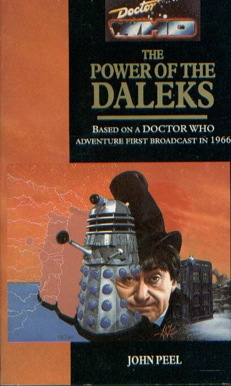
Cover: Alister Pearson’s cover art is working around a new template – the ‘Slatter-Anderson’ design similar to the one used on Virgin’s ‘Missing Adventures’ range. It’s a strange affair, a stunning portrait of the new Doctor in his Paris Beau hat (we all know it’s not a stovepipe now, don’t we?), which merges into a Dalek with two silhouettes echoing backwards, surrounded by electrical sparks. To the right lies the TARDIS, standing in a Vulcan swamp.

Final Analysis: At last! Thanks to his connections to Terry Nation and some frankly miraculous archiving on the part of David Whitaker’s widow, June Barry, John Peel gets to adapt the remaining Troughton Dalek stories. We’ve come a long, long way since the days of Whitaker’s own adaptations, written with a mass-market child audience in mind; these final entries were very much for the aging completist fans. 

Peel had already put some effort into ensuring his novels drew from wider references than just the individual scripts, creating a more cohesive universe where the Daleks view the Doctor as an ever-increasing threat and tararium is an essential mineral beyond The Daleks’ Master Plan. We’ll see more of this next time, but here the story is self-contained with few links to Dalek continuity. Instead, Peel looks to the end of The Tenth Planet, linking the events to UNIT, Counter Measures and Sarah Jane Smith. The references might feel gratuitous (the term ‘fanwank’ was growing in popularity around this time, personal tastes dictating whether it was meant to be abuse or celebration), but I’m not sure it is – certainly not as sure as I was when I first read the book in 1993.

Unlike David Whitaker – who was writing without any knowledge that the books or even the TV show that inspired them would have any kind of longevity – Peel has the benefit of hindsight; he knows these books are likely to be the closing chapters to the story, at least as far as Target’s readership is concerned. His references add to the wider universe (Benton lives!) while creating a really intelligent connection between two adjacent stories novelised decades apart. Just as we read An Unearthly Child knowing that Old Mother’s prophecy that ‘fire will kill us all’ would be echoed in the radioactive wastelands of Skaro, so the Earth’s ‘first contact’ with an alien invader leads to humanity’s expansion across the universe in colonies such as the one we encounter in Vulcan. Similarly, the discovery that the colony is run by IMC means nothing to Polly, but its connection to Colony in Space on TV (novelised as Doctor Who and the Doomsday Weapon) helps to explain why there’s a rebellion in the first place and add a greater level of jeopardy without spending pages detailing mining rights and the kind of ground already handled by Malcolm Hulke in his own novelisation, published 19 years earlier.

A couple of other items of note. The addition of Thane means that Janley isn’t the colony’s only prominent female (on TV she’s the Smurfette of Vulcan), but it also gives us a more balanced view of the rebellion. We know that the Governor is vain, lazy and self-serving, but on screen the rebels are fanatics, whereas here, they’re individuals motivated by wide-ranging concerns. They criticise the lack of support from IMC, the poor leadership from Governor Hensell and the stresses that come with a new colony on the frontier of known space; they also reveal more selfish desires – greed, lust, pride – which Bragen and Janley exploit to their cost.

Writing for a much older audience now, Peel is able to introduce a little violence, including one of the most graphic scenes to date, the death of Bragen: 

Bragen choked on his own blood and staggered forwards. Then his heart gave a final spasm. Valmar’s third bullet went through his brain, killing him instantly.

It’s not one of Ian Marter’s bubbling-pus corpses, but it comes suddenly and is so matter-of-fact that Peel doesn’t need to overdo it – it’s sufficiently shocking. Though the departure of the Doctor and his friends is just as abrupt as on TV, we’re given some reassurance as the new Doctor recalls that Vulcan eventually grows into something of a paradise:

The surface of Vulcan was unchanged. One day, the Doctor knew, the humans would remake the world. The bleakness would vanish under a canopy of green. The colony would become just the first of many cities. The humans would thrive. 

Chapter 142. Doctor Who – The Daleks’ Master Plan Part II: The Mutation of Time (1989)

Synopsis: Joined by Sara, who now accepts Chen’s treachery, the Doctor and Steven continue to evade the Daleks. A stop-off in ancient Egypt leads to a reunion and a bloody massacre, before a return to Kembel and a final confrontation with Chen and the Daleks’ Time Destructor.

Chapter Titles

  • 1. The Nightmare Continues
  • 2. The Feast of Steven
  • 3. The Toast of Christmas Past
  • 4. Failure
  • 5. Volcano
  • 6. Land of the Pharaohs
  • 7. Golden Death
  • 8. Into the Pyramid
  • 9. Hostages
  • 10. Escape Switch
  • 11. The Abandoned Planet
  • 12. The Secret of Kembel
  • 13. Beginning of the End
  • 14. The Destruction of Time
  • 15. The Nightmare is Ended

Background: John Peel adapts scripts from episodes 7-12 of the 1965 serial known collectively as The Daleks’ Master Plan, by Dennis Spooner and Terry Nation. This is the first time since The Space War that a novelisation has had a different title to the one used on the TV episodes (although see ‘Cover’ below for more). This book completes the run of stories from season 3.

Notes: The back cover blurb on the original release mentions a ‘Time Destroyer’. The opening chapter reveals that Sara has been having nightmares about Bret’s death and she sleeps with a light on. She’s been aboard the TARDIS for ‘several months’ and considers it her home now (Peel clearly a supporter of the ‘Sara as companion’ fan myth). The Doctor has read the American novelist Peter S Beagle and quotes from The Last Unicorn. Trying to provide some comfort to Sara, the Doctor reveals a personal philosophy:

…if you found out that the Daleks had killed Chen, then you’d want to find out something else, and then something else after that. There are no endings – everything continues to grow and to progress. One of the reasons that I never learned how to control this old ship of mine was to prevent myself from falling into that trap of yours – wanting to see happy endings.

He then tells her about his own granddaughter and the two schoolteachers, who he likes to imagine married and surrounded by their own ‘noisy children’. The reason for the Doctor’s original stay on Earth is revealed! A ‘catastrophic malfunction had forced him to rebuild part of the main console’. 

Peel’s description of Liverpool is very accurate – the red bricks were indeed blacked by pollution in 1965 and well into the following decade (as seen on the opening titles of the Liverpool-set sitcom The Liver Birds). The police officers in Liverpool are (altogether now) named after actors from the popular BBC drama Z Cars – (Colin) Welland, (Brian) Blessed, (James) Ellis and (Frank) Windsor; three of whom had appeared in Doctor Who on TV by the time this book was released. The joke about the Doctor recognising a man from a market in Jaffa is retained (unusual as Peel tends to cut a lot of the sillier elements from stories). Steven decides to copy the sergeant’s accent, as on screen, but this needs a little unpicking. We’re told that Steven sounds ‘like a bad actor’s version of North Country speech’. On TV, despite being in Liverpool, only Peter Purves manages to effect a decent Scouse accent (he does very well!) but everyone else does ‘generic Northern’. In Z Cars, which was also set in Liverpool, none of the characters who pop up here actually had the local accent: James Ellis was from Belfast; Brian Blessed from South Yorkshire; Frank Windsor from Walsall, West Midlands; and Colin Welland from Leigh. So even if these had been the actual characters from Z Cars (as the production team had hoped), Steven would still have been the only one with a Liverpool accent! Just to continue the nitpicking, in 1965, the sergeant in Z Cars was played by Bob Keegan, who was the only one of the regular characters to have a genuine Liverpool accent (he appeared in Doctor Who many years later, as Sholakh in The Ribos Operation).

Steven has a serious crush on Sara and wishes she found him attractive. The clown figure who the Doctor helps in Hollywood is clearly Charlie Chaplin (he’s specifically not him on TV). 

New arrival to the Dalek cause is Celation, a ‘tall creature, which breathed the oxygen-rich air with difficulty, giving his speech a throaty, disjointed effect’ (it’s a close match for the description of the alien ‘Warrien’ in the previous volume and there is a theory that Warrien was actually a mis-named Celation!). The Dalek force includes a ‘chief’ or first scientist along with a second scientist and ‘monitor Daleks’ who keep an eye on computer banks. The Time Destructor looks like ‘a large, glass-encased cannon’ (as opposed to a globe made of tubular spokes as on telly). The Dalek time ship is ‘a featureless silver-grey cube’ (‘some ten feet to a side’, Steven notes when it lands in Egypt) and its commander is the Red Dalek seen on the book’s cover. Chen is disturbed to learn that the Daleks have their own stash of Taranium and they claim they used him to obtain more merely out of expedience; they have sufficient to power their time-machine but not enough for the Time Destructor too, so this would appear to be a lie just to undermine Chen’s over-confidence. There’s reference to the Dalek Prime back on Skaro. 

The TARDISes of both the Doctor and the Monk are said to have ‘chameleon circuits’ (a phrase that wouldn’t be used on telly until Logopolis – but see Doctor Who and the Doomsday Weapon and Doctor Who and the Terror of the Autons). Working away on the TARDIS lock, the Doctor has a bit of a rant:

The Doctor worked away on the lock, muttering to himself. ‘I think it’s about time that some people remembered that these journeys of mine are for the purpose of scientific discovery! I’m not in the business of giving sight-seeing tours of the Universe, with everyone behaving like a bunch of rowdy tourists and rushing off to look at whatever they wish! I thought that Barbara and that Chesterton fellow were bad enough, but it’s getting worse! Much worse’ The Doctor continued muttering under his breath as he laboured on, unaware that he was alone, at least for the moment.

The Monk ‘never paid attention in class’ so is aware that his knowledge of history is hazy and doesn’t actually know which year he’s landed in, having followed the Doctor. He does, however, recognise a Dalek, having ‘paid attention to a few things in class’ [so the Time Lords of the Monk’s time study Dalek history!]. The Doctor doesn’t actually dislike the Monk, and feels that  ‘with the proper guidance, the man might make himself useful instead of troublesome’. The massacre of the Egyptians is much more even-handed with the Red Dalek destroyed by an onslaught of heavy rocks. Inspired by his warriors fending off the alien invaders, the Egyptian Khephren decides to commission a monument of the Sphinx to guard the Pharaoh’s pyramid. 

Mavic Chen and the surviving Daleks return to Kembel in the time-machine and are greeted by the Dalek city administrator (the idea of a Dalek whose role involves admin is reassuringly comical). The Doctor assumes that the absence of Varga plants is a sign that they’ve been allowed to die off as the Daleks no longer need to use them as guards. Chen shoots Beaus dead (on TV, Gearon is Chen’s victim). The Doctor accompanies Sara and Steven when they release the delegates from the locked room – and he persuades Sara to spare Chen’s life, reminding her of the political chaos on Earth that might result from his death. 

Chapter 13 is a reworking of a recurring Terrance Dicks title, ‘Beginning of the End’. The heart of the complex contains a vast hanger that houses hundreds of Dalek saucers, maintained by Daleks on ‘flying discs’. The Doctor uses his cloak to break the circuit on a Dalek door and he recalls the first such doorway he encountered in the Dalek city on Skaro. Caught in the winds of the Time Destructor, Sara begins to hallucinate the ghost of her brother:

Sara collapsed, and felt dust and sand on her face. She hardly had the strength to open her eyes, but somehow she managed it. The twig-like fragility of her arm shocked her, as she clawed towards the fallen Time Destructor. It was no use, no use… she was too weak, too old now… Her dying vision blurred, and in the glow of the Destructor, she felt certain that she could see the smiling face and beckoning finger of her brother’s spirit.

Sara felt a sudden peace, and all was still.

Affected by the reversal of the Time Destructor, the Daleks become embryos and then briefly humanoid before turning to dust. Back on Skaro, the Dalek Prime realises that the fleet on Kembel has been destroyed and it is filled with a desire for revenge. On Earth, Karlton is arrested by Senator Diksen for his part in Chen’s treachery. He reveals that Marc Cory’s lost tape was found on the body of Bret Vyon (and it contained a recording that was not part of the one he makes in Mission to the Unknown). The story concludes with the scene where the Monk discovers he is stranded on a frozen world.

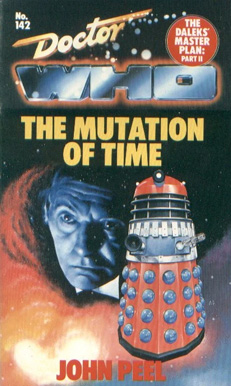
Cover: Alister Pearson’s cover is much more understated than for Mission to the Unknown. A severe-looking Doctor (referencing a photo fromThe Space Museum) is formed in the stars of a nebula as a very grand Dalek with a red casing and blue spots dominates the frame (based on a Madame Tussauds Dalek that appeared on the back page of the 1983 Radio Times 20th Anniversary Doctor Who special). The livery is an invention of John Peel, but it really works and it’s a shame it never appeared on telly. The title as shown on the front cover is ‘The Mutation of Time’ (a new title not taken from the episodes), but a circular flash states that this is ‘The Daleks’ Master Plan Part II’, while on the spine it’s ‘The Daleks’ Masterplan Part II’ (‘Masterplan’ is one word). The title page inside gives the title ‘The Daleks’ Masterplan Part II The Mutation of Time’.

Final Analysis: As he moves into the second half of The Daleks’ Master Plan, which was authored mainly by Dennis Spooner, it’s a relief that John Peel allows himself room for a little fun in a way that he tactfully avoided with The Chase. Whether it’s the farce of the Hollywood scenes or the triviality of the Monk’s side-quest, the first half of this volume is a hoot. It’s only when the action returns to Kembel that the mood changes to something more sombre.

Officially, Sara Kingdom was not a companion (something Jean Marsh herself stressed at her first ever convention in 1996, to the shock of many), but fandom has always included her in the lists and here, John Peel makes sure she counts by giving her several months as a passenger aboard the TARDIS. The opening chapter delves into her fractured psyche, tortured by her guilt over killing her brother and wanting absolution through the certainty that Chen will pay for his manipulation of her. Whatever the original intentions of the production team, these two books ensure that for the fans – she counts!

Over the course of his first three books, Peel manages to capture William Hartnell’s performance better than any other writer. The tetchiness is present in the works of other authors (including Terrance Dicks), but it’s his lightness and sense of humour that really lands here – where it’s appropriate, Peel remembers to make the Doctor funny. In this volume, the Doctor is said to ‘steeple’ his hands together, which conjures up a perfect mental image of the kind of pose this Doctor often adopted. I’m a huge fan of The Daleks’ Master Plan, both in what we’re still able to experience on video and audio, plus all the mysteries that surround it (who are all those delegates?!) – but I’m now a fan of John Peel too. It was an ambitious risk to take on this epic adventure, but in Peel’s hands, it’s a huge success. Who couldn’t love the way he disposes of his main villain (with echoes of Caligula in I Claudius)?:

The Daleks opened fire, and several of the bursts of rays caught him squarely. Mavic Chen staggered slightly, staring at them as the wave of energy washed over him. As it ceased, Chen suddenly realized that he had been terribly, terribly wrong. He was not immortal after all…

Chapter 141. Doctor Who – The Daleks’ Master Plan Part I: Mission to the Unknown (1989)

Synopsis: On the planet Kembel, delegates assemble for a conference led by the Daleks. Among the attendees is the Guardian of the Solar System, Mavic Chen, who has betrayed the planet Earth by providing a vital element for the Daleks’ latest weapon, the Time Destructor. The Doctor steals the element but, cut off from the TARDIS, he and his friends take Mavic Chen’s ship in a bid to warn Earth of his treachery. Chen alerts the Space Security Service and identifies the Doctor as the traitor. Now, Space Agent Sara Kingdom has Chen’s enemies in her sights…

Chapter Titles

  • 1. The Toppled Towers of Ilium
  • 2. The Screaming Jungle
  • 3. Extermination!
  • 4. The Nightmare Begins…
  • 5. No Ordinary Ship
  • 6. The Day of Armageddon
  • 7. The Face of the Enemy
  • 8. Devil’s Planet
  • 9. Dangers in the Night
  • 10. The Sacrifice
  • 11. The Traitors
  • 12. Counter-plot
  • 13. Allies
  • 14. Desperate Measures
  • 15. Out of Time
  • 16. Interlude

Background: John Peel adapts scripts from Mission to the Unknown, by Terry Nation, and episodes 1-6 of the 1965 serial known collectively as The Daleks’ Master Plan, by Terry Nation and Dennis Spooner.

Notes: The opening chapter dramatises the events that were missing from Donald Cotton’s jolly adaptation of The Myth Makers. Katarina struggles to comprehend much that she witnesses, so we have to assume a lot of terminology is translated for our benefit. Nevertheless, she considers the TARDIS control room to be about thirty metres across, with walls that look like polished stone. She compares the sound of the TARDIS dematerialising to ‘Cerberus, guardian hound of the Underworld’ (have we had it compared to a growling dog before?). The wound in Steven’s shoulder on TV has become a gash to his side; while the attacking blade didn’t strike anything vital, Steven has lost a lot of blood and the Doctor also worries that the sword was unlikely to have been sterile, exposing Steven to germs from way before his own time [and see The Ark for how something similar plays out to humans from Earth’s future].  

Chapter 2 takes its title from an earlier Nation-scripted episode. Gordon Lowery is the captain-pilot of a crashed ship. The ship’s passenger, Marc Cory, is ‘lean, tall and dark, in a good-looking way’ and ‘just a shade on the right side of thirty’. Cory and Lowery discuss the Dalek-Movellan wars a thousand years before and the Dalek expansion across the Andromeda galaxy and the region of Miros. The Black Dalek has been despatched to Kembel by the Dalek Prime on Skaro (mentioned in Peel’s novelisation of The Chase). The Black Dalek is second in the Dalek hierarchy and rarely leaves Skaro.

The descriptions of each representative of the alliance seem to match the (later revised and debunked) best guesses available in 1989: Gearon, ‘a somewhat faceless creature with an egg-shaped head’, wears a thick visor as his world is ‘almost perpetually in darkness’; Trantis has tendrils on his face and is vaguely telepathic; Beaus is from the Miron systems and is a tall creature, half-vegetable, half animal, ‘like an animated tree’ [and] possessing two burning eyes’; Warrien wears a ‘cowled hood and a pressure suit that contains an atmosphere other than oxygen; also wearing a spacesuit, Sentreal has a ‘dark face… wreathed in the chlorine fumes that he breathed, and a small radio antenna on his head [that] kept him in constant contact with his fellow beings still on their ship (his people share a communal mind, and Isolation from the others would apparently kill him); Malpha, the last of the members, is ‘tall and colourless’ with a white suit and skin, aside from ‘the thick, dark network of veins that created a patchwork of his face’. Later, we meet Zephon, who dresses all in black with just his eyes visible through the hood of his cloak.

On TV, the terms Space Security Service and Special Security Service appear interchangeable, but here only the back cover uses ‘Space Security’. Lizan had joined the SSS with ambitions to work in an embassy on Draconia or Alpha Centauri; instead, she was allocated as section leader in Communications Central, a post that comes with a lime-green uniform. The Communications map shows Earth territories in blue, with Dalek space marked in red. Mavic Chen is over six feet tall with a ‘trim, muscular body’. His face showed signs of an ‘oriental ancestry, but much mixed with other races’. His white hair is closely cropped and his eyes are deep blue and ‘hypnotic’, while his voice is ‘deep, clear and precise’ and displays ‘no signs of age’. In his broadcast interview, he discusses ‘mineral agreements with the Draconian Empire’. 

When the Doctor returns to the TARDIS on Kembel, he sees a Dalek emerging from inside it! Before fleeing the TARDIS, Bret manages to select some suitable clothes for Steven, which he changes into only after the Doctor has led Katarina away to give Steven some privacy (this solves a mystery that is unresolved from the TV episode, where as far as we can tell we never learn when Steven changes out of his armour). The Doctor observes that the Daleks now have solar panels on their bodies to enable them to move about without static electricity – but their city is still built from pure metal, like the one he saw on Skaro. He also remembers that the Dalek time ship that chased him, Ian, Barbara and Vicki through time was powered by taranium, like the Time Destructor.  Realising that the Daleks will pursue them for the taranium core, the Doctor tells Bret Vyon ‘We haven’t escaped from danger – in fact, the danger has barely begun!’ … there’s a chapter title desperate to be used here…

According to Bret, Earth is three days away from Kembel, but he points out that their diversion to Desperus will have allowed Chen to reach Earth before them. Chen’s deputy, Karlton, differs from his bald and smooth-faced appearance on telly: ‘His craggy features were lined with care, and his hair was thick and grey.’ Chen views Sara Kingdom as ‘a born warrior’.

She reminded him of a tightly coiled spring – ready to leap in any direction at an instant’s notice. She was dressed in the inevitable black catsuit that all SSS agents wore, accentuating her perfect figure. She was beautiful, but it was the beauty of ice or steel. Her hair was shoulder-length, and curled inwards. Her face was somewhat elfin. If she smiled, Chen knew she would be considered very desirable. He could not imagine her smiling. Her blue-grey eyes gave back no warmth. She looked every inch the perfect killing machine that her record had informed him she was.

Chen has never ‘felt the attraction of women himself’, believing they’d want a share of his power. The Doctor is similarly unswayed, irritated by Sara’s crying, as he feels pained by ‘overt displays of sentimentality’. 

The machine that brings the Doctor, Steven and Sara to Mira does not contain mice. There’s a more energetic battle with the Visians – and they can talk! Surrounding the Doctor, they chant ‘Kill it!’ in ‘wet, reedy’ voices. Although they’re invisible, one of them is pushed into a pool and emerges swathed in mud, revealing ‘thin, bony, with two long, clawed arms, feet like birds’ claws, and a narrow head with a beak’. Later, fearing the metallic invaders seek to take over their foraging areas and wipe out the whole tribe, the Visians stage a huge attack against the Daleks. The Doctor has ‘examined a number of Dalek installations and craft during his numerous encounters with them’, and is fairly familiar with the design that he faced now [suggesting either that he and Steven have had multiple unseen adventures involving Daleks since The Chase, unless the Doctor is counting multiple ships during the Dalek invasion of Earth too]. Some of the Daleks aboard the ship have mechanical claws instead of suction cups on their arms.

While walking towards the TARDIS, the Doctor tells Chen the name of his ship and introduces himself – thereby solving a minor continuity issue later on from the TV version. The TARDIS door is still open from when Steven and Katarina left it (so the Doctor doesn’t need to give Sara the key). With the real Taranium Core still in his possession, the Doctor speculates that Chen will get his comeuppance when the Daleks inevitably turn on him. Sara is invited to stay in Vicki’s old room and freshen up with a bath. The three fugitives await their next encounter with the Daleks…

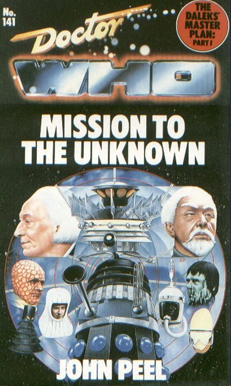
Cover: Alister Pearson gives us another appropriately energetic composition similar to The Chase, It showcases the black Dalek leader (cleverly repurposed from a photo of a Dalek from Resurrection of the Daleks!), surrounded by Mavic Chen and his spaceship, the Doctor and a selection of delegates. The title as shown on the front cover is ‘Mission to the Unknown’ but a circular flash states that this is ‘The Daleks’ Master Plan Part I’, while on the spine it’s ‘The Daleks’ Masterplan Part I’ (‘Masterplan’ is one word). The title page inside gives the title ‘The Daleks’ Masterplan Part I Mission to the Unknown’.

Final Analysis: Poor Katarina. While we might accept that a person can’t change ‘one line’ of history, this is usually because a character wants to overthrow an entire regime or culture, but this is all tied to the destiny of a single otherwise unimportant handmaiden. The Doctor chastises Steven for asking too many questions and praises Katarina for the way she ‘simply looks and learns’, but it’s this quality that seals her fate; having learned of the importance of the Spar’s outer door, she realises that she can save her new friends by opening it and allow her destiny to be fulfilled. Steven has a personal reason for being patient with Katarina, aware that her kindness probably saved his life: his justification that ‘she’s from Troy’ is enough for him. Bret Vyon lacks Steven’s experience with time travel and simply thinks there’s something wrong with the girl, while the Doctor is irritated by her stupidity and vows to never accept a companion from a pre-technological age. This shows just how impractical Katarina is as a character. While we might empathise with her bewilderment at being transported in a space vessel, her confusion over something as simple as a key makes her much more alien to the reader than any of the delegates in the Dalek conference room. And Bret is right – the mission to inform Earth of the Dalek plan is greater than any one individual… and with Steven restored to full health, their own success is enabled by the sacrifice of the most disposable of the team. 

All of this is present in the televised episodes, but John Peel foreshadows the tragic event throughout the early chapters. It also gives credence to the ‘primitive’ beliefs of Troy and the prophecies of Cassandra. From what we can tell from the surviving episodes and audio recording, The Daleks’ Master Plan is a bit of a ‘best of’ compilation – the most impressive space ships up to that point, the best jungle – and the Daleks are at their most sinister and scheming. Peel doesn’t miss a beat in conveying this on the page. Chen is every bit as pompous and self-aggrandising as in Kevin Stoney’s TV performance and this might also be the most accurate depiction of the first Doctor in over 140 books; he’s every bit as irascible as he is in Terrance Dicks’ Dalek Invasion of Earth or The Smugglers, but Peel also remembers to make him funny, with that self-congratulatory chuckle. For any inattentive fan who didn’t know how long this story is (and missed the ‘part 1’ on the cover), this book also ends as if we’re done with the Master Plan. But as someone would later say in another episode, ‘It’s far from being all over…’

Chapter 140. Doctor Who – The Chase (1989)

Synopsis: A brief holiday on the planet Aridius is interrupted when the Doctor gains advance warning that the Daleks are coming for him. So begins a frantic flight through time, each stop brings their pursuers ever closer. Their final battleground is Mechanus, home to killer plants, the robotic Mechanoids and their sole prisoner, a space pilot called Steven. As the Doctor prepares to confront his enemies at last, his friends have no idea that this will be their last adventure together in the TARDIS.

Chapter Titles

  • Author’s Note
  • 1. The Executioners
  • 2. A Speech in Time
  • 3. The Sands of Death
  • 4. The Victims
  • 5. Deadline
  • 6. Flight through Eternity
  • 7. Nightmare
  • 8. Journey into Terror
  • 9. Fallen Spirits
  • 10. Who’s Who?
  • 11. To the Death!
  • 12. The Mechanoids
  • 13. The End of the Hunt
  • 14. Home!

Background: John Peel adapts scripts from a 1965 serial by Terry Nation. As the author’s note explains, he worked mainly from early drafts, before they were rewritten by story editor Dennis Spooner, so he explains that the book is ‘not strictly an adaptation of the televised version of The Chase’ (ie, it’s not written as if by Terrance Dicks).

Notes: The opening chapter depicts a grand Dalek control room with ‘a background pulse, like an electronic heart slowly beating’. The Black Dalek looks down from a raised platform onto various other Dalek units, including a Chief Scientist. The Daleks know the Doctor by name. They’re also aware that his appearance ‘has changed many times over the years’ and they have tracked him through his ‘basic metabolic pattern’ [meaning these Daleks come from the Doctor’s own future]. 

The Doctor ‘borrowed’ the TARDIS and lost the operational notes while on prehistoric Earth. He is nearly 750 years old and has not yet experienced his first regeneration. We’re reminded of the introduction stories of Ian and Barbara, that Susan left the TARDIS after falling in love and that Vicki recently joined them after being rescued from the planet Dido. The space/time visualiser is just one of many trinkets that the Doctor has picked up over the years. Neither Ian nor Barbara recognise the Beatles song that appears on the visualiser. Vicki has not encountered a Dalek up to this point, but knows of them from her history books.

The Daleks are led by the Dalek Prime, which is ‘larger than most, and painted a uniform golden colour’ (similar to the Emperor from the comic strips). The TARDIS team have encountered the Daleks twice before. The Daleks use flying discs to survey the surface of Aridius. Aridians have blue skin and they wear the skins of mire beasts as cloaks. We’re party to the meeting of the Aridian elders with the Daleks where they’re given the ultimatum. Ian and Barbara had an unseen adventure on Cetus Alpha. The TARDIS dematerialises with a ‘customary groaning and wheezing’. The Dalek time ship is powered by Taranium, ‘both the rarest and most unstable element in the Universe’; one gram can power a time ship for centuries and it took the Daleks two decades to obtain that amount. 

It’s clear the author has done a little research into the crew of the Mary Celeste as the characters are named and fleshed out (he also has one of them exterminated by a Dalek – something that we don’t see on TV). The schoolteachers debate whether they were responsible for the death of the passengers and crew of the ship and Ian reminds Barbara of her attempts to change the history of the Aztecs; they take some comfort from the possibility that the Marie Celeste was always fated to become a mystery. Morton C. Dill is from Alabama. He encounters the TARDIS crew and a Dalek in 1967. The Dalek considers killing him, but then decides to let him live, considering it ‘far worse for the human race to allow this fool to live on’. Ever since that day. Dill has been a resident of the Newman Rehabilitation Clinic for the bewildered (a reference to a routine by American humourist Tom Lehrer). The haunted house is a part of Battersea Funfair, London, and is closed for repair. Vicki uses her months of experience of operating the radio on the crashed spaceship on Dido to use the Dalek radio. After the robot Doctor is destroyed, the real Doctor proves his credentials by reminding his companions of their past adventures, how Ian was knighted by Richard Coeur de Lion, Vicki, led a ‘revolution on the planet Xeros’ and Barbara ‘escaped with the Menoptera from the Crater of Needles’.

Steven Taylor explains that the Earth’s plans for expansion were brought to an end by the Draconian conflict, followed by the Third Dalek War. Realising that the execution squad is outnumbered by Mechonoids and facing defeat, the Dalek squad leader separates from the battle to hack into a computer and trigger the city’s destruction in a final attempt to trap the TARDIS crew. 

Steven manages to escape, makes his way through the jungle and reaches the TARDIS, where he collapses. The Doctor is initially very dismissive of the unstable and brutish Dalek technology of their time ship, but quickly becomes more tactful to avoid frightening Ian and Barbara. He’s pragmatic enough to help the schoolteachers to use the Dalek time ship to return home, but he deliberately sets the time of their destination a couple of years in their future to offset the three years they’ve spent travelling with him. They return to the TARDIS to collect their belongings, including souvenirs of their travels. Barbara wonders if she owes back-rent on her flat, while teasing Ian about the amount of dust that will have settled in the house that he owns. They stow their belongings at King’s Cross Station before enjoying a visit to a pub by the Thames and exploring their home city anew.

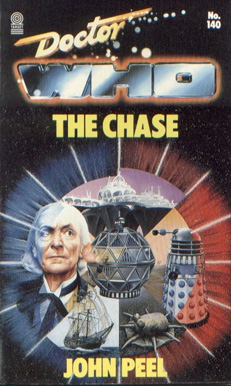
Cover: Against a backdrop of the time vortex, divided like a 16-hour clock, the Doctor looks across at a Mechanoid and the city of Mechanus, a Dalek, a mire beast and the Mary Celeste. A suitably busy composition from Alister Pearson.

Final Analysis: There was a lot of build-up to this, the first of the remaining Terry Nation Dalek stories to be novelised, courtesy of a deal struck with author John Peel. I’m a fan of the TV story – comical elements included – and the scattergun approach is the set-up for the next Dalek story, which is similarly meandering but on a grander scale. Glad to say, I’m also a fan of this novel. It’s determined to be grown-up about it all, so the jokey aspects are cut back massively, and some of the additional details appeal mainly to the fan gene in linking this story to ones broadcast later or told in other media. At this point in the history of Target, that’s who the readership was. Peel manages to make the Daleks menacing, scheming and not remotely comical (something their own creator chose not to do in the original TV version). His real success though is in capturing the TARDIS team, the growing relationship between the schoolteachers, Vicki’s resourcefulness and most of all the Doctor’s contrary nature, clearly lamenting the departure of two people who forced their way into his life and became good friends – but refusing to let this show. It’s rather wonderful to have another adventure with this particular crew, as this is the last of their adventures to be novelised. And there are only two more stories from this era left to come…