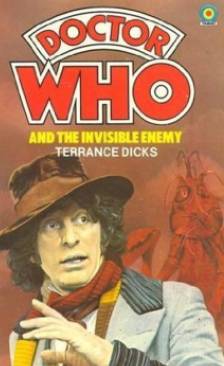
Chapter 47. Doctor Who and the Invisible Enemy (1979)

Synopsis: The Doctor is unwell, fighting off an alien virus that is trying to possess him. Heading to a hospital in deep space, the Doctor meets Professor Marius and his robot dog K9, who eagerly assists Leela in fighting off an army of infected people. Realising they need to take the fight to the cause of the infection, the Doctor and Leela are cloned, miniaturized and injected inside the Doctor’s brain to find the nucleus of the virus before it can take hold permanently and use the Doctor to spread its swarm throughout the galaxy.

Chapter Titles

  • 1. Contact
  • 2. The Host
  • 3. Death Sentence
  • 4. Foundation
  • 5. Counter-Attack
  • 6. The Clones
  • 7. Mind Hunt
  • 8. Interface
  • 9. Nucleus
  • 10. The Antidote
  • 11. The Hive
  • 12. Inferno

Background: Terrance Dicks adapts the scripts for a 1977 story by Bob Baker and Dave Martin; that’s three consecutive books to be based on their scripts.

Notes: Terrance Dicks was using the very latest information available, so the reference to Saturn having ten moons is based on the discovery of Janus in 1966. In 1978, it was suspected that Janus shared its orbit with another moon – named Epimetheus – a theory confirmed two years later by the Voyager probe, which also revealed three more moons. It’s now believed that Saturn has over 80 satellites, plus many others embedded within its rings. Considering the definitions of ‘Moon’ and ‘Planet’ have shifted repeatedly in the last 40 years, we can therefore accept that the narrator of this book is using a classification of a significant size of satellite that was common in the year 5000. Or that something terrible happened to Epimetheus or Janus. So there.

The Doctor has high regard for Leela, despite his teasing of her as a savage, and has apparently shown her the basics of TARDIS piloting – and she’s retained the training enough to input coordinates, despite otherwise struggling with general levels of technology. Professor Marius came to the BI-AL foundation from the New Heidelberg University. Growing bored waiting for news of the Doctor, Leela explores the station, bypassing the lifts because she doesn’t trust them and scaling numerous flights of stairs before she finds the Doctor’s ward.

We’re introduced to the legendary K-9, who is a ‘squat metallic creature’ that looks like ‘a kind of squared-off metal dog’, with a ‘computer display screen for eyes, and antennae for ears and tail’.

Dicks manages to work around the visuals of the nucleus of the swarm, which, at micro-scale has ‘waving antennae, glistening wet red flesh, and a bulbous black eye that seemed to swivel to and fro’, while the version in the macro-world is rather unpleasant:

A horrible, incredible shape [which] was filling the booth. It was blood-red in colour and was as big as a man with a bony glistening body and lashing tentacles. The huge black bulbous eyes swivelled malevolently around the ward.

… and definitely not a giant prawn.

The virus tries to reinfect the Doctor through Marius and when it fails, the Doctor is full of glee. Marius gains help from the entire surviving staff at the Foundation in preparing the antidote samples. Back on Titan, the nucleus swells to an enormous size while its hatching brood look like ‘huge, malevolent dragonflies’.

Cover: A rather lovely portrait of the Doctor with the nucleus of the swarm in the background, courtesy of Roy Knipe.

Final Analysis: The opening scene adds a very subtle message that the people of the future are trained for their jobs, but then their environments are controlled so extensively by technology that they’re never required to put any of that training into practice. We also get a decent paragraph that explains the back-history behind Marius’s casual use of the term ‘spaceniks’. Once again though, it’s the little details added to give the monster of the week a greater sense of scale and menace than they could have achieved onscreen.
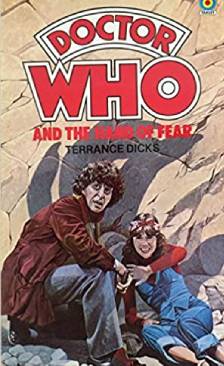
Chapter 46. Doctor Who and the Hand of Fear (1979)

Synopsis: Trapped under a rockfall after an explosion, Sarah Jane reaches out for help and grabs a hand-shaped object – but it is not the Doctor’s. While Sarah recovers at a nearby hospital, the Doctor discovers that the object Sarah found, though made of stone, appears to have once been ‘alive’. His theory is soon proven correct when Sarah, under a malevolent influence, breaks into a nuclear power station and places the hand inside the reactor – where it regenerates into the alien Eldrad. Free from Eldrad’s control, Sarah accompanies the Doctor as he returns the alien home to Kastria – unaware that this will be Sarah’s final trip…

Chapter Titles

  • Prologue
  • 1. The Fossil
  • 2. The Ring of Power
  • 3. Power Source
  • 4. The Will of Eldrad
  • 5. Eldrad Must Live
  • 6. Countdown
  • 7. Blow-up
  • 8. Counterstrike
  • 9. The Return of Eldrad
  • 10. Return to Kastria
  • 11. The Caves of Kastria
  • 12. Eldrad Reborn
  • 13. Eldrad’s Destiny
  • 14. Sarah’s Farewell

Background: Terrance Dicks adapts the 1976 scripts by Bob Baker and Dave Martin.

Notes: Although the prologue covers much of the same ground as the TV story’s first scene, it’s actually possible to understand what’s being said by the characters here! There’s a lovely description of the captured Eldrad lying in the capsule, totally still except for a flexing hand with a ring on it. And of course, when the capsule explodes, it’s that hand that survives and gets embedded in primeval mud ‘for one hundred and fifty million years’. The Doctor sees an overhang in the cliff face, which is what protects them from the explosion. He uses his UNIT connections to regain access to the quarry, where the foreman, Tom Abbott, has moved his police box to a safe area.

According to Dr Carter, Sarah is wearing ‘a striped overall dress’, not the ‘Andy Pandy’ suit. Professor Watson’s first name is Owen and he has a handgun in case of terrorist attacks, for which he’s had half-an-hour’s training (reminder to American readers: Someone having access to a gun is extremely unusual in the UK). He decides to patiently listen to his daughter’s story on the phone, in case her last memory of her father might be his shouting at her. The disembodied hand tries repeatedly to leap up and grab the handle to the reactor but eventually gives up to gather its strength. Watson gives Sarah and the Doctor a lift in his Jag away from the complex towards a hill several miles away (so, not in the car park like on telly). When the Doctor drives off in Watson’s car with Sarah and Eldrad, Watson is left behind to explain the situation on the phone to a government minister. The Doctor pretends to be hurt to trick Sarah into crossing the ravine on Kastria – twice!

Cover: Roy Knipe rejigs a publicity photo from Planet of Evil to show the Doctor and Sarah cowering under the huge shadow of a clawed hand. 

Final Analysis: Aside from a few lines of clarification, this is a simple retelling of the story, but it still manages to draw the reader in. It helps to be a fan of the transmitted version, so we can imagine the actors in position, and perhaps because of familiarity, I still got choked up by the final scene.

Chapter 45. Doctor Who and the Sontaran Experiment (1978)

Synopsis: Arriving on the surface of the Earth, thousands of years since the planet was abandoned, the Doctor, Sarah and Harry find a small party of explorers hiding in terror from a mechanical hunter. The machine has captured other members of the party and taken them off across the rocky terrain. Hidden among the rocks is a Sontaran with a sinister mission – and Sarah is about to become his next victim.

Chapter Titles

  • 1. Stranded
  • 2. Unknown Enemies
  • 3. Capture
  • 4. The Experiment
  • 5. Mistaken Identities
  • 6. The Challenge
  • 7. Duel to the Death
  • 8. A Surprise and a Triumph

Background: Adapted by Ian Marter, based on the 1975 scripts by Bob Baker and Dave Martin. This completes the run of stories for Season 12.

Notes: Consistent with his new ending to The Ark in Space, Ian Marter has our heroes arrive in the TARDIS – which lands before toppling over. As soon as the three travellers have emerged, it vanishes for no clear reason. As in that earlier book, the space station is referred to as Terra Nova. The robot kills Zake with a vicious whip of its tentacle, rather than pushing him over a ravine.As viewed by Harry, Styr (not Styre) is an imposing being:

… an enormous figure – like the statue of a huge, thick-limbed man somehow brought to life – was gradually silhouetted against the circle of daylight. As it lumbered out of the far end of the tunnel into the open, Harry glimpsed its coarse greyish hide – like pumice stone -shuddering at each step. 

Sarah recognises him and her point of view gives us even more vivid detail:

… the gaping oval panel was filled by a squat, lumbering shape like a monstrous puppet. Its domed, reptilian head grew neckless out of massive, hunched shoulders. Each trunk-like arm ended in three sheathed talons and was raised in anticipation towards her. The creature began to lurch down the ramp on thick, stumpy legs, the rubbery folds of its body vibrating with each step. Mean eyes burned like two red-hot coals amid the gnarled, tortoise-like features, and puffs of oily vapour issued from the flared nostrils.

….The wobbling folds of its lipless jaws were suddenly drawn back, baring hooked, metallic teeth. Sarah stared transfixed at the ghastly smile while the creature slowly shook its domed head…. The shrivelled, tortoise face thrust forward, its red piercing eyes boring into her.

The ‘three sheathed talons’ on each hand neatly fixes the continuity error of the TV episodes. According to the Doctor, Sontaran brains are like seaweed and their lungs are made from ‘a kind of spongy steel-wool’. Styr’s ship is the size of a large house, like ‘a giant Golf-ball’, consisting of a ‘honeycomb of modules’, small, interconnected spherical rooms arranged around a central control chamber. Styr’s robot – called ‘the Scavenger’ here – is a bell-shaped hovering dome with probing tentacles and there are a few of them, including one on guard inside the ship and a spider-like one that Harry dodges. Inside the ship, there are also two other Sontarans, lying dormant in recharging pods.

Styr reports to a ‘Controller’, not a ‘Marshal’, who tells him that a rendezvous with the ‘Allied Squadrons from Hyperion Sigma’ is overdue (is this a squadron of various Sontaran factions or are the Sontarans allied to another race? There’s no mention of the Rutans at all). Styr has a weapon secreted in the arm of his suit.

While unconscious, the Doctor has a vivid nightmare about the TARDIS, wrecked and heading towards a black hole, being overrun with rats while a giant cat emerges from the console and sleeps on his chest. He speculates that the Sontarans might be prospecting for a mineral not known in this galaxy – Terullian – and he keeps many objects in his pockets, including:

… marbles, pieces of twisted wire, shrivelled jelly babies, weird keys, a pirate’s eye-patch, strange coins, sea shells, a dead beetle…

… but not his ‘Liquid Crystal Instant Recall Diary,’ in which he thinks he wrote some notes about Sontarans in the past. Harry hallucinates Sarah as a vicious, snarling beast and is attacked by an illusionary giant spider-like creature.

The Doctor and Sarah each destroy a Scavenger robot with the sonic screwdriver. Styr sends Vural to his death over a ravine. The Doctor pours a flash of Glenlivet whisky into Styr’s probic vent and Styr swells to over three times his normal size before he and his ship deflate like balloons into congealed heaps. The Doctor remembers he set the TARDIS ‘Boomerang Orientators’ so assumes it’ll be back on Terra Nova. He, Sarah and Harry depart via the transmat field, thereby making the story fit with the previously published Genesis of the Daleks and Revenge of the Cybermen.

Cover: The Doctor holds a log as a weapon in front of a background of a supersized Sontaran helmet. Another strong illustration from Roy Knipe.

Final Analysis: While this is based on a two-episode adventure, it’s by no means the shortest novel; indeed, it feels like it takes up the same page-count as, say, the six-part Genesis of the Daleks, without becoming padded or over-written. It’s another Ian Marter ‘movie version’, with everything turned up to eleven. Predictably, the horror elements are more grotesque – the terrifying hallucinations of faces emerging from rocks, soaring monster-infested wave, burning desert sands or giant ants. Marter’s real skill is in the characterisation: He makes Styr a much more terrifying presence than the TV version as the huge, hulking ‘golem’ is wheezing and gurgling, but also flawed as his sadism makes him forget the real purpose of his mission; Sarah’s ability to be both terrified and brave, as in the way she responds defiantly to Styr’s interrogation by pointing out that it’s not her fault if her mere presence doesn’t match his data; and Harry is still as bewildered by the technology, particularly the Doctor’s description of Sontaran biology, but he’s still got a great way of summing things up – calling Styr ‘the Humpty Dumpty thing’. What was merely a side dish on TV has been reimagined as a macabre banquet.

Chapter 44. Doctor Who and the Android Invasion (1978)

Synopsis: The TARDIS brings the Doctor and Sarah to an English village where something is wrong. The locals seem cold and machine-like, while a group of blank-faced astronauts patrol the area and shoot at the new arrivals. The Doctor tries to piece together the clues around him, but it’s Sarah who reveals the truth; the village isn’t a real village, this isn’t really Earth – and Sarah is not the real Sarah! The whole thing is an elaborate copy created by Styggron – chief scientist of the Kraals. And the real invasion is about to begin…

Chapter Titles

  • 1. Strange Arrival
  • 2. Village of Terror
  • 3. The Watcher
  • 4. Hunted
  • 5. Captured
  • 6. The Test
  • 7. The Countdown
  • 8. Braindrain
  • 9. Blastoff
  • 10. Hero’s Return
  • 11. Takeover
  • 12. Death of a Doctor

Background: Terrance Dicks adapts Terry Nation’s 1975 scripts, completing the run of Season 13 stories for Target.

Notes: Sarah wears ‘casual late-twentieth-century clothes, with a brightly coloured scarf at her throat’. The army soldier who throws himself off the cliff isn’t from UNIT and the android Sarah finds inside the capsule by the TARDIS is an old lady. Chased by patrol dogs, the Doctor has a curious thought that anyone who thinks foxes enjoy being hunted should try being chased across country by dogs themselves. Styggron is described thusly:

The face hovering over her was broad and flat with leathery greenish skin. It was heavily jowled with a squashed pig-like snout, underhung jaw, and enormous ears set flat against a massive skull. Huge eyes glowed in cavernous sockets beneath the jutting brows. 

The calendar in the Fleur de Lys only shows the month of September (on TV, it’s a day-by-day calendar with solely ‘Friday July 6th’ pages). The entrance to the Kraal bunker is hidden inside an empty barn. When Styggron says ‘There is no time for pleasantries’, the Doctor asks rudely: ‘How about unpleasantries, pig face?’ Haha!

Benton has promised to take his sister to the village dance (not The Palais). It’s not exactly clear on TV, but the android Benton is found leaning over Benton’s body. Here’s the paragraph:

The kneeling man turned and looked up at him and Adams gave a gasp of astonishment. The soldier leaning over Benton, was Benton… He opened his mouth to shout an alarm, and a savage blow struck him down from behind. The android technician caught the falling body and laid it down beside the body of the real Benton. The android Benton got to its feet, and gave a nod of satisfaction. ‘Good. Have them taken away…’

That’s not just ‘the unconscious Benton’, it’s ‘Benton’s body’. Eek!

It’s the Benton android, not the Doctor Android, that points out that there’s ‘much to do’. Once the Doctor has bluffed his way past Android Benton, the scene is not repeated with the android Doctor. We don’t get the final scene of the Doctor and Sarah leaving in the TARDIS; instead, the Doctor plans to collect up all the androids and dismantle them before the scanner beam can be switched off. Marshal Chedaki, meanwhile, waits in vain for Styggron’s signal to begin the invasion. ‘With Styggron dead, his master plan had come to nothing. The android invasion was over.’

Cover: Another brilliant cover by Roy Knipe, it’s just the Doctor being tied to the village memorial by spacemen while Styggron looks off into middle distance, but it’s so effective.

Final Analysis: Often dismissed as lightweight because of the grittier stories that surround it, I’m very fond of The Android Invasion. Here, Dicks adds a little to the playfulness between Sarah and the Doctor where, in the past, that might have been trimmed. Chedaki is more of an antagonist to Styggron, as a disgruntled leader of the military wing, and he’s more threatening a presence than the subservient TV version. Dicks then tidies up all the loose ends in a final section that unfortunately stresses just how rushed the conclusion was on telly.

And just in case we’re in any doubt – it’s Benton’s BODY! Not so lightweight now, eh?

Chapter 40. Doctor Who and the Horror of Fang Rock (1978)

Synopsis: A lighthouse off the coast of England at the start of the 20th Century. A light in the sky heralds the arrival of an alien warrior separated from its fleet, far from the battlefield. It explores the lighthouse, examines and dismembers one of its staff – and takes his form. The Doctor and Leela arrive shortly before they are joined by the survivors of a shipwreck. When the body of the lighthouse crewman is discovered, the Doctor realises they are locked inside the lighthouse with a murderer…

Chapter Titles

  • Prologue
  • 1. The Terror Begins
  • 2. Strange Visitors
  • 3. Shipwreck
  • 4. The Survivors
  • 5. Return of the Dead
  • 6. Attack from the Unknown
  • 7. The Enemy Within
  • 8. The Bribe
  • 9. The Chameleon Factor
  • 10. The Rutan
  • 11. Ambush
  • 12. The Last Battle

Background: Terrance Dicks adapts his own scripts from the 1977 serial.

Notes: A prologue! Dicks sets up the location, a craggy rock in a furious sea, upon which stands a lighthouse. He tells of the legends of Fang Rock, the historic deaths and the glowing beast said to inhabit the waters that surround it. The Doctor wears a soft floppy hat and not the bowler hat he sports on the cover. Reuben, Vince and the Doctor help the survivors of the shipwreck from their lifeboat onto the shore of the east crag. As Leela ponders Reuben’s tale about the ‘Beast of Fang Rock’, the Doctor tries to rationalise the story, surmising that two men fought, one was killed, the other jumped into the sea, full of remorse, the third man was sent ‘out of his mind’ after spending weeks with a corpse for company. When Skinsale mocks Leela for sensing the temperature drop, Adelaide enters the room and complains about suddenly feeling cold. After Palmerdale’s death, Vince realises that he has his Lordship’s money and coded message in his pocket. Worried that it might incriminate himself in Palmerdale’s death, Vince sets fire to the evidence. There’s a detailed description of the Rutan that’s not quite what we see on screen.

In place of Reuben’s form there was a huge, dimly glowing gelatinous mass, internal organs pulsing gently inside the semi-transparent body. Somewhere near the centre were huge many-faceted eyes, and a shapeless orifice that could have been a mouth.

The Rutan’s habit of speaking in the first-person plural isn’t an affectation; Rutans don’t have individual identity, but are just one element of the whole race. It can move with ‘appalling speed’. The Doctor’s improvised rocket launcher is backed with ‘nuts and bolts, nails, cogs and other engineering debris’, as opposed to coins from various pockets. 

Cover: For the first edition, Jeff Cummins paints a superbly creepy scene of the Doctor standing in front of the lighthouse (which Clayton Hickman later mimicked for the DVD cover). Such a shame that the reprints were canceled, as we lost Alister Pearson’s cover, featuring a lesser-seen Doctor pic with a Rutan and the lighthouse.

Final Analysis: The legend goes that Robert Holmes insisted Terrance Dicks should research lighthouses for the scripts for this story and it’s possible some of his studies ended up in the novelisation (such as the description of each room on each level of the structure). I suspect that Terrance Dicks might have been working from an earlier script version for this, with a couple of scenes that feel like they might have been abandoned for the final TV edit. Vince’s disposal of Palmerdale’s bribe and message is a welcome addition, especially how it conveys Vince’s conflict, not just in doing the right thing but also in protecting himself from accusation:

It was more money than he’d ever see again in his lifetime – but there was nothing but relief in Vince’s heart as he watched it burn.

One thing that’s missing is a sense of the Rutans point of view – literally how we see many scenes on TV – Dicks creates a sense of menace through a ‘faint crackling sound’ that denotes the Rutan’s presence, but we get little sense of how it feels, how it considers the humans and their environment.

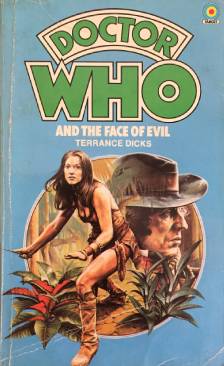
Chapter 39. Doctor Who and the Face of Evil (1978)

Synopsis: In the village of the Sevateem, the great god Xoanon speaks through his High Priest, Neeva, and his word is law. When he uncovers a lack of faith in a young huntress called Leela, Neeva banishes her under threat of death. In the jungle that surrounds the village, Leela encounters a stranger called The Doctor. She shows him a nearby mountain into which is carved a huge bust of Xoanon – and it bears the face of the Doctor…

Chapter Titles

  • 1. The Outcast
  • 2. The Invisible Terror
  • 3. Captured
  • 4. The Face on the Mountain
  • 5. Attack
  • 6. Danger for Leela
  • 7. The Test of the Horda
  • 8. Beyond the Wall
  • 9. The Tesh
  • 10. The Summons
  • 11. Xoanon
  • 12. The Trap
  • 13. The Last Battle
  • 14. Recovery
  • 15. Departure

Background: Terrance Dicks adapts 1977 scripts by Chris Boucher.

Notes: Tomas is in love with Leela and it’s expected that he will father many children with her, but after the verdict of her trial, he consoles himself that there are ‘other women’ in the tribe (you might spot the other one in film sequences in the original series). The Doctor arrives fresh from his adventure on Gallifrey fighting the Master [See The Deadly Assassin] and immediately misses having Sarah Jane Smith by his side; he recalls that he chose not to bring her to Gallifrey in respect for Time Lord law, and that she’s now back on Earth with Harry Sullivan and the Brigadier. The Doctor’s heading for Earth when the TARDIS brings him to the unnamed jungle planet. Leela is introduced on the first page and it’s a handsome description unlike that for any other companion, capturing her distinctive appearance and overall character in just three lines:

She was tall, with brown hair and dark eyes, a broad clear forehead and a firm chin. Her arms and legs, exposed by her brief skin costume, were brown and smoothly muscular. She stood before her accusers wary but unafraid, like a captured wild animal.

There’s a cheeky namecheck for the story title as Leela explains that the Tesh ‘set the Face of Evil on the mountain’ with their ‘magic’. A Horda is a ‘white, snake-like creature, rather like a giant slow-worm’, (unlike the purple bug / fish-like creature on telly).

Dicks places the Doctor’s first meeting with Xoanon within the haze of his last regeneration [a trip from some point in between his first and second appearances in Robot]. It’s an unseen adventure that his recuperating mind has forgotten until now. Xoanon speaks in three voices – the Doctor’s, that of a woman and a ‘young man’ (so not a child). The Sevateen village is wrecked by the invisible monsters, forcing the villagers to seek refuge in the jungle, explaining why Calib’s assault force is so depleted. The Doctor and Leela work their way through a foil tray of concentrated food cubes (not chocolates). The final scene takes place inside the TARDIS as Leela willfully ignores the Doctor and pulls a ‘large important-looking lever’ that closes the doors and sets them off on their next adventure together.

Cover: The original release has one of the very best covers ever, thanks to Jeff Cummins, with Leela stepping out of the jungle through a circular frame, while the face of the Doctor looms large in the background, all against a blue background. The 1993 reprint has a very jolly-looking Leela in front of two faces of the Doctor.

Final Analysis: Another basic adaptation and, around this time, Terrance Dicks was beginning to receive criticism from fans for his ‘script-to-book’ approach, but I think this is unjustified – at least here. While the prose lacks some of the depth we might expect from Malcolm Hulke or even newcomer Ian Marter, there’s still a lot of subtlety at play. The simple scene where Leela knocks out a Tesh guard gains a little from being told from the guard’s point of view, getting excited by the thought of capturing the aliens and the expectation that ‘he would win great praise from Jabel if he destroyed them’. We get a much better sense of Calib’s ambitions and of course Leela is well served in the way she begins to trust the strange Doctor precisely because his actions are at odds with her understanding of what Xoanon should be like. Readers had already met Leela just two books earlier, but as the text on the back of the 1993 edition states proudly, this is ‘the creation of one of the TV Series’ most memorable teams’.

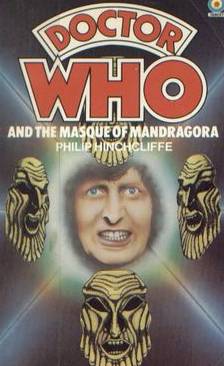
Chapter 38. Doctor Who and the Masque of Mandragora (1977)

Synopsis: A chance encounter with the Mandragora Helix results in the Doctor unwittingly transporting sentient and malevolent energy to 15th-Century San Martino. The energy quickly takes hold of Hieronymous, an influential astrologer and leader of a sinister cult. As the Doctor and Sarah try to limit the damage their arrival has caused, they find themselves snared in the fraught politics of San Martino. Can they help a young prince evade the murderous ambitions of his uncle, Count Federico? Will Hieronymous’s new-found power bring a dark and bloody end to the Renaissance?

Chapter Titles

  • 1. The Mandragora Helix
  • 2. The Brethren of Demnos
  • 3. Execution!
  • 4. Sacrifice
  • 5. The Prince Must Die
  • 6. The Secret of the Temple
  • 7. The Spell of Evil
  • 8. Torture!
  • 9. The Invasion Begins
  • 10. Siege
  • 11. Duel to the Death
  • 12. The Final Eclipse

Background: Philip Hinchcliffe adapts scripts from 1976 by Louis Marks.

Notes: Sarah has now been travelling with the Doctor for ‘several years’ but this is the first time she’s been allowed to explore deeper within the TARDIS. She is ‘Five feet five and a quarter’ – so an inch and a quarter taller than she is on telly, unless she’s counting the heel of her boots.  She apparently finds Giuliano attractive. Swit swoo!

Hinchcliffe tells us that it’s been a long time since the Doctor rode a horse (which might make you wonder when the last time might have been). As he finds the altar within the catacombs, he experiences a vision of the ‘Ghostly Temple of Demnos’:

He was filled with an unaccountable urge to escape, but as he ran towards the tunnel exit a large wall materialised in front of him with a deafening crash. Blindly he stumbled towards the other side of the cavern and a second wall blocked his path. The ghostly Temple of Demnos had sprung up before his very eyes! Panic-stricken he turned this way and that seeking escape but all around him thick stone walls seemed to be hemming him in. He was trapped.

Cover: Mike Little gives us a rather spooky composition for the first edition cover – the Doctor’s face is surrounded by darkness (as with The Deadly Assassin) and four faces of Hieronymous’s mask. A 1991 reprint had a cover by Alister Pearson showing Hieronymous sat on a throne alongside a rather cheery-looking Doctor.

Final Analysis: There can’t have been a fan in any of the libraries of the UK who didn’t mispronounce the title of this until they saw it on VHS or DVD, just as readers will have done when the same word ‘Mandragora’ appeared in the Harry Potter books (‘Man-DRA-gora’, not ‘MAN-dra-GOR-a’). It’s Philip Hinchclcffe’s second novel and another from his ‘golden era’, but it’s not one that allows for showboating. What we get is a straightforward retelling of the script with a few lines to explain the thought processes of the characters. We share the experience of Sarah’s falling under Hieronymous’s spell as her mind tries to make sense of the twisted logic it’s presented with, while her total lack of reaction to the possibility of meeting Leonardo Da Vinci is what first alerts the Doctor that something is wrong. Giuliano reacts beautifully to witnessing the departure of the TARDIS, inspecting the ground where it once stood, ‘puzzled but not afraid’:

‘There is a reason for everything,’ he said to himself. ‘Even this. One day science will explain it all.’

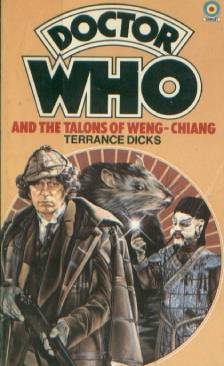
Chapter 37. Doctor Who and the Talons of Weng Chiang (1977)

Synopsis: A London music hall in the late 19th Century is the setting for murder. Its proprietor, Mr Henry Gordon Jago, has just secured the services of a master magician of Chinese origin while a mortician called Litefoot examines a body fished from the Thames and covered in huge bite marks. The Doctor and Leela follow the clues that lead them into the lair of a Chinese God…

Chapter Titles

  • 1. Terror in the Fog
  • 2. The Horror in the River
  • 3. Death of a Prisoner
  • 4. The Monster in the Tunnel
  • 5. The Quest of Greel
  • 6. The Tong Attacks
  • 7. The Lair of Weng-Chiang
  • 8. The Sacrifice
  • 9. In the Jaws of the Rat
  • 10. A Plan to Kill the Doctor
  • 11. Death on Stage
  • 12. The Hunt for Greel
  • 13. The House of the Dragon
  • 14. The Prisoners of Greel
  • 15. The Firebomb

Background: Terrance Dicks adapts the 1977 scripts by Robert Holmes, just seven months after they were broadcast.

Notes: The ghoulish woman on the dockside who (on telly) discovers the body of the cabby, Alf Buller, becomes an old man who wants his reward – until he sees the state of the mutilated body. The young woman who Leela saves from becoming a victim of Magnus Greel is named Teresa Hart and Dicks explains that she’s up in the small hours of the morning because she’s employed as a waitress in a gambling club across London in Mayfair – just in case there’s any possibility of some other reason why a woman might be walking the streets alone at that time of night.

As he did with the cuddly Yeti in The Abominable Snowmen, Dicks also solves the basic failure of the giant rat on TV, too clean and plodding in its original form, but now ‘huge and savage’ with red eyes’, a ‘trumpeting scream’ and ‘yellow fangs bared in fury’. 

The Doctor taunts Greel by offering him a jelly baby (although North American editions change this for a jelly bean – utter sacrilege!). On TV, the Doctor recalls that Mr Sin – aka ‘the Peking Homunculus’ – was given to the Icelandic Commissioner’s children as a toy, but ‘something went wrong’ and the thing was ‘almost’ the cause of World War Six, but here there’s a little more more detail: the homunculus was really a programmed assassin, which ‘massacred the Commissioner and all his family’, which then ‘set off’ the World War. We later learn that Magnus Greel was the inventor of Mr Sin and that he triggered the war intentionally. As part of a ‘Supreme Alliance’ of dictators, he was defeated at the Battle of Reykjavik and, branded a war criminal, used the time cabinet to flee with Mr Sin to 19th-Century China.

There’s a slight addition to the last scene, as Jago invites Litefoot to a ‘little tavern’ for a ‘celebratory libation’. And it’s the beginning of a beautiful friendship.

Cover: Jeff Cummins provides a wonderful composition of the Doctor in his Holmesian gear, holding a shotgun, while behind him are Mr Sin, a giant rat and a circular design evoking the sewer. This is his first cover for Target, even though The Mutants was published earlier – and apparently it was later stolen from his portfolio, never to return. The 1994 reprint boasted Alister Pearson’s final reprint cover (as this was also the final release of the original Target books run), featuring the Doctor, Greel, Mr Sin and the head of the ornate dragon-shaped ray gun.

Final Analysis: Recently, this story has come under attack for the unsettling undertones inherent in the very racist genre it takes its inspiration from. While much of the problems are still here – an assumption that all the Chinese population of Limehouse are opium addicts, Irish Casey having ‘a weakness for the bottle’ as well as the general racism of characters from the time – there’s one section that suggests Dicks was at least aware of certain ironies; as Jago appraises the great magician Chang, Dicks makes a dig at the casting in the TV serial:

Perhaps he really was from China as he claimed. After all he really was Chinese, unlike most Oriental magicians who were usually English enough once the makeup was off. 

But Dicks also spells out that Chang’s own stage persona, speaking in pidgin English, is an artifice he employs solely to appease his English audience’s expectations; in this version, it’s the audience who are very much at fault. 

The opening chapter feels like Malcolm Hulke has stepped in to provide some social context by focusing on the different strata within the audience of the Palace Theatre:

The body of the theatre and the Grand Circle above were filled with local people, tradesmen and their wives and families, bank clerks and shop assistants. High above in the top-most balcony, known as the ‘Gods,’ the poorer people were crowded onto hard wooden benches. Labourers, dock workers, soldiers and sailors, even some of the half starved unemployed – they’d all managed to scrape together a few coppers for the big night of the week.

It’s an atypical observation for Dicks, but there’s plenty of social commentary throughout the story. Professor Litefoot is from a ‘wealthy upper-class family’ and his ‘aristocratic relations’ have ceased trying to get him to relinquish his calling to do proper work in the East End, instead of pampering ‘silly women’ in Harley Street. Chang considers the workers of London as ‘peasants’ – but presumably this is a description that places himself on an equal level to them – all subjects to higher powers. It’s a difficult challenge, respecting the original author’s work while also taking opportunities to polish up the stories, so this one’s really down to your own background and exposure to ‘language and attitudes of the time’, I guess.

Chapter 36. Doctor Who and the Deadly Assassin (1977)

Synopsis: The Time Lords of Gallifrey enjoy immense power, living in isolation from the rest of the universe. On the day that the President of the Time Lords is expected to announce his successor, security is tight! Yet somehow, an obsolete and unauthorised time capsule – a TARDIS – has landed right in the heart of the Capitol. Its owner, a criminal called the Doctor, is nowhere to be found. Then the President is assassinated – and the Doctor is found holding the gun. But could there really be two rogue Time Lords at play? Soon, the future of the Time Lords will depend on a battle of wits between two bitter rivals – and it will be a fight to the death.

Chapter Titles

  • 1. Vision of Death
  • 2. The Secret Enemy
  • 3. Death of a Time Lord
  • 4. Trapped
  • 5. The Horror in the Gallery
  • 6. Into the Matrix
  • 7. Death by Terror
  • 8. Duel to the Death
  • 9. The End of the Evil
  • 10. The Doomsday Plan
  • 11. The Final Battle
  • 12. The End – and a Beginning

Background: Terrance Dicks adapts Robert Holmes’s 1976 scripts.

Notes: That epic crawl from the start of the TV version is dropped, though its main details are absorbed into the rest of the book. In his youth, the Doctor trained for a seat on the High Council on Gallifrey, but he grew frustrated at the ‘never-ending ceremonials and elaborately costumed rituals’ and the ‘endless accumulation of second-hand knowledge that would never be used’. The Doctor recalls ‘boyhood memories of forbidden games, of hide-and-seek’, while the spark that sent him to flee Gallifrey is described as ‘a final crisis’. Dicks builds in vague gaps in the story deliberately, as none of this completely contradicts other explanations for why he left Gallifrey, but it does add to his possible reasons. There are a few references to ‘the Omega crisis’ and the ‘Omega file’ [see The Three Doctors]. The Doctor’s TARDIS control room is in the more traditional configuration, with a console that has a column at the centre (the one on telly is the wooden one without a central column).

The large dome at the heart of the Capitol (not actually seen on TV until 2007) houses the Panopticon. Spandrell is ‘unusually broad and muscular for a Time Lord’ and Goth is ‘tall, handsome, immensely impressive in his elaborate robes’. Goth is now head of the Prydonians, with Borusa elevated to the status of ‘High Cardinal’. The captain of the Guard is Hildred (not Hilred). Runcible and the Doctor had been at school together, where Runcible had been ‘utterly fascinated by rituals and traditions’. Now, he’s a ‘small plump figure’ unlike his onscreen depiction. When the hypnotised guard, Solis, tries to wreck the APN cables, Spandrell shoots him repeatedly. 

The villain at the heart of the tale was revealed on TV in the end credits but it wasn’t spelled out until the Doctor saw the shrunken corpse of the cameraman and realised who he was up against. For the reader, Dicks teases the identity and after his accomplice calls him ‘Master’, he starts to use this as the villain’s title, but it’d still be fairly easy for a new reader to wonder if this is the Master, or just a master, especially as this Master is even more gruesome than on telly:

The cracked, wizened skin, stretched tight over the skull, one eye almost closed, the other wide open and glaring madly. It was like the face of death itself.

Later, the Master’s ‘bloodless lips [draw] back in a smile of hatred. The Doctor describes his enemy to Borusa thus:

He was always a criminal, sir, throughout all his lives. Constant pressure, constant danger. Accelerated regenerations used as disguise… He was simply burnt out.

During the trial, the Doctor interjects to confirm that the witness, an elderly Time Lord, can hear loud voices, thereby disputing the prosecution’s claim that he misheard the Doctor’s cries of ‘They’ll kill him’.

The final chapter uses a variation of a Terrance Dicks favourite – ‘The End – and a Beginning’.

Cover: The decaying Master leers from the top of the cover, while a stern-looking Doctor, flanked by two Time Lords in ceremonial robes and collars, looks off to the side. I can scarcely believe this is by Mike Little, it’s a huge step up from his previous efforts. 

Final Analysis: Not much to add to this, to be honest; it’s a straightforward adaptation, which is going to be the norm for a while now. Dick adds a few little details here and there, so as is often the case, it’s just a matter of scale – the Panopticon houses many more Time Lords from many other chapters than we could see on telly – but doesn’t change anything too much. When he’s working from scripts by his pal Robert Holmes, perhaps he doesn’t feel the need or the inclination.

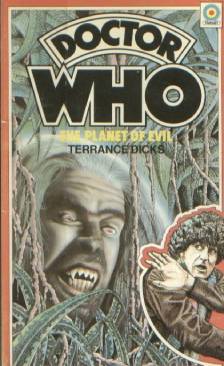
Chapter 34. Doctor Who and the Planet of Evil (1977)

Synopsis: An expedition party on the remote planet Zeta Minor has been devastated by unexplained deaths and a rescue mission finds only one survivor. The arrival of the Doctor and Sarah provides convenient suspects for the murders, but the Doctor realises there’s another possible culprit – the planet itself…

Chapter Titles

  • 1. Killer Planet
  • 2. The Probe
  • 3. Meeting with a Monster
  • 4. Tracked by the Oculoid
  • 5. The Lair of the Monster
  • 6. The Battle for the Spaceship
  • 7. The Creature in the Corridor
  • 8. Marooned in Space
  • 9. Sentenced to Death
  • 10. The Monster Runs Amok
  • 11. An Army of Monsters

Background: Terrance Dicks adapts Louis Marks’ 1975 scripts.

Notes: The plaque marking the grave reads ‘Edgar Lumb’ (not Egard as on TV). We’re reminded that this follows on from The Loch Ness Monster and on leaving the TARDIS, Sarah is not ‘in the least surprised to find that they’d arrived in the middle of a particularly sinister-looking alien jungle’, which might just be a comment on Sod’s Law, but this is the first alien jungle she’s ever visited – and, on TV at least, she doesn’t visit any others!

Ponti is said to be ‘tall and dark’ (played onscreen by Gambian actor Louis Mahoney) and De Haan is a ‘stocky fair-haired’ chap (unlike the dark-haired Graham Weston on TV). The Morestran advance party are transported to Zeta Minor by ‘force beam’, disintegrated in a capsule and reassembled on the planet’s surface. The Doctor’s descent into the Black Pool is surrounded by ‘many coloured swirling currents’, while the anti-matter beast appears to resemble a dragon at many points. We learn that Vishinsky returns home to a hero’s welcome and a much-deserved promotion, while Sorenson becomes ‘the most famous scientist in the Morestran Empire’. 

Cover: The first edition has a cover by Mike Little, which again lacks the sophistication of the previous artists, showing the Doctor (inset) cowering from a fanged, snarling Anti-Man in the jungle. Andrew Skilleter uses the same photo reference of the Anti-Man for the 1982 reprint but to a much higher standard.

Final Analysis: Continuing the horror theme of this period is a mash-up of The Tempest and Stephenson’s perennial Jekyll and Hyde. Dicks takes the time to create backstories for Vishinsky (overlooked for promotion but very experienced) and Salamar (ambitious with friends in high places, but under-qualified) that really enhance the characterisation. Other than this though, it’s a fairly consistent adaptation from screen to page.