Chapter 57. Doctor Who and the Power of Kroll (1980)

Synopsis: On the marshy moon of Delta Three, a methane refinery plant squats in the murky swamp. The small service staff have only minimal contact with the Swampies – primitive green natives whose village is nearby. The arrival of gun-runner Rohm Dutt on the planetoid coincides with that of the Doctor and Romana, still hunting for the Key to Time. Soon, the new arrivals will be forced into an uneasy partnership as they face the terrifying power of the Swampies’ god, Kroll.

Chapter Titles

  • Prologue
  • 1. The Swamp
  • 2. The Gun-Runner
  • 3. The Sacrifice
  • 4. The Tunnel
  • 5. The Thing in the Lake
  • 6. The Attack
  • 7. The End of Harg
  • 8. The Storm
  • 9. Escape Through the Swamps
  • 10. The Rocket
  • 11. Countdown
  • 12. The Power of Kroll
  • Epilogue

Background: Terrance Dicks adapts Robert Holmes’s scripts from 1978. This followed The Androids of Tara on TV, so this is the first time that three stories are released consecutively.

Notes: In the prologue (and with a lovely opening line: ‘Deep beneath the waters of the immense lagoon, Kroll slept’), we learn that Kroll has slept for hundreds of years, drawing power and growing in size due to swallowing whatever it was that the Key to Time had been disguised as. Then the men in rockets land on the planet and set up their rigs, which awakens the beast below the lagoon. In chapter 1, we’re told more about the Sons of Earth, an environmental pressure group concerned that the overpopulation of Earth is happening again on Delta Magna, and also regret over the displacement of the Swampies from their original home on Delta Magna to this moon (named here as Delta Three). Romana is again called a Time Lady and she’s wearing a bright orange tunic as well as boots to guard against the mud. We’re once more reminded of the mission to find the segments of the Key to Time.

Unusually for this kind of story, we’re told that Thawn’s crew are ‘all expert at their jobs and they worked well together, an efficient team’. Thawn tells Fenner that he’s seen Rohm Dutt on Delta Magna many times, which is how he knows the Doctor isn’t him. The roles of the named Swampies are clarified, so in addition to the chief, Ranquin, we have the war-chief, Varlik, and Skart is the High Priest, rather than just a part-time rubbish Kroll impersonator. Rohm Dutt thinks Romana might be a government spy. When the deception over the monster in the sacrifice is exposed, Romana is ‘disgusted with herself for being so terrified by such a simple device’. Significantly, when Thawn calls the Sons of Earth ‘fanatics’, Dugeen says ‘We are not fanatics’ (on TV, it’s ‘they’), so he’s not just sympathetic to the Sons of Earth’s cause, he is one of them. After he’s salvaged the Key to Time segment and saved the day, the Doctor suggests to Fenner that he should share his food stocks with the Swampie survivors.

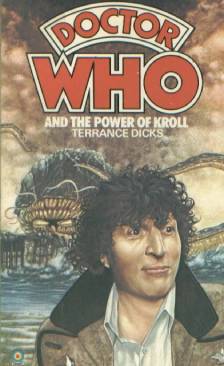
Cover: It’s not immediately obvious but this is a game-changing cover by Andrew Skilleter. A bemused Doctor smirks as Kroll thrashes behind him in the swamp, but it’s believed that this is the first cover to take reference from a screenshot from the episode itself instead of a publicity still (it’s the frame where the Doctor escapes Kroll’s tentacles and grabs the Key to Time segment). The back-of-book text included another promotional block: ‘THE POWER OF KROLL is a novel in the Key To Time Sequence. Also available THE RIBOS OPERATION, THE STONES OF BLOOD and THE ANDROIDS OF TARA. Coming soon: THE ARMAGEDDON FACTOR’. Hmm – one story is conspicuous by its absence (and will be for over thirty years!).

Final Analysis: We’re so very close to the end of this rather dry period for the books. Dicks once again translates the TV story onto the pages and makes it look easy, but he’s working from one of Robert Holmes’ worst scripts so there’s very little to work with. Dicks manages to add a little socio-economic commentary, but I can’t help feeling Malcolm Hulke would have done something more with this, had he still been around. We only have to wait a few years to see Holmes’ second attempt at the same story, for the fifth Doctor’s finale, and wait to see what Terrance Dicks does with that. Until then, we just have that final segment to find in the next book…
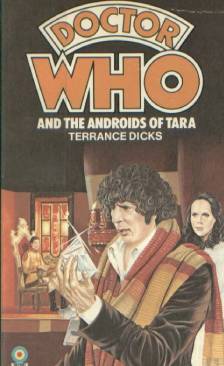
Chapter 56. Doctor Who and the Androids of Tara (1980)

Synopsis: The Doctor has gone fishing, leaving Romana to hunt down the next segment of the Key to Time. She completes her hunt with surprising ease, but just as quickly she becomes a prisoner of the scheming Count Grendel. Meanwhile, the Doctor’s holiday is interrupted by guards who serve Prince Reynart, a sickly monarch-in-waiting, whose reign is about to be cut short by Grendel. The Prince has an android duplicate of himself, which he hopes to use as a decoy long enough to ascend the throne. The android, however, doesn’t work. Separately, the Doctor and Romana work from opposite sides to fix the state of Tara. 

Chapter Titles

  • 1. The Doctor Goes Fishing
  • 2. Count Grendel
  • 3. The Double
  • 4. The Princess
  • 5. The Prisoner of Gracht
  • 6. The Android King
  • 7. Invitation to an Ambush
  • 8. The Android Killer
  • 9. Flag of Truce
  • 10. Count Grendel plans a Wedding
  • 11. Attack by Night
  • 12. Victory

Background: Terrance Dicks adapts scripts by David Fisher for his second story from 1978. This followed The Stones of Blood on TV, so that’s another pair of stories to be released consecutively.

Notes: The statue that transforms into the Key to Time segment depicts ‘a vaguely dragon-like heraldic beast, thrusting time-blunted claws towards the blue summer sky’. The very-much-alive creature that attacks Romana is a very generous evolution of the short, comedic beast seen on telly:

The monster was a good eight feet tall – and it walked upright like a man. It had coarse black fur, slavering jaws filled with yellow, pointed teeth and a stubby horn projecting from the centre of its forehead. A mixture of bear, ape and boar, with the nastiest features of all three. 

Count Grendel is said to possess a ‘darkly handsome face’ which is ‘marred only slightly by a fiercely jutting beak of a nose’ – an unflattering description of actor Peter Jeffrey. At the end, the Doctor rescues the adrift K9 – and Romana jokes that he ‘managed to catch a fish on Tara after all’ – before the time travellers depart in the TARDIS.

Cover: A scene painted by Andrew Skilleter shows the Doctor inspecting a segment of the Key to Time, watched by Romana (in her Ribos costume), appearing on a cover for the first time. In the background, K9 makes his first appearance on a book cover too, looking up at the Prince on his throne. The back cover announces ‘THE ANDROIDS OF TARA is a novel in the Key To Time Sequence. Read THE RIBOS OPERATION and THE STONES OF BLOOD available now.’ (said books didn’t carry this linking text).

Final Analysis: Around the time that this book was published, Shredded Wheat had an advertisement campaign that boasted that the product had ‘nothing added, nothing taken away’. Aside from the exaggerated details of the beast in the woods, this is all we get here. I still think it’s not fair to dismiss Dicks’ writing simply as just adding ‘he said / she said’ to the script, as he paints a vivid picture of the castles and woodlands of Tara, but this is a great example of Dicks at his most perfunctory. Everything that we might like about this came from David Fisher.

Chapter 55. Doctor Who and the Stones of Blood (1980)

Synopsis: A stone circle in southern England, known locally as ‘The Nine Travellers’. Which is strange, as clearly there are more than nine stones. This is just one of many legends from the region. Another speaks of a woman who lives for centuries, who might have been a Celt goddess called ‘The Cailleach’. And then there’s the tale of two time travellers who expose a galactic criminal and discover a spaceship hidden in another dimension… 

Chapter Titles

  • 1. The Awakening of the Ogri
  • 2. The Circle of Power
  • 3. De Vries
  • 4. The Sacrifice
  • 5. The Ogri Attack
  • 6. The Cailleach
  • 7. The Vanished
  • 8. The Prison Ship
  • 9. The Victims
  • 10. The Trial
  • 11. Surprise Witness
  • 12. Verdict

Background: Terrance Dicks adapts scripts by David Fisher for a story from 1978.

Notes: As The Pirate Planet wasn’t scheduled to be novelised at this point (or indeed, at any point in the foreseeable future), the first chapter explains that the second segment of the Key to Time was found on the planet Calufrax, which is almost right. As on TV, Romana learns that she wasn’t assigned to the Doctor by the President of Gallifrey but by the White Guardian, which amends the alternative continuity established by Ian Marter in The Ribos Operation. The Key to Time pieces are kept in the TARDIS control room inside a ‘wall-locker’ that opens to the Doctor’s palm-print. Professor Amelia Rumford mistakes the Doctor for Doctor Cornish Fougous (rather than an academic who specialised in Cornish fogous). Martha had been a school teacher before she met De Vries and she joined the druid cult to liven up an otherwise dull life. The doomed campers are newly-weds. The Megara are floating silver spheres about the size of a football. The Doctor namedrops Tacitus and Julius Caesar, who he was particularly pally with even though he refused to accept advice and the Doctor had to dress up as a soothsayer to warn him about the ‘ides of March’.

Cover: A composition by Andrew Skilleter featuring the Doctor, the Cailleach and some cult members among the flame-lit stones.

Final Analysis: Possibly Dicks’ most straightforward adaptation of a TV story so far, though he does offer up an delightful description of Professor Rumford: 

The woman was quite old, though her back was straight, her eyes clear and alert. Her straggly hair was a snowy white, her face a mass of lines and wrinkles. It was the face of a woman of formidable character.

He’s clearly more interested in her than Vivien Fay, who is ‘a tall, strikingly attractive dark-haired woman in her forties’ but doesn’t really receive much more attention. This is particularly odd when we consider that the last time she’s described at all in the book, she’s dressed as a bird-faced Celtic goddess and on TV she arrives on the space-ship in a silver gown with metallic skin to match.

Chapter 54. Doctor Who and the Invasion of Time (1980)

Synopsis: The Doctor has returned home to claim the Presidency of the Time Lords. As the Gallifreyan elite is driven to panic by this shocking development, this is just the first in a chain of horrific events as the new President banishes senior figures to the barren wastelands of Gallifrey – including his friend Leela. And then the Vardans arrive. This is all part of a trap created by the Doctor to defeat the invaders, but the trap backfires when the Vardans are vanquished and in their place arrive the Sontarans!

Chapter Titles

  • 1. Treaty for Treason
  • 2. The President-Elect
  • 3. Attack from the Matrix
  • 4. The Fugitive
  • 5. The Betrayal
  • 6. The Invasion
  • 7. The Outcasts
  • 8. The Assassin
  • 9. The Vardans
  • 10. False Victory
  • 11. The Sontarans
  • 12. The Key of Rassilon
  • 13. Failsafe
  • 14. The Chase
  • 15. The Wisdom of Rassilon

Background: Terrance Dicks adapts the 1978 scripts attributed to David Agnew (Anthony Read and Graham Williams). This followed Underworld on TV, so that’s another pair of stories to be released consecutively.

Notes: Leela has brown eyes again [see The Horror of Fang Rock]. There are many references back to The Deadly Assassin that provide clarification or other information that wasn’t revealed in the onscreen Invasion of Time. There’s a summary of the events that led to the Doctor assuming the position of President by default, including the Doctor’s previous encounter with the Matrix, as well as an explanation that as there was no other candidate available, and the Doctor was absent, Borusa took on the role of acting President as well as Chancellor, making him extremely powerful. Castellan Spandrel has retired and his very recent replacement, Kelner, quickly established a Bodyguard Squad to protect himself; Kelner took possession of a suite of offices that are… :

… of transparent plastic and gleaming metal, with complex control consoles and brightly flickering vision screens everywhere. It was over-technological even by Time Lord standards, but Kelner, the new Castellan felt it helped to maintain his image. 

Kelner is ‘thin-faced, nervous, rather insecure Time Lord’ who gained his position thanks to ‘good birth and political intrigue’. He has a bodyguard who is ‘very big, very brave, and very stupid’. Terrance Dicks maintains the impression given in The Deadly Assassin of the ceremonial chamber at the centre of the Panopticon and the scale of the Time Lord ensemble, which could never be achieved on TV:

The grand hall of the Panopticon is an immense circular chamber used by the Time Lords for all their major ceremonies. It is one of the largest and most impressive chambers in the known universe. The immense marble floor is big enough to hold an army, the domed glass roof seems as high above as the sky itself. Row upon row of viewing galleries run around the walls, and on the far side of the hall an impressive staircase leads down to a raised circular dais. By now the hall was filled with rank upon rank of Time Lords, all wearing the different-coloured robes and insignia of the different Chapters, the complex social family and political organisations that dominated Time Lord Society. 

The Great Key of Rassilon is just a lost artefact on TV, but Dicks ties it to the one named in The Deadly Assassin; the one the Master stole was a replica and the real one is kept in the possession of the Chancellor; also unlike on TV, the Doctor deduces which one of Borusa’s keys is the correct one without Borusa first offering a decoy. The buildings on the edge of the Capitol have ‘sheer white walls’ and the gleaming towers can be seen many miles away. 

Rodan is described as a ‘Time Lady’. The Outsiders live in log huts. Nesbin was expelled from the Capitol for an unprecedented violent attack upon another Time Lord. Ablif is a ‘burly young man’ and is the Outsiders who first captures Leela and Rodan – and gains a scratch across his face for his troubles. Jasko is also a ‘burly young Outsider’ who isn’t ‘especially bright’ but is ‘brave and strong’ and obedient. While these two Outsiders appeared on TV, a third member of the assault party is called ‘Jablif’ and it’s he who is fatally wounded but manages to kill a Sontaran before he dies.

Dicks’ description of Stor echoes that from Robert Holmes’ prologue for The Time Warrior:

The head was huge and round and it seemed to emerge directly from the massive shoulders. The hairless skull was greeny-brown and small red eyes were set deep in cavernous sockets. The nose was a snubby snout, the wide mouth a lipless slit. 

Stor calls our hero ‘Dok-tor’ as if it’s his name, which is lovely.

Cover: Andrew Skilleter paints a much-minicked design of the Doctor and Stor smothered by metal cogs.

Final Analysis: Terrance Dicks guides us through what was actually quite a complicated script and helps it make sense along the way. Even Leela’s sudden departure is given a little assistance (in Leela’s tribe, it turns out, the women choose the men and Andred’s fighting skills and bravery clearly impressed her). He also succeeds in making the Vardans seem impressive: 

The space ship was enormous, terrifying, a long, sleek killer-whale of space. Its hull-lines were sharp and predatory and it bristled with the weapon-ports of a variety of death dealing devices. Everything about it suggested devastating, murderous power. 

… so that when their human forms are revealed, it’s more dramatic and less underwhelming as they’d already been fairly disappointing before the reveal. We’re still in this dry period where the books largely transcribe what happened on TV, but here, this at least prevents everything from feeling as cheap and improvised as it does on home video.

Chapter 53. Doctor Who and the Underworld (1980)

Synopsis: A group of space travellers seek the lost gene banks of the Minyans, a race of beings with tragic connections to the Time Lords. When their space craft becomes surrounded by a planet, the Minyan travellers discover a subjugated race – the Trogs – who live in underground tunnels as the slaves of the Seers and the god-like Oracle. Could these slaves be the descendants of the lost Minyans? The answers rest with the Oracle – and the quest is the quest…

Chapter Titles

  • Prologue
  • 1. The Nebula
  • 2. The Minyans
  • 3. The Intruders
  • 4. The Quest
  • 5. Buried Alive
  • 6. The Trogs
  • 7. Skyfall on Nine
  • 8. The Smoke
  • 9. The Mouth of the Dragon
  • 10. The Sword of Sacrifice
  • 11. The Crusher
  • 12. The Battle
  • 13. Doomsday
  • 14. The Legend

Background: Terrance Dicks adapts the 1978 scripts by by Bob Baker and Dave Martin.

Notes:  We begin with a prologue (how I love a prologue!) that details the events that led to the loss of Minyos and the isolation policy of the Time Lords. Back in The Invisible Enemy, the Doctor complained that the TARDIS control room is such a boring colour – ‘No aquamarines, no blues. No imagination!’ – and here, he’s trying to paint the control room aquamarine and getting paint everywhere (but in the final scene, he’s painting it white again). On learning of the sword ritual, the Doctor reminds Leela that her own tribe had a similar trial by ordeal. Leela suggests that they return to the TARDIS and leave the Minyans to their fate but the Doctor wants to solve the mystery of the P7E.

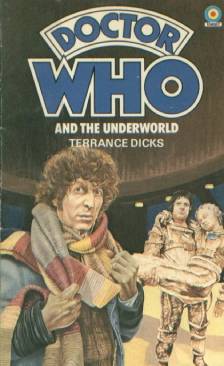
Cover: Bill Donohoe combines two photo reference from this story to create something rather like a pulp sex book you’d find in the saucy rack in a 1970s newsagent – the Doctor looks pensive  while Herrick carries a near-death Tala – as if we’ve just walked in on a scene we don’t really want to be a part of.

Final Analysis: This would always be a tricky one, a real clunker from Bob Baker and Dave Martin (the kings of overambition) and it’s one that’s always been unpopular for good reason. Devoid of the visibly low budget of the TV version, we’re left with a story with no recognisable human interaction, just mythology that gets a bit repetitive. It’s a relief that Terrance Dicks finds a way to highlight that humanity: The father who grieves for his lost wife and daughter after they’re killed in a landfall is a rare highlight. Something I’ve noticed though is that the Fourth Doctor in this period is brash and often his overconfidence borders on bullying, which makes him hard to like. The real highlight is that Dicks makes great use of K9 for his comedy potential, the wilfully over-literal explanations are hilarious.

Chapter 52. Doctor Who and the Ribos Operation (1979)

Synopsis: The White Guardian compels the Doctor (on pain of nothing… ever) to undertake a mission to find the six segments of the Key to Time. As part of the mission, the Doctor is given a new companion in the form of Romana. On the planet Ribos, a pair of grifters called Garron and Unstoffe are setting up an elaborate con, assuming the locals are too primitive to see through their scheme. Unfortunately, they have underestimated a visiting despot by the name of the Graff Vynda Ka .

Chapter Titles

  • 1. Unwelcome Strangers
  • 2. The Beast in the Citadel
  • 3. A Shaky Start
  • 4. Double Dealings
  • 5. Arrest and Capture
  • 6. Unlikely Allies
  • 7. Escape Into the Unknown
  • 8. The Doctor Changes Sides
  • 9 .Lost and Found
  • 10. Conjuring Tricks

Background: Ian Marter adapts the 1978 scripts by Robert Holmes.

Notes: The opening scene has the Doctor and K9 being rather snarky with each other. The Doctor suggests ‘Occhinos’ as a holiday destination.The TARDIS doors are opened from the inside by a brass handle. The Guardian sits within an exotic garden that features huge orchids and fountains. The garden disappears along with the Guardian, leaving the Doctor teetering on the edge of space and he has to propel himself backwards into the TARDIS. The Guardian makes no mention of a new companion for the Doctor; it’s left to Romana to introduce herself. Her tracer device is presented as the ‘Locatormutor Core’ and she knows of the existence of the Guardian (on TV, she’s left under the belief that she was selected for the mission by the President of the Time Lords). She graduated from the Academy with a ‘Triple Alpha’ and claims the Doctor achieved a ‘Double Gamma… on [his] third attempt’. The initial destination is Cyrrhenis Minimis (not ‘Minima’). 

We learn that, while he was away fighting campaigns alongside his Cyrrhenic allies, the Graff Vynda Ka (‘not ‘K’) was deposed by his half-brother on the Levithian throne; his alliance forgotten, he received no help from his former allies and he now lives in exile (we lose the rest of his back story from the TV episodes). Thanks to its elliptical orbit, Ribos’s summer (the ‘Sun Time’) lasts 11 years. The Doctor refers to Garron and Unstoffe as ‘Laurel and Hardy’ before apologising to Romana for the reference. When the Doctor is searched, Sholakh finds ‘an ear trumpet. a corkscrew, string, marbles, a magnifying glass, a paper bag with a few jelly babies melted into a lump…’ – some of which have been referenced by Marter in his previous books. There are many Shrivenzales living in the catacombs under the city. The Seeker is…:

… a scrawny hag dressed in long strips of crudely dyed remnants. Her frizzled grey hair was parted on the crown of her domed head, and it reached almost to her feet in a thickly tangled cascade.

She survives the knives of the Graff Vynda Ka and crawls off towards the Hall of the Dead, only to be caught in the blast of the Shrieve’s cannon. Despondent after the cave-in, Garron wonders if it would be possible to commit suicide with the Locatormutor Core. 

Chapter 7 brings Ian Marter’s take on a popular title, ‘Escape into the Unknown’, almost the same one Terrance Dicks used in Death to the Daleks. 

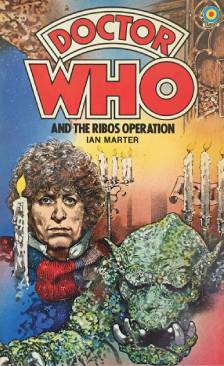
Cover: John Geary created an atmospheric shot of the Doctor, a shrivensale and some moody candles.

Final Analysis: It wasn’t one of Robert Holmes’ greatest scripts and sadly it’s not one of Ian Marter’s best books either. There’s little room for Marter’s violent imagery here and it’s all a bit flat. Without the performances to help sell the characters, Garron and Unstoffe lack any depth beyond their grift, while the Doctor is a horrific bully to Romana (something that was thankfully phased out on screen within a couple of stories, but which comes across as much more savage here). Marter is able to make the lumbering TV shrivenzale into a fearsome beast with claws that make sparks against the catacomb walls and he takes on the death of Sholakh and makes it a little bloodier, but… no, this is largely as dull as I’d expected.

I’ve got to be honest, this is the beginning of a run of books I’ve been dreading.

Chapter 51. Doctor Who and the Destiny of the Daleks (1979)

Synopsis: The Doctor and Romana explore a dead world, unaware that one of them has been there before. A spaceship arrives containing the beautiful Movellans who inform the Doctor that the planet is Skaro – home of the Daleks – and their mission is to find the Dalek creator, Davros. But Davros is dead… and coincidentally, so is Romana!

Chapter Titles

  • 1. The Dead City
  • 2. Underground Evil
  • 3. The Daleks
  • 4. The Movellans
  • 5. Slaves of the Daleks
  • 6. Escape
  • 7. The Secret of the Daleks
  • 8. The Prisoner
  • 9. The Hostages
  • 10. The Bait
  • 11. Stalemate
  • 12. Suicide Squad
  • 13. Blow-up
  • 14. Departure

Background: Terrance Dicks adapts Terry Nation’s scripts for a story that aired just two months earlier.

Notes: Dicks calls Romana a ‘Time Lady’ and summarises the events from the climax of The Armageddon Factor, which hasn’t been novelised yet. The Doctor surmises that Romana’s higher score at the academy accounts for her greater control over how she regenerates, unlike his own traumatic experiences. They arrive on the strange dead world at night during a storm (it’s a bright, sunny day on TV). The slaves bury their dead under rocks because the foundations of the city ruins are too thick to dig up. The dead body that the Doctor investigates was a ‘Space Major Dal Garrant’ (so close to that familiar ‘Tarrant’ that Nation often used). While pinned under the fallen masonry, the Doctor reads ‘The Origins of the Tenth Galaxy’,  written by a ‘particularly pompous Time Lord historian’ who he has never liked. He’s interrupted by the arrival of just two Movellans (Lan and Agella) and they’re wearing ‘simple, military-type space coveralls’, rather than the beautifully distinctive space-dreadlocks and Top of the Pops dance-troop suits. On the Movellan spaceship, Commander Sharrell’s rank is denoted by an insignia on his uniform. 

Sharrel does not identify the planet they’re on beyond the serial number. Only later does the Doctor discover that it’s Skaro, when Tyssan tells him. As Davros revives, his eyes open [see The Witch’s Familiar in 2015]. The journey to the surface with Davros involves a long, steep, spiralling ramp. The Daleks cheat and make their way to Davros’s level using ‘eerily silent anti-grav discs’ as seen in Planet of the Daleks. Disappointingly, the Doctor doesn’t tell the Daleks to ‘spack off’. The Dalek mutant that he encounters in the sand dunes is more active than the blob of Slime-with-Worms from TV. It’s a ‘pulsating green blob, a kind of land-jellyfish’ that crawls up his arm. There’s a fair bit of gender-swapping here: Veldan and Jall’s genders are reversed, the Daleks’ sacrificial victims are both male and the Movellan that captures the Doctor and Tyssan is also male. Romana doesn’t dismember Sharrel during their fight, she merely kicks away his power tube.

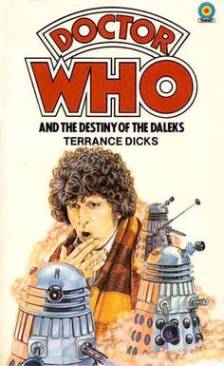
Cover: Welcome Andrew Skilleter, who surrounds an image of the Doctor (based on a pic from The Pirate Planet) with very TV Century 21-style Daleks moving around in fog, as if at a disco. Alister Pearson’s 1990 reprint cover puts the Doctor and Romana alongside a moody Davros in profile, a Dalek and Agella against a salmon background.

Final Analysis: Destiny of the Daleks seems to polarise opinion, but as it was the first Dalek story where I was old enough to follow the plot in full, I didn’t care about how tatty the props looked or that the central point about a robotic impasse shouldn’t have worked because Daleks aren’t robots. I just enjoyed it for being Daleks on my telly. This novelisation is, for me, the first point in this project where Terrance Dicks’ straightforward script-to-page approach feels a little lacking. Racing to get this story novelised meant that Romana v2 is introduced before V1 – we’ve leapt past a season and a half of stories, which is quite confusing – but there’s no real explanation as to who Romana is, only that she’s changed and she’s from Gallifrey. The Movellan costumes are described in such generic terms that they lose some of their onscreen glamour, and it’s all a little… thin. However, there is this lovely harkback to Genesis of the Daleks, which highlights a decision the Doctor has returned to time and time again:

The Doctor sighed. He had hesitated once before, at a time when he could have destroyed the Daleks before their creation, simply by touching the two wires that would complete an explosive circuit. Who knows what horrors he had unleashed upon the Universe? The Daleks were stronger now and more numerous, and with Davros to help them… He must not hesitate again. The Doctor pressed the switch. 

Bonus Chapter #1. Junior Doctor Who and the Giant Robot (May 1979)

Synopsis: A giant robot created by evil scientists stalks through the night, smashing everything in its path, while the Doctor recovers from changing his body. It’s the same plot as Doctor Who and the Giant Robot, but much, much faster!

Chapter Titles

Almost identical to the original novel, apart from an edit to chapter two.

  • 1. Killer in the Night
  • 2. More than Human
  • 3. Trouble at Thinktank
  • 4. Robot!
  • 5. The Killer Strikes Again
  • 6. Trapped by the Robot
  • 7. The World in Danger
  • 8. In the Hands of the Enemy
  • 9. The Battle at the Bunker
  • 10. The Countdown Begins
  • 11. The Kidnapping of Sarah
  • 12. The Giant Terror

Background: Terrance Dicks rewrites his previous adaptation of the story for ages 5-8.

Notes: The whole story is streamlined down to very simple descriptions and dialogue. Harry’s entire James Bond subplot is reduced down to two lines before he’s knocked out (and he calls the Brigadier on a radio rather than finding a telephone). The story ends with the Doctor watching as the robot turns to rust and is blown away. He muses whether he can tempt Sarah off on another adventure – but there’s no mention of Harry joining them.

Cover & Illustrations: The cover by Harry Hants has a slightly caricatured Tom Baker with a very detailed side-on view of K1 and an army truck. Peter Edwards provides 46 line illustrations that aren’t exactly flattering to their subjects but are still better likenesses of the guest cast than most of the early Target books had (they’re reminiscent of the kind of illustrations Terrence Greer used to do for Penguin, or it might remind modern adult readers of the grotesque characters in BBC Three’s animated comedy Monkey Dust). There’s a joyful picture of the Doctor emerging with a beaming grin from the TARDIS in a Viking outfit, while the scene of the virus being flung at the robot is gleefully epic. Kettlewell is, surprisingly, more refined than on telly, a bespectacled bald man, lacking the TV version’s crazy hair.

Final Analysis: Writing for younger children, Dicks manages to get all the details lined up in the correct order and rushes through the story with lots of energy. As the original novel was also the first not to have any illustrations, Peter Edwards’ ink drawings are a real treat that really help to tell the story rather than just break up the text.

Chapter 49. Doctor Who and the Image of the Fendahl (1979)

Synopsis: Time experiments in an old priory resurrect an ancient evil. The Doctor and Leela arrive just as the manifestations begin – an image of the Fendahl, a legend from the Doctor’s own people that brings with it death – but how can they kill death itself?

Chapter Titles

  • 1 The Skull
  • 2 Dead Man in the Wood
  • 3 Time Scan
  • 4 Horror at the Priory
  • 5 The Fendahleen
  • 6 The Coven
  • 7 Stael’s Mutiny
  • 8 The Missing Planet
  • 9 Ceremony of Evil
  • 10 The Priestess
  • 11 Time Bomb
  • 12 The End of the Fendahl

Background: Terrance Dicks adapts scripts from 1978 by Chris Boucher.

Notes: We start with an introduction to the fated walker, who recalls a rhyme about a ‘frightful fiend’ on a ‘lonely road’. It’s not exactly confirmed onscreen but Colby is a professor, while Professor Fendelman has become ‘Fendleman’. Thea Ransome is described as being ‘strikingly attractive’, while Max Stael has ‘stiff Germanic good looks’ and ‘rather woodenly handsome features’ (which feels like a dig at actor Scott Fredericks). 

We’re reminded where K9 came from, although this story doesn’t necessarily follow on immediately from The Invisible Enemy, as K9 has ‘developed some mysterious ailment’. Leela (or maybe just the narrator) wonders if the Doctor’s love of Earth wore off when he was exiled there by the Time Lords (let’s hope it’s the narrator as Leela wouldn’t know this) and Leela recalls her trip to a music hall [See The Talons of Weng Chiang]. Dicks explains the joke behind calling Colby’s dog ‘Leakey’, a tribute to ‘the famous anthropologist’. 

Security Team leader Mitchell’s first name is Harry. By the way, in both the TV serial and this book, Stael is ordered to call ‘Hartman’ in London to send a security team to the priory; I’m calling this now with zero evidence – Hartman works for Torchwood.

Cover: John Geary paints the Doctor being menaced by a fendahleen in front of a grandfather clock in a wooden-panelled room.

Final Analysis: I remember reading this accompanied by a fan-made audio recording of the TV episodes and I managed to pretty much keep time with the programme. It’s a slim volume, possibly the slimmest, and it’s by no means as gory as it could have been, but Dicks maintains the horror levels rather nicely for a children’s book: The Doctor considers his first view of an adult fendahleen to be ‘the nastiest looking life-form he had ever seen’.

In shape it was vaguely like an immensely thick snake, though the segmented front gave a suggestion of a caterpillar. It was green, and glistening, and it seemed to move on a trail of slime, like a shell-less snail.

Later, the ‘green slimy skin’ of a dead fendahleen is said to have ‘burst in several places like rotting fruit’ – nice!

Chapter 48. Doctor Who and the Robots of Death (1979)

Synopsis: Aboard a mining vessel, the crew consists of indolent humans who allow robotic servants to do all the work. When one of the crew is found murdered just as the Doctor and Leela arrive, suspicion naturally falls upon the strangers. But as the murders continue, the crewmembers begin to suspect each other. Leela wonders why the killer couldn’t be the mechanical men, but it’s against their programming – robots cannot kill… can they?

Chapter Titles

  • 1 Sandminer
  • 2 Murder
  • 3 Corpse Marker
  • 4 Death Trap
  • 5 Captives
  • 6 Suspicion
  • 7 The Hunter
  • 8 Sabotage
  • 9 Pressure
  • 10 Robot Detective
  • 11 Killer Robot
  • 12 Robot Rebellion
  • 13 The Face of Taren Capel
  • 14 Brainstorm

Background: Terrance Dicks adapts Chris Boucher’s scripts from 1977, completing Target’s adaptations of Season 14 stories and the first three seasons of the Fourth Doctor.

Notes: The vessel is called ‘The Sandminer’ (it’s ‘Storm Mine 4’ on TV) and Dicks describes it as ‘a massive metal crab on an immense, multi-coloured sea of sand’. Cass is said to be ‘young and muscular, dark-skinned like Zilda’ (he’s also rather difficult to kill as he’s accidentally included in the assembled crew scene in Chapter 6 that takes place after his death. Oops!).

The robots are all silver (not shades of metallic green like the onscreen versions), have ‘high, polished boots’ (not bacofoil moccasins) and their numbers are denoted on a collar around the neck, rather than on the chest-plates. When Uvanov says it’s some consolation that the murders have increased their own share of the takings, it’s Toos, not Zilda who corrects him that it’s ‘no consolation’. ‘Lucanol’ is the rarest mineral of all. Poul clarifies that Chub’s weather balloons contained helium, which sets up the trap that catches Dask at the end.

As the ore threatens to drown him, the Doctor goes full-on Sherlock Holmes to work out a solution to the problem:

In any kind of emergency, the first thing to do is think. Wrong action can be worse than no action at all. 

… and dismisses a number of options before settling on breathing through the tube. 

There were 20 families who came from Earth to colonise the planet and it’s their descendants who are known as ‘Founding Families’.  Poul reveals that many of the crewmembers on this tour were working for Uvanov on the tour that saw the death of Zilda’s brother. Robophobia is known as Grimwold’s syndrome (not ‘Grimwade’ as on TV). Dask’s ‘robot upbringing’ is expanded upon, laying the blame for his madness on the ‘lack of parental love’. The Doctor and Leela stay long enough for the survivors to send a distress satellite and request a rescue ship.

Cover: John Geary joins the family of Target artists with an attractive golden Voc and a lovely illustration of the Doctor holding a Laserson probe. The 1994 reprint was one of the very last Target publications and it had a painting by Alister Pearson showing the Doctor, a Voc face (as well as a full-length Voc) and the Sandmine, with a background inspired by the Sandmine decor.

Final Analysis: Terrance Dicks continues to provide us with a pre-home-video copy of the broadcast story, but he doesn’t get anywhere near enough recognition for the way he paints each scene, not just what we might have seen, but how it should have made us feel, as in this paragraph where the Doctor meets the mine crew for the first time:

He studied the people around him, the elaborate robes and head-dresses, the complex designs of the face paint. It was a form of dress typical of a robot-dependent society, in which no human needed to perform any manual labour.

Efficient, precise and slightly critical. And then he turns his attentions to Uvanov:

There was something pathetic about Uvanov. A middle-aged man pretending to be young, a weak man trying to be strong.

Yet just a few pages later, we’re told:

At times like this, there was something curiously impressive about Uvanov. Whatever his other faults, he was the complete professional when it came to his job.

Chris Boucher’s scripts were already among the best of the series up to this point (and, dare I say it, beyond), but it’s down to Dicks that this opportunity isn’t wasted. 

Even if he does accidentally resurrect one of the murder victims…