Chapter 6. Doctor Who and the Doomsday Weapon (1974)

Synopsis: The Master has stolen information from the Time Lords regarding a mythical weapon, which can be found on a planet recently occupied by Earth colonists. The desperate people are caught between hostile attacks from the indigenous natives and a mining corporation intent on taking the planet’s resources for their own ends. All this awaits Jo in her first trip in the Tardis.

Chapter Titles

  • 1. A Missing Secret
  • 2. Into Time and Space
  • 3. The Planet
  • 4. The Monster
  • 5. Starvation
  • 6. The Survivor
  • 7. The Robot
  • 8. The Men from IMC
  • 9. The Spy
  • 10. The Claw
  • 11. Face-to-face
  • 12. The Bomb
  • 13. The Attack
  • 14. The Adjudicator
  • 15. Primitive City
  • 16. The Ambush
  • 17. Captain Dent Thinks Twice
  • 18. The Master’s TARDIS
  • 19. The Return of Captain Dent
  • 20. The Doomsday Weapon

At twenty, this book sets a record for the most number of chapters in a novelisation, which will remain unbroken until 1985.

Background: Malcolm Hulke adapts his scripts from 1971 for Colony in Space.

Notes: Another prologue of a scene that never happened, as an old Time Lord shares stories with an apprentice, revealing the history of early TARDISes and his own personal involvement in the resolution of The War Games returning the kidnapped soldiers to their rightful times. He refers to the Doctor’s TARDIS and the fact that it’s lost its ‘chameleon-like quality’. There’s also another cheeky ‘Who’ reference as the old Time Lord explains the Doctor’s inability to pilot his TARDIS: ‘‘Who? No, Who can’t control it… not always.’

Newly qualified security agent Jo Grant is introduced, having come top of her year in spy school before getting her uncle to pull some strings to arrange a posting to UNIT, where she’s ignored by everyone except Sergeant Benton and attempts to reprimand the Doctor before she finds herself whisked off to an alien world as her very first adventure. A lovely if inconsistent flashback. Meanwhile, Jane Lesson recalls being aware of other ‘terrifying space creatures’ ‘Monoids, Drahvins, some small metallic creatures called Daleks’ before referencing Hulke’s own creations, the ‘reptile men’.

The story’s set a bit further forward in time, 2972, and there’s a grim but casual detail in the Doctor realising that the colonists describe a creature ‘like a big lizard… from the picture books’ because the Earth animals were ‘exterminated by Mankind by the year 2500’ and not because, for example, they were describing dinosaurs. The Doctor speculates on the size of an attacking creature as ‘about twenty feet high’ and then corrects himself to ‘six metres’ as he remembers that all of Earth went metric a thousand years before. Surprisingly, the IMC robot is described as humanoid – a much more achievable look on TV than the bulky robot we ended up with (and the illustrations don’t quite match this new design either). Hulke provides an unsettling vision of the future: The entire surface of Earth in this time is covered in tiny cube apartments within huge buildings; The Interplanatary Mining Corporation arranges marriages based on computer-decided compatibility (though strangely Dent’s marriage seems happy while Caldwell’s has ended in separation); food is sourced solely from the sea; even when IMC chief Dent offers his team champagne, it’s from a can.

There’s a hint of the first pioneers across America here as the colonists have never done physical work (‘on Earth machines did everything’) so they’re even more badly equipped to found a new civilisation than it might appear. But when they have to consider how to bury their dead, Ashe recalls an ‘audiobook’ from back when Earth ‘still had open land’; it seems that even the disposal of dead bodies on Earth is automated as the Doctor has to explain to the colonists the rituals of graves, religious services and the importance of ‘a time for tears, and then a time to rejoice in the continuation of life. Hence the tea.’ 

The leader of the primitives is described as the size of a doll, explaining the earlier foreshadowing of the primitives reaction to a child’s doll, while the primitive priests have the faces of otters – and the rest of the primitives are stark naked!

Cover & Illustrations: The original cover and illustrations were by Chris Achilleos (though my first edition was the 1979 reprint with Jeff Cummins’ impressive portrait of Roger Delgado as the Master). I’m really not keen on the illustrations here, they’re a bit scrappy – some are clearly working from set photos while others show people who we don’t see in the TV version (Caldwell could just be an Auton!). I love the pic of the Doctor and the Master at the controls of the Doomsday machine though, as it looks like the Master is washing his hands.

Final Analysis: We’re only three books into Target’s own run of books and there’s still no guarantee that every story will be novelised, so we get a new introduction to Jo Grant that ignores all of her adventures prior to this, but gives her a marvellous backstory too. Some of the supporting characters benefit from an expanded biography too, specifically Ashe and Dent. Hulke’s second novel for the range hints at the author’s politics in the way it describes Earth in the far future as a desperate place: IMC represents the worst excesses of capitalism, dictating a person’s quality of life by how much debt they owe to the company and all minimal perks can be removed at the say-so of a cruel boss like Dent. Hulke doesn’t make the colonists too perfect either, as they’re more than happy to kill to survive (there’s none of the Thal-like pacifism here, and Smedley’s disposal of Norton, however justified, is quite callous. It seems the new (unnamed) world offers new hope to the colonists; as the Doctor and Jo leave, the entire landscape has already begun to sprout with grass and shrubs.

As Doctor Who Magazine writer Alan Barnes points out, the original title, Colony in Space, might have been exciting for viewers who’d become used to the Doctor’s Earthbound adventures, but as part of the mix-and-match releases of Target, it’s less of a draw. The Doomsday Weapon’ is a much better title anyway.
Chapter 5. Doctor Who and the Cave Monsters (1974)

aka Doctor Who – The Silurians (1992)

Synopsis: Long before mankind evolved to take over the Earth, it was inhabited by a race of technologically advanced reptiles. An oncoming catastrophe drove them into hibernation for millions of years. Now they’ve awakened and they want the planet back.

Chapter Titles

  • 1. Prologue: The Little Planet
  • 2. The Doctor Gets a Message
  • 3. The Traitor
  • 4. Power Loss
  • 5. The Fighting Monster
  • 6. Into the Caves
  • 7. Quinn Visits His Friends
  • 8. Into an Alien World
  • 9. The Search
  • 10. Man Trap
  • 11. The Doctor Makes a Visit
  • 12. Goodbye, Dr Quinn
  • 13. The Prisoner
  • 14. Man from the Ministry
  • 15. Attack and Counter-Attack
  • 16. The Itch
  • 17. Epidemic
  • 18.  A Hot World
  • 19. The Lie

Background: Malcolm Hulke adapts his scripts from the 1970 serial Doctor Who and the Silurians. As this followed Spearhead from Space on TV, this is our first pair of stories to be adapted as consecutive releases.

Notes: The prologue introduces us to Okdel, a reptile, who sees the rest of his race entering the shelters in preparation for catastrophe. He wonders if there’s life on this new object in the sky and K’to, a scientist, tells him it’s unlikely as it’s been travelling across space. It’s such a kind, considerate question – is this going to be a cataclysm for them too? The prologue explains the basic idea behind the reptile hibernation and shows us division among their ranks as Okdel keeps mammals as pets but his colleague Morka considers them ‘vermin’ and K’to is concerned by the mammal raids on reptile-grown crops. Okdel also notes how scientists often get things wrong – a handy excuse for some of the scientific liberties Hulke will be taking in his story. While it robs the reader of the surprise of who the ‘cave monsters’ are, it prepares us for a tale that tries to see things from multiple perspectives.

Once we join the Doctor and Liz, it’s clearly been some time since the Auton Invasion as Liz recognises a Corporal, who in turn knows the Doctor well enough to know the name of his new car, and Liz has also formed an opinion of the Doctor as ‘the most thoughtful and considerate scientist I have ever worked with’ (though this might be sarcasm as he’s being unconsciously patronising to her). The opening scenes of the potholers have been cut, condensed into a reported summary from Dr Quinn, and in fact, we meet almost all the core human cast in the space of a few pages and learn much more about their background and motivations than we do across seven episodes of TV: Dr Quinn and Miss Dawson gain first names (Matthew and Phyllis); Quinn’s wife was killed in a car crash and he wants to gain fame for discovering the reptile men (they’re not called Silurians, but the word is used as the password to gain entry to the base); Phyllis Dawson is excited by the prospect of doing actual research now that she’s free from being held back by her recently deceased mother; Major Baker is now ‘Barker’ and is shown to be insensitive (calling one patient ‘looney’) and generally paranoid and bigoted against ‘communists… fascists… Americans’, basically anyone who isn’t English.

The outbreak of the reptile virus is depicted differently: Instead of Masters arriving at St Pancras Station and collapsing , we see him aboard the train (infecting a ticket inspector who later dies) and then he leaves the train, catches a taxi and dies before reaching London. Dr Lawrence’s given a different exit too, killed by a reptile heat ray as a warning to the other humans, rather than falling victim to the virus.

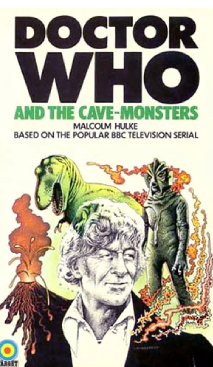
Cover & Illustrations:  The first release had a cover by Chris Achilleos. The cover showed the Doctor from Day of the Daleks with a green Silurian (without a third eye!), a T-rex-like dinosaur and a volcano. I’m very fond of the 1992 Alister Pearson reprint cover (when the book was retitled) with the ‘windows’ over the Earth and photorealistic versions of the T-rex and Silurian, but the Achilleos one is truly epic. The illustrations, also by Achilleos, include a horizontal section showing the cave system beneath Wenley Moor. My favourite shows Dr Quinn chatting with a Silurian that looks like he’s a guest on a chat show.

Final Analysis: I always assumed this was renamed ‘The Cave Monsters’ to simplify the idea of ‘Silurians’ make the title easier for younger readers to understand, but reading this again, I suspect it might also have been Hulke making a point; as Whitaker did in The Crusaders, Hulke works hard to show balance, there are progressive reptile men (though no women) as shown with Oktel, as well as the paranoid and bigotted Morka, plus the pragmatic K’po – and their emotions are mirrored by the Doctor, Barker and Quinn (and later Lawrence) – and the various actions of the humans make then as equally monstrous cave dwellers as the members of the much older race. Aside from that cheeky password the Doctor uses to gain entry to the base, the word ‘Silurian’ doesn’t appear in the book – and as it was written a couple of years after the sequel to this story, Hulke manages to fix his original geological errors and establish the race as simply ‘Reptiles’.

And just one little namecheck for ‘Doctor Who’ in the text as well.

Chapter 4. Doctor Who and the Auton Invasion (1974)

Synopsis: An alien intelligence lands on Earth and begins to establish a bridgehead for an invasion by creating an army of plastic dummies. The Doctor arrives in a new body, disoriented and without the ability to operate his TARDIS – but finds a job with the Brig’s UNIT (and usurps Liz Shaw as UNIT’s scientific adviser in the process).

Chapter Titles

  • 1. Prologue: Exiled to Earth
  • 2. The Mystery of the Meteorites
  • 3. The Man from Space
  • 4. The Faceless Kidnappers
  • 5. The Hunting Auton
  • 6. The Doctor Disappears
  • 7. The Horror in the Factory
  • 8. The Auton Attacks
  • 9. The Creatures in the Waxworks
  • 10. The Final Battle

Background: The first book written for Target and the first by Terrance Dicks, adapting Robert Holmes’ scripts for Spearhead from Space (1970). The book also introduces the Third Doctor (after a prologue recounting the final minutes of the second Doctor’s trial in The War Games), along with Liz Shaw – and reintroduces Brigadier Lethbridge-Stewart as a regular (even down to having him appear on the cover!).

Notes: It’s Terrance Dicks’ first novel and straight off, he describes the materialisation noise of the TARDIS (which is now in full caps and no italics!) as ‘wheezing and groaning’, a description we’ll see again. The Brigadier is given the first name ‘Alastair’ (a detail not revealed on TV until Planet of the Spiders but it appeared in print in Piccolo’s 1972 edition of The Making of Doctor Who). A few characters gain a little extra detail (Dr Henderson and his colleague at the hospital are fierce rivals, Captain Munro is called Jimmy, Seeley and his wife play a bigger part) and a few details are changed (the Auton devices are green, not pink, Channing accompanies the facsimile to kidnap General Scobie). Channing acquires a repeated description of possessing ‘handsome, regular features’ (which is better than ‘a middle-aged man with an ill-fitting wig and one huge hair poking out of his left ear’, I suppose). We’re told by Captain Munro that Corporal Forbes is an expert driver, so it’s right that he survives the car crash – but is then chopped down and flung brutally into a ditch by the Auton. There’s also a lovely flashback as Hibbert recalls how he first found the glowing green sphere and felt it possess him and build the machine that created Channing.The biggest change is the final depiction of the Nestene, which improves upon the original’s wriggling rubber tentacles somewhat:

‘A huge, many tentacled monster something between spider, crab and octopus. The nutrient fluids from the tank were still streaming down its sides. At the front of its glistening body a single huge eye glared at them, blazing with alien intelligence and hatred.’

The Doctor considers ‘reversing the polarity of the neutron flow in the dematerialisation circuit’ – two phrases that we’ll see a lot of in the future, but that ‘neutron flow’ term popped up a lot less often on TV than we might think.

Cover & Illustrations: The first Target edition had a cover and illustrations by Chris Achilleos. The cover shows the Doctor and the Brigadier with a green octopus, but the final illustration has a go at capturing that lurid description of the Nestene creature. My first edition of this was the 1982 Andrew Skilleter cover with a colourful cuttlefish, while Alister Pearson’s 1991 reprint cover is a vision in pink, with the Doctor and an auton mannequin amid a meteor shower.

Final Analysis: Terrance hits the ground running with the efficiency he’ll become famous for. Episode one spans four chapters, but the rest are covered in two chapters each. It’s all the more impressiove considering this is Dicks’ first book ever and he takes the opportunity to tweak a few things here and there, solving problems from the broadcast episodes, such as making Hibbert explain that the shop window dummies they make are called Autons, after his company, Auto Plastics (as opposed to the Doctor somehow just knowing what they’re called in a later scene in the TV version). It’s a great start to this new range.

Chapter 3. Doctor Who and the Crusaders (1965)

Synopsis: The Doctor and his chums meet King Richard the Lionheart, his willful sister, Joanna, and his nemesis, Saladin.

Chapter Titles

  • Prologue
  • 1. Death in the Forest
  • 2. The Knight of Jaffa
  • 3. A New Scheherazade
  • 4. The Wheel of Fortune
  • 5. The Doctor in Disgrace
  • 6. The Triumph of El Akir
  • 7. The Will of Allah
  • 8. Demons and Sorcerers

Background: David Whitaker adapts his own scripts from a serial broadcast in March to April 1965, published by Frederick Muller Ltd in September 1965, first reprinted as a Target book in 1973. t followed The Web Planet on screen, so very early on, we have our first set of consecutive stories to be novelised.

Notes: The prologue gives us a short summary of what’s happened since the first book – and it is incredible. Apparently Susan had left the Tardis to live with David Cameron (!) and her place taken by Vicki, who we met in the previous volume. Ian and especially Barbara are now perfect physical specimens thanks to their travels and Barbara is now apparently ‘the admiration and desire of all who met her’ [see The Keys of Marinus and The Romans], but he’s foreshadowing future events too. Though it’s never explicit on screen, Ian and Barbara’s ‘destinies were bound up in each other’. There’s mention of an unseen adventure involving ‘the talking stones of the tiny planet Tyron in the seventeenth galaxy’ while Barbara and Vicki are playing Martian chess.

… and then Whitaker has the Doctor explain why they can explore all these alien worlds and interfere but they can’t change anything in Earth’s history. The examples he chooses from history – from Pompeii to John F Kennedy – are frank and somewhat surprising. And then, with some additional foreshadowing that really sets out Whitaker’s aims, we have this from the Doctor:

‘The next time we visit Earth,’ he said, ‘I hope we encounter a situation where two men are opposed to each other, each for the best reasons… ‘That is the only way to understand the folly, the stupidity and the horror of war. When both sides, in their own way, are totally right.’

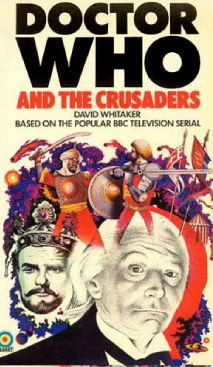
Cover & Illustrations: Henry Fox’s original cover shows a raging crusader and the Tardis with a yellow background, while the Armada hardback by Mary Gernat shows the Doctor fleeing a crusader on a blue background. Chris Achilleos’s Target cover features the Doctor with a strong likeness of Julian Glover as King Richard. The 1975 White Lion hardback again pops Tom Baker in along and the one I first owned was the 1982 Andrew Skilleter cover shows the Tardis (I think it’s from an early Peter Davison photo). Henry Fox’s 15 illustrations are gorgeously melodramatic, in particular the image of Barbara about to be whipped.

Final Analysis: My surprise at the impressive prologue suggests that this is the first time I’ve read this book! As with the previous two volumes, this expands upon the scale of what could be achieved in Riverside Studio 1. In fact it’s hard to visualise a small studio set at all when there is such a sense of distance between each location. Whitaker develops the romance between Ian and Barbara, which gives the pair extra motivation to be reunited, although he also adds to the horror of Barbara’s experience by having El Akir whip her repeatedly, leaving her badly scarred (the death of El Akir is also more violent, strangled before his skull is dashed against a wall, rather than the more theatrically clean stabbing on telly). It’s a mature work, living up to the promise of the prologue by trying to present both sides of the war evenly and with Ian trying to explain how all religions have a basic central idea of a higher being.

Chapter 2. Doctor Who and the Zarbi (1965)

aka Doctor Who – The Web Planet (1990)

Synopsis: The Tardis crew land on a rocky alien world occupied by a variety of insects being controlled by a malevolent parasite. Susan has disappeared and she’s been replaced by Vicki. And after Ian’s suggestion for a nickname for their pilot, it seems ‘Doctor Who’ is his actual name now.

Chapter Titles

  • 1 The Web Planet
  • 2 The Zarbi
  • 3 Escape to Danger
  • 4 The Crater of Needles
  • 5 Invasion
  • 6 Centre of Terror

Background: Bill Strutton adapts his own scripts from a serial broadcast just six months earlier, in February to March 1965. Published by Frederick Muller Ltd in September 1965, first reprinted as a Target book in 1973.  At 174 pages, it remains the longest of the adaptations until Fury from the Deep, though this includes the 15 illustration plates too.

Notes: Although this is a follow-on from The Daleks and was in production alongside The Crusaders, there’s no attempt to explain where Susan has gone or who Vicki is, aside from ‘the youngest member of the Tardis inhabitants. There are a few references to past episodes – Barbara’s gold bangle, which was a gift from Nero; Vicki’s crashed rocket on the planet Dido; using ‘like poles’ to repel magnets on the Dalek saucer – so unlike An Exciting Adventure With The Daleks, this isn’t part of a series of books so much as an extension of the TV series.

Ian describes his tie as that of the ‘Coal Hill Old Boys’, suggesting he was a pupil there too. Maybe this is why he was tired of teaching in the first book? Strutton assumes that the light on top of the police box is in fact a Tardis searchlight (possibly the one mentioned in the first book). A couple of the female characters on TV are male here, even though there are other female Menoptera and Optera. And of course, the ‘larvae gun’ are renamed ‘venom grubs’, which makes much more sense.

Cover & Illustrations: The first cover, for Frederick Muller, is a black-and-white illustration with a red background and a weird non-canonical, shimmering  “Dr. Who” logo. White Lion did another odd one with Tom Baker for the 1975 hardback and Alister Pearson’s VHS cover was used on a 1990 paperback reprint. Once again it’s the Chris Achilleos cover that endures, using the same photo reference as his cover for The Daleks, a pair of mahogany Zarbi and a startled Menoptera. There are 15 illustrations by John Woods and they depict the world of the novel, not the TV show. For some reason his Vicki is terrible but the others look spot on and the Zarbi look particularly impressive directing an attack from the edge of a cliff. My favourite pic though is of the Doctor and Ian looking up at a creepy statue in the rocks. Really helps create a sense of vastness on the Vortis landscape.

And we get our first chapter title called ‘Escape to Danger’ too!

Final Analysis: In contrast to David Whitaker’s approach, Bill Strutton appears to be writing for a much younger age group. Is this because that’s who was buying the books or just who he assumes would be buying them? Also, Whitaker was writing when the programme was still in its first series and many things were still being ironed out; despite calling him ‘Doctor Who’, Strutton’s Doctor is more recognisably the one from TV than Whitaker’s, complete with umms and ahhs, even if he does fix Hartnell’s fluffs from the original recording. Also, his descriptions of the motivations and movements of the  Zarbi really help to make sense of the TV episodes – for instance the beginning of episode two, where Barbara is walking around the pool of acid, where the book explains that the Zarbi is controlling her, as opposed to waggling an arm and beeping.

It might seem an odd story to adapt but it was the highest rated serial of the programme so far and Strutton takes every opportunity to make Vortis seem so weird and beautiful, especially on the very last page.

Chapter 1. Dr Who in an Exciting Adventure with the Daleks (1964)

aka Doctor Who and the Daleks (1973)

Synopsis: Ian Chesterton meets Barbara Wright and searches a foggy Barnes Common for her missing student, Susan. The pair bump into a mysterious old man near a police box and inside they find Susan, a huge white control room and the beginning of a terrifying adventure in another universe…

Chapter Titles

  • Prologue
  • 1. Meeting on the Common
  • 2. Prisoners in Space
  • 3. The Dead Planet
  • 4. The Power of the Daleks
  • 5. Escape into Danger
  • 6. The Will to Survive
  • 7. The Lake of Mutations
  • 8. The Last Despairing Try
  • 9. The End of the Power
  • 10. A New Life

Background: David Whitaker adapts Terry Nation’s scripts from the second Doctor Who serial, broadcast in 1963-4. Published by Frederick Muller Ltd in November 1964, first reprinted as a Target book in 1973. 

Notes: David Whitaker’s novelisation begins with a reworking of the first ever episode, with some significant changes. Ian is a science teacher, but is applying for other jobs and recently lost out on a position as an assistant research scientist. Barbara has recently taken up personal tuition as a side-line to her secretarial work; and her pupil is called Susan English. Also, Ian smokes, which would have been handy if this had been a mere rewrite of the rest of An Unearthly Child. As it is, he’s longing for a ciggie as he awaits the Thals to warn them of the Dalek trap, but that’s the last we hear of that! 

Across the first two chapters, Whitaker introduces the four lead characters and the ‘Tardis‘ through the eyes of the narrator, Ian, who doesn’t know Barbara as they’re not teachers at the same school. After they board the Tardis, Barbara tells him that she grew curious about her pupil as she seemed extremely knowledgeable on the subject of Robespierre, even down to ‘what walks he took and the measurements of some of his clothes.’ The mistakes that give Susan away differ from the TV episodes: ‘She thought Australia was in the Atlantic Ocean… she thought the Spanish Armada was a castle… she had written that Japan was a county in Scotland.’ When Ian and Barbara find Susan inside the Tardis, she’s described as wearing a ‘most extraordinary scarf’ on her head with ‘thick red and yellow stripes on it and made her look like a pirate’ [See The Edge of Destruction for another use of this futuristic bandage]. Ian’s description of her is clearly from a more innocent age, though it does foreshadow events that the very first readers wouldn’t see on TV for another month or so.

I imagined from what Barbara had said that Susan was aged about fifteen but silhouetted there as she was, with her dark, short cut hair against the white rocks behind her, she looked like a young woman in her twenties, very attractive and vivacious. I wondered briefly what would happen when she met a man she wanted to marry and decided not to travel in the Tardis with her grandfather any longer [See The Dalek Invasion of Earth].

The Doctor’s initially as unhelpful as his screen counterpart, though his mild scuffle with Ian becomes a full-on wrestle to the floor. But he becomes a charmer much quicker as he patiently explains his reasoning to an indignant Ian. By the end of chapter 3, The Dead Planet, Ian realises that they don’t even know the Doctor’s real name or what he does. ‘Perhaps that’s what we ought to call him. “Doctor Who?”.’ The Doctor reveals that he and Susan are ‘cut off from our own planet and separated from it by a million, million years of your time’. Ian noticed that the old man has a kindly smile even when Ian threatens him and later, while Susan and Barbara take his words at face value, he thanks Ian for not exposing his lie about the fluid link.

The Tardis control room is described loosely as we saw on TV, but ‘twenty feet in height and with the breadth and width of a middle-sized restaurant’. One corner contains ‘a row of at least twenty tape-recording spools’ beneath which are ‘a similar number of barometric needles [that] zig-zagged uneven courses across moving drums of paper’, all of which must have seemed futuristic in 1964. Susan provides the explanation of the name ‘Tardis‘ as ‘Time and Relative Dimensions [sic] in Space’, less than a year after the TV version gave us a more singular ‘dimension’ [See An Unearthly Child]. Tardis is said to contain a shower room that pummels the body with oils and warm water jets, a headset that’s programmed to give Ian a haircut and a device the size of a marshmallow that gives him a smooth shave. When using the scanner, the Doctor claims that the Tardis has ‘very strong searchights accompanying the picture… they’re quite invisible outside of the Tardis, of course. They merely serve to make a picture possible at night-time.’ The food machine provides Ian’s bacon and eggs (which looks like a Mars Bar ‘the colour of white icing’), while the Doctor enjoys ‘Venusian Night Fish’, while the next morning, Ian is served a drink that ‘looked like tomato juice and tasted of melon’ that Susan tells him is a concentrate of ‘the winter berries of Mars’.

Initially, Ian tells us the Daleks are ‘a round metal thing about three feet in height, like an upturned beaker with a domed top’ – but when climbing into a casing later, he revises this to ‘four feet three inches’. The Daleks refer to chemicals in the air but don’t mention radiation (is this Whitaker simplifying the science or just trying not to frighten children?), and while the Doctor speculates that the Daleks harness static electricity, this isn’t actually confirmed. 

It’s outside the Dalek city that Whitaker allows himself poetic license by improving on what we saw on telly. The Thal males are all well over six feet tall, while Dyoni is nearly six feet and all of them are ‘perfectly proportioned’. During the expedition to the mountains, the swamp creature from the TV show (two glowing eyes on a bladder with rubbery legs)  is much more impressive: 

Its very size was enough to dry up my mouth as tons of water cascaded off its scaly back and plunged back into the lake. With a body the thickness of a house, its head seemed to be all teeth and on the short neck I could see two pairs of claws… I could see it had six webbed feet on either side of its body, which propelled it forward through the water at a frightening speed.,, I saw one terrible red eye glaring malevolently at me…

As they leave the scene, twenty or more of the beasts devour the body of the one they have just defeated.

The other famous inclusion is the Glass Dalek, which seems to suggest the mutant creature looks like a one-armed Mekon:

The Dalek looked totally evil, sitting on a tiny seat with two squat legs not quite reaching the floor, The head was large, and I shuddered at the inhuman bumps where the ears and nose would normally be and the ghastly slit for a mouth. One shrivelled little arm moved about restlessly and the dark-green skin glistened with the same oily substance that had revolted me before.

Though Ian’s relationship with the Doctor thaws into growing mutual respect, it’s strange to see that he and Barbara are at loggerheads for much of the book. While Ian tries and fails to work out what he’s done wrong, it’s only after the final battle when he overhears Barbara talking to the Thal Kristas that he begins to understand: ‘He hates me. I know he does. I was stupid. Trying to fight… the way I felt…’

The Doctor explains to the pair that he cannot promise to ever get them home, but he and Susan would value their company, Ian gallantly invites Barbara to make the choice for them. As she holds Ian’s hand, he wonders if she seeks ‘comfort? Affection? I still didn’t dare hope it might be love. Only time could tell.’ Blimey! That escalated quickly!

Cover & Illustrations: There have been many covers for this story, the first was a line drawing in the style of the illustrations, while the Armada release in 1965 had a painting by Peter Archer showing some bloke in a cloak and a massive non-canonical logo declaring “Dr. WHO” (Archer also supplied the interior illustrations). A 1967 Avon edition bore the dramatic strapline “One man stands against the mutant minds and bodies of an incredible space monster.” The cover photo showed an unidentified couple cowering in terror from a trio of Dalek toys manufactured by Herts Plastic Moulders and sporting a sparkler in its arm. The book’s most famous cover, the first Target-branded version by Chris Achilleos, is a beautiful combination of pointillism shading with colour washes, featuring Daleks that look straight out of the pages of the TV Century 21 comic strips. Alister Pearson provided a disappointing montage for the 1992 reprint, depicting a pensive Ian. a Dalek and the Doctor, inset – all expertly painted but lacking drama. The first edition I saw though was the 1975 White Lion hardback issued to libraries, depicting a stylised psychedelic Tom Baker on the cover! Inside, there are 12 illustrations by Arnold Schwartzman, all faithfully reproducing on-set photos and none of them try to elaborate or embellish what appeared on screen. The best of these, the third, is an odd one as it just shows the Doctor and Ian. It’s supposed to be inside the Tardis, but it’s taken from the side-room with the geiger counter in the Dalek laboratory, and the lighting effect is rather marvellous. It’s a shame that these illustrations were dropped from later Target reprints, though they were restored for BBC Books’ 2016 hardback rereleases of the three Muller novels .

Final analysis: Even though Whitaker is writing this for younger readers, it never feels that he’s talking down to them. I’m still not sure why there are so many changes to the origins of the characters as it creates almost as many problems as it solves. As it was presumably intended to be a stand-alone novel though, Whitaker improves where he can – his Doctor may have alien motivations, but he’s a lot more likeable than his TV counterpart was at this stage. He’s authoritative and commanding, but defers to Ian on occasion as a sign of respect. Barbara comes off as badly as on screen, despite matching the moves of the rest of the party at every step. At the time of writing, Whitaker may not have known the future of the series itself beyond the next six months or so, let alone any potential sequels in print, so the ending is enticing enough for us to want more without writing himself (or other writers) into a corner.

Prologue – The Journey Begins

As a child, I was a frequent visitor to my local library. It was the boundary for the furthest point I was allowed to walk unaccompanied, it was a meeting place for friends – and it was the cause of more than one row with my best friend, who had a habit of snatching books out of my hand and rushing to sign them out before I could protest. They were hardback books with white spines that displayed the title and author in thick, black letters. The covers were laminated with plastic sheeting that was often tatty or torn and they had the same four words at the start of each title: ‘Doctor Who and the…’. Terrance Dicks wrote many of them, but there were others by such authors as Malcolm Hulke, David Whitaker and Gerry Davis. Some of them had illustrations inside of people looking shocked in a variety of scientific bases and weird alien landscapes. I had a real fascination for the covers, which were often montages of black-and-white portraits against brightly coloured galaxies made of bubbles.

Many Doctor Who fans who grew up in the 70s and 80s will recognise the descriptions here. Although the hardbacks were published by WH Allen, the paperback editions were released by their sub-brand Target. By the time I was nine years old, and recognising that an eagerness for reading should be encouraged, my parents bought me my first Target books of my own: Doctor Who and the Keys of Marinus, Doctor Who and the Carnival of Monsters, Doctor Who and the Ark in Space, and Doctor Who and the Loch Ness Monster. Throughout the 1980s, I added to my collection at Christmas and birthdays, or if I’d saved up enough pocketmoney, and many of my own editions were bought from a two-storey bookshop on Renshaw Street, Liverpool (sadly no longer there). That’s where I bought Doctor Who and the Zarbi, Doctor Who and the Terror of the Autons and many, many more…

Despite an enthusiasm for the stories and easy access to other bookshops, I never quite managed to collect the set. Doctor Who had been huge in 1984, but just a year later, it was put on hold for 18 months and even though it limped on for four more years, it wasn’t the communal interest it had once been. By the early 90s, Doctor Who was over and my friends were discussing Star Trek: The Next Generation or looking back to other shows such as Blake’s 7, The Avengers or Gerry Anderson’s puppet series. 

In this digital age, where space is limited and bookshelves store DVDs instead, it’s been a real blessing to stumble across someone who has scanned every one of the Doctor Who books, including the covers and illustrations, and made them available in an eBook-friendly format. There are also audiobooks of many of the books, read by the actors who starred in the TV originals. So now, equipped with a complete set of Target books for the first time, I’m ready to start a pilgrimage through time and space.

Just a quick note, though. As of 2021, although there are a select few modern stories adapted (ie, stories transmitted after 2005), there’s no stated intention to novelise every single one. On the upside, the addition of four new novels means there’s now a complete run of books spanning 1963-96. Just to give it a proper end-point therefore, the focus of this project will be the ‘classic’ era only.

Care to join me on this quest? This amazing wiki guide lists all the books in order of publication with loads of extra information. https://tardis.fandom.com/wiki/Target_Books