Synopsis: When a government inspector fails to approve a new pesticide, the chemical’s inventor takes drastic action. Meanwhile, the Doctor finally succeeds in getting his schoolteacher friends back to their own time and place – but at the wrong scale! Shrunk to the size of an ant, the travellers suddenly face danger at every turn, from running water and the attentions of a curious cat to the very same pesticide that has just driven a man to murder…
Chapter Titles
1. Dangerous Landfall
2. The Unknown
3. The Terrible Truth
4. The Destroyer
5. Death in a Country Garden
6. Getting Away with Murder
7. Dangerous Rescue
8. Whirlpool
9. Suspicion
10. The Doctor’s Plan
11. Barbara’s Peril
12. Plan of Action
13. Fire!
14. A Question of Size
Background: Terrance Dicks adapts scripts by Louis Marks for the 1964 serial (inspired by an idea from CE Webber), completing the run of stories from the second season and the first Doctor’s era as a whole! At 25 years and two months, this is now the holder of the record for biggest gap between broadcast and novelisation. It’s also the first novel to be released after the end of Doctor Who as an on-going TV series – not that we knew this for certain at the time.
Notes: The opening chapter summarises each of the stories of Season One, from the teachers’ first meeting with the Doctor through to the Daleks, Sensorites and the Reign of Terror (and they’ve just left 18th-century France. There’s also a curious sentence: ‘Her name was Susan Foreman and she called the Doctor “grandfather.”‘ – as opposed to ‘she was the Doctor’s granddaughter’. Apparently, one of the Doctor’s favourite sayings is ‘all the savage species in the galaxy, few were more dangerous and bloodthirsty than man’.
The Doctor tries to explain the complexities of time-travel to Ian and Barbara by comparing the action of moving a chair from one room to another to that of moving the chair from a house in 1796 to a house in 1964 – ‘a different matter altogether’. Susan elaborates:
‘If you put a dish in a bowl of water, the water rises, doesn’t it?’
‘Yes of course, that’s simple,’ said Barbara impatiently.
‘But, suppose the water was filling the bowl to the very top and there was a tight lid on as well? There’d be no room for displacement. Well, it’s rather like that when the weight of the TARDIS suddenly enters the atmosphere. Something has to give way.’
Ian shrugged. ‘The air, presumably…’
The Doctor spoke without looking up from the fault indicator. ‘Exactly! And the atmospheric pressure on Earth is fourteen point seven pounds to the square inch. You’re getting the idea, Chesterton. It’s all right when the TARDIS is fully materialized, the envelope of air canalways give way somewhere.’
‘Just as we’re entering the time dimension,’ said Susan. ‘That’s the danger point.
The Doctor admits to Barbara that he’s never visited Africa and Australasia, asking if gigantic earthworms might be common there (she confirms that they are not).
The cat that continues to bring jeopardy for the time-travellers is a ginger tom. Farrow is a civil servant whose motto is ‘waste not, want not’, hence why he picks up the box of matches he finds in the garden. He recognises Mark Forester from his photo, which he’s seen in the newspaper. Forester is dark haired, thick-set and ‘beetle-browed’ with a ‘heavy jaw’ and a ‘deep authoritative voice’; he’s not a big man but in his expensive suit from Savile Row, he gives off ‘a feeling of power’, looking ‘every inch the tycoon’. The scientist, Smithers, worked on famine relief projects for the United Nations when he was a young man. He saw ‘hundreds’ of people die while locusts devoured their food; ‘the terrible sights of death by starvation were burned into his memory’.
The village where Smithers lives is so small that the village shop and the police station are in the same building. The exchange operator Hilda Rowse is married to the local police officer, Bert. Hilda has been curious about the cottage ever since it was bought by a London company who installed lots of scientific equipment and a man called Smithers moved in. She recognises that Forester is not Farrow, as she met the civil servant when he came into the shop for provisions for his boat. Smithers is distressed to find that the cat has died, which is what alerts him to the dangers of DN6.
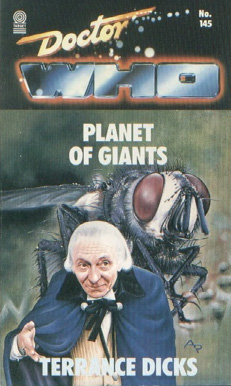
Cover: Alister Pearson’s cover shows a friendly Doctor beckoning (a reworking of a photo reference from The Celestial Toymaker) as a giant fly approaches him from behind.
Final Analysis: The last novelisation of the first Doctor’s era and the penultimate book in the range by Terrance Dicks, Planet of Giants is another example of a rather sleight story being expanded just enough. Dicks fills in some of the details that were removed when the TV story was truncated from four episodes to three. He also adds explanations for things that might be alien to young readers in 1990, such as ‘reversing the charges’ and a telephone operator who manually connects the calls. There’s a final treat as the final chapter concludes with a huge tease into the next story (also novelised by Dicks back in 1977):
Outside in the ruins of London the Daleks were waiting…
Synopsis: The Psychic Circus has travelled the universe and amassed many fans over the years. Now, it has settled on the planet Segonax, where it has fallen on hard times while under the influence of a malign power. As visitors compete for the approval of the audience, the Doctor has to overcome a major obstacle – Ace’s deep hatred of clowns…
Chapter Titles
Overture
1. Beginners
2. Welcome to Segonax
3. Captain Cook
4. The Hippy Bus
5. The Psychic Circus
6. Nord’s Finest Hour
7. The Well
8. The End of Bellboy’s Dream
9. That Old Devil Moon
10. Kingpin
11. The Gods of Ragnarok
12. Positively Last Performance
Coda
Background: Stephen Wyatt adapts his own scripts from the 1988 serial. This followed Silver Nemesis on TV, so this was the last time that a pair of stories was released consecutively.
Notes: The approach of the advertising satellite is written in the present tense. Ace is hunting for a new batch of nitro-9 that she recently concocted but is now missing from her rucksack. The Doctor monitors the approaching satellite on the ‘observation screen’ and tells Ace that the TARDIS has a few levels of defence – all of which the satellite bypasses. The satellite lands in the Control Room (hurrah – Wyatt uses the proper name!) and sprouts eight legs to position itself nearer the console. The view of Segonax projected onto the screen shows the circus tent in the middle of a ‘beautiful, lush, green meadow’. The Doctor believes that the founders of the Psychic Circus originally came from Earth.
‘Nord the Vandal of the Roads’ is a thick-set man, with ‘big muscles, large tattoos, masses of black leather clothing, a brutal unshaven face and a fearsome Viking-style crash-helmet’. When we first meet Captain Cook, he’s delivering a lecture to Mags about the planets Treops and Neogorgon; the latter was where he encountered ‘a whole valley full of electronic dogs’ heads submerged in mud’, which he assumes was a ‘primitive burglar alarm system’. The buried robot begs to be released in a sweet voice, until Ace and Mags get close, when it turns nasty, shouting threats, gnashing its teeth and firing lasers in all directions. Captain Cook, with Mags in tow, drives off and briefly abandons the Doctor and Ace, until they are reunited at the site of the abandoned bus. The bus reminds Ace of when she was a child, when her Aunt Rosemary used to tell her about the Beatles and the Swinging Sixties.
Nord is given a strongman costume to wear for his act. Whizzkid asks for autographs from the Chief Clown, Morgana and the Ringmaster – which is what propels them into submitting him as a contestant.
By the time Ace first sees Bellboy, his hair is almost white and she suspects he might have received an electric shock. Ace is said to be unable to cope with ‘deep emotion in other people’ and Bellboy’s trauma over Flowerchild makes her feel uncomfortable. She’s ‘never been so close to such naked grief before’. She briefly considers stealing Nord’s bike to help her escape from the circus, but realises it’s useless as Nord didn’t fix the valve properly.
There is a small team of ‘makeup clowns’ who prepare each contestant for the stage – though they allow the Doctor, Mags and the Captain to enter the ring without making them change their costumes. The robot clowns seal Morgana and the Ringmaster into boxes and then when they’re opened, they contain smaller boxes, which contain even smaller boxes until the final two boxes are opened and revealed to be empty. The chief caretaker’s hearse crashes into the Stallholder’s cart, which gets entangled in the limousine’s wheels (on TV, it merely comes to an abrupt halt as she blocks the way). The Doctor has apparently ‘always enjoyed juggling’. His act for the Gods of Ragnarok includes fire eating and a bed of nails. The stallholder claims to have seen the final end of the Psychic Circus, as did everyone else on Segonax as a huge wind scattered leaflets for the circus for miles around.
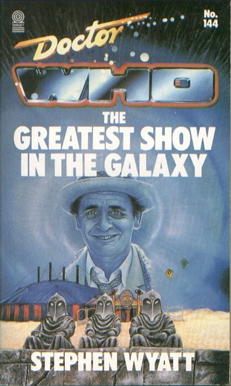
Cover: Alister Pearson paints a smiling Doctor in the blue sky above the Circus marquee as the three Gods of Ragnarok sit in judgement.
Final Analysis: Stephen Wyatt approaches the TV scripts methodically, delivering a straightforward adaptation with a few minor changes to scene order. The value he brings to the text is a deeper insight into the regular characters: it’s quite a brave thing to show Ace as emotionally under-developed, unable to react appropriately to Bellboy’s grief ; and we get a greater sense of the Doctor’s frustration at being tricked twice because he’s focusing all his attention on the mystery that’s at the heart of the Psychic Circus. The highlight of the TV episodes was the transformation of Mags into a feral beast and it’s beautifully realised here:
The moonlight was working its awful transformation. The hands had grown longer and hairier. The nails had turned to claws. The eyes were becoming blood-shot and savage, the face darker and more bestial, the hair like fur. And, worst of all, the mouth. Mags was slavering now. Huge teeth sprouted in her gums. Her tongue lolled hungrily. Then she snarled, baring her terrible fangs. This was no longer Mags: this was a werewolf. And if the Captain had his way, the werewolf would kill the Doctor.
It’s also interesting that, while she’s under the effects of the moonlight, Mags is described as ‘the werewolf’ except where the Doctor tries to connect with Mags to calm her atavism. A solid story well told.
Synopsis: Three different groups await the arrival of a meteor as it passes the Earth for the first time in 25 years: A 17th-Century witch and her servant; an army of fanatics led by an elderly war criminal; and a unit of tall, silver, cybernetic men. The Doctor has also expected the meteor’s arrival, for it contains a terrible weapon – the Nemesis. The Doctor must influence events to make sure the Nemesis falls into the right hands – but even with an Ace up his sleeve, can he defeat a player who has decided to change the rules of the game?
Chapter Titles: Numbered One to Eleven.
Background: Kevin Clarke adapts his own scripts from the 1988 serial.
Notes: Kevin Clarke dedicated the book to ‘DHF Somerset’, the then-chief cashier of the Bank of England, whose signature appeared on bank notes at the time. The first chapter opens with a very cheeky line:
The closer one travels towards it from the cold silent darkness of infinite space, the more the planet Earth appears as a backcloth to some small theatrical performance taking place on a limited budget.
[See The Ambassadors of Death for more on the ‘darkness of infinite space’]. The scene at the jazz gig takes place in late summer. The musician whose gig the Doctor and Ace attend is, in the Doctor’s opinion, ‘the most exciting musical discovery since John Coltrane’ (and on screen was played by Courtney Pine). The Doctor claims to have met and influenced Louis Armstrong. The Cybermen’s henchmen are ‘twins’. By 1988, Lady Peinforte’s house has been converted into the Princess of Wales Burger Bar. The Doctor and Ace travel by TARDIS from an afternoon in late summer to the early hours of 23 November the same year, at the same point that Lady Peinforte and Richard arrive and the Nemesis statue lands. The meteorite lands inside a building site. The Cyberman’s ship is ‘disc-shaped’.
The previous time the Doctor was with the Nemesis, he was under attack by Lady Peinforte and ‘agents of the Inquisition’ (on TV he says it was the Roundheads). Peinforte doesn’t initially recognise the Doctor but quickly deduces that his face has changed – ‘The wench’s too’ (so the original Doctor had a female companion). One of the police officers who was knocked out by the nerve gas survives the attack and witnesses the Cybermen, their two controlled thugs and the statue disappear (they walk up into the space ship, which is camouflaged).
One of the skinheads wields a ‘ninja fighting stick’, which ends up being used to tie his feet to suspend him from a tree branch. The American tourist who offers Lady Peinforte a lift is called Lavinia P Hackensack of Connecticut, not Mrs. Remington of Virginia. Ace’s battle with the Cybermen takes place back at the building site where the Nemesis meteorite landed; she spends some time keeping the Cybermen distracted while the Doctor does his calculations using an abacus. The Doctor tells the Cyber Leader that he cannot hand the Nemesis statue over to him and when the Leader becomes riled, the Doctor mocks him for showing emotions and being ‘defective’. The final scene takes place in a pub garden in 1988, not Richard’s time; Ace has taught Richard how to get served at the bar and he returns laden with drinks.
Cover: The back cover text on the first edition stated: ‘This story celebrates 25 years of Doctor Who on television’. Alister Pearson painted the original and reprint versions of the cover, both of which feature a subtle swastika in the design (Pearson claimed in an interview for DWB that he started work on the original cover on Hitler’s birthday, but the interview was full of exaggerations and apocryphal tales largely for Pearson’s own amusement so this might not be true). The first cover shows the Doctor with a smirk on his face, the Cyberleader, Ace and the Nemesis encased in rock. For the 1993 reprint, Ace is in attack mode with her catapult (really impressive, this pose) on the opposite side to the Cyberleader, while a more sombre Doctor holds up his question-mark umbrella in front of Lady Peinforte’s tomb.
Final Analysis: We often find that authors who have just the one entry in the Doctor Who library tend to throw everything they have at their text. In places, Kevin Clarke gets a little purple with his prose (as the excerpt from the opening chapter above shows). It’s a shame then to reach the climax and have to reread the paragraph where Lady Peinforte joins with the Nemesis statue, as it feels like a summary of what happens on screen without any real explanation as to why it’s happening.
There was a blinding flash of radiant light as Lady Peinforte and the statue shimmered and then coalesced. The rockets fired and the statue of Nemesis was launched once again to return into space.
Seriously – what?
We realised with the TV version that the mystery surrounding the Doctor wouldn’t be answered and it was largely just one huge tease, but here it’s almost glossed over as Clarke rushes to get to the final page. There’s no additional insight into what any of the interested parties want to do with the Nemesis and as a consequence the story merely fizzles out. In some aspects, it’s a very traditional novelisation, transposing the script to prose, but without any of the additional nuances we might have gained from Terrance Dicks or any other author.
Synopsis: Joined by Sara, who now accepts Chen’s treachery, the Doctor and Steven continue to evade the Daleks. A stop-off in ancient Egypt leads to a reunion and a bloody massacre, before a return to Kembel and a final confrontation with Chen and the Daleks’ Time Destructor.
Chapter Titles
1. The Nightmare Continues
2. The Feast of Steven
3. The Toast of Christmas Past
4. Failure
5. Volcano
6. Land of the Pharaohs
7. Golden Death
8. Into the Pyramid
9. Hostages
10. Escape Switch
11. The Abandoned Planet
12. The Secret of Kembel
13. Beginning of the End
14. The Destruction of Time
15. The Nightmare is Ended
Background: John Peel adapts scripts from episodes 7-12 of the 1965 serial known collectively as The Daleks’ Master Plan, by Dennis Spooner and Terry Nation. This is the first time since The Space War that a novelisation has had a different title to the one used on the TV episodes (although see ‘Cover’ below for more). This book completes the run of stories from season 3.
Notes: The back cover blurb on the original release mentions a ‘Time Destroyer’. The opening chapter reveals that Sara has been having nightmares about Bret’s death and she sleeps with a light on. She’s been aboard the TARDIS for ‘several months’ and considers it her home now (Peel clearly a supporter of the ‘Sara as companion’ fan myth). The Doctor has read the American novelist Peter S Beagle and quotes from The Last Unicorn. Trying to provide some comfort to Sara, the Doctor reveals a personal philosophy:
…if you found out that the Daleks had killed Chen, then you’d want to find out something else, and then something else after that. There are no endings – everything continues to grow and to progress. One of the reasons that I never learned how to control this old ship of mine was to prevent myself from falling into that trap of yours – wanting to see happy endings.
He then tells her about his own granddaughter and the two schoolteachers, who he likes to imagine married and surrounded by their own ‘noisy children’. The reason for the Doctor’s original stay on Earth is revealed! A ‘catastrophic malfunction had forced him to rebuild part of the main console’.
Peel’s description of Liverpool is very accurate – the red bricks were indeed blacked by pollution in 1965 and well into the following decade (as seen on the opening titles of the Liverpool-set sitcom The Liver Birds). The police officers in Liverpool are (altogether now) named after actors from the popular BBC drama Z Cars – (Colin) Welland, (Brian) Blessed, (James) Ellis and (Frank) Windsor; three of whom had appeared in Doctor Who on TV by the time this book was released. The joke about the Doctor recognising a man from a market in Jaffa is retained (unusual as Peel tends to cut a lot of the sillier elements from stories). Steven decides to copy the sergeant’s accent, as on screen, but this needs a little unpicking. We’re told that Steven sounds ‘like a bad actor’s version of North Country speech’. On TV, despite being in Liverpool, only Peter Purves manages to effect a decent Scouse accent (he does very well!) but everyone else does ‘generic Northern’. In Z Cars, which was also set in Liverpool, none of the characters who pop up here actually had the local accent: James Ellis was from Belfast; Brian Blessed from South Yorkshire; Frank Windsor from Walsall, West Midlands; and Colin Welland from Leigh. So even if these had been the actual characters from Z Cars (as the production team had hoped), Steven would still have been the only one with a Liverpool accent! Just to continue the nitpicking, in 1965, the sergeant in Z Cars was played by Bob Keegan, who was the only one of the regular characters to have a genuine Liverpool accent (he appeared in Doctor Who many years later, as Sholakh in The Ribos Operation).
Steven has a serious crush on Sara and wishes she found him attractive. The clown figure who the Doctor helps in Hollywood is clearly Charlie Chaplin (he’s specifically not him on TV).
New arrival to the Dalek cause is Celation, a ‘tall creature, which breathed the oxygen-rich air with difficulty, giving his speech a throaty, disjointed effect’ (it’s a close match for the description of the alien ‘Warrien’ in the previous volume and there is a theory that Warrien was actually a mis-named Celation!). The Dalek force includes a ‘chief’ or first scientist along with a second scientist and ‘monitor Daleks’ who keep an eye on computer banks. The Time Destructor looks like ‘a large, glass-encased cannon’ (as opposed to a globe made of tubular spokes as on telly). The Dalek time ship is ‘a featureless silver-grey cube’ (‘some ten feet to a side’, Steven notes when it lands in Egypt) and its commander is the Red Dalek seen on the book’s cover. Chen is disturbed to learn that the Daleks have their own stash of Taranium and they claim they used him to obtain more merely out of expedience; they have sufficient to power their time-machine but not enough for the Time Destructor too, so this would appear to be a lie just to undermine Chen’s over-confidence. There’s reference to the Dalek Prime back on Skaro.
The TARDISes of both the Doctor and the Monk are said to have ‘chameleon circuits’ (a phrase that wouldn’t be used on telly until Logopolis – but see Doctor Who and the Doomsday Weapon and Doctor Who and the Terror of the Autons). Working away on the TARDIS lock, the Doctor has a bit of a rant:
The Doctor worked away on the lock, muttering to himself. ‘I think it’s about time that some people remembered that these journeys of mine are for the purpose of scientific discovery! I’m not in the business of giving sight-seeing tours of the Universe, with everyone behaving like a bunch of rowdy tourists and rushing off to look at whatever they wish! I thought that Barbara andthat Chesterton fellow were bad enough, but it’s getting worse! Much worse’ The Doctor continued muttering under his breath as he laboured on, unaware that he was alone, at least for the moment.
The Monk ‘never paid attention in class’ so is aware that his knowledge of history is hazy and doesn’t actually know which year he’s landed in, having followed the Doctor. He does, however, recognise a Dalek, having ‘paid attention to a few things in class’ [so the Time Lords of the Monk’s time study Dalek history!]. The Doctor doesn’t actually dislike the Monk, and feels that ‘with the proper guidance, the man might make himself useful instead of troublesome’. The massacre of the Egyptians is much more even-handed with the Red Dalek destroyed by an onslaught of heavy rocks. Inspired by his warriors fending off the alien invaders, the Egyptian Khephren decides to commission a monument of the Sphinx to guard the Pharaoh’s pyramid.
Mavic Chen and the surviving Daleks return to Kembel in the time-machine and are greeted by the Dalek city administrator (the idea of a Dalek whose role involves admin is reassuringly comical). The Doctor assumes that the absence of Varga plants is a sign that they’ve been allowed to die off as the Daleks no longer need to use them as guards. Chen shoots Beaus dead (on TV, Gearon is Chen’s victim). The Doctor accompanies Sara and Steven when they release the delegates from the locked room – and he persuades Sara to spare Chen’s life, reminding her of the political chaos on Earth that might result from his death.
Chapter 13 is a reworking of a recurring Terrance Dicks title, ‘Beginning of the End’. The heart of the complex contains a vast hanger that houses hundreds of Dalek saucers, maintained by Daleks on ‘flying discs’. The Doctor uses his cloak to break the circuit on a Dalek door and he recalls the first such doorway he encountered in the Dalek city on Skaro. Caught in the winds of the Time Destructor, Sara begins to hallucinate the ghost of her brother:
Sara collapsed, and felt dust and sand on her face. She hardly had the strength to open her eyes, but somehow she managed it. The twig-like fragility of her arm shocked her, as she clawed towards the fallen Time Destructor. It was no use, no use… she was too weak, too old now… Her dying vision blurred, and in the glow of the Destructor, she felt certain that she could see the smiling face and beckoning finger of her brother’s spirit.
Sara felt a sudden peace, and all was still.
Affected by the reversal of the Time Destructor, the Daleks become embryos and then briefly humanoid before turning to dust. Back on Skaro, the Dalek Prime realises that the fleet on Kembel has been destroyed and it is filled with a desire for revenge. On Earth, Karlton is arrested by Senator Diksen for his part in Chen’s treachery. He reveals that Marc Cory’s lost tape was found on the body of Bret Vyon (and it contained a recording that was not part of the one he makes in Mission to the Unknown). The story concludes with the scene where the Monk discovers he is stranded on a frozen world.
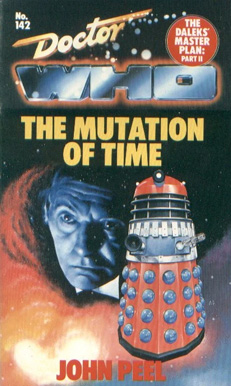
Cover: Alister Pearson’s cover is much more understated than for Mission to the Unknown. A severe-looking Doctor (referencing a photo fromThe Space Museum) is formed in the stars of a nebula as a very grand Dalek with a red casing and blue spots dominates the frame (based on a Madame Tussauds Dalek that appeared on the back page of the 1983 Radio Times 20th Anniversary Doctor Who special). The livery is an invention of John Peel, but it really works and it’s a shame it never appeared on telly. The title as shown on the front cover is ‘The Mutation of Time’ (a new title not taken from the episodes), but a circular flash states that this is ‘The Daleks’ Master Plan Part II’, while on the spine it’s ‘The Daleks’ Masterplan Part II’ (‘Masterplan’ is one word). The title page inside gives the title ‘The Daleks’ Masterplan Part II The Mutation of Time’.
Final Analysis: As he moves into the second half of The Daleks’ Master Plan, which was authored mainly by Dennis Spooner, it’s a relief that John Peel allows himself room for a little fun in a way that he tactfully avoided with The Chase. Whether it’s the farce of the Hollywood scenes or the triviality of the Monk’s side-quest, the first half of this volume is a hoot. It’s only when the action returns to Kembel that the mood changes to something more sombre.
Officially, Sara Kingdom was not a companion (something Jean Marsh herself stressed at her first ever convention in 1996, to the shock of many), but fandom has always included her in the lists and here, John Peel makes sure she counts by giving her several months as a passenger aboard the TARDIS. The opening chapter delves into her fractured psyche, tortured by her guilt over killing her brother and wanting absolution through the certainty that Chen will pay for his manipulation of her. Whatever the original intentions of the production team, these two books ensure that for the fans – she counts!
Over the course of his first three books, Peel manages to capture William Hartnell’s performance better than any other writer. The tetchiness is present in the works of other authors (including Terrance Dicks), but it’s his lightness and sense of humour that really lands here – where it’s appropriate, Peel remembers to make the Doctor funny. In this volume, the Doctor is said to ‘steeple’ his hands together, which conjures up a perfect mental image of the kind of pose this Doctor often adopted. I’m a huge fan of The Daleks’ Master Plan, both in what we’re still able to experience on video and audio, plus all the mysteries that surround it (who are all those delegates?!) – but I’m now a fan of John Peel too. It was an ambitious risk to take on this epic adventure, but in Peel’s hands, it’s a huge success. Who couldn’t love the way he disposes of his main villain (with echoes of Caligula in I Claudius)?:
The Daleks opened fire, and several of the bursts of rays caught him squarely. Mavic Chen staggered slightly, staring at them as the wave of energy washed over him. As it ceased, Chen suddenly realized that he had been terribly, terribly wrong. He was not immortal after all…
Synopsis: On the planet Kembel, delegates assemble for a conference led by the Daleks. Among the attendees is the Guardian of the Solar System, Mavic Chen, who has betrayed the planet Earth by providing a vital element for the Daleks’ latest weapon, the Time Destructor. The Doctor steals the element but, cut off from the TARDIS, he and his friends take Mavic Chen’s ship in a bid to warn Earth of his treachery. Chen alerts the Space Security Service and identifies the Doctor as the traitor. Now, Space Agent Sara Kingdom has Chen’s enemies in her sights…
Chapter Titles
1. The Toppled Towers of Ilium
2. The Screaming Jungle
3. Extermination!
4. The Nightmare Begins…
5. No Ordinary Ship
6. The Day of Armageddon
7. The Face of the Enemy
8. Devil’s Planet
9. Dangers in the Night
10. The Sacrifice
11. The Traitors
12. Counter-plot
13. Allies
14. Desperate Measures
15. Out of Time
16. Interlude
Background: John Peel adapts scripts from Mission to the Unknown, by Terry Nation, and episodes 1-6 of the 1965 serial known collectively as The Daleks’ Master Plan, by Terry Nation and Dennis Spooner.
Notes: The opening chapter dramatises the events that were missing from Donald Cotton’s jolly adaptation of The Myth Makers. Katarina struggles to comprehend much that she witnesses, so we have to assume a lot of terminology is translated for our benefit. Nevertheless, she considers the TARDIS control room to be about thirty metres across, with walls that look like polished stone. She compares the sound of the TARDIS dematerialising to ‘Cerberus, guardian hound of the Underworld’ (have we had it compared to a growling dog before?). The wound in Steven’s shoulder on TV has become a gash to his side; while the attacking blade didn’t strike anything vital, Steven has lost a lot of blood and the Doctor also worries that the sword was unlikely to have been sterile, exposing Steven to germs from way before his own time [and see The Ark for how something similar plays out to humans from Earth’s future].
Chapter 2 takes its title from an earlier Nation-scripted episode. Gordon Lowery is the captain-pilot of a crashed ship. The ship’s passenger, Marc Cory, is ‘lean, tall and dark, in a good-looking way’ and ‘just a shade on the right side of thirty’. Cory and Lowery discuss the Dalek-Movellan wars a thousand years before and the Dalek expansion across the Andromeda galaxy and the region of Miros. The Black Dalek has been despatched to Kembel by the Dalek Prime on Skaro (mentioned in Peel’s novelisation of The Chase). The Black Dalek is second in the Dalek hierarchy and rarely leaves Skaro.
The descriptions of each representative of the alliance seem to match the (later revised and debunked) best guesses available in 1989: Gearon, ‘a somewhat faceless creature with an egg-shaped head’, wears a thick visor as his world is ‘almost perpetually in darkness’; Trantis has tendrils on his face and is vaguely telepathic; Beaus is from the Miron systems and is a tall creature, half-vegetable, half animal, ‘like an animated tree’ [and] possessing two burning eyes’; Warrien wears a ‘cowled hood and a pressure suit that contains an atmosphere other than oxygen; also wearing a spacesuit, Sentreal has a ‘dark face… wreathed in the chlorine fumes that he breathed, and a small radio antenna on his head [that] kept him in constant contact with his fellow beings still on their ship (his people share a communal mind, and Isolation from the others would apparently kill him); Malpha, the last of the members, is ‘tall and colourless’ with a white suit and skin, aside from ‘the thick, dark network of veins that created a patchwork of his face’. Later, we meet Zephon, who dresses all in black with just his eyes visible through the hood of his cloak.
On TV, the terms Space Security Service and Special Security Service appear interchangeable, but here only the back cover uses ‘Space Security’. Lizan had joined the SSS with ambitions to work in an embassy on Draconia or Alpha Centauri; instead, she was allocated as section leader in Communications Central, a post that comes with a lime-green uniform. The Communications map shows Earth territories in blue, with Dalek space marked in red. Mavic Chen is over six feet tall with a ‘trim, muscular body’. His face showed signs of an ‘oriental ancestry, but much mixed with other races’. His white hair is closely cropped and his eyes are deep blue and ‘hypnotic’, while his voice is ‘deep, clear and precise’ and displays ‘no signs of age’. In his broadcast interview, he discusses ‘mineral agreements with the Draconian Empire’.
When the Doctor returns to the TARDIS on Kembel, he sees a Dalek emerging from inside it! Before fleeing the TARDIS, Bret manages to select some suitable clothes for Steven, which he changes into only after the Doctor has led Katarina away to give Steven some privacy (this solves a mystery that is unresolved from the TV episode, where as far as we can tell we never learn when Steven changes out of his armour). The Doctor observes that the Daleks now have solar panels on their bodies to enable them to move about without static electricity – but their city is still built from pure metal, like the one he saw on Skaro. He also remembers that the Dalek time ship that chased him, Ian, Barbara and Vicki through time was powered by taranium, like the Time Destructor. Realising that the Daleks will pursue them for the taranium core, the Doctor tells Bret Vyon ‘We haven’t escaped from danger – in fact, the danger has barely begun!’ … there’s a chapter title desperate to be used here…
According to Bret, Earth is three days away from Kembel, but he points out that their diversion to Desperus will have allowed Chen to reach Earth before them. Chen’s deputy, Karlton, differs from his bald and smooth-faced appearance on telly: ‘His craggy features were lined with care, and his hair was thick and grey.’ Chen views Sara Kingdom as ‘a born warrior’.
She reminded him of a tightly coiled spring – ready to leap in any direction at an instant’s notice.She was dressed in the inevitable black catsuit that all SSS agents wore, accentuating her perfect figure. She was beautiful, but it was the beauty of ice or steel. Her hair wasshoulder-length, and curled inwards. Her face was somewhat elfin. If she smiled, Chen knew she would be considered very desirable. He could not imagine her smiling. Her blue-grey eyes gave back no warmth. She looked every inch the perfect killing machine that her record had informed him she was.
Chen has never ‘felt the attraction of women himself’, believing they’d want a share of his power. The Doctor is similarly unswayed, irritated by Sara’s crying, as he feels pained by ‘overt displays of sentimentality’.
The machine that brings the Doctor, Steven and Sara to Mira does not contain mice. There’s a more energetic battle with the Visians – and they can talk! Surrounding the Doctor, they chant ‘Kill it!’ in ‘wet, reedy’ voices. Although they’re invisible, one of them is pushed into a pool and emerges swathed in mud, revealing ‘thin, bony, with two long, clawed arms, feet like birds’ claws, and a narrow head with a beak’. Later, fearing the metallic invaders seek to take over their foraging areas and wipe out the whole tribe, the Visians stage a huge attack against the Daleks. The Doctor has ‘examined a number of Dalek installations and craft during his numerous encounters with them’, and is fairly familiar with the design that he faced now [suggesting either that he and Steven have had multiple unseen adventures involving Daleks since The Chase, unless the Doctor is counting multiple ships during the Dalek invasion of Earth too]. Some of the Daleks aboard the ship have mechanical claws instead of suction cups on their arms.
While walking towards the TARDIS, the Doctor tells Chen the name of his ship and introduces himself – thereby solving a minor continuity issue later on from the TV version. The TARDIS door is still open from when Steven and Katarina left it (so the Doctor doesn’t need to give Sara the key). With the real Taranium Core still in his possession, the Doctor speculates that Chen will get his comeuppance when the Daleks inevitably turn on him. Sara is invited to stay in Vicki’s old room and freshen up with a bath. The three fugitives await their next encounter with the Daleks…
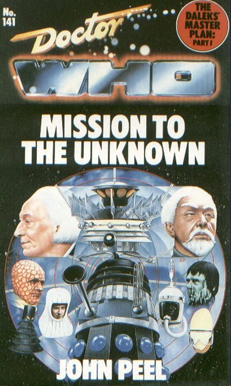
Cover: Alister Pearson gives us another appropriately energetic composition similar to The Chase, It showcases the black Dalek leader (cleverly repurposed from a photo of a Dalek from Resurrection of the Daleks!), surrounded by Mavic Chen and his spaceship, the Doctor and a selection of delegates. The title as shown on the front cover is ‘Mission to the Unknown’ but a circular flash states that this is ‘The Daleks’ Master Plan Part I’, while on the spine it’s ‘The Daleks’ Masterplan Part I’ (‘Masterplan’ is one word). The title page inside gives the title ‘The Daleks’ Masterplan Part I Mission to the Unknown’.
Final Analysis: Poor Katarina. While we might accept that a person can’t change ‘one line’ of history, this is usually because a character wants to overthrow an entire regime or culture, but this is all tied to the destiny of a single otherwise unimportant handmaiden. The Doctor chastises Steven for asking too many questions and praises Katarina for the way she ‘simply looks and learns’, but it’s this quality that seals her fate; having learned of the importance of the Spar’s outer door, she realises that she can save her new friends by opening it and allow her destiny to be fulfilled. Steven has a personal reason for being patient with Katarina, aware that her kindness probably saved his life: his justification that ‘she’s from Troy’ is enough for him. Bret Vyon lacks Steven’s experience with time travel and simply thinks there’s something wrong with the girl, while the Doctor is irritated by her stupidity and vows to never accept a companion from a pre-technological age. This shows just how impractical Katarina is as a character. While we might empathise with her bewilderment at being transported in a space vessel, her confusion over something as simple as a key makes her much more alien to the reader than any of the delegates in the Dalek conference room. And Bret is right – the mission to inform Earth of the Dalek plan is greater than any one individual… and with Steven restored to full health, their own success is enabled by the sacrifice of the most disposable of the team.
All of this is present in the televised episodes, but John Peel foreshadows the tragic event throughout the early chapters. It also gives credence to the ‘primitive’ beliefs of Troy and the prophecies of Cassandra. From what we can tell from the surviving episodes and audio recording, The Daleks’ Master Plan is a bit of a ‘best of’ compilation – the most impressive space ships up to that point, the best jungle – and the Daleks are at their most sinister and scheming. Peel doesn’t miss a beat in conveying this on the page. Chen is every bit as pompous and self-aggrandising as in Kevin Stoney’s TV performance and this might also be the most accurate depiction of the first Doctor in over 140 books; he’s every bit as irascible as he is in Terrance Dicks’ Dalek Invasion of Earth or The Smugglers, but Peel also remembers to make him funny, with that self-congratulatory chuckle. For any inattentive fan who didn’t know how long this story is (and missed the ‘part 1’ on the cover), this book also ends as if we’re done with the Master Plan. But as someone would later say in another episode, ‘It’s far from being all over…’
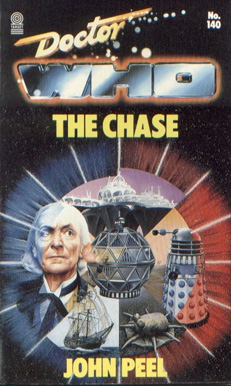
Synopsis: A brief holiday on the planet Aridius is interrupted when the Doctor gains advance warning that the Daleks are coming for him. So begins a frantic flight through time, each stop brings their pursuers ever closer. Their final battleground is Mechanus, home to killer plants, the robotic Mechanoids and their sole prisoner, a space pilot called Steven. As the Doctor prepares to confront his enemies at last, his friends have no idea that this will be their last adventure together in the TARDIS.
Chapter Titles
Author’s Note
1. The Executioners
2. A Speech in Time
3. The Sands of Death
4. The Victims
5. Deadline
6. Flight through Eternity
7. Nightmare
8. Journey into Terror
9. Fallen Spirits
10. Who’s Who?
11. To the Death!
12. The Mechanoids
13. The End of the Hunt
14. Home!
Background: John Peel adapts scripts from a 1965 serial by Terry Nation. As the author’s note explains, he worked mainly from early drafts, before they were rewritten by story editor Dennis Spooner, so he explains that the book is ‘not strictly an adaptation of the televised version of The Chase’ (ie, it’s not written as if by Terrance Dicks).
Notes: The opening chapter depicts a grand Dalek control room with ‘a background pulse, like an electronic heart slowly beating’. The Black Dalek looks down from a raised platform onto various other Dalek units, including a Chief Scientist. The Daleks know the Doctor by name. They’re also aware that his appearance ‘has changed many times over the years’ and they have tracked him through his ‘basic metabolic pattern’ [meaning these Daleks come from the Doctor’s own future].
The Doctor ‘borrowed’ the TARDIS and lost the operational notes while on prehistoric Earth. He is nearly 750 years old and has not yet experienced his first regeneration. We’re reminded of the introduction stories of Ian and Barbara, that Susan left the TARDIS after falling in love and that Vicki recently joined them after being rescued from the planet Dido. The space/time visualiser is just one of many trinkets that the Doctor has picked up over the years. Neither Ian nor Barbara recognise the Beatles song that appears on the visualiser. Vicki has not encountered a Dalek up to this point, but knows of them from her history books.
The Daleks are led by the Dalek Prime, which is ‘larger than most, and painted a uniform golden colour’ (similar to the Emperor from the comic strips). The TARDIS team have encountered the Daleks twice before. The Daleks use flying discs to survey the surface of Aridius. Aridians have blue skin and they wear the skins of mire beasts as cloaks. We’re party to the meeting of the Aridian elders with the Daleks where they’re given the ultimatum. Ian and Barbara had an unseen adventure on Cetus Alpha. The TARDIS dematerialises with a ‘customary groaning and wheezing’. The Dalek time ship is powered by Taranium, ‘both the rarest and most unstable element in the Universe’; one gram can power a time ship for centuries and it took the Daleks two decades to obtain that amount.
It’s clear the author has done a little research into the crew of the Mary Celeste as the characters are named and fleshed out (he also has one of them exterminated by a Dalek – something that we don’t see on TV). The schoolteachers debate whether they were responsible for the death of the passengers and crew of the ship and Ian reminds Barbara of her attempts to change the history of the Aztecs; they take some comfort from the possibility that the Marie Celeste was always fated to become a mystery. Morton C. Dill is from Alabama. He encounters the TARDIS crew and a Dalek in 1967. The Dalek considers killing him, but then decides to let him live, considering it ‘far worse for the human race to allow this fool to live on’. Ever since that day. Dill has been a resident of the Newman Rehabilitation Clinic for the bewildered (a reference to a routine by American humourist Tom Lehrer). The haunted house is a part of Battersea Funfair, London, and is closed for repair. Vicki uses her months of experience of operating the radio on the crashed spaceship on Dido to use the Dalek radio. After the robot Doctor is destroyed, the real Doctor proves his credentials by reminding his companions of their past adventures, how Ian was knighted by Richard Coeur de Lion, Vicki, led a ‘revolution on the planet Xeros’ and Barbara ‘escaped with the Menoptera from the Crater of Needles’.
Steven Taylor explains that the Earth’s plans for expansion were brought to an end by the Draconian conflict, followed by the Third Dalek War. Realising that the execution squad is outnumbered by Mechonoids and facing defeat, the Dalek squad leader separates from the battle to hack into a computer and trigger the city’s destruction in a final attempt to trap the TARDIS crew.
Steven manages to escape, makes his way through the jungle and reaches the TARDIS, where he collapses. The Doctor is initially very dismissive of the unstable and brutish Dalek technology of their time ship, but quickly becomes more tactful to avoid frightening Ian and Barbara. He’s pragmatic enough to help the schoolteachers to use the Dalek time ship to return home, but he deliberately sets the time of their destination a couple of years in their future to offset the three years they’ve spent travelling with him. They return to the TARDIS to collect their belongings, including souvenirs of their travels. Barbara wonders if she owes back-rent on her flat, while teasing Ian about the amount of dust that will have settled in the house that he owns. They stow their belongings at King’s Cross Station before enjoying a visit to a pub by the Thames and exploring their home city anew.
Cover: Against a backdrop of the time vortex, divided like a 16-hour clock, the Doctor looks across at a Mechanoid and the city of Mechanus, a Dalek, a mire beast and the Mary Celeste. A suitably busy composition from Alister Pearson.
Final Analysis: There was a lot of build-up to this, the first of the remaining Terry Nation Dalek stories to be novelised, courtesy of a deal struck with author John Peel. I’m a fan of the TV story – comical elements included – and the scattergun approach is the set-up for the next Dalek story, which is similarly meandering but on a grander scale. Glad to say, I’m also a fan of this novel. It’s determined to be grown-up about it all, so the jokey aspects are cut back massively, and some of the additional details appeal mainly to the fan gene in linking this story to ones broadcast later or told in other media. At this point in the history of Target, that’s who the readership was. Peel manages to make the Daleks menacing, scheming and not remotely comical (something their own creator chose not to do in the original TV version). His real success though is in capturing the TARDIS team, the growing relationship between the schoolteachers, Vicki’s resourcefulness and most of all the Doctor’s contrary nature, clearly lamenting the departure of two people who forced their way into his life and became good friends – but refusing to let this show. It’s rather wonderful to have another adventure with this particular crew, as this is the last of their adventures to be novelised. And there are only two more stories from this era left to come…
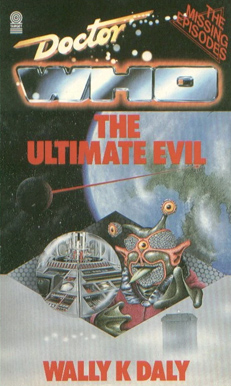
Synopsis: The Doctor has finally achieved his life’s work and fixed everything that was wrong with the TARDIS. Peri suggests a holiday and they find themselves in an idyllic land free from war. But peace is bad for business – and an arms dealer called The Dwarf Mordant has a plan to change everything.
Chapter Titles: Numbered One to Twenty-Nine.
Background: Wally K Daly adapts a storyline originally submitted for the aborted Season 22.
Notes: The ‘evil Dwarf’ Mordant (who needs to work on that title) comes from the planet Salakan, where he previously failed to draw the Doctor into one of his schemes. The Mordant has a mouth that is a ‘scaly toothless hole’. His hands are webbed with three fingers on each, he has two eyes on ‘stubby flexible stalks above his forehead, in the centre of which is another ‘cold yellow eye’. His laugh is a ‘high-pitched chuckle full of a wicked, childish glee’.
The TARDIS has a stowage cupboard that contains, among other items, a device that can pilot the TARDIS to the source of a transmission, a torch-like gadget that can be pointed at any object to calculate its weight and a crystal ball that helps its owner plan a holiday – an object that is one of a set presented to the Time Lords by Dwarf Mordant as a means of keeping an eye on them and avoiding their interference. The TARDIS has a ‘main thrust unit’, which makes it sound like a space rocket. The Doctor is so distressed that the TARDIS is now in perfect working order that he doesn’t notice that the chameleon circuit hasn’t worked and the TARDIS is still in the form of a police box. The Doctor threatens Mordant that he’ll inform the Time Lords that he has been spying on them and they will wipe him from history [not quite as seen in The War Games, as this involves manipulating genes to ensure his parents have a different child entirely].
Cover: In Alister Pearson’s cover, the Dwarf Mordant pulls tongues at a crystal ball containing the TARDIS console, while the TARDIS exterior materialises in a mist. The first edition featured a flash proclaiming ‘The Missing Episodes!’
Final Analysis: It’s a difficult thing for a fan to accept that the series they love is failing. We might instinctively defend Season 22, but we also know that there were a fair few issues that justified Michael Grade’s cancellation above and beyond his own personal prejudices. Thanks to this mini-series of novels based on the commissioned scripts for the abandoned Season 23, there’s a sense that we might have ended up with more of the same and that the cancellation of this run of stories was a blessing. Even within the framework of a show that stars a man flying through time and space in a phone box, there’s something that stretches credibility when the main villain seems to know that they’re the baddie. Far from being an ‘ultimate evil’, Dwarf Mordant is a diluted Sil, an exploitative capitalist who revels in the torture and misery of others. All very unfortunate, considering a rematch with the maniacal Mentor was also scheduled for the same season. Strangely though, I can easily imagine Colin Baker delivering lines such as this on TV:
Now I have nowhere I particularly want to go and no task to perform – and this is the time the TARDIS chooses to turn on me with this vicious display of goodness, and unwonted mechanical and electrical magnanimity. Now do you see why it is disasterous [sic]? I have nothing, at all, to do!’
… though that’s less about them being authentic than them being the kind of rubbish they were giving him to fight with on TV at the time. It might not be a fair comparison, but while Terrance Dicks is reliable and efficient, if rarely remarkable, this is giddy and over-written. Sorry, this one’s not for me. The best thing about it is the cover.
Synopsis: The Doctor is still on trial – and still wondering where his friend Peri is. The Valeyard presents his second piece of damning evidence, from the Doctor’s most recent escapade. On the planet Thoros Beta, leader of the Mentors Lord Kiv is suffering from an expanding brain and if a suitable replacement body can’t be found, he will die. Chief scientist Crozier thinks he’s made a breakthrough that means Kiv could live forever. Urged on by Kiv’s enthusiastic deputy, Sil, Crozier finds a test subject – the Doctor’s friend, Peri.
Chapter Titles: Numbered One to Seventeen.
Background: Philip Martin adapts his own scripts for episodes 5-8 of The Trial of a Time Lord, completing the run of stories from Season 23 and the Sixth Doctor era as seen on TV. Having learned a lesson with the delayed Vengeance on Varos, Mindwarp wasn’t allocated a number in the library until publication; a good thing too, as this was similarly tardy in arrival.
Notes: The opening chapter sees the Doctor alone in the courtroom, except for a solitary guard. He knows the next piece of evidence comes from something that happened on Thoros Beta, but he can’t remember what happened. A fat, officious Time Lord dressed in a cream uniform is Zom, Keeper of the Record of Time and as the Time Lord jurors enter the chamber, the Doctor is reminded of ‘the giant butterflies of Genveron’ from an unseen adventure. The Inquisitor wears ‘the gold and silver robe of supreme Gallifreyan justice’. Rather brilliantly, the view from space of Thoros Alpha and Beta, followed by the shoreline on Thoros Beta (as seen on TV) is explained in a TARDIS control room scene where the Doctor initially misses his target destination and has to reset the TARDIS controls to try again.
The Raak, the creature that attacks the Doctor and Peri, is glistening and green with arms covered in suckers and ending in clawed pincers. It has a huge domed head with a single ‘basilisk eye’ in the centre and it has tentacles growing from its sides. Lord Kiv has a ‘bulbous’ cranium, acid-yellow eyes and a yellow body with black stripes. Sil now has red eyes, but he still sits above a water tank. Kiv recalls the moment when he left his mire and joined other Mentors who had evolved beyond the swamps. Mentors are destined to live for only a few years before inevitable death. The Mentor with the sensitivity to loud noises is called Marne and he makes his first appearance much earlier, in the induction centre where the Alphan slaves are assessed for suitability (and the slave selections include children). Sil instructs his slaves to spray him with waters from his own home mire. Kiv is surrounded by many Mentor advisers, rather than just Sil.
The Doctor reacts with much more sadism after he escapes from Crozier’s Cell Discriminator; as Yrcanos boasts of his strength, the Doctor urges him to ‘flatten her face’, slowly’ and during his interrogation of his companion on the Rock of Sorrows, he tells Crozier that he only intends to inflict ‘a little assault and battery to help her memory’. The role of the Alphan rebel Verne is taken by two other characters, Ger and Sorn, who are both found dead and aged. Dorf dies after stepping into a blast aimed at Yrcanos. The alien delegate who meets with Kiv is one of a number of Sondlex representatives, feathered and with ‘turkey-red’ faces. During Yrcanos’ final attack, Sil’s water tank is shot, sending him ‘crashing down from his throne to thresh about in a paroxysm of utter terror’.
The Valeyard concludes this portion of the prosecution’s case with promises that his third section of evidence will come from the Doctor’s future, to prove that he does not improve (on TV, the next section represents the Doctor’s defence). As this book was released after the adaptations of the rest of the trial segments, the final chapter reveals Peri’s ultimate fate. Rescued by the Time Lords, Peri and Yrcanos found themselves on Earth in the 20th Century. Happy to be back home, Peri sets Yrcanos up as a wrestler, with herself as his manager.
Cover: Alister Pearson gives us Sil and two versions of Kiv with a background of the ocean on Thoros Beta in all its glory. Instead of the corner flash for the other Trial of a Time Lord books, there’s a subtitle at the top of the cover (and the title page lists this simply as ‘Mindwarp’ without the Trial of a Time Lord suffix). A generation of fans (about ten of them) were up in arms with disgust and rage at this inconsistency, as the Target books editor trolled them gleefully. Then they slapped the Oliver Elms logo over the top.
Final Analysis: While working on his scripts, Philip Martin claimed he repeatedly asked his script editor, Eric Saward, how much of the evidence in the trial is a distortion and how much actually happened – without much success. Here, Martin presents this version as a straightforward depiction of events, with the Doctor’s uncharacteristic sadism and self-centred actions the side effects of Crozier’s brain manipulation. While it’s a shame to lose the element of the Valeyard corrupting the evidence, the story actually makes more sense (and it even enhances the subsequent part of the trial in making the Valeyard’s involvement more of a desperate ploy). The violence is increased a little here, but so is the humour, especially with the expanded role of the sensitive Marne. This was always my favourite segment of the season and for me, it’s also the most successful of the novelised trial stories.
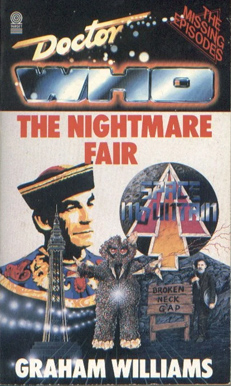
Synopsis: After surviving an encounter with The Nexus of the Primeval Cauldron of Space-Time, the Doctor and Peri arrive in Blackpool, where a visit to the famous Pleasure Beach sees them ensnared by the Celestial Toymaker. But why is the eternal villain there and what does he want with the Doctor? It can’t be anything as mundane as revenge, can it?
Chapter Titles: Numbered One to Nine.
Background: Graham Williams adapts his scripts for an unmade serial intended for broadcast in 1986 before the original Season 23 was cancelled.
Notes: The Doctor and Peri begin their adventure on the observation platform of the Blackpool Tower, just as the Doctor nearly promised at the end of Revelation of the Daleks. The young guest hero this time is called ‘Kevin Stoney’ [see The Daleks’ Master Plan, The Invasion and Revenge of the Cybermen for why that’s funny] and he’s from Liverpool. The Toymaker – also referred to as The Mandarin – uses a crystal ball to observe the Doctor and other points of interest. The Doctor boasts that he has ‘shot through Black Holes’, ‘sailed through Supernovae and ‘eaten Vanarian Sun Seed Cake’ but has never experienced such a ‘magnificent’ thrill as the roller coaster; although there is a coaster in Blackpool called ‘The Roller Coaster, this one is most likely the Revolution, Europe’s first full-loup rollercoaster, which opened in 1979 and, like the Sixth Doctor, once featured in a memorable episode of a BBC wish-fulfilment entertainment show that we can’t really talk about any more. By the way, the Doctor’s also never had candy floss before; Peri pays for it with a £5 note she found in a sporran in the TARDIS wardrobe, prompting the Doctor to note that it must have been Jamie’s and he was always so careful with money [so putting aside offensive stereotypes for a second, Jamie having legal tender from the mid-1980s suggests an unseen adventure].
After hearing Kevin’s statement about seeing ‘red giants’, Detective Inspector Truscott suggests that if the lad sees any more that he directs them towards Preston North End, as they could do with the help; Preston North End’s kit at the time was white with blue piping, and the away kit was yellow and blue – but they did eventually adopt a red jersey as their main away kit for the 95-6 season.
As in the Toymaker’s debut adventure, it’s suggested that he and the Doctor have sparred on many occasions. The Doctor took part in the Globus Wars of Independence. His pockets contain a single jelly baby and ‘the signet-ring of Rasillon’, which is ‘the most powerful single object in the known Universes. He tells Peri and Kevin that he doesn’t actually know who the Toymaker is:
‘Nobody knows. He existed before the start of Time Lord records. There was an attempt to track him back through his own continuum – trace his path through the fabric of time, but the researchers got bored with all the games, which was possibly what they were there for. As they do so often,’ he sighed, ‘my erstwhile colleagues met something they didn’t understand, and they ran away from it. If they’d been able to control him, they would have investigated further, I’m sure. But they couldn’t, so they didn’t.’
The Toymaker is known to be telepathic and telekinetic, ‘up to a point’, and he was once ‘observed playing with a supernova as though it was a kiddies’ paddling pool… and we know he’s old beyond imagining…’
If fact, the Doctor realises that the Toymaker is from another universe and that he carries his own matter with him – but not anti-matter – concluding that the Toymaker will live for millions of years; the Toymaker confirms that he already has done, having spent thousands of years creating and destroying civilisations until he came up with the idea of his games.
Cover: Alister Pearson’s composition includes the Toymaker, the Blackpool Tower, a sign for Space Mountain, a miner and a fanged-and-clawed alien. The first edition featured a flash proclaiming ‘The Missing Episodes!’
Final Analysis: The whole concept of a ‘celestial’ toymaker is an archaic pun, ‘celestial’ meaning both ‘of the stars’ and ‘from China’ (a loose translation of ‘Tianchao’, the former name for the Chinese Empire). While the word might have been used to signify ‘exotic’ or mysterious qualities, it was also a racial descriptor that is now largely forgotten. As previously mentioned in (among other chapters) The Sensorites, the word ‘oriental’ can also be problematic for some. Meaning simply ‘from the East’, it’s a colonial view of the world map, positioning China solely in relation to how it appears on a British Empire map with the United Kingdom (well, let’s be honest, England) at its centre.
… and in Doctor Who, we then have the Celestial Toymaker as a Chinese-presenting character played by an English actor. While Michael Gough didn’t resort to the kind of theatrical make-up we saw in The Talons of Weng Chiang, it’s still an example of cultural appropriation – or at best cosplaying – based on a suspicion of the Chinese. How might that have seemed had this story made it to air in 1986? In a season where a story set in Singapore had a working title ‘Yellow Fever and How to Cure It’…. you can draw your own conclusions as to how this might have played out at the time – and how it might have been received by young viewers discovering the era for themselves 36 years later. Despite spending two paragraphs discussing this issue, it’s not really something I dwell on, but it’s a handy distraction to ruminate on while trying to avoid thinking about the rest of the book.
What we have here is something that feels authentic to the period it might have been a part of had Michael Grade not stepped in and saved us. By which I mean, the Doctor is fairly unlikeable and while the adventure features a returning villain, he’s one that few of the viewers would have actually remembered and he doesn’t even act like the character as portrayed in his original appearance. The story is, like the original, a series of events rather than a plot and, sadly, it’s all a bit dull. The greatest joy comes from the Doctor’s two companions being called ‘Kevin and Peri’ in a book published a year before Harry Enfield’s teenage characters Kevin and Perry made their TV debut. All entirely coincidentally.
To be fair, there is one scene though where Williams captures that alien quality that Colin Baker had so wanted to portray, able to comprehend the vastness of eternity:
‘The isolation of aeons,’ whispered the Doctor, overcome with compassion for the being he’d detested all his adult life. ‘The crushing loneliness of thousands of millennia… you poor, poor creature…’
Synopsis: The Doctor and Peri follow a distress beacon only to discover it was sent by Commander Lytton, formerly of the Dalek taskforce. Lytton has now allied himself with the Cybermen in a bid to escape Earth. The Cybermen have a plan to change the web of time and it’s down to the Doctor to stop them.
Chapter Titles
1. The Day Begins
2. The Perfect Crime
3. The Peripatetic Doctor
4. The Search Begins
5. A Close Encounter of a Very Nasty Kind
6. Telos
7. The Tombs of the Cybermen
8. The Great Escape
9. Caught
10. The Final Encounter
Background: Eric Saward adapts scripts for a 1985 story attributed to Paula Moore, but actually written by Saward and Ian Levine.
Notes: There’s some major restructuring in play here. The original opening scene with the sewer workmen is removed and scenes on the surface of Telos are bumped to the second half, which makes so much more sense. The opening chapter is reminiscent of the scenes with Shughie McPherson in Malcolm Hulke’s Doctor Who and the Dinosaur Invasion, as we’re introduced to Lytton’s gang members. We meet Charles ‘Charlie’ Windsor Griffiths, whose poor, single-parent childhood inspired a life of petty crime. Now at the age of 35 (15 years younger than Brian Glover, who played the role on TV), he’s already spent a total of eight years and seven months in prison, though he currently lives with his mother at 35 Milton Avenue (a real address, so probably Highgate, North London). He’s been a part of Lytton’s gang for some time now. The driver, Joe Payne, is a very heavy smoker who runs a garage. He’s never been in prison, despite his business being a front for numerous illegal activities. Joe had sourced the getaway car for a recent job from his own pool of vehicles, which had then been caught on camera and traced back to him – hence why, for the first time in two years, the gang is now being investigated by Special Branch. Joe lies about seeing someone lurking in the sewers, so he can sneak away for a cigarette – and is then killed by something lurking in the sewers. Charlie Griffiths doesn’t like Vincent Russell; he reminds him of a policemen he once knew, which is unusually perceptive of him: Russell is an undercover police office – something Lytton is aware of and is exploiting for his own means.
Commander Gustave Lytton is an alien Charnel mercenary from Vita Fifteen, in the star system Tempest Dine, though on TV he tells the Cyber Leader that it’s called ‘six-nine-zero’ and the planet (not the ‘satellite’ as on TV) is ‘Riften five’. He has been trapped on Earth for two years [so either he’s counting his service to the Daleks as part of this, or Resurrection of the Daleks took place in 1983]. The site of his audacious robbery is Hatton Garden, the famous ‘Diamond District’ of London that was also the location of a 2015 safe deposit robbery that involved tunnelling (tempting to ponder if any of the perpetrators were fans of this story).
The sentinel in the sewers ‘looks like ‘a huge black suit of medieval plate armour’. Lytton introduces the aliens to Griffiths as ‘‘Cybermen! Undisputed masters of the galaxy!’ The Cybermen have rasping respirators on their chests (reminiscent of the oily creatures depicted by Ian Marter in his Cybermen stories). The creature later looms through the darkness towards Lytton and his gang:
Where there should have been eyes and a mouth, there were slits. Instead of ears, there were what appeared to be inverted horns that continued parallel with the side of the head, until turning ninety degrees and joining some sort of bosslike device situated at its crown.
Consistent with The Twin Dilemma, Saward once again claims that Time Lord regeneration is made possible by the release of a hormone called ‘lindos’. The corruption of the Time Lords – and the inability of the propaganda to cover up various scandals – is what prompted the Doctor to leave behind both his home planet and his original name when he stole a TARDIS to explore the universe. While at college, Peri dated a ‘first-year engineering student’ called ‘Chuck’. The Doctor recognises the two policemen who he encounters at Joe’s garage, but can’t remember who they worked for, due to the effects of his regeneration. The time travellers find Lytton’s ‘well-polished shoes… fashionable grey suit, a crisp white shirt and a silk tie’
Cybermen convert human bodies by covering them in a substance called ‘arnickleton’, which smothers and eventually replaces body parts, all except for the processed brain. A strict hierarchy governs the Cybermen, led from the top by the Controller, then Senior Leaders who command a Major Phalanx; these are assisted by Leaders and Junior Leaders – and below them are the army troopers (and we encounter more than just the one Cyber Leader once the Doctor reaches Telos). Later, when Lytton is captured, we learn that the Cyber Controller has been fighting to cure a poison released by the Cryons that has resulted in ‘only a few hundred surviving Cybermen’. It’s this imminent threat of extinction that has motivated the Controller’s plan to change the timelines.
The bodies of Russell and a Cyberman are dumped in a corridor off from the main TARDIS console room. The Doctor remembers the ‘last time’ he’d encountered the Cybermen, when Adric had been killed [is his regenerative amnesia making him forget The Five Doctors?]. The Doctor thinks that he’d rather trust a wounded speelsnape [see Slipback] than trust Lytton.
The two partly Cybernised men are Flight Leader Lintus Stratton and Time Navigator Eregous Bates. They come from the planet Hatre Sedtry in ‘the star system known as Repton’s Cluster’ – and they were the original crew of the time ship now possessed by the Cybermen. The TARDIS’s arrival in the tombs on Telos (instead of Cyber Control) seems to concern the Cyber Leader, prompting the Doctor to wonder if these Cybermen have been programmed with ‘limited emotional response’. He could be right there, as the Cyber Controller chooses to have the Doctor thrown into a refrigerated cell with the express purpose of humiliating him before they can meet again.
The Cryon Thrast is renamed Thrust here (really, Eric…). The physiques of the Cryons resemble those of Earth women, but their faces are covered in a ‘translucent membrane’ with ‘large bulbous eyes’ and ‘coarse white hair’ on their jaws. Flast is ‘grotesquely disfigured’ with a gouge that runs the length of her face, the result of Cyber-torture. The rogue Cybermen’s condition is explicitly stated as a side effect of the Cryon toxin; it poisons the Cyberman’s brain and sends it insane before it eventually dies. After being stabbed in the arm by Lytton, the Cyber Controller strikes a blow to his neck, killing him outright. The surviving Cryons take refuge deep within the caves, watching the destruction of the tombs and planning to rebuild their planet.
Cover: The first cover was by Colin Howard, showing a Cyberman and a Cryon, a soaring comet and the frozen planet Telos. Alister Pearson’s 1992 cover presents the Doctor, holding a tracking device, and a Cyberman with the black handles of the Leader (something Pearson had wanted to do for the original cover, before it was awarded to Colin Howard). The figures are presented within frames against the backdrop of a dark, foreboding planet.
Final Analysis: Many years ago, before Doctor Who’s 21st-Century return to our screens, I did my first ever pilgrimage with a friend through every episode of Doctor Who, in order. We managed to get through over 600 episodes in less than a year and then we reached episode one of Attack of the Cybermen. About four months later, we picked up with episode two and it was a struggle. So obviously, I wasn’t looking forward to this novelisation, especially because Eric Saward’s track record after his initial volume hasn’t been the most encouraging.
This is such a surprise. It still has all the clunky backstory and references to the past that made the TV version such a chore, but right from the start, Saward puts the effort in to make sense of the story he helped to create. He’s hugely sympathetic towards Charlie Griffiths (always ‘Charlie’ here), who might be a petty criminal hired for his muscle, but we’re shown how he feels happy seeing someone catch a bus and still worries about the risk of a local shopkeeper being mugged. Later, as he tries to take in the new information about Cybermen having ‘no emotions’, Charlie reviews the things that he feels give his life purpose, like walking in the park, eating one of his mother’s breakfasts, stroking his cat, drinking with his friends, or snuggling under his duvet; it’s a rather sweet encapsulation of the Doctor’s similar speech in Earthshock, but made a bit more tangible thanks to our privileged insight into Charlie’s mundane life in the first chapter.
This eagerness to make the characters more sympathetic extends to the Doctor himself. Saward always had a difficult relationship with this incarnation, yet this shows just how little needed to be changed to make him much more likeable. After an early outburst about his being ‘unstable’, the Doctor apologises to Peri:
‘Listen, Peri..’ The Doctor was now calmer. ‘Inside, I am a peaceful person… Perhaps on occasion,’ he demurred, ‘I can be all noise and bluster.’ Gently he took her arm. ‘But it is only bluster… You’ve nothing to fear. You’re quite safe.’ The Doctor looked baleful. ‘You will stay?’
Saward makes a real attempt to ‘fix’ this Doctor, removing a lot of the rough edges and bullying traits we saw on telly. Of course, the greatest effort of all goes into making us like – or at least respect – Lytton. In tone, he’s a lot closer to Kline, the character Maurice Colbourne played in the TV show Gangsters; he’s pragmatic and a little cold, but his claim to the Doctor that he’s a ‘reformed character’ is a lot more credible here, reinforced by a few peeks into his psyche and how Charlie notices changes in his behaviour, including the addition of a few jokes here and there.
The main plus point here is that the whole story is structured much more coherently. Without the need (if there really ever was one) to keep cutting frantically from location to location, Saward is able to introduce locations and characters when they become relevant. So, Stratton and Bates only appear once we’re on our way to Telos, while the Cyber Controller is foreshadowed but not actually seen until Lytton is presented to him. One of the few joyful moments we had with this story during our pilgrimage was a scene where, realising they’re in a room about to explode, two Cybermen push each other away in a panic, as if saying to each other, ‘Save yerself, Margaret!’ It’s a glorious moment of two under-directed performers improvising their motivations and turning it into farce. While that particular scene is played here strictly for drama, we’re treated to something almost as ridiculous when we finally encounter the Cyber Controller:
Dwarfing all around him, the Cyber Controller stood well over two metres high. With legs slightly apart and hands on hips he appeared like a mighty Colossus dominating the middle of the room. Surrounded by counsellors and guards, who fussed and responded to his every need, he made an impressive and terrifying sight.
Christopher Robbie made the same mistake in Revenge of the Cybermen: Cybermen do not look ‘impressive and terrifying’ with their hands on their hips.




 Escape to Danger